Could you claim for a public injury in Scotland without losing part of your settlement to legal fees? After an accident, you may be facing pain, time off work and unexpected costs. It’s understandable to want to know how much compensation you’ll actually receive.
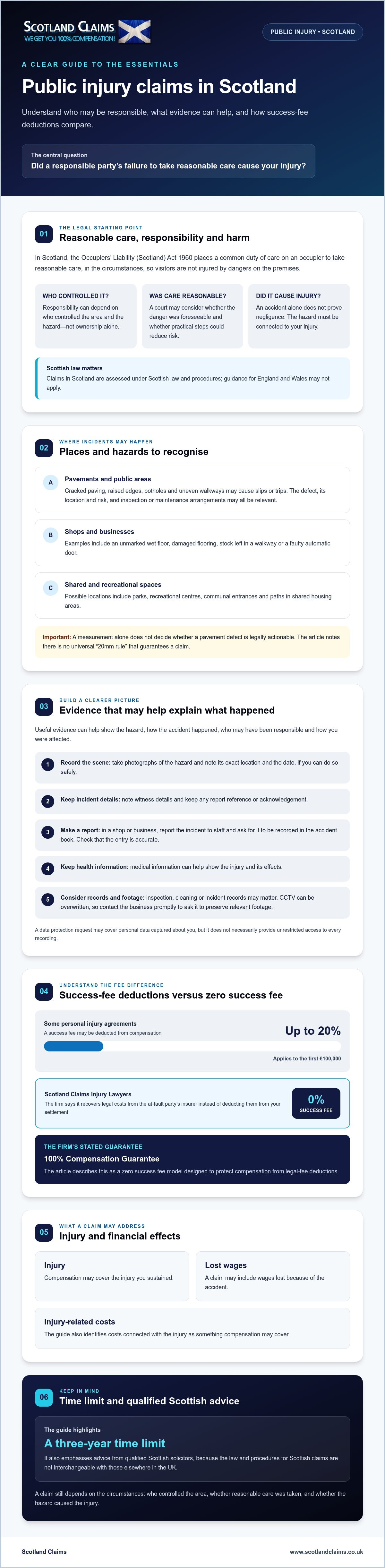
Some personal injury agreements allow a success fee to be deducted from compensation, with deductions of up to 20% applying to the first £100,000. Scotland Claims Injury Lawyers offer a 100% Compensation Guarantee with zero success fee. The firm recovers its legal costs from the at-fault party’s insurer instead of deducting them from your settlement.
This guide explains when you may be able to claim after an accident in a public place, what evidence can help establish responsibility and what compensation may cover, including lost wages and injury-related costs. It also explains Scotland’s three-year time limit and why advice from qualified Scottish solicitors matters. The aim is to help you understand your options and how to pursue a claim while keeping the full compensation awarded to you.
Key Takeaways
- Learn what may qualify as a public injury in Scotland and how an occupier’s duty of care could apply.
- Recognise common hazards behind slip, trip and pavement accident claims, including uneven surfaces and potholes.
- Find out what evidence can help show how your accident happened and who may be responsible.
- Understand how Scotland Claims’ zero success fee model aims to protect your compensation from legal fee deductions.
- See why working with qualified Scottish solicitors can help you approach a claim with clarity and confidence.
Understanding Public Injury and the Duty of Care in Scotland
A public injury claim may be possible if you’re hurt because someone responsible for a place failed to take reasonable care of it. The accident might happen in a place open to the public or a shared area used by residents and visitors. An accident alone doesn’t prove negligence. You generally need to show that a responsible party’s failure caused your injury.
The general concept of public liability centres on responsibility for harm caused by negligence. In Scotland, the Occupiers’ Liability (Scotland) Act 1960 is a key part of the law. It places a common duty of care on an occupier to take reasonable care, in the circumstances, to see that visitors are not injured by dangers on the premises.
What Qualifies as a Public Place in Scotland?
What matters is the nature of the place and who controls it, not simply whether it’s owned by the council or a private organisation. An accident might happen in:
- Council-maintained pavements, parks and recreational centres.
- Private commercial premises such as supermarkets, shopping centres and restaurants.
- Shared areas in tenements or private housing developments, such as communal entrances or paths.
Responsibility can depend on who controlled the area and the hazard. A council may be responsible for a pavement it maintains, a business may control its shop floor, and a landlord or property manager may be responsible for a shared space. Ownership alone doesn’t settle the question. The accident circumstances and any arrangements for managing the area need to be considered.
Establishing Negligence: The Core of Your Claim
The key question is whether the responsible occupier took reasonable care in the circumstances. A court may consider whether the hazard could have been anticipated and whether practical steps could have reduced the risk. For example, evidence that a spill was left on a busy shop floor for a period of time may be relevant. So may records showing how an uneven surface was inspected or maintained.
You’ll need to connect the hazard to your injury. Photographs, witness details, incident records and medical information can help show what happened and how it affected you. The occupier’s response and any relevant inspection or cleaning records may also be important.
Scottish claims must be assessed under Scottish law, including the 1960 Act. The rules and procedures aren’t interchangeable with those in England and Wales, so English guidance or references to the MOJ portal may not apply. A “non-fault” claim means you say another party was responsible. You still need to establish negligence and show that it caused your injury.
Common Types of Public Liability Claims
Public liability claims can follow accidents in shops, on streets or in places used for recreation. A slip or trip is a common example, but the circumstances matter. The accident itself doesn’t establish that anyone was legally responsible. Consider what caused it, who controlled the area and whether reasonable steps could have prevented the danger.
Scotland has its own legal framework. The Occupiers’ Liability (Scotland) Act 1960 is relevant to an occupier’s duty of care. Don’t assume that English claims guidance or procedures automatically apply to an accident in Scotland.
Pavement and Council Negligence
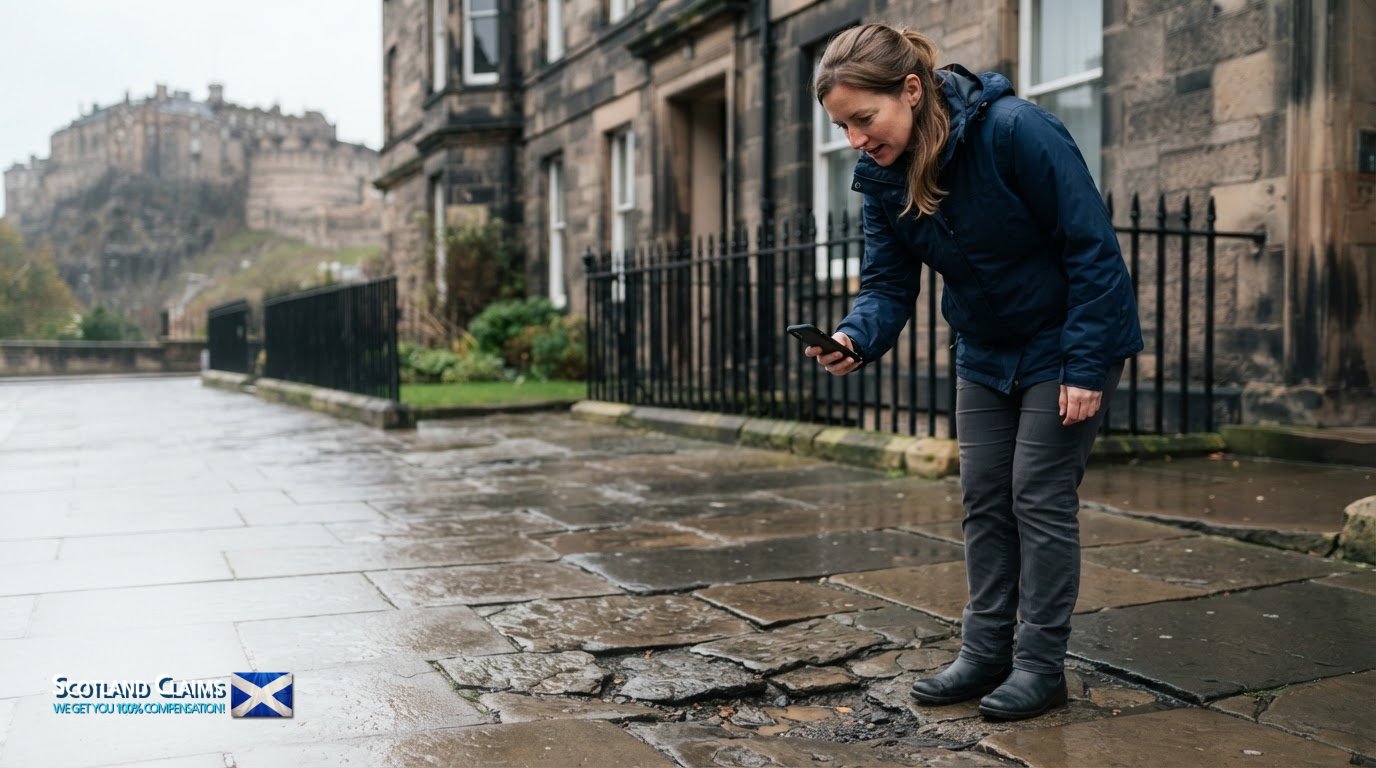
Cracked paving slabs, raised edges, potholes and uneven walkways can cause injuries. But a measurement alone doesn’t decide whether a defect is legally actionable. There isn’t a universal “20mm rule” that guarantees a claim. The defect’s location, condition and risk, along with the council’s inspection and maintenance arrangements, may all be relevant.
Reporting a hazard to the local authority can create a useful record and alert it to the problem, but it isn’t automatically a prerequisite to making a claim. If you can do so safely, note the exact location and date, photograph the defect, and keep any report reference or acknowledgement. For practical guidance on falls caused by hazards, read about slip or trip claims.
Accidents in Shops and Businesses
Retail hazards may include an unmarked wet floor, damaged flooring, stock left in a walkway or a faulty automatic door. Report the incident to staff promptly and ask them to record it in the accident book. Check that the entry accurately describes where and how you were hurt. Keep a note of when you reported it and who you spoke to.
CCTV may help establish what happened, but footage can be routinely overwritten. Contact the business promptly to ask it to preserve relevant footage. You can make a data protection request for personal data captured about you, though this doesn’t necessarily entitle you to unrestricted access to every recording.
Public injury incidents can also involve hazards in parks and playgrounds, such as damaged equipment, or risks at organised events. Who may be responsible depends on who controlled or managed the area and what caused the injury. Record the details while they’re fresh, and seek advice if you’re unsure who to approach.
The Financial Advantage: 100% Compensation vs. Success Fees
A “No Win, No Fee” agreement doesn’t always mean you keep your entire compensation. Some agreements in Scotland include a success fee deducted from the award if your claim succeeds. The amount depends on the agreement and applicable limits, so check the terms before proceeding. Ask what will be deducted, what happens if your claim doesn’t succeed and whether any other costs could apply.
Scotland Claims Injury Lawyers offer a different model for eligible claims: a 100% Compensation Guarantee with zero success fee. The firm recovers its legal costs from the at-fault party’s insurer, rather than taking them from your settlement. This means the success fee doesn’t reduce the compensation you receive under the firm’s model.
Visualising the 100% Difference
Here’s how the figures compare if a firm deducts a 20% success fee from the compensation amount. These examples illustrate the deduction, not what your claim may be worth:
- £5,000 settlement: you keep £5,000 under a 100% model, compared with £4,000 after a 20% deduction.
- £12,000 settlement: you keep £12,000 under a 100% model, compared with £9,600 after a 20% deduction.
- £30,000 settlement: you keep £30,000 under a 100% model, compared with £24,000 after a 20% deduction.
The difference is the deduction, not an increase in the settlement itself. Your compensation depends on the facts and evidence of your case. Check whether your solicitor’s fee will reduce the award you receive.
Eliminating Lawyer Fee Anxiety
Clear terms matter. Before signing an agreement, make sure you understand how the solicitor is paid and whether any deductions or other charges could come out of your compensation. Scotland Claims’ zero success fee model means no success fee is deducted from your award. Ask for the agreement’s terms so you know how costs are handled.
Under Scotland Claims’ No Win, No Fee arrangement, you owe the firm nothing if your claim is unsuccessful. Read the agreement and ask how any costs are handled so you understand what the arrangement covers. For more detail on how these agreements work in Scotland, see our guide to No Win No Fee Scotland.
Want to understand who will handle your case and how fees are explained? Find out more about injury lawyers in Scotland.
How to Prove Liability and Maximise Your Settlement
Strong evidence helps show what caused your accident, who was responsible and how the injury affected you. If you’ve suffered a public injury, act promptly where you can, but don’t put yourself at risk to gather proof.
- Record the scene: Note the exact location, date and time, and photograph the hazard from different angles. Include nearby signs, lighting or conditions that may help explain what happened.
- Keep documents: Save any incident report reference, messages with the occupier and receipts for expenses related to your injury.
- Get witness details: Ask anyone who saw the accident or the hazard for their contact details. An independent account may help clarify what happened.
Seek medical attention as soon as you reasonably can. This is important for your health, and medical records can document your symptoms, treatment and recovery. Be accurate about when symptoms began and how the injury affects your daily life. Medical attention isn’t a legal requirement for making a claim, but gaps in records may make it harder to evidence the injury and its effects.
The 3-Year Time Limit in Scotland
In general, a personal injury claim must be brought within three years from the accident date or, in some cases, the date you knew or should reasonably have known that your injury was caused by someone else’s fault. This Scottish time limit is distinct from the rules in England and Wales. For a person injured before turning 16, the three-year period generally runs from their 16th birthday, giving them until their 19th birthday to raise a claim. Different rules may apply where someone lacks mental capacity, so get advice based on the individual circumstances.
Don’t wait until the deadline is close. Witnesses may become harder to trace, records may no longer be available and the hazard may have changed. Acting early gives you more time to investigate and assess the evidence. It doesn’t guarantee a particular outcome or compensation amount.
Valuing Your Claim with Precision
In Scotland, compensation for pain, suffering and loss of amenity is known as solatium. Its assessment depends on the injury and its effects. A claim may also include special damages, meaning evidenced financial losses such as lost earnings, necessary travel expenses or private medical costs. Keep payslips, invoices and receipts, and record time away from work. A compensation calculator can provide an initial estimate, but it can’t replace an assessment of your evidence and circumstances.
Discuss your injury claim with Scottish solicitors who can assess your circumstances and explain the next steps.
Starting Your Public Accident Claim with Scotland Claims
After a public accident, it can be difficult to know who to contact or what happens next. Scotland Claims Injury Lawyers help people across Scotland with non-fault public injury claims. Start by explaining where and how the accident happened, what caused it and how you were injured. Photographs, witness details or incident reports you’ve gathered may help a solicitor understand the circumstances.
Choosing a firm regulated by the Law Society of Scotland gives you a way to check that you’re dealing with Scottish solicitors subject to professional regulation. Before instructing a firm, ask who will handle your case, how they’ll keep you informed and how the costs work. Scotland Claims Injury Lawyers is a trading style of Kerr Brown Solicitors, established in 2006. You can learn more about injury lawyers in Scotland and the role of qualified solicitors in a claim.
Your Injury. Your Claim. 100% Your Compensation.
The aim is to make the legal process clearer, so you know what information is needed and what the next steps may involve. Scotland Claims offers a 100% Compensation Guarantee with zero success fee, recovering legal costs from the at-fault party’s insurer instead of deducting a success fee from your compensation. Ask for the terms in writing so you understand how costs are handled before agreeing to proceed.
A solicitor can deal with communications with the insurer and explain what evidence may be needed, whilst you focus on your recovery. No firm can promise a particular settlement: the value and outcome depend on the evidence and circumstances of your case.
Why Specialist Expertise Matters
A specialist Scottish personal injury solicitor can assess the facts under Scottish law, identify relevant evidence and organise the case accordingly. Before choosing a service, check whether qualified solicitors will advise on and manage your claim. Ask who your point of contact will be and how the firm will explain progress, decisions and any settlement offer.
Scotland Claims provides a 24-hour freephone helpline on 0800 611 8132. You can also begin an enquiry online. Use the first conversation to explain what happened and ask any questions you have about the process and fees.
Start your claim online now
Take the Next Step Towards Your Public Injury Claim
If you’ve been injured in a public place in Scotland, responsibility depends on the evidence: what caused the accident, who controlled the area and whether reasonable care was taken. Keep records of the incident, your treatment and any related losses. Personal injury claims generally have a three-year time limit in Scotland, so get advice promptly to understand your options.
Qualified Scottish solicitors can help you make sense of the process. Check that your representatives are regulated by the Law Society of Scotland, and ask clearly how their fees work before proceeding. Scotland Claims Injury Lawyers offer a 100% Compensation Guarantee with zero success fee and a 24-hour freephone helpline.
For a clear next step, call Scotland Claims on 0800 611 8132 or start an enquiry online.
Frequently Asked Questions
Can I claim for a trip on a public pavement in Scotland?
Yes, you may be able to claim if a pavement defect caused your injury and the party responsible failed to take reasonable care. The responsible organisation may be the council or another body, depending on who maintained or controlled the area. There’s no single measurement that automatically proves a defect is actionable. Photograph the hazard, note its exact location and report it to the relevant authority if you can.
How long do I have to make a public injury claim?
In Scotland, the general time limit is three years from the accident date, or from the date you knew or should reasonably have known your injury was caused by someone else’s fault. Different rules may apply to children and people who lack mental capacity. Don’t assume the deadline is straightforward in your circumstances. Getting advice promptly can help protect your options and allow time to gather evidence.
Will I really receive 100% of my compensation?
Scotland Claims’ 100% Compensation Guarantee means the firm charges no success fee from your settlement and recovers its legal costs from the at-fault party’s insurer. If your claim succeeds, the full compensation award is passed to you under this model. Ask for the agreement’s terms and check how costs are handled. “No Win, No Fee” arrangements can differ between firms, so understand the terms before proceeding.
Who is responsible if I fall in a supermarket or shop?
Responsibility may rest with the business or another party that controlled or managed the area where you fell. It depends on the facts, including what caused the accident and who was responsible for the relevant floor or equipment. A spill without warning signs, damaged flooring or a faulty automatic door may be relevant evidence. Report the incident promptly, ask for it to be recorded and keep details of witnesses.
Can I claim if I was partially to blame for the accident?
Possibly. Being partly responsible doesn’t automatically prevent you from making a claim, but it may affect whether the other party is liable and the compensation you could recover. The circumstances matter, including what you did, what caused the hazard and whether the responsible party took reasonable care. Be open with your solicitor about what happened. They can assess the evidence and explain how any shared responsibility may affect your case.
What happens if my public injury claim is unsuccessful?
Under Scotland Claims’ No Win, No Fee arrangement, you won’t owe the firm legal fees if your claim is unsuccessful. Check the agreement before proceeding so you understand how costs are handled. Your solicitor can explain the arrangement and keep you informed as the claim progresses. A claim’s outcome depends on its evidence and circumstances, so it can’t be guaranteed.
How much compensation can I expect for a public place injury?
There’s no fixed amount for an injury in a public place. Compensation depends on factors such as the nature and effects of your injury, your recovery and any evidenced financial losses. In Scotland, solatium covers pain and suffering, whilst special damages may include losses such as lost earnings or necessary expenses. A calculator can offer an initial estimate, but a solicitor needs to assess your individual circumstances and supporting evidence.
Do I need to go to court for a public liability claim?
Not necessarily. A claim may be resolved through discussions and settlement without a court hearing, but court proceedings could be needed if responsibility or compensation is disputed. No one can promise that a case will settle or predict the steps it will require. Your solicitor can explain the options based on the evidence and keep you informed about important decisions. Ask how they’ll discuss any settlement offer with you before you decide.