
There’s no single compensation figure for an accident in Dundee. The amount depends on the injury and its effect on your work, daily life and finances. Personal injury lawyers in Dundee can assess these factors, while the general deadline for making a personal injury claim in Scotland is three years from the accident, according to the UK Government.
It’s understandable to want a clear idea of what your claim could be worth before taking the next step. The value depends on the evidence and losses linked to your injury, so a headline figure alone won’t tell the whole story.
This guide explains what can affect compensation, how responsibility and the Scottish time limit may affect eligibility, and what to consider when choosing a solicitor. You’ll also learn what information can help support a claim and how to discuss your circumstances.
Key Takeaways
- Learn which details of a road traffic accident can help support your claim and clarify responsibility.
- See how injury impact, work and related losses can shape the compensation assessment.
- Use practical criteria to assess a solicitor’s personal injury expertise and understand the terms of representation.
- Find out what information to prepare before making an enquiry and how to plan a visit to a Dundee office.
- Explore the claim support and calculator options available for road traffic, work and slip or trip injuries.
How Dundee Injury Solicitors Assess Compensation Claims
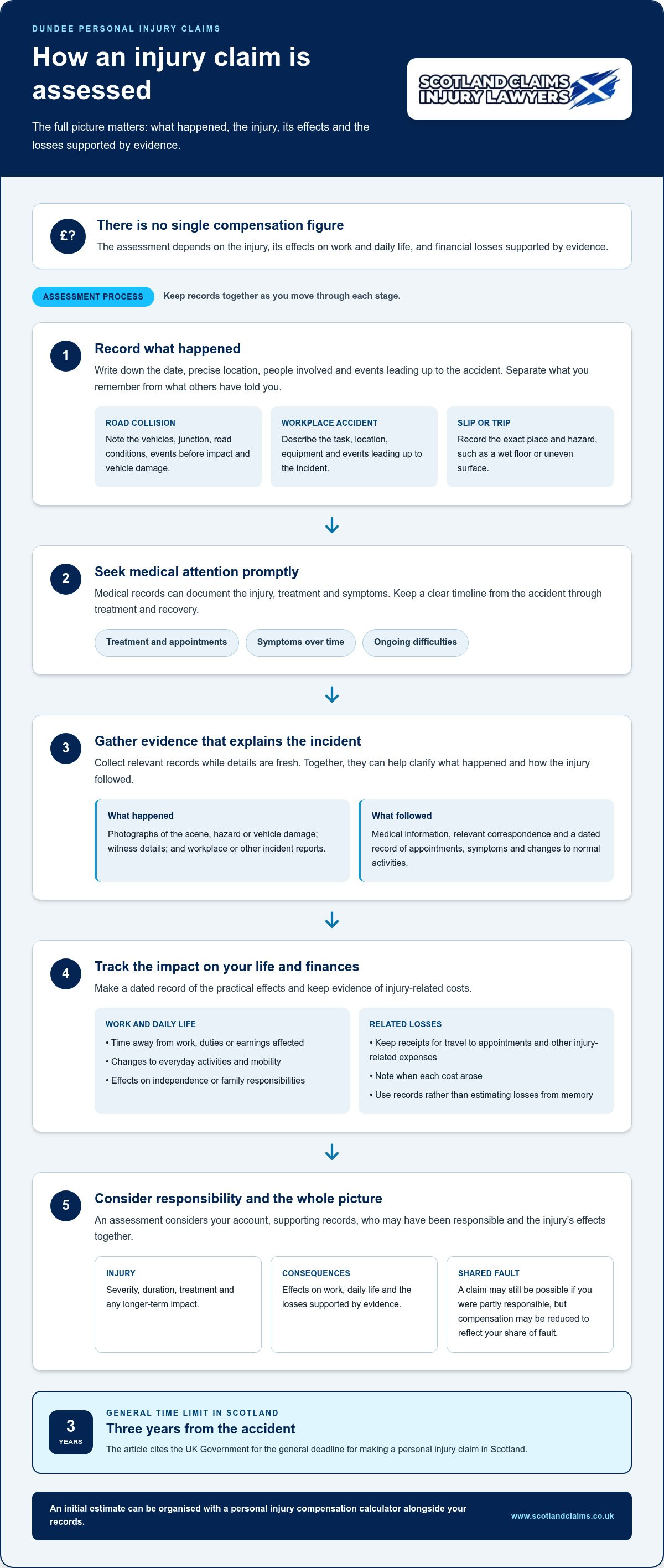
To make a personal injury claim in Scotland, record what happened, seek medical attention promptly and gather supporting evidence. The general deadline is three years from the accident date, according to the UK Government (legislation.gov.uk).
For a road traffic accident, assessment begins with how the collision happened, who may have been responsible and what injuries followed. Note the date, location, vehicles involved and events before impact. Photographs, witness details and medical records can help show what happened and how the collision affected you.
Keep receipts for expenses linked to your injury, such as travel to appointments. Note any time away from work and changes to everyday activities. If you were partly responsible, you may still be able to claim, though compensation may be reduced to reflect your share of fault.
Personal injury lawyers in Dundee will need a clear account of the collision and its consequences. Details such as the junction, road conditions and vehicle damage can help distinguish disputed accounts. Avoid guessing: separate what you remember from what someone else told you.
Workplace accident claims
Work injury claims can arise from incidents involving equipment, unsafe conditions or exposure to hazards. APIL says employers have a duty to provide a safe working environment and protect employees from injury. Describe the task, location, equipment and events leading up to the accident.
Keep relevant records, including incident reports, witness details and medical information. Explain whether the injury affected your duties or ability to work. These details help connect the workplace incident to your injury and its practical effects.
Serious injury claims
Serious injury claims need evidence of both the injury and its longer-term impact. Medical records can document treatment and symptoms, while your account can explain changes to work, mobility, independence or family responsibilities.
Describe the support you need and any expenses arising from the injury. A clear timeline, from the accident through treatment and recovery, helps show how your needs have changed. Include ongoing difficulties, even if they are less visible than the initial injury.
Slips and trips in public places may be treated as public liability claims. APIL says these injuries are often known as public liability claims, and a person injured in a slip or trip may be entitled to compensation. Record the exact location and hazard, such as a wet floor, and take photographs if possible.
Claims involving suspected criminal conduct differ from claims about a road collision, workplace accident or hazard on public premises. Write down what happened and keep relevant records so the circumstances can be assessed accurately.
Whether an accident happened in Dundee or nearby, note the precise place, date and people involved. A specific location can help identify witnesses and relevant evidence. A solicitor assessing an injury claim will consider your account, supporting records, responsibility and the injury’s effects together.
How much compensation can I claim for an accident?
There’s no fixed compensation figure for every accident. An assessment considers the injury, its effects on your life and work, and losses supported by evidence.
Accidents at work
For a workplace injury, explain what task you were doing, what went wrong and how the injury followed. The UK Government (legislation.gov.uk) identifies the Health and Safety Act of 1974 as the basis for employers’ duty of care towards employees at work.
Describe any effect on your duties, earnings or ability to manage everyday tasks. Medical records, workplace incident reports and relevant correspondence can help link the accident to your injury and its consequences. Keep receipts for injury-related expenses and note when each cost arose.
Accidents in public places
A fall in a shop, hospital, sports facility or public transport building may involve a hazard such as a spill or uneven surface. APIL says people injured in trips or slips may be entitled to compensation.
Record the exact place and condition that caused the fall. Photographs can show the hazard, while witness details and an incident report may help establish what happened. Note the injury’s effect on your activities and keep receipts for related expenses.
Road traffic accident considerations
For a road traffic accident, write down the location, circumstances and people involved. Photographs of the scene and vehicle damage, witness details and medical records can support your account.
Compensation depends on the injury’s severity and duration, its effect on work and daily life, and evidenced financial losses. If responsibility is disputed, accounts of the collision and available records matter. If you were partly responsible, a claim may still be possible, with compensation reduced to reflect your share of fault.
Evidence is easier to organise while details are fresh. Keep a dated record of symptoms, appointments, time away from work and changes to normal activities. Gather receipts for travel or other injury-related expenses, and store photographs and correspondence together. Seek medical attention promptly so your injury and treatment are recorded.
For a work-related accident, include the task, equipment and work area in your notes. An employer’s incident report or a witness account may help explain what happened. The effect on your earnings and ability to do your job can also shape the assessment. Use payslips or receipts to support any losses rather than estimating from memory.
Personal injury solicitors assess the full picture, not just the accident description. An enquiry form can help you set out the incident, injury, evidence and losses. To organise your initial estimate, use a personal injury compensation calculator alongside your records.
Choosing a personal injury solicitor
Compare relevant injury experience, professional standing and how clearly each solicitor explains the process. In Dundee, focus on the person handling your claim, not just the firm’s name.
Comparing Dundee solicitors and law firms
A listing presents 49 law firms in Dundee, so narrow your options by the type of accident involved. Ask who will handle your case, how they’ll keep you informed and what evidence they need to assess liability and losses.
Check whether the solicitor regularly handles personal injury claims like yours. Richard Poole is accredited by the Law Society of Scotland as a specialist in personal injury law. This professional credential is relevant alongside clear explanations and practical experience.
Using online solicitor reviews
Read reviews for specific examples of how a firm communicated, explained paperwork or handled a delay. A detailed account gives more useful context than a short rating alone. Look for recurring themes across reviews, rather than treating one person’s experience as a promise about your outcome.
Check when a review was posted and whether it describes a personal injury case. A comment about another legal matter may not reflect the service you need. Use reviews as one comparison tool, then discuss your circumstances directly with the solicitor.
Selecting a Dundee personal injury solicitor
Choose a solicitor who explains the next steps in plain language. Ask how they’ll assess responsibility, what documents they need and how they’ll update you. Their answers should clarify the process and your role in providing records or responding to requests.
Before proceeding, read the written terms carefully. Make sure you understand the funding arrangement, any deductions that could apply and what happens if the claim doesn’t succeed. Clear answers help you compare the actual terms, not assumptions.
Scottish solicitors are regulated by the Law Society of Scotland. Consider this professional oversight alongside a solicitor’s relevant expertise, communication and proposed approach. If your injury happened at work, for example, ask how the solicitor will examine incident records and evidence about your employer’s actions.
Prepare a short summary before making an enquiry. Include where and when the accident happened, your injury, treatment received and any effect on work or daily life. Bring photographs, correspondence and receipts if available. A focused first discussion can help identify what further information may clarify responsibility and the impact of your injury.
Compare the answers, not just your first impression. A solicitor who explains the issues in your case, sets out what they need from you and responds clearly gives you a stronger basis for choosing legal advice. Note each firm’s answers so you can review them side by side.
A local office can make an in-person discussion easier if travel, paperwork or giving a detailed account matters to you. Before arranging a visit to a solicitor in Dundee, prepare the information needed to identify your claim and explain what you want from the meeting.
Start your enquiry with the accident location, date, injury and its main effect on your daily life. For a road collision, note the road or junction and vehicles involved. For a workplace accident, name the worksite and task. These details help the solicitor understand responsibility issues and direct your enquiry appropriately.
For an office visit, plan your route using the full address and your preferred transport. If you need step-free access, a quieter meeting space or help with paperwork, mention this when arranging the discussion. Keep appointment details and directions together, especially if pain or treatment makes travelling more difficult.
Bring a short timeline, medical documents, photographs, correspondence and receipts relevant to your injury. You don’t need to organise every record perfectly. Grouping documents by type, such as treatment, accident evidence and expenses, makes it easier to explain what each item shows during an initial discussion.
Scotland’s professional framework differs from arrangements elsewhere in the UK. The Law Society of Scotland regulates Scottish solicitors. If you are comparing firms, note who will handle your enquiry and their relevant personal injury experience. Ask how they will explain next steps and keep you informed, rather than assuming every office follows the same process.
Keep solicitor contact details distinct from court-service information. The Scottish Courts and Tribunals Service lists a customer service address in Edinburgh, EH11 3XD, and a telephone number, 0131 444 3300. Those details relate to the court service, not a Dundee solicitor’s office. Don’t use them as the address or contact number for legal representation.
Be precise about the type of injury when making an enquiry. A road traffic collision, workplace accident and slip in a public place raise different questions about evidence and responsibility. Medical negligence is a separate category, so describe the circumstances clearly rather than grouping it with an ordinary accident.
For a practical first discussion, write down your main questions before contacting a solicitor. Include what happened, what outcome you need help understanding and which records you already have. This keeps the conversation focused, whether you meet at a Dundee office or discuss the details another way. Note who you spoke with and any agreed next steps so you can follow the process without relying on memory.
Dundee personal injury lawyers
Choose a specialist whose experience matches the circumstances of your injury. For a road collision, ask how they assess disputed accounts and injury-related losses. For a workplace accident, ask how they examine workplace records and responsibility. The key question is not simply whether a firm handles injury claims, but whether it can explain the issues your case raises.
Start by describing the accident in a short, factual sequence: where it happened, what you were doing and what changed afterwards. A Dundee solicitor can use your account to identify key questions, such as who may have been responsible and which records could help. Bring relevant documents, then ask what further information could clarify the circumstances.
A serious injury may affect more than your immediate treatment. Explain any changes to work, mobility, independence or caring responsibilities. For example, if an injury prevents you from returning to your usual duties, describe what those duties involved and how your abilities have changed. This helps the solicitor consider the injury’s practical impact, not just its initial symptoms.
For a workplace accident, name the worksite, task and equipment involved. Explain whether the incident was reported and identify anyone who saw it. These details give a solicitor a practical starting point for understanding the event and considering workplace evidence. Ask how they will approach questions about your employer and which documents could help clarify them.
For a road traffic claim in Dundee, prepare the location, date, people involved and any available photographs or correspondence. Tell the solicitor whether responsibility is disputed, and distinguish what you witnessed from what others told you. A clear account helps identify gaps, consider evidence and explain the next steps without relying on assumptions.
Professional standing is another useful point of comparison. The Law Society of Scotland regulates Scottish solicitors. Ask who will handle your claim and what experience they have with your type of injury. Then ask for a plain explanation of the proposed approach, how updates will be shared and what you need to do. Clear answers make it easier to assess whether the solicitor’s working style suits your needs.
Before proceeding, read the written funding terms and ask what happens if your claim succeeds or does not succeed. Make sure you understand any deductions and how legal costs are handled. Compare written explanations, not assumptions. This helps you understand the financial arrangement before agreeing to representation.
Your takeaway: choose a Dundee solicitor who can connect your accident type, evidence and injury impact to a clear case plan. That matters whether you’ve been injured in a road collision, a workplace incident or another accident. A focused enquiry can help establish what information is needed and how your claim will be handled.
Explore personal injury legal support in Scotland
Scotland Claims Injury Lawyers: Road Traffic Accident Claims
Scotland Claims Injury Lawyers can help if you’ve been injured in a road traffic accident and need support assessing a claim. Its Road Traffic Accident Claims service can help you organise the circumstances, injury details and evidence. The firm also handles Work Injury Claims and Slip or Trip Claims, and its Personal Injury Compensation Calculator can help you explore potential claim value.
Its 100% compensation promise means the firm recovers its fees from the at-fault party and passes the entire settlement to you. This gives you a clear basis for understanding how the firm’s approach works. Gather your accident details, medical records and receipts before making an enquiry, so you can explain the impact and losses involved.
Contact Scotland Claims Injury Lawyers to discuss your circumstances.
Take the next step with confidence
Your next move can be simple: set out what happened, what has changed since the accident and what you want clarified. A focused discussion can turn a difficult situation into practical questions about evidence, responsibility and the way forward.
Personal injury lawyers in Dundee can help you understand how those details relate to a claim. Scotland Claims Injury Lawyers handles Road Traffic Accident Claims, Slip or Trip Claims and Work Injury Claims, so you can discuss the type of accident that applies to you.
You don’t need every document organised before starting an enquiry. Begin with the key facts and ask for a clear explanation of the next steps. This gives you a firmer basis for deciding how to proceed, without rushing into a decision.
Take it one step at a time. A clear first conversation can help you move forward with greater confidence.
Frequently Asked Questions
Can I make a claim if I was partly at fault?
Yes, being partly responsible doesn’t automatically prevent a personal injury claim in the UK. Compensation may be reduced to reflect your share of responsibility. For example, if accounts differ about a collision, describe separately what you did and what the other road user did. Photos, witness details and medical records can help clarify events. Give a solicitor an honest account, including facts that may count against your position.
How long do I have to make a claim in Scotland?
The general deadline for a personal injury claim in Scotland is three years from the accident date, according to the UK Government. Don’t wait until the deadline approaches to organise your claim. Write down the accident date, keep relevant documents together and seek advice promptly if the date or circumstances are unclear. A solicitor can assess how the time limit applies to the details you provide.
How long does it take to resolve a personal injury claim?
Some personal injury claims may be resolved within a few months. A disputed account, missing evidence or an injury requiring ongoing treatment can affect how quickly issues are resolved. Keep medical and expense records organised, and respond promptly when your solicitor requests information. Ask what is holding up progress and which step remains outstanding, such as obtaining records or assessing responsibility.
Will I need to go to court?
Many personal injury claims settle through negotiation rather than going to court. If the parties disagree about responsibility or compensation, court proceedings may become necessary. Your solicitor can explain the disagreement and which documents or evidence matter. Keep copies of formal letters and note any response dates. If a court hearing is proposed, ask what it involves and what preparation is expected from you.
Which personal injury solicitors in Dundee handle accident claims?
Scotland Claims handles road traffic accident, workplace injury and slip or trip claims arising in Scotland. For an accident in Dundee, prepare the location, date and a short account of what happened before making an enquiry. Include your injury and its effect on your daily routine. This helps the solicitor understand the type of claim and what information may help assess it.
How do I choose a personal injury lawyer in Dundee?
Choose a solicitor who understands the type of accident involved and explains the proposed approach clearly. Ask who will handle your claim, how they’ll keep you updated and what information they need from you. A workplace claim, for example, may require different records from a road collision. Read the written terms before proceeding and make sure you understand the funding arrangement and any possible deductions.
Do Dundee personal injury lawyers offer no win, no fee agreements?
Some personal injury solicitors offer no-win, no-fee arrangements, including Scotland Claims. Under the firm’s stated arrangement, you owe nothing if the claim is unsuccessful. Before proceeding, read the agreement and ask how fees and deductions are handled if the claim succeeds. This makes the terms clear from the outset and helps you understand what the arrangement means for your settlement.
What fees and deductions do personal injury solicitors in Scotland charge?
Fees and deductions depend on the solicitor’s written funding agreement. Before signing, look for what happens if your claim succeeds or fails, whether any deduction comes from compensation, and who pays legal costs. Ask the solicitor to explain each term in plain English and show how it applies to your claim. Don’t rely on a verbal summary alone; keep the signed agreement with your claim documents.