
What if the personal injury claims new rules you’ve read about apply to England and Wales, not Scotland? Headlines can blur the difference, leaving you unsure whether your eligibility, compensation or deadline could change. The answer depends on where your claim is brought, and Scottish personal injury law has its own procedures.
For example, Scotland doesn’t use the fixed whiplash tariff or Official Injury Claim portal used in England and Wales. Scotland has a separate update too: from 10 October 2026, the judicial expenses rate increased for solicitors’ work carried out on or after that date. This doesn’t automatically mean your claim is worth more or that you need to take a different next step.
This guide explains which rules may apply to your situation, what differs across the border, and what information to gather before seeking advice. It also explains deadlines, cost protections and solicitor fees, including how Scotland Claims Injury Lawyers’ no-success-fee terms work. That way, you can focus on the rules relevant to your claim, not a summary written for another legal system.
Key Takeaways
- Start by establishing which jurisdiction your claim falls under. The phrase personal injury claims new rules can refer to changes that don’t apply in Scotland.
- Separate changes already in force from proposals and rules specific to England and Wales before deciding what may affect your claim.
- Record when and where the accident happened, keep relevant evidence, and note how your symptoms affect you.
- Get advice on the rules and timing that apply to your circumstances rather than relying on a general online summary.
- Scotland Claims’ terms include no success fee, no deduction from your settlement and no payment if your claim is unsuccessful.
Personal injury claims new rules: what Scottish claimants need to know
First establish which jurisdiction your claim concerns. If your accident happened in Scotland, don’t assume a news story about changes to personal injury claims in England and Wales applies to you. Scotland has its own legal system, courts and procedures. The accident’s location is an important starting point, although the circumstances of a claim can affect which rules are relevant.
“New rules” can mean different things: a change in legislation, a court procedure, how legal expenses are calculated, or a proposal that has not become law. A rule change is an adopted measure that has taken effect; a proposal is a suggested change that may not become law. The distinction matters. A draft bill may attract headlines, but it doesn’t change your rights or the steps you must take by itself.
Do personal injury claims rules apply across the UK?
No. Scotland and England and Wales have separate legal systems, so a procedure introduced in one jurisdiction shouldn’t be treated as a UK-wide rule. For example, England and Wales use the Official Injury Claim service for certain low-value road traffic claims. It isn’t the process for Scottish claims. Scotland also has its own court structure and civil procedures. The Courts Reform (Scotland) Act 2014 provides background on reforms to Scotland’s civil justice system, including court jurisdiction. For current rules, consult the relevant legislation and official court guidance for the jurisdiction concerned.
Check the scope, not just the headline. A change may apply only to a particular claim type, court process or date range. A road traffic rule, for instance, may not affect a workplace injury or a slip or trip claim. If your circumstances cross jurisdictional boundaries, don’t rely on a general online summary to decide which system applies.
What does ‘new rules’ mean for an injury claim?
Sort developments by what they affect. Eligibility rules concern who can bring a claim. Procedure covers how information is exchanged or a case progresses through court. Costs rules affect legal expenses, while evidence requirements determine what information may be needed to support a claim. Each change should also be labelled accurately as implemented, proposed or under review, with its effective date and jurisdiction made clear.
For example, Scotland’s Compulsory Pre-Action Protocol applies to personal injury claims valued up to £25,000. Introduced in 2016, it is an existing procedure, not a new 2026 reform. By contrast, the Scottish Law Commission’s draft Damages (Scotland) Bill, published in late 2024, contains proposals. A draft is not automatically law. The change to Scotland’s judicial expenses rate took effect on 10 October 2026 for solicitors’ work carried out on or after that date.
Before acting on a claim update, match it to your accident location, claim type and relevant dates. This helps distinguish a change that may affect your case from a proposal, an older rule or a process designed for another part of the UK.
Which personal injury claims changes are being discussed in 2026?
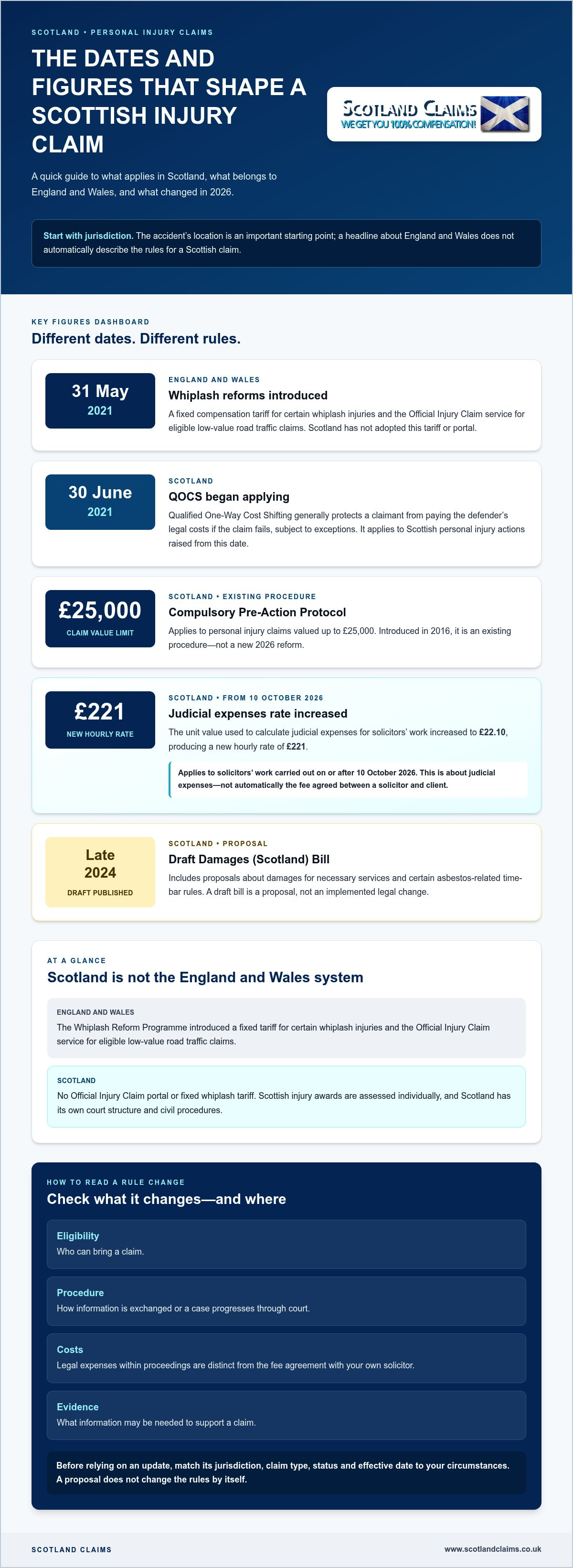
The phrase personal injury claims new rules covers several developments, but not all are new, Scottish or already in force. This dated tracker sets out the position as at October 2026. Treat the date and jurisdiction as essential details, not small print.
- 31 May 2021, England and Wales: The Whiplash Reform Programme introduced a fixed compensation tariff for certain whiplash injuries and the Official Injury Claim service for eligible low-value road traffic claims. The Law Society’s account of this programme concerns England and Wales. It is not a Scottish claims portal or tariff.
- 30 June 2021, Scotland: Qualified One-Way Cost Shifting (QOCS) began applying to Scottish personal injury actions raised from this date. It generally protects a claimant from paying the defender’s legal costs if the claim fails, subject to exceptions.
- 10 October 2026, Scotland: The unit value used to calculate judicial expenses for solicitors’ work increased to £22.10, producing a new hourly rate of £221. The increase applies to work carried out on or after that date. It concerns judicial expenses, not automatically the fee a solicitor agrees with a client.
- Proposal, Scotland: The Scottish Law Commission’s draft Damages (Scotland) Bill, published in late 2024, includes proposals about damages for necessary services and certain asbestos-related time-bar rules. A draft bill is not an implemented legal change.
Whiplash reforms and the Official Injury Claim portal
The key point is jurisdiction. The Official Injury Claim portal and fixed whiplash tariffs described in the Law Society’s account are for qualifying claims in England and Wales. Scotland has not adopted that system for whiplash claims. Scottish injury awards are assessed individually, rather than through that fixed tariff. Before applying portal guidance or a tariff figure, check the official rules for the accident’s location and the type of claim.
Fixed costs, legal fees and proposals
“Costs” can refer to different things. Judicial expenses or recoverable costs concern amounts that may be claimed within legal proceedings. Your solicitor’s fee agreement sets out what you may owe your own solicitor. One does not automatically determine the other. In Scotland, the 2026 rate change relates to judicial expenses for work carried out from its effective date; it does not, by itself, set every client’s fee.
England-and-Wales fixed-cost arrangements shouldn’t be assumed to govern Scottish cases. Nor should a review or consultation be presented as law: a proposal suggests a possible future change, a review examines an issue, and an implemented rule has taken effect. For a live claim, consult current Scottish legislation and Scottish Courts and Tribunals Service guidance. If you need help understanding costs in a Scottish road traffic, workplace or slip or trip claim, explore Scottish personal injury legal advice.
Scotland versus England and Wales: how jurisdiction can change your claim
The same type of accident can follow different procedures depending on where the claim belongs. A headline about reforms in England and Wales may explain why a particular process exists, but it doesn’t show that Scotland has adopted it. Use the comparison below as a starting point, then check current official guidance for your jurisdiction and claim type.
| Jurisdiction | Relevant process | Source to check |
|---|
| Scotland | Personal injury claims valued up to £25,000 generally follow the Compulsory Pre-Action Protocol. Scotland does not use the England-and-Wales Official Injury Claim portal or its fixed whiplash tariff. | Scottish Courts and Tribunals Service, Scottish legislation and Law Society of Scotland guidance. |
| England and Wales | Eligible low-value road traffic claims may use the Official Injury Claim service. Certain whiplash injuries are subject to a fixed tariff under the Whiplash Reform Programme. | GOV.UK, Ministry of Justice and relevant legislation for England and Wales. |
Which country's rules should you check?
Start with where the accident happened, then consider the people and circumstances involved. Location is a key clue, but complex or cross-border events can raise questions about which law and court process apply. Don’t treat location alone as a final eligibility decision.
Check the jurisdiction labels on the page before relying on its advice. Look for phrases such as “England only”, “England and Wales” or “Scotland”, and note the publication or update date. Official sources are useful for checking whether a rule is in force and which claims it covers. For advice tailored to a Scottish claim, a Scottish solicitor can assess the facts and applicable procedure. Scotland Claims’ Scottish personal injury legal guidance provides broader context on getting advice in Scotland.
What can Scottish claimants take from England-and-Wales reform coverage?
Use those reports as context, not as proof of a Scottish change. The Whiplash Reform Programme and Official Injury Claim portal apply to qualifying road traffic claims in England and Wales. They don’t set the procedure for Scottish road traffic claims. If you’re reading about a Scottish road traffic accident, look for Scottish guidance on the claim process and valuation instead.
Some legal terms appear in more than one jurisdiction. “Costs”, for example, may refer to legal expenses in a court action or to the fees agreed between a client and solicitor. A shared term doesn’t guarantee a shared rule, calculation or exception. Check what the source means and which court system it addresses.
The personal injury claims new rules discussion can also blur Scotland’s rules with proposals being considered elsewhere. Before acting, match the information to your accident location, claim type and the rule’s effective date. For help understanding the Scottish process, you can request a no-obligation claim assessment.
What should you do if a rule change may affect your Scottish injury claim?
Don’t wait for every detail of a possible rule change to become clear before organising your information. Record what happened, keep relevant evidence and get advice based on the accident’s location and circumstances. This gives a solicitor a clearer starting point to identify which Scottish rules apply and whether a reported change matters to your claim.
Early advice can help you identify the rules that apply before a deadline or procedural step is missed. This isn’t a reason to panic. It’s a practical way to replace uncertainty with case-specific guidance. Clearly record the accident date and the date you first noticed an injury or a change in your symptoms.
Information and evidence to gather
Start a file, on paper or digitally. Keep original records where possible and note where each item came from. Useful information includes:
- Accident details: the date, time and location, what happened in your own words, and the names and contact details of other people involved.
- Supporting records: relevant photographs, messages or letters, incident reports, and any available details of witnesses.
- Injury information: when symptoms began, how they have changed, their effect on daily activities, and relevant medical records or appointment details.
- Follow-up correspondence: communications with an employer, insurer or another party about the accident or your injury.
Keep your account factual. If you’re unsure about a detail, say so rather than guessing. Don’t edit photographs or alter documents, and don’t exaggerate symptoms. A clear record can include what you remember, what you don’t, and when you made the note. If your symptoms develop, add a dated update rather than rewriting your original account.
How to check deadlines without relying on the wrong guidance
Time limits depend on the applicable law and individual circumstances. Guidance written for England and Wales may describe a familiar limitation period, but that doesn’t make it automatic advice for a Scottish claim. Different accident types or personal circumstances can also affect how a time limit is assessed.
Write down the accident date and relevant injury dates, then seek prompt advice from a solicitor authorised in Scotland. Ask which jurisdiction applies, what time limit is relevant to your circumstances, and whether any exception or procedural step needs attention. Don’t assume that reporting an incident, contacting an insurer or starting a conversation with a solicitor has stopped a legal time limit. Only case-specific advice can clarify what action is needed.
Bring your notes and records to an initial assessment. You don’t need to decide whether a rule change applies before asking for help. An accurate timeline and preserved evidence make it easier to assess what happened and explain the next steps.
How Scotland Claims helps you understand the next step
Once you’ve established that Scottish rules are relevant and gathered the basic facts, a case-specific assessment can help you understand what to do next. Scotland Claims handles personal injury claims in Scotland, including road traffic accidents, workplace injuries and slips or trips. Its solicitors are authorised and regulated by the Law Society of Scotland.
A Scottish focus matters when online information mixes procedures from different parts of the UK. Explain where and when the accident happened, what injury you’ve experienced and which rule or headline has caused concern. The assessment can consider those details in the context of your circumstances. It won’t assume that every claim succeeds or promise a particular compensation outcome.
How the firm’s no-win, no-fee model works
Scotland Claims charges no success fee and makes no deduction from your settlement. In plain English, if your claim succeeds, you keep the full settlement. The firm recovers its legal costs from the at-fault party’s insurer, rather than taking a success-fee percentage from your compensation.
If your claim is unsuccessful, you owe the firm nothing. These are Scotland Claims’ terms, not a rule that applies to every solicitor or every no-win, no-fee agreement. A claim still needs to be assessed on its facts, and compensation isn’t guaranteed. Before proceeding, make sure you understand the agreement and how it applies to your case.
This addresses a common worry: whether asking for legal help means accepting an unclear deduction later. The firm’s approach is designed to make the financial position clear from the outset. You can raise questions about costs, the relevant Scottish procedure and the information needed to assess your claim before deciding how to proceed.
Get a Scottish claim assessment
Scotland Claims offers no-obligation claim assessments, a 24-hour freephone helpline and an online option to start a claim. Use the initial conversation to explain what happened and ask which rules may apply. It’s a practical way to move from general searches about personal injury claims new rules to guidance centred on your own accident and injury.
You don’t need to arrive with a legal conclusion. A straightforward timeline, any records you’ve kept and your questions about deadlines or costs can help make the discussion useful. The aim is to give you a clearer view of the possible next step, without suggesting that a claim is certain to succeed.
Request a free, no-obligation claim assessment
Choose a clear next step for your claim
Headlines about personal injury claims new rules can make it seem as though you need to act before you understand what has changed. You don’t. Start by getting advice that fits your accident, where it happened and your individual circumstances. That gives you a sounder basis for deciding what to do next.
If you’re unsure what to ask, write down the points causing concern. You might want to understand which rules apply, what information could help assess your claim, or how the process and costs work. A focused discussion can turn those questions into practical next steps without assuming the outcome in advance.
Scotland Claims’ solicitors are authorised and regulated by the Law Society of Scotland. The firm’s approach means clients keep their full settlement, with legal costs recovered from the at-fault insurer. Your claim will still depend on its own facts, but you can get clarity before deciding how to proceed.
You can take this one step at a time, with clear information and a practical route forward.
Frequently Asked Questions
Do the new personal injury claims rules apply in Scotland?
Some changes apply in Scotland, while others are specific to England and Wales. The phrase personal injury claims new rules can refer to different laws, procedures or costs, so check the jurisdiction and effective date before relying on a headline. For example, a change to judicial expenses in Scotland may affect how legal work is valued without changing whether you’re eligible to claim. Your accident details also matter.
What are the new whiplash claim rules?
Scotland doesn’t use the fixed whiplash compensation tariff introduced for qualifying claims in England and Wales. In Scotland, compensation for whiplash is assessed individually, with the injury and its effects considered when valuing the claim. Keep records of treatment, symptoms and how your injury affects daily life. A Scottish solicitor can explain how evidence may be relevant to your circumstances and whether a reported reform applies.
Can I use the Official Injury Claim portal for an accident in Scotland?
No. The Official Injury Claim portal is for eligible low-value road traffic claims in England and Wales, not accidents in Scotland. If you were injured in a Scottish road traffic accident, don’t use portal guidance to decide how to start your claim. The applicable route depends on the circumstances, so seek Scottish-specific advice and keep details of the accident, any other parties and relevant correspondence together.
Has the time limit for personal injury claims changed in Scotland?
The usual time limit for most Scottish personal injury claims remains three years from the accident, under the Prescription and Limitation (Scotland) Act 1973. This isn’t a complete answer for every case: exceptions can apply, and the relevant date may need careful assessment. Record both the accident date and when you became aware of the injury. Get advice promptly rather than relying on a deadline described for another UK jurisdiction.
Do fixed recoverable costs apply to Scottish personal injury claims?
Don’t assume fixed recoverable costs introduced in England and Wales automatically apply to a Scottish claim. Scotland has its own rules for expenses and procedures, and the applicable arrangements can depend on the type and value of the claim and whether court proceedings are involved. Also distinguish recoverable expenses from the fee agreement between you and your solicitor. Ask for the terms applying to your case to be explained clearly.
What happens if I started a claim before a rule change?
It depends on the wording and start date of the specific change. Some measures apply only to work carried out after a stated date; others may depend on when proceedings began. For example, Scotland’s judicial expenses rate change applies to solicitors’ work carried out from 10 October 2026, not earlier work. Keep records of key dates and ask a Scottish solicitor how any transitional arrangements affect your claim.
Can I make a personal injury claim in Scotland without paying a success fee?
Yes. Scotland Claims charges no success fee, makes no deduction from your settlement and recovers legal costs from the at-fault party’s insurer. If your claim is unsuccessful, you owe the firm nothing. These are the firm’s terms, not a universal rule for all solicitors. Read and understand the agreement before proceeding, and remember that compensation is not guaranteed.