
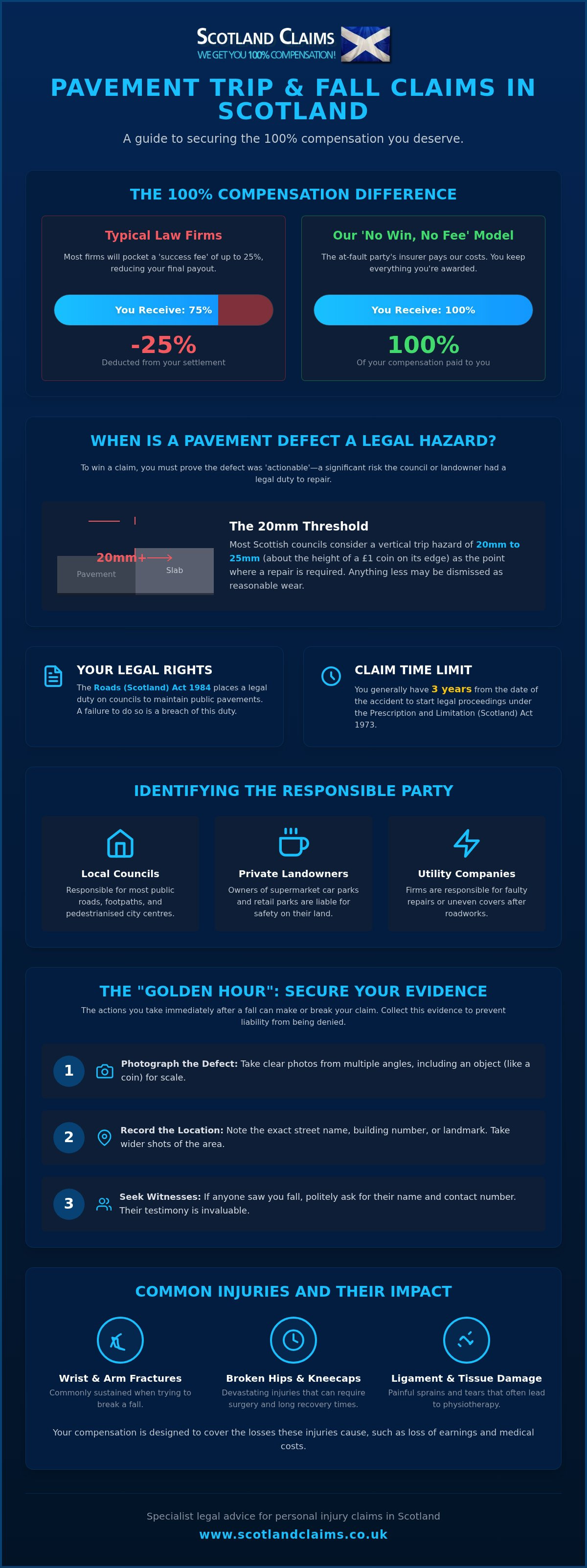
Most law firms in Scotland will quietly pocket up to 25% of your settlement as a success fee after you've already suffered the pain of a fall. You shouldn't have to pay a legal expert for the privilege of recovering what you've lost. When starting a pavement trip claim scotland, it's frustrating to deal with a painful injury and lost wages while wondering if that uneven paving slab was actually deep enough to justify a case. You likely feel that if the council or a landowner failed to maintain the path, they should be the ones to pay the price, not you.
This guide shows you exactly how to hold negligent parties accountable under the Roads (Scotland) Act 1984 without losing a portion of your payout to hidden costs. We'll explain how to navigate the 2026 legal landscape, understand the true inspection standards councils must meet, and discover a specialist path to securing your full financial recovery. You'll learn how to handle the paperwork professionally and ensure you receive the 100% settlement you deserve.
Key Takeaways
- Understand your rights under the Roads (Scotland) Act 1984 and why local councils are legally responsible for maintaining safe pavements.
- Identify the specific measurements that turn a pavement defect into a legal hazard and learn how to start your pavement trip claim scotland.
- Learn how to secure 100% of your compensation by choosing a model where the at-fault party's insurer pays the legal costs instead of you.
- Discover the essential evidence you must collect during the "Golden Hour" after an accident to prevent the negligent party from denying liability.
- Access a professional, no-obligation assessment of your situation through the Scotland Claims Injury Lawyers 24-hour helpline to clarify your next steps.
Understanding Pavement Trip Claims in Scotland
A pavement trip is rarely just an "accident". In the eyes of the law, it's often the direct result of a failure in maintenance. When you suffer an injury because a walkway was left in a dangerous state, you may be entitled to a pavement trip claim scotland. These cases are built on the Scots law of delict, which establishes that individuals and authorities have a legal duty to avoid causing harm to others through their actions or omissions.
The Roads (Scotland) Act 1984 is the cornerstone of these claims. It places a statutory duty on local councils to manage and maintain public roads and footways. This doesn't mean every minor crack is a legal hazard. A successful claim hinges on proving negligence. You must show that the council failed to implement a reasonable system of inspection or ignored a reported defect that posed a clear risk to pedestrians. If you've fallen on a surface that was visibly crumbling or uneven, you aren't just a victim of bad luck. You're a victim of a breach of duty.
Timing is critical. Under the Prescription and Limitation (Scotland) Act 1973, you generally have three years from the date of the accident to initiate legal proceedings. If you wait too long, your right to claim expires. This is why acting quickly to document the scene and seek expert advice is essential to protecting your settlement. Don't let a council's oversight become your financial burden.
Who is Responsible for Your Injury?
Identifying the right defender is the first step toward your recovery. Most slip or trip claims involve local authorities, but they aren't the only ones responsible for Scottish walkways. Responsibility depends on where the fall happened:
- Local Councils: They manage the vast majority of public pavements and pedestrianised city centres.
- Private Landowners: If you trip in a supermarket car park or a private retail park, the owner of that land is responsible for your safety.
- Utility Companies: Companies like Scottish Water or Openreach often perform works that leave pavements uneven. If their temporary repairs or covers are faulty, they are the negligent party.
Common Injuries from Scottish Pavement Falls
Pavement injuries are often dismissed as minor, but the reality is frequently much more severe. We see clients dealing with life-altering physical damage and the resulting financial strain. Common injuries include:
- Fractures to the wrist or arm as you try to break your fall.
- Shattered kneecaps or broken hips, which are particularly devastating for older residents.
- Severe ligament tears and soft tissue damage that require months of physiotherapy.
These injuries don't just cause physical pain. They lead to a loss of earnings and unexpected medical costs. You shouldn't have to shoulder these burdens alone because a council failed to do its job. Our goal is to ensure you recover every penny of your settlement to cover these losses.
Proving Liability: When is a Pavement Defect a Legal Hazard?
Proving a pavement trip claim scotland requires more than just showing you fell. You must demonstrate that the walkway was in a state of disrepair that no reasonable authority would allow. This revolves around the Roads (Scotland) Act 1984, specifically Section 1, which mandates that councils manage and maintain public footways. However, "maintenance" is a subjective term. To win your case, we must prove the defect was "actionable", meaning it posed a significant enough risk to trigger a legal obligation to repair.
The location of your fall plays a decisive role in the strength of your claim. A defect on a busy high street in Glasgow or Edinburgh is treated differently than a crack on a remote rural path. Busy urban areas require more frequent inspections and faster repair times because the risk to the public is higher. If a council fails to monitor a high-traffic zone, their negligence is much easier to establish. We examine the specific maintenance logs for the area to see if the council followed their own safety protocols.
The 20mm Threshold Explained
While Scots law doesn't have a rigid statutory height for defects, local authorities use internal benchmarks to prioritise repairs. Most councils consider a vertical displacement of 20mm to 25mm as the trigger for intervention. Anything smaller is often dismissed as "reasonable wear and tear" that a pedestrian should expect. If you encounter a protruding paving slab, measuring it against a coin or a matchbox provides essential scale for your evidence. The 20mm rule is the industry standard for Scottish pavement litigation.
Council Defences: The "Reasonable Care" Argument
Councils often try to hide behind a "Section 1" defence to avoid paying compensation. They'll argue they had a reasonable system of inspection in place and that the defect simply appeared between their scheduled checks. We challenge this by demanding full inspection records and maintenance logs. If a busy shopping centre walkway hasn't been checked for six months, their "reasonable care" argument falls apart. Specialist solicitors know how to bypass these standard rejections by highlighting gaps in the council's own data. If you aren't sure if your injury meets these legal criteria, you can use our slip or trip claim assessment to get a professional opinion on the strength of your case.
The 100% Compensation Difference: Why Your Settlement Amount Matters
Most people don't realise that a "No Win, No Fee" agreement often comes with a sting in the tail. While it protects you from upfront costs, many firms will deduct a "success fee" of up to 25% from your final settlement. If you've already suffered through a painful injury and the stress of recovery, losing a quarter of your compensation to legal fees feels like a second blow. Our approach to a pavement trip claim scotland is fundamentally different. We believe that if you are awarded compensation for your pain and suffering, you should keep every single penny.
Let's look at the actual numbers to see the difference. Imagine a court or insurer awards you £5,000 for a broken wrist caused by a council's negligence. With a traditional firm charging a 20% success fee, you'd only walk away with £4,000. That's £1,000 of your money going straight to the lawyer's pocket instead of helping with your recovery. With Scotland Claims Injury Lawyers, you receive the full £5,000. This "Zero Deductions" model isn't just a marketing slogan; it's a commitment to financial integrity that sets us apart from the rest of the market.
How We Offer 100% Compensation
You might wonder how we operate without taking a cut of your payout. The answer is simple and transparent. We recover our legal costs directly from the at-fault party's insurance company. In the Scottish legal system, the unsuccessful defender is typically responsible for the pursuer's expenses. By operating this way, Scotland Claims Injury Lawyers ensures our specialist expertise is funded by the negligent party, not by the victim. It ensures you don't face any financial risk or hidden deductions at the end of the process.
Calculating Your Potential Payout
The value of your claim, often called "quantum", depends on several critical factors. It's not just about the physical injury itself. We also consider the wider financial impact on your household. If you couldn't work for weeks, we claim for those lost earnings. If your family had to provide extra care or help with daily tasks, those costs are included in the final figure. To get an accurate estimate of what your case might be worth, you can use our compensation calculator to see the potential value of your settlement. We work to maximise this figure, ensuring your pavement trip claim scotland covers every financial loss you've incurred.
Step-by-Step: How to Secure Evidence for Your Claim
The hour following your accident is the most critical time for your pavement trip claim scotland. Once a defect is reported, councils often rush to repair the fault to prevent further incidents. While this is good for public safety, it can effectively destroy the physical evidence of the negligence that caused your injury. You must act quickly to capture the scene exactly as it was when you fell. If you're physically unable to do this, ask a friend or family member to return to the site as soon as possible.
Evidence isn't just about taking a quick snap on your phone. You need to prove the hazard was actionable and dangerous. Use everyday objects to provide scale for the court. A 50p coin or a standard ruler placed inside a hole or against a protruding slab clearly demonstrates depth. Don't forget to look for witnesses. If someone helped you up or saw the fall, their contact details are invaluable. A brief statement from a neutral third party can be the difference between a contested case and a swift settlement.
Report the incident to the relevant authority immediately. For most public walkways, this is the local council's roads department. If the fall happened in a retail park or outside a shop, ensure the manager records it in their accident book. Demand a copy or take a photo of the entry. This creates an official paper trail that prevents the defender from claiming the accident never occurred.
Start your specialist evidence assessment now
Photographic Evidence Requirements
Effective photos show both the defect and its surroundings. Start with wide-angle shots that include local landmarks, street signs, or shop fronts. This establishes the exact location beyond doubt. Move in for close-up shots from multiple angles to show the height of the trip hazard. Ensure your phone's date and time stamps are enabled. These digital fingerprints provide the forensic proof needed to counter any claims that the photos were taken at a different time or location.
Medical and Financial Records
Your medical records are the primary evidence of your pain and suffering. Even if your injury seems minor, visit your GP or the local A&E department immediately. A professional medical report links your physical damage directly to the trip. Alongside this, maintain a detailed diary of your recovery. Track every out-of-pocket expense, including prescription costs, taxi fares to appointments, and any private physiotherapy fees. These records allow us to recover the full financial impact of the accident on your life whilst building a robust pavement trip claim scotland.
Starting Your No Win No Fee Pavement Claim Today
Initiating a pavement trip claim scotland is designed to be a seamless experience that removes the administrative burden from your shoulders. Scotland Claims Injury Lawyers provides a straightforward path to justice, beginning with an efficient online assessment tool. This allows you to check your eligibility in minutes without any initial commitment. Once you have submitted the basic details of your fall, a specialist from Scotland Claims Injury Lawyers will conduct a comprehensive review of your situation to determine the best way forward.
Our solicitors take full control of all correspondence with the negligent council or landowner. You will not have to deal with defensive letters or complex requests from insurance companies. We understand the tactics defenders use to delay or deny liability, and we act as your protective advocate throughout the process. This professional handling ensures your case moves toward a resolution with speed while you focus entirely on your physical recovery. Because we operate on a true No Win, No Fee basis, there is absolutely no financial risk to you at any stage.
The Legal Process in Scotland
Our approach focuses on efficiency and transparency from the moment of instruction to the final settlement. After Scotland Claims Injury Lawyers has compiled your case file, we enter into direct negotiations with the at-fault party's insurers. Because our injury lawyers Scotland are experts in local regulations, we often secure the full settlement amount without the need for a court appearance. This methodical process ensures you retain the 100% compensation promised without the stress of a prolonged legal battle.
Contacting Scotland Claims Injury Lawyers
Expert legal guidance is available whenever you need it. You can reach our team at any time by calling our 24-hour freephone helpline on 0800 611 8132. We offer a strict no-obligation promise, meaning you can receive professional advice and a clear assessment of your case without any pressure to proceed. It is a transparent and risk-free way to secure the financial recovery you deserve following a pavement accident.
Start your 100% compensation claim now
Take Control of Your Recovery
A fall on a neglected pavement is more than a minor mishap; it's a breach of your legal rights. You now understand that local authorities have a clear statutory duty to keep walkways safe and that documenting a defect correctly is the key to proving negligence. By choosing a specialist who recovers costs from the at-fault party, you ensure that your injury doesn't result in a lasting financial loss. You deserve a resolution that prioritises your needs over a law firm's profit margins.
Starting a pavement trip claim scotland shouldn't be a source of stress or anxiety. We are regulated by the Law Society of Scotland and operate with a strict zero success fee policy. This ensures you keep 100% of your payout to cover your recovery, medical costs, and lost earnings. Our 24-hour freephone legal advice is always available to provide an expert assessment of your situation without any upfront cost or hidden risks.
Start your no-obligation 100% compensation assessment today
You don't have to face the council or their insurers alone. Let us handle the legal complexities and the paperwork while you focus on getting back on your feet. Your path to a full and fair settlement starts with a single professional conversation.
Frequently Asked Questions
Can I claim for a pavement trip if I didn’t see the hole?
Yes, you can. Pedestrians aren't required to keep their eyes fixed on the ground at all times. The legal responsibility lies with the council or landowner to ensure the walkway is safe for normal use. If a defect is large enough to be a hazard, the fact you didn't spot it doesn't prevent you from seeking a settlement. We focus on proving the surface was dangerous and neglected.
How long do pavement trip claims take to settle in Scotland?
Most cases settle within six to twelve months. The timeline depends on how quickly the council or landowner admits liability. If the evidence is clear and the injury is straightforward, the process is relatively fast. For more complex injuries or cases where the defender disputes the defect size, it can take longer. We work to resolve your case efficiently while ensuring you receive your full payout.
What is the minimum height for a pavement trip claim?
There is no fixed legal height in Scots law, but 20mm to 25mm is the standard benchmark used by most local authorities. If a paving slab is protruding by about an inch, it's generally considered an actionable hazard. However, smaller defects may still qualify for a pavement trip claim scotland if they are located in busy areas or have been previously reported and ignored by the council.
Will I have to go to court for a pavement accident claim?
It is very rare to step foot in a courtroom. Statistics show that over 90% of personal injury claims in Scotland are settled out of court through direct negotiation. Our solicitors deal with the insurance companies and their legal teams on your behalf. We only recommend court action as a last resort if the defender refuses to offer a settlement that reflects the true value of your injury.
Can I claim if the trip happened on private property like a supermarket car park?
You can certainly claim against private landowners. Businesses like supermarkets and retail park operators have a legal duty to maintain safe car parks and footpaths for their customers. If they fail to repair a known defect, they are negligent. The process involves claiming against their public liability insurance. We handle these cases with the same specialist expertise as council claims to ensure you keep 100% of your compensation.
What happens if the council says they inspected the pavement recently?
We don't simply take the council's word for it. Local authorities often try to argue they have a reasonable inspection system to avoid liability. We demand to see their actual maintenance logs and inspection records for that specific street. If their records show they missed a visible hazard or failed to stick to their own inspection frequency, we can successfully challenge their defence and secure your settlement.
Are there any upfront costs when starting a claim with Scotland Claims Injury Lawyers?
There are absolutely no upfront costs to pay. We operate a true No Win, No Fee model, meaning there is zero financial risk to you. Unlike other firms that might charge a success fee, we ensure you receive 100% of your settlement. We generate our revenue by billing the at-fault party's insurance company for the legal work we perform. You get professional representation without ever reaching into your own pocket.
Can I still claim if I was wearing high heels or "unsuitable" footwear?
Your choice of footwear does not negate the council's duty of care. Pavements must be safe for everyone, whether they are wearing trainers, high heels, or using a mobility aid. While an insurance company might attempt to blame your shoes to reduce their payout, this is rarely a successful tactic. A valid pavement trip claim scotland is based on the dangerous state of the walkway, not your fashion choices.