
A claim against the council for a pavement fall in Glasgow may succeed if a dangerous defect caused your injury and the responsible authority failed to take reasonable steps to maintain the pavement. The Roads (Scotland) Act 1984 places a duty on Glasgow City Council, as the roads authority, to manage and maintain public roads and footways in its area, according to The National Archives. A fall alone doesn’t prove the council was at fault, but evidence of the defect, your injury and what the council knew can help establish whether you have a claim.
It’s understandable to expect public pavements to be safe and to want clear answers after a fall. The key question is whether the organisation responsible for that stretch should have identified or repaired the hazard before you were injured.
This guide explains when a pavement accident may support a compensation claim, what evidence to gather and how Glasgow City Council’s maintenance duties may affect your case. You’ll also learn what to do after a fall, how responsibility depends on the location and what happens when you make a claim.
Key Takeaways
- A fall may support a compensation claim when a pavement defect caused your injury and the organisation responsible failed to take reasonable care.
- Record the exact location, photograph the defect from different angles and keep details of witnesses and medical treatment.
- Responsibility can depend on who maintains the specific pavement, so establish whether it falls under the council or another organisation.
- The defect’s size and appearance matter, but so do inspection records, previous reports and the council’s response.
- Keep evidence of injury-related expenses as well as the accident itself, since a claim can include financial losses alongside compensation for pain and suffering.
Can you really get compensation for a pavement accident claim?
Yes. A pavement fall in Glasgow may support a compensation claim if a defect caused your injury and the responsible organisation failed to maintain the area reasonably. Evidence needs to connect the hazard to your fall and the resulting losses.
Qualifying pavement falls
A trip on a raised paving stone, broken surface or pothole may lead to a personal injury claim. Identify the defect, show how it caused your fall and document your injury. A fall alone does not prove responsibility: the pavement’s condition and the council’s response to known hazards also matter.
Can I claim if I contributed to my fall or did not see the pavement defect? Yes. Those details do not automatically rule out a claim. Your actions and the defect’s visibility may be considered alongside the pavement’s condition and how it caused the accident.
Injury and financial loss compensation
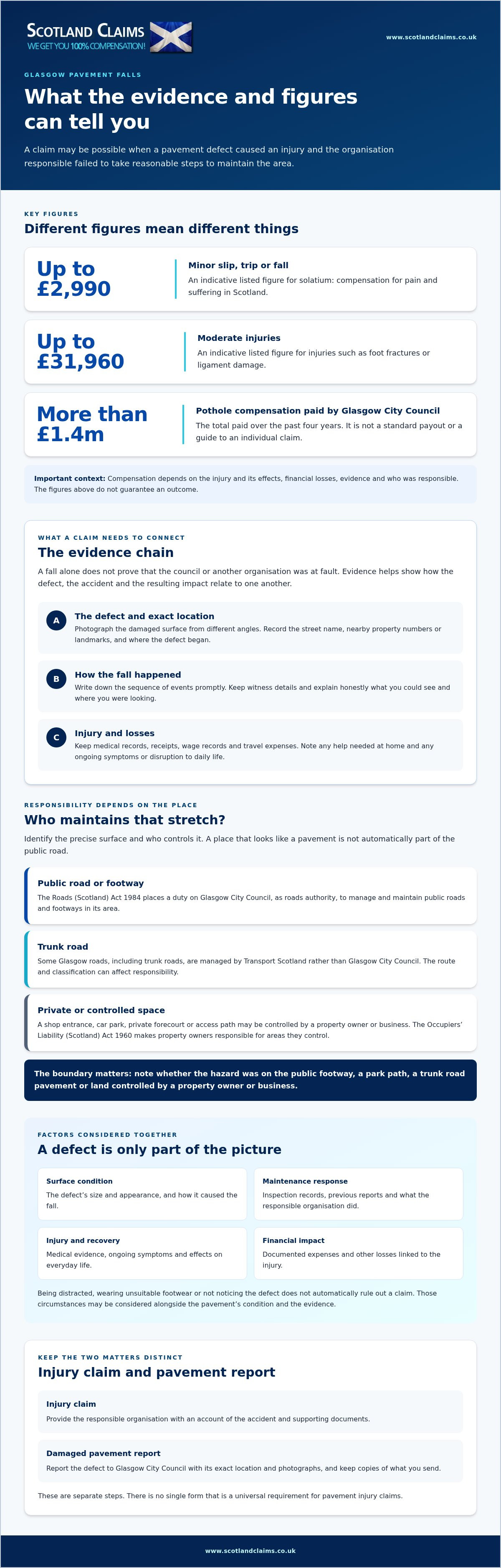
In Scotland, compensation for pain and suffering is called solatium. The amount reflects the injury and its effects, including recovery, ongoing symptoms and disruption to daily life. As an indication, listed figures include up to £2,990 for a minor slip, trip or fall, and up to £31,960 for moderate injuries such as foot fractures or ligament damage.
A claim may also include financial losses linked to the injury. Keep receipts, wage records and travel expenses, and note any help you needed at home. These documents show the financial impact of the fall, alongside medical records describing your injury and treatment.
Contributing to a fall
If you were distracted, wearing unsuitable footwear or did not notice the defect, explain that honestly in your account. These circumstances may affect how responsibility is assessed, but they do not by themselves prove that the pavement was safe or that the council met its duties.
Write down the sequence of events promptly, including what you could see and where you were looking. A clear account helps compare your actions with photographs, witness details and the pavement defect.
Glasgow City Council payout considerations
Glasgow City Council paid out more than £1.4 million in pothole compensation over the past four years. That figure shows previous payouts, not a standard amount for an individual fall. Injury severity, financial losses, evidence and responsibility all affect the assessment.
How do I make a claim against Glasgow City Council for a fall on a pavement? Send the responsible organisation an account of the accident and supporting documents. Report the damaged pavement to Glasgow City Council with its exact location and photographs, and keep copies of what you send. The injury claim and defect report are separate steps. If an offer is refused or inadequate, assess the reasons against your evidence and losses before deciding how to challenge it. There is no single form that is a universal requirement for pavement injury claims.
Council responsibility for pavements, roads and public spaces
Responsibility depends on who controls the precise stretch where the accident happened. In Glasgow, the road’s status and the site’s use can help identify who should address the hazard.
Council road and pavement upkeep
The Roads (Scotland) Act 1984 places a duty on Glasgow City Council, as the roads authority, to manage and maintain public roads and footways in its area, according to The National Archives (legislation.gov.uk). This covers public pavements, but not automatically every surface that looks like a pavement. Identify the precise location, then establish whether it forms part of the public road or another site.
Some Glasgow roads, including trunk roads, are managed by Transport Scotland rather than Glasgow City Council. A road’s route and classification can therefore affect which organisation is responsible. For an accident near a junction or road boundary, record the street name, nearby property numbers and landmarks. These details help distinguish the pavement from adjoining private land.
Maintenance responsibilities
Responsibility may also depend on the type of public space. Scottish local authorities generally maintain public parks, play areas, roads and pavements they are legally obliged to keep safe. They also generally maintain lighting and signage in public areas, including the stability of street lights and road signs. A hazard beside a lamp post or sign may involve a different maintenance issue from a broken footway.
For a public route, consider whether the surface belongs to the road authority or sits within land controlled by a property owner or business. The Occupiers’ Liability (Scotland) Act 1960 makes property owners responsible for areas they control, according to The National Archives (legislation.gov.uk). A shop entrance, car park or private access path may therefore have a different responsible party from the adjoining public pavement.
Consider businesses and other occupiers if the accident happened inside their premises or in an area they control. For example, a fall on a private forecourt may raise different questions about responsibility from a fall on the public footway outside it. The boundary matters. Note where the defect began and where you fell, rather than relying only on the nearest street address.
To identify the responsible organisation, record the exact location and describe the surface and its use. Note whether the route was a public footway, park path, trunk road pavement or part of private premises. If its status is unclear, these details can help distinguish Glasgow City Council’s responsibilities from Transport Scotland’s or an occupier’s. This directs a report and any later investigation to the right organisation.
Photographs and medical records as evidence
A strong pavement injury claim connects three things: the defect, your fall and the resulting injury. Gather evidence promptly, while the location and events are clear. Photographs, medical records and witness details can each support a different part of your account.
At the scene, photograph the defect from several angles. Include a wider view showing its position on the pavement, then closer images of its surface and size. Capture nearby landmarks, street signs or property numbers to identify the location. If it is safe, take photographs before anyone moves or repairs the hazard.
Keep a simple record of the evidence you collect:
- Write down the street name, nearby landmarks and where you fell.
- Note the date, time, weather and what you were doing immediately beforehand.
- Save the original photographs and any messages or reports about the accident.
- Record the names and contact details of people who saw the fall or its aftermath.
Seek medical attention and follow the treating professional’s advice. Medical records can help show the nature of your injury, when you reported symptoms and what treatment you received. Tell the clinician that you fell on a pavement and describe your symptoms accurately. Keep appointment details, discharge information and receipts for injury-related expenses with your records.
How do I get medical records and witness details for a pavement injury claim? Contact the hospital, GP practice or other service that treated you to request copies of relevant records. Ask witnesses for their names and contact details, then note what each person saw, such as the fall or the pavement’s condition afterwards.
A witness need not have seen every moment to provide useful evidence. Someone who helped you stand, saw the defect immediately afterwards or accompanied you for medical attention may be able to describe relevant events. Where possible, write down their account in their own words, distinguishing what they observed from what you told them later.
Keep a dated timeline linking the accident to its consequences. For example, note when pain began, when you first sought treatment and how symptoms affected work or daily tasks. Preserve wage records, travel receipts and evidence of paid help. These documents may support claimed losses, while medical records explain your injury. Together, they help present a consistent account if the council disputes how the fall happened or what it caused. Courts may consider the evidence gathered, so keep copies organised and leave photographs and original records unaltered.
Pothole and uneven-pavement defect examples
A raised slab, broken paving or pothole can create a trip hazard on a Glasgow street. The defect’s dimensions help describe it, but size alone does not establish that the local authority is responsible or that you can claim compensation. Document what caused your fall and what the surface looked like.
Examples of defects that may support a claim in Scotland include a paving stone sticking up by more than one inch or a pothole deeper than 1.5 inches. A pothole deeper than 40 mm is another example. These measurements are useful reference points, not automatic pass-or-fail rules for every pavement injury.
Smaller defects also need careful consideration. A pavement defect less than an inch long or less than an inch deep should be considered carefully before pursuing a personal injury claim. Note whether the edge was raised, loose or difficult to see, and whether its position created a tripping risk. A solicitor assessing the evidence needs the defect’s actual condition, not just a label such as “uneven”.
Record the location and dimensions as soon as it is safe. Photograph the defect from different angles, including one image showing the surrounding pavement and another close-up that makes its size clear. Place a familiar object beside it for scale without changing or disturbing the surface. Include the street name, nearby landmarks or property numbers so the local authority can identify the precise spot.
Photographs should show how the hazard appeared to someone using the pavement. Take pictures from the direction you approached and from the side. Capture nearby lighting, roadworks or other obstructions if they affected visibility. Keep the original files, since editing or cropping can remove details about the scene. If the surface is repaired later, earlier photographs may help show its condition when the accident happened.
When describing the defect’s seriousness, explain how it caused your fall rather than relying only on a measurement. For example, say whether your foot caught on a raised edge or entered a pothole, and identify where you landed. Add the date and time to your notes. This links the street location and visible defect to the accident, giving solicitors and the responsible organisation clearer evidence to assess.
A defect’s size, appearance and position can all matter, alongside evidence of the resulting injury. A deeper pothole or raised slab may be easier to show in photographs, but no single measurement guarantees compensation. Preserve images and notes before repairs alter the surface, then include copies with your report to the organisation responsible for that pavement.
Glasgow City Council’s pavement maintenance duties
Glasgow City Council’s responsibility depends on whether it maintained the pavement reasonably and responded appropriately to hazards. For a claim against the council for a pavement fall in Glasgow, evidence needs to connect the defect, the council’s maintenance decisions and your injury.
The council may investigate the precise location, inspection history, repair records and previous reports. These records can help show whether staff knew, or should have known, about a defect before your fall. A complaint about a raised paving slab, for example, may be relevant if it identifies the same hazard and location.
Glasgow City Council may avoid liability if it can show that a reasonable inspection and repair system was operating. It may also argue that the defect had not been identified or was reasonably scheduled for repair before the accident. The question is not simply whether a defect existed. Evidence needs to address what the authority knew, what its system required and whether its response was reasonable.
Reporting the incident to the organisation responsible for maintaining the pavement creates a record of what happened. Include the accident date, exact street location, defect description, injury details and photographs. You do not have to report a pothole before an accident to make a claim. A report made afterwards may help when inspection records are requested.
Keep a copy of your report and note when you sent it. Preserve any response with your photographs, medical records and witness details. A specialist can compare these materials with the council’s explanation and identify gaps, such as a missing inspection entry or a delay after an earlier complaint. For a claim against the council for a pavement fall in Glasgow, evidence of negligence depends on the full sequence, not one document alone.
In Scotland, the responsible organisation should have an opportunity to address the matter before a personal injury action is raised in court. Court proceedings must be issued before the third anniversary of the accident. Record the accident date and allow time for the council’s investigation and any follow-up. Reporting the incident to the council does not replace issuing proceedings within the time limit.
To organise your case, keep these records together:
- Your dated account of the fall and the pavement’s condition.
- Photographs showing the defect and its precise Glasgow location.
- Medical records and documents showing injury-related losses.
- Reports, replies and details of previous complaints about that spot.
These steps help focus the dispute on the council’s system, knowledge and response. Strong evidence can clarify whether the authority maintained the pavement reasonably or failed to act on a known hazard.
Scotland Claims Injury Lawyers: Road Traffic Accident Claims
Scotland Claims Injury Lawyers can help if a pavement fall in Glasgow has left you with an injury and questions about your next steps. Its Slip or Trip Claims offering is relevant to falls caused by pavement hazards, with support focused on assessing the accident, evidence and resulting losses.
The firm works on a no-win-no-fee basis with a success fee capped at 18% including VAT: it recovers its legal costs from the at-fault party and agrees the cap in writing before the claim starts. This can help you understand the funding arrangement before deciding how to proceed. Its Personal Injury Compensation Calculator can also help you explore how compensation is assessed.
If you want guidance about your pavement fall, contact Scotland Claims Injury Lawyers to discuss your situation.
Take the next step with confidence
If you’re considering a claim against the council for a pavement fall in Glasgow, organise what happened and what you need to establish. A decision is easier when your account, supporting records and questions are together. Note what remains unclear, including who controlled the accident location and how the fall affected your daily life.
Getting guidance can help you understand the relevant issues and your options. The outcome depends on the evidence and circumstances of your accident, so be open about details that may complicate your account as well as those that support it. This gives you a grounded basis for deciding how to proceed.
You don’t have to work out the next step alone. Take the time to ask questions, understand your position and move forward with greater clarity.
Frequently Asked Questions
How long do I have to make a pothole claim against Glasgow City Council?
Generally, the time limit is three years from the accident date. The National Archives (legislation.gov.uk) identifies the Prescription and Limitation (Scotland) Act 1973 as the relevant legislation. For a council injury claim, court proceedings must be issued before the accident’s third anniversary. Keep the accident date recorded and act promptly, so investigating responsibility and preparing evidence doesn’t leave proceedings until the deadline.
Will it cost me anything to claim?
Scotland Claims Injury Lawyers handles personal injury claims on a no-win, no-fee basis. You owe nothing if the claim is unsuccessful. If it succeeds, the firm recovers its legal costs from the at-fault party and deducts a success fee capped at 18% including VAT from your compensation. Read the funding agreement carefully so you understand how it applies to your claim.
Do I need to have reported the pothole before my accident?
No. You do not have to report a pothole before your accident to make a claim. Reporting it afterwards can still create a useful record and help identify earlier complaints or council inspection entries for that location. Include the street, a nearby landmark and the precise pavement section in your report. Keep a copy and note when you sent it, so it can be matched with the accident evidence.
How Much Compensation Can You Get?
Compensation depends on the injury, its effects and financial losses, rather than a fixed payment for every pavement fall. In Scotland, compensation for pain and suffering is called solatium. Figures listed for examples include up to £2,990 for a minor slip, trip or fall, and up to £31,960 for moderate injuries such as foot fractures or ligament damage. Treatment, recovery and documented losses help assess an individual award.
How and when is a council legally responsible for my injury?
Glasgow City Council’s responsibility applies to public roads and footways within its roads authority area. The Roads (Scotland) Act 1984 places a duty on the council to manage and maintain them. Responsibility for an injury turns on whether a defect caused the fall and whether the council failed to take reasonable maintenance steps. The council’s inspection and repair system, knowledge of the hazard and response are relevant to assessing liability.
What evidence is needed for a Glasgow pavement trip or fall compensation claim?
Useful evidence includes photographs showing the defect and its position, medical records documenting your injury, and witness contact details. Keep the original images and note the exact street location, date and time. Records of missed work, travel to treatment and other injury-related spending may support financial losses. Ask witnesses to describe what they personally saw, such as the fall or the pavement’s condition immediately afterwards.
What is the time limit for a personal injury claim against a Scottish council?
For most adult claims, court proceedings must be issued before the third anniversary of the accident. A child’s claim can be brought until age 19, described as three years after turning 16. There is no time limit for a council claim made on behalf of someone who lacks mental capacity, although they may regain capacity. These distinctions make it important to identify who the claim is for and the relevant circumstances.
What must be proved to show Glasgow City Council was responsible for a pavement defect?
You need evidence that the defect caused your fall and injury, and that Glasgow City Council was responsible for maintaining the location. The assessment also considers whether the council knew, or should have known, about the hazard and failed to respond reasonably. Photographs, previous reports and inspection or repair records may help establish these points. The council may rely on evidence of a reasonable system and repair response when disputing responsibility.