
Could an offer that appears to settle your claim put your compensation or expenses at risk? If you’re searching for the part 36 offer scotland equivalent, the key point is that Part 36 applies in England and Wales, not Scotland. Scottish courts use different procedures, and the potential consequences depend on who made the offer and what type it is.
The terminology can be confusing. A pursuer’s offer, a defender’s tender and a Calderbank offer can all feature in settlement discussions, but they work differently. Before accepting or rejecting an offer, understand its terms and how it could affect your next steps and, in some circumstances, the expenses a court may award.
This guide explains the main Scottish offer types, how they differ from Part 36 and what to review before responding. Check the amount, what the offer covers, any stated deadline and the possible expenses consequences. If you’re pursuing a personal injury claim, consider the offer alongside the evidence and value of your case. A claim assessment can help you understand your position before deciding what to do next.
Key Takeaways
- The part 36 offer scotland equivalent isn’t a single procedure. Scottish pursuer’s offers, tenders and Calderbank offers have different rules and potential expenses effects.
- Identify who made the offer and what it covers before considering your response. The type of offer can shape what happens next.
- Check any response date and keep the full offer with related correspondence. Don’t assume an informal message has the same status as a formal offer.
- Compare the offer with your claim’s evidence and value, and consider the possible expenses consequences before deciding.
- A Scottish personal injury solicitor can explain the procedure and assess the terms. Whether to accept or reject depends on your circumstances.
Does a Part 36 offer apply in Scotland? Start with the jurisdiction
No. Part 36 is not the Scottish court procedure for settlement offers. It belongs to the civil court rules of England and Wales. Scotland has its own legal system and court rules, so an offer in a Scottish case must be considered under the procedure that applies there, not automatically treated as a Part 36 offer.
A settlement offer is a proposal to resolve a claim, usually by agreeing a payment and bringing the dispute to an end. Expenses is the Scottish term for legal costs associated with a case. Depending on the offer and the court’s decision, expenses may be affected if a party rejects an offer and the case continues.
What does Part 36 mean in England and Wales?
Part 36 is a formal offer mechanism set out in the Civil Procedure Rules for England and Wales. It has prescribed requirements and consequences under those rules. If you have seen a Part 36 letter in another case, don’t assume its form, response period or possible sanctions apply to a claim in Scotland. Similar settlement aims do not make the procedures interchangeable.
Why does Scotland use different settlement procedures?
Scottish civil procedure is governed by separate court rules. Scottish cases may involve a pursuer’s offer, a defender’s tender or a Calderbank offer, but none is simply Part 36 under another name. The relevant process depends on the case and how the offer is made. Part 36 governs formal settlement offers in England and Wales; Scottish claims follow separate procedures, with their own rules and potential consequences.
You may also see the phrase without prejudice. In plain English, it usually signals that a settlement discussion is not intended to be used as evidence of who is right in the dispute. A Calderbank offer is commonly marked “without prejudice save as to expenses”. That wording allows the offer to be raised when the court considers expenses, even though it is generally kept from the court when deciding the underlying claim. The effect depends on the circumstances and applicable rules.
If you’re searching for the part 36 offer scotland equivalent, look beyond the label. First establish that the claim is being dealt with in Scotland, then identify the type of offer and the court procedure it refers to. A letter using English terminology does not, by itself, make English rules apply to a Scottish action.
Rules and procedures can change, and the details may depend on the court and claim. Before acting, consider the current Scottish rules and the wording of the document. If you’re pursuing a Scottish personal injury claim, identifying which jurisdiction’s procedure applies is a practical first step towards understanding your options.
What is a pursuer’s offer in Scotland, and how does it work?
A pursuer is the person or organisation bringing a civil claim in Scotland. The defender is the party responding to it. A pursuer’s offer is a formal settlement offer made on the claimant’s side during a court action. It proposes a resolution, usually involving payment, so the parties can settle instead of continuing towards a hearing.
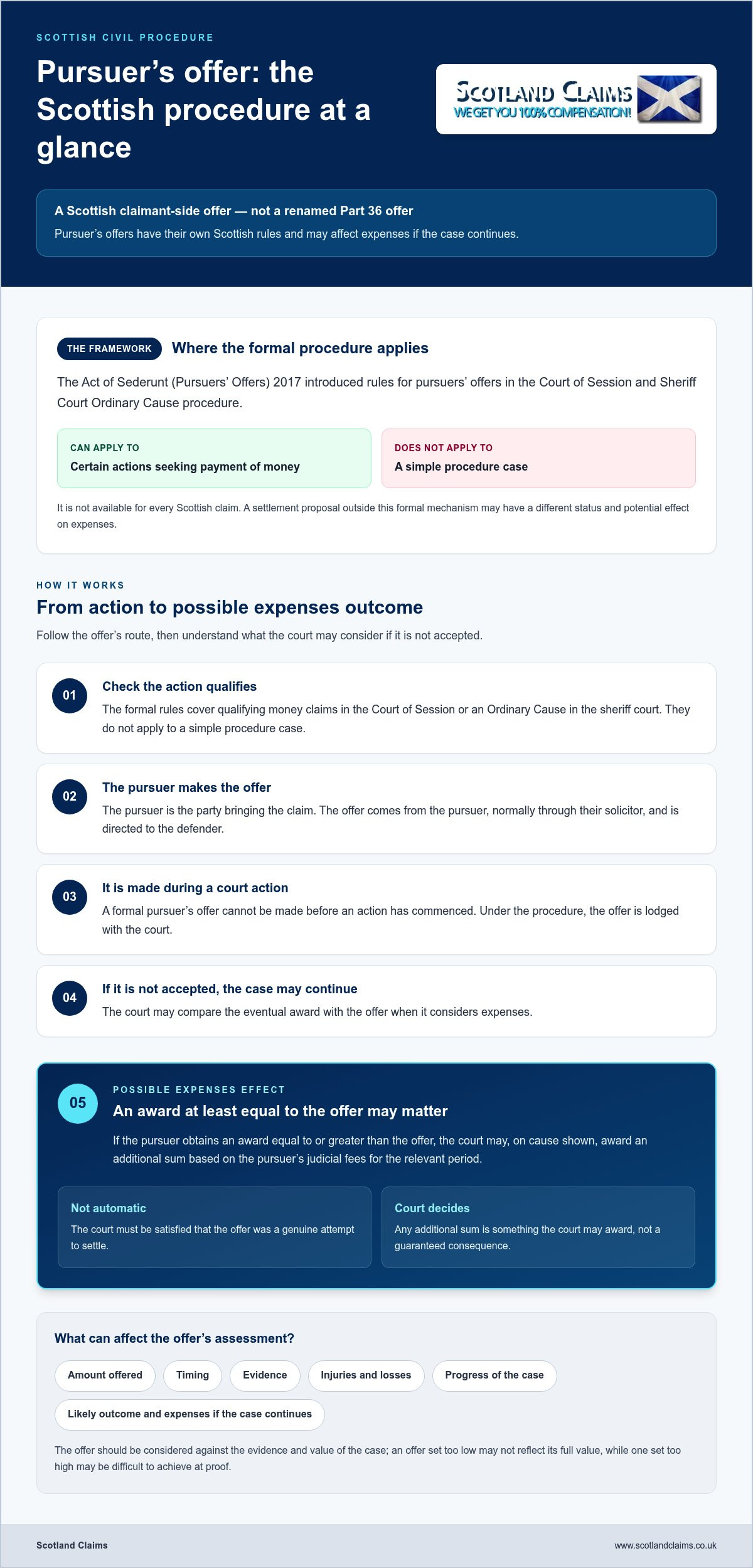
It is a Scottish procedure with its own requirements, not a renamed Part 36 offer. The Act of Sederunt (Pursuers' Offers) 2017 introduced rules for pursuers’ offers in the Court of Session and Sheriff Court Ordinary Cause procedure. The rules apply to certain actions seeking payment of money, not every type of Scottish claim. For someone searching for the part 36 offer scotland equivalent, this is one claimant-side mechanism to understand.
Who can make a pursuer’s offer and when?
The offer comes from the pursuer, normally through their solicitor, and is directed to the defender. It can set out a considered settlement position while court proceedings are under way. Under the formal procedure, the offer is lodged with the court and cannot be made before an action has commenced. Whether the procedure is available depends on the court and type of action, so it should not be assumed to apply to every claim.
In particular, the rules cover qualifying money claims in the Court of Session or an Ordinary Cause in the sheriff court. They don’t apply to a simple procedure case. A settlement proposal can still be made outside this formal mechanism, but its status and potential effect on expenses may differ. Check the wording, timing and procedural steps against the rules for the specific action.
What could happen if the offer is not accepted?
If the defender rejects or does not accept the offer, the case may continue. The eventual award can then be compared with the offer when the court considers expenses. Under the pursuer’s offer rules, if the pursuer obtains an award equal to or greater than the offer, the court may, on cause shown, award an additional sum based on the pursuer’s judicial fees for the relevant period. This is not automatic. The court must also be satisfied that the offer was a genuine attempt to settle.
That possible expenses consequence is one reason to think carefully about the offer’s amount and timing. An offer set too low may not reflect the claim’s full value; one set too high may be difficult to achieve at proof. The evidence, injuries, losses and progress of the case all matter. A defender considering an offer should also compare it with the likely outcome and possible expenses if the case continues.
Before making or rejecting a pursuer’s offer, consider the current rules, the evidence and the practical consequences for your case. If you’re weighing an offer as part of a personal injury claim, understanding your claim position can help you consider the decision more clearly.
Pursuer’s offer, tender or Calderbank offer: what is the difference?
These terms describe different ways to make a settlement proposal in a Scottish case. The person making the offer, the procedure used and the possible expenses implications all matter. The table is a starting point, but the label alone cannot tell you exactly what accepting or rejecting an offer may mean.
| Offer type | Who usually makes it? | Broad purpose and jurisdiction |
|---|
| Pursuer’s offer | The pursuer, or claimant | A formal claimant-side settlement offer under specific Scottish court rules. |
| Tender | The defender, or respondent | A formal offer by the defender to settle a Scottish court action, with potential expenses consequences under the applicable rules. |
| Calderbank offer | Either party | A settlement proposal generally marked “without prejudice save as to expenses”. A court may consider it when deciding expenses, depending on the circumstances. |
| Part 36 offer | Either party | A formal offer under the Civil Procedure Rules of England and Wales, not the Scottish procedure. |
How does a Scottish tender differ from a pursuer’s offer?
The main difference is who makes the offer. A pursuer’s offer comes from the claimant side; a tender is generally the defender’s formal offer to settle a Scottish claim. Each has its own procedural context. If a pursuer rejects a tender and the eventual court award does not exceed it, the pursuer may face responsibility for the defender’s expenses from the point the tender could reasonably have been accepted. The outcome depends on the case and relevant rules. A tender is not a Scottish version of Part 36.
For example, a defender might tender a sum to resolve a personal injury action. The pursuer needs to compare that figure with the evidence, losses and likely outcome if the case continues. The label “tender” does not establish whether the amount is fair or what the court will decide about expenses. Review the terms and procedural details carefully.
Where does a Calderbank offer fit in Scotland?
A Calderbank offer is a settlement proposal made “without prejudice save as to expenses”. In general, it is kept from the court when it decides the main dispute, but may be shown later when expenses are considered. This differs from a formal tender or pursuer’s offer made under specific court rules. It does not carry the same defined procedural consequences, although the court may take a rejected offer into account when exercising its discretion on expenses.
If you’re asking what the part 36 offer scotland equivalent is, there isn’t one direct substitute. The offer type, precise wording, timing, applicable court rules and final result can all affect how it is treated. Before responding, identify who made the offer, what settlement it proposes and whether it is presented as a formal procedure or a Calderbank offer. Consider the document and your case circumstances before accepting or rejecting it.
Received a Scottish settlement offer? Steps to take before responding
An offer can look straightforward, but the figure alone won’t tell you whether it covers your whole claim or what rejecting it could mean. Review it methodically. Don’t rely on an English legal label or assume an informal message has the status of a formal Scottish offer.
What details should you check in the offer?
Start with the offer and any covering correspondence. Keep complete copies, including emails and attachments. Check who sent it, who it is addressed to and whether it identifies a particular procedure. If it is described as a tender, pursuer’s offer or Calderbank offer, note that wording, but review the actual terms too.
- Identify the offer and parties. Establish who is making the proposal and whether it is addressed to you or your solicitor. If it is an informal message, don’t assume it is a formal offer under Scottish court rules.
- Check what the settlement covers. Look for the claims and losses included, such as injury compensation, lost earnings or other financial losses. Check whether expenses are addressed and whether accepting would settle the whole claim or only part of it.
- Note any response date. Record the stated date and keep the original document. A date in a letter may matter, but its legal significance depends on the offer type and applicable procedure. Have the terms assessed promptly.
How can you avoid a rushed decision?
Compare the offer with the evidence, rather than reacting only to the headline amount. In a road injury claim, relevant material may include medical information, treatment and recovery details, proof of earnings loss, expenses and evidence about how the accident happened. Gaps in records or uncertainty about longer-term effects may influence how the offer should be assessed.
For a road traffic accident claim, the circumstances of the collision and the available evidence about responsibility can also matter. Scotland Claims’ Scottish personal injury solicitor information explains how case-specific guidance can help when reviewing an offer. Keep your documents together and note any questions or missing information before discussing your options.
Don’t accept or reject an offer solely because familiar English terminology appears in the correspondence. The words “Part 36” do not, by themselves, establish which rules govern a Scottish claim. Consider the type of offer, its full wording, what it settles and the evidence together. The right response depends on the circumstances of the claim.
Clarifying the offer’s scope and the evidence behind your claim can help you make a more informed decision. If you’re pursuing a road injury claim, the Scottish road traffic accident claim guidance provides context on issues that may shape a compensation assessment.
How can a Scottish personal injury solicitor help you assess an offer?
Assess an offer in the context of your case, not in isolation. A Scottish personal injury solicitor can identify whether it is a tender, pursuer’s offer, Calderbank offer or another proposal, then explain how its terms relate to the applicable procedure. This helps clarify what the offer appears to settle and what questions to resolve before deciding how to respond.
If you’re looking up the part 36 offer scotland equivalent, identifying the Scottish offer type is only the starting point. A solicitor can review the amount and scope, note any response date and consider the offer alongside evidence about liability, your injuries and financial losses. They can explain potential procedural and expenses implications, but the right response depends on the facts of your claim. Don’t accept or reject an offer based on a general rule alone.
What can a claim assessment clarify?
A claim assessment can help you understand whether the proposal accounts for the relevant parts of your injury claim and how strong the available evidence is. For example, it may consider medical information, the effect of the injury on work and day-to-day life, documented losses and the circumstances of the incident. It can also identify information that may be needed to evaluate the offer more fully.
Scotland Claims Injury Lawyers handles road traffic accident, workplace injury and slip or trip claims in Scotland. A claim assessment can help you understand your position and the offer in the context of your particular claim, without promising a specific settlement or prescribing an answer before reviewing the facts. A court’s expenses rules and a solicitor’s fee arrangement are separate matters. Possible expenses consequences after an offer do not, by themselves, explain what you would pay under a legal representation agreement.
How does Scotland Claims Injury Lawyers’ fee model work?
Scotland Claims Injury Lawyers operates on a no-win-no-fee basis, with no success fee and no payment if your claim is unsuccessful. The firm recovers legal costs from the at-fault party’s insurer, so clients keep their full settlement. This fee model is separate from Scottish court rules that may affect expenses after an offer is made or rejected. Understanding one does not replace checking the other.
The firm’s Scottish no-win-no-fee guide explains the fee arrangement separately from settlement-offer procedures. An assessment can then focus on the offer itself: its wording, what it covers, the evidence supporting your claim and the relevant Scottish process. This gives you a clearer basis for considering your options, while recognising that whether to accept or reject depends on your case.
Take your next step with confidence
Before responding to an offer, focus on what it means for your claim and what the evidence supports. The phrase part 36 offer scotland equivalent may lead you to Scottish offer types, but your decision should turn on the actual terms, procedure and circumstances of your case. A claim discussion can help you understand the issues and consider your options.
Scotland Claims is the trading style of Kerr Brown Solicitors, established in 2006 and authorised and regulated by the Law Society of Scotland. The firm’s no-win-no-fee arrangement means clients keep their full settlement and owe nothing if their claim is unsuccessful. These arrangements are separate from court rules about settlement offers and expenses.
With a clearer understanding of the offer and your claim, you can make your next decision with greater confidence.
Frequently Asked Questions
What is the Scottish equivalent of a Part 36 offer?
There isn’t one exact equivalent. If you’re searching for the “part 36 offer scotland equivalent”, the closest Scottish formal mechanisms are a pursuer’s offer from the claimant side and a tender from the defender. A Calderbank offer is another settlement route, but it is less formal. Which one is relevant depends on the court action and the document’s terms, so identify the offer type before considering its possible effects.
Does Part 36 apply to claims in Scotland?
No. Part 36 is part of the Civil Procedure Rules for England and Wales, not the Scottish court procedure. For example, if a Scottish court action is underway, an offer using the words “Part 36” doesn’t automatically bring those rules or consequences into the case. Check which court is dealing with the claim and get advice on the applicable Scottish procedure before relying on a deadline or legal label.
What is a tender in Scottish law?
A tender is generally a formal settlement offer made by the defender in a Scottish court action. It sets out a proposed resolution, often involving payment, for the pursuer to consider. If you receive one, note the amount and any stated response date, then assess what the offer covers against your claim. Its possible expenses effects depend on the procedure and the eventual outcome, so don’t judge it by its title alone.
What happens if I reject a pursuer’s offer or tender?
The consequences depend on which party made the offer and what the court eventually awards. If a defender rejects a pursuer’s offer and the pursuer later obtains at least that amount, the court may, on cause shown, award an additional 50% of the pursuer’s judicial fees for the relevant period. If a pursuer rejects a tender but fails to obtain a higher award, they may face the defender’s expenses from when the tender could reasonably have been accepted. Neither consequence should be assumed to be automatic.
Can I make a Calderbank offer in a Scottish personal injury claim?
Yes, a party may make a Calderbank offer in a Scottish personal injury dispute. It is usually marked “without prejudice save as to expenses”. In everyday terms, that means the proposal is generally kept from the court when it decides the main claim, but may be raised when expenses are considered. It isn’t the same as a formal tender or pursuer’s offer, and the court’s treatment depends on the wording and circumstances.
Should I accept a settlement offer in a Scottish injury claim?
There’s no safe answer without reviewing your circumstances. Before deciding, consider whether the offer resolves the entire claim, how it accounts for your injury and financial losses, and whether important evidence is still outstanding. For instance, if your recovery or ability to work remains uncertain, that may affect how the offer should be assessed. Have the terms and possible consequences explained before deciding. Don’t accept or reject solely because a deadline feels pressing.
Are Scottish settlement offers the same as Part 36 offers?
No. They may share the broad aim of encouraging settlement, but Scottish pursuer’s offers, tenders and Calderbank offers arise under different procedures from Part 36. Their requirements and possible expenses consequences aren’t interchangeable. For example, a Scottish offer’s effect may depend on the applicable court rules, its wording and the final award. Treat the document according to the Scottish procedure that applies, rather than importing assumptions from an England and Wales case.