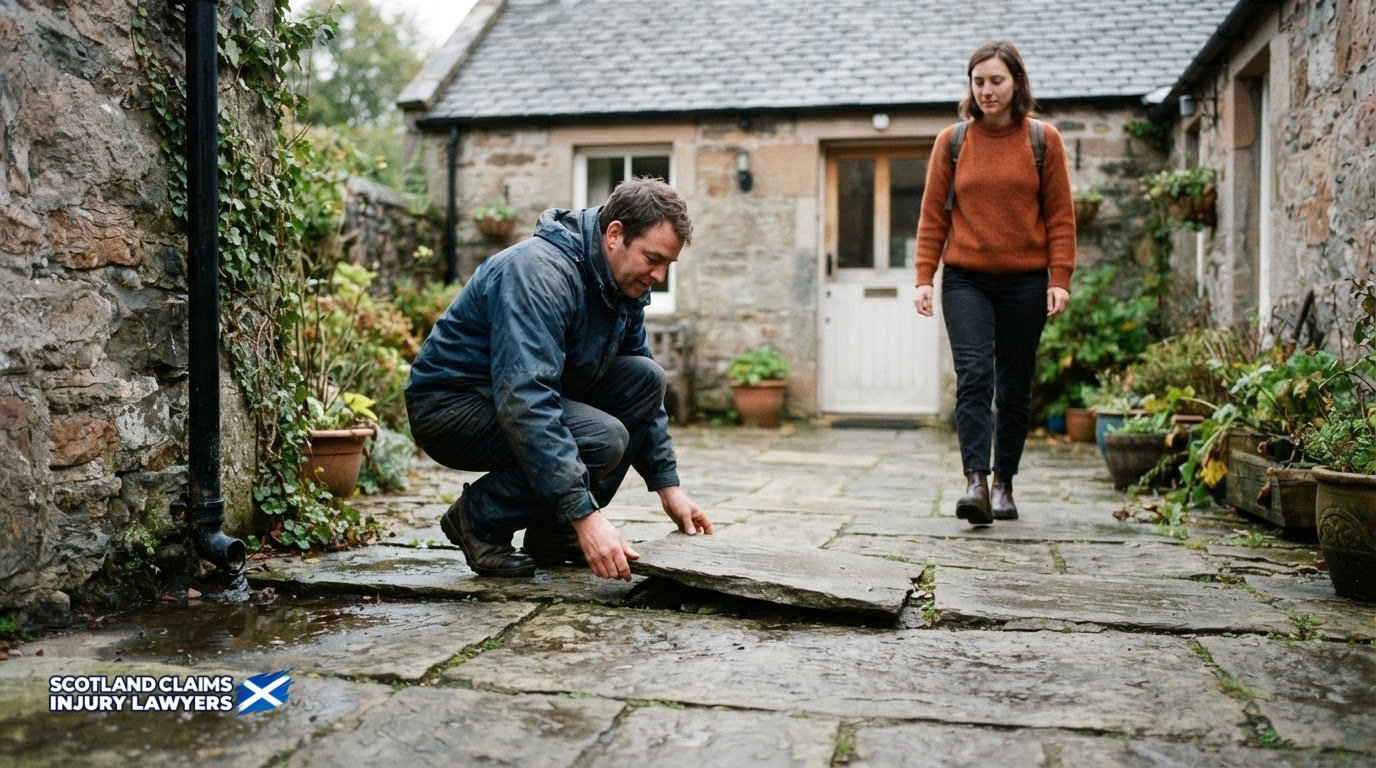
The owner isn’t automatically responsible when someone is injured on Scottish premises. Responsibility may rest with whoever controls the land or building, and section 2 of the Occupiers’ Liability (Scotland) Act 1960 requires an occupier to take reasonable care to prevent injury or damage from the state of the premises or things done or not done there, according to the UK legislation portal. This guide to occupiers’ liability in Scotland explains how that duty works.
It’s understandable to think that a hazard means someone must be at fault. But responsibility depends on the circumstances: who had control, what danger could reasonably be foreseen, and whether the person’s status or purpose affected the care required. The law sets a single duty in principle for people entering premises, including trespassers, although the circumstances still matter.
Here, you’ll learn who may count as an occupier, how lawful status and permission to enter can affect a case, and what courts consider when deciding whether reasonable care was taken. Examples of accidents on Scottish premises show why the details matter: a fall, poor lighting or an unsafe feature does not, by itself, establish who is responsible.
Key Takeaways
- Learn why responsibility may rest with the person or organisation controlling the premises, not necessarily the owner.
- See how permission to enter and the visitor’s purpose can affect the care expected.
- Understand how foreseeability, obvious dangers and reasonable safety measures shape a court’s assessment.
- Explore Scottish case examples that show why the specific hazard and circumstances matter.
- Find out when an injury on unsafe premises may relate to a slip or trip claim or a work injury claim.
What Factors Do Courts Consider?
According to the UK legislation portal, the Occupiers' Liability (Scotland) Act 1960 establishes occupiers’ duty of care. An occupier may argue that a visitor willingly accepted a risk, or that the danger was obvious and inherent.
Assessing Reasonable Care
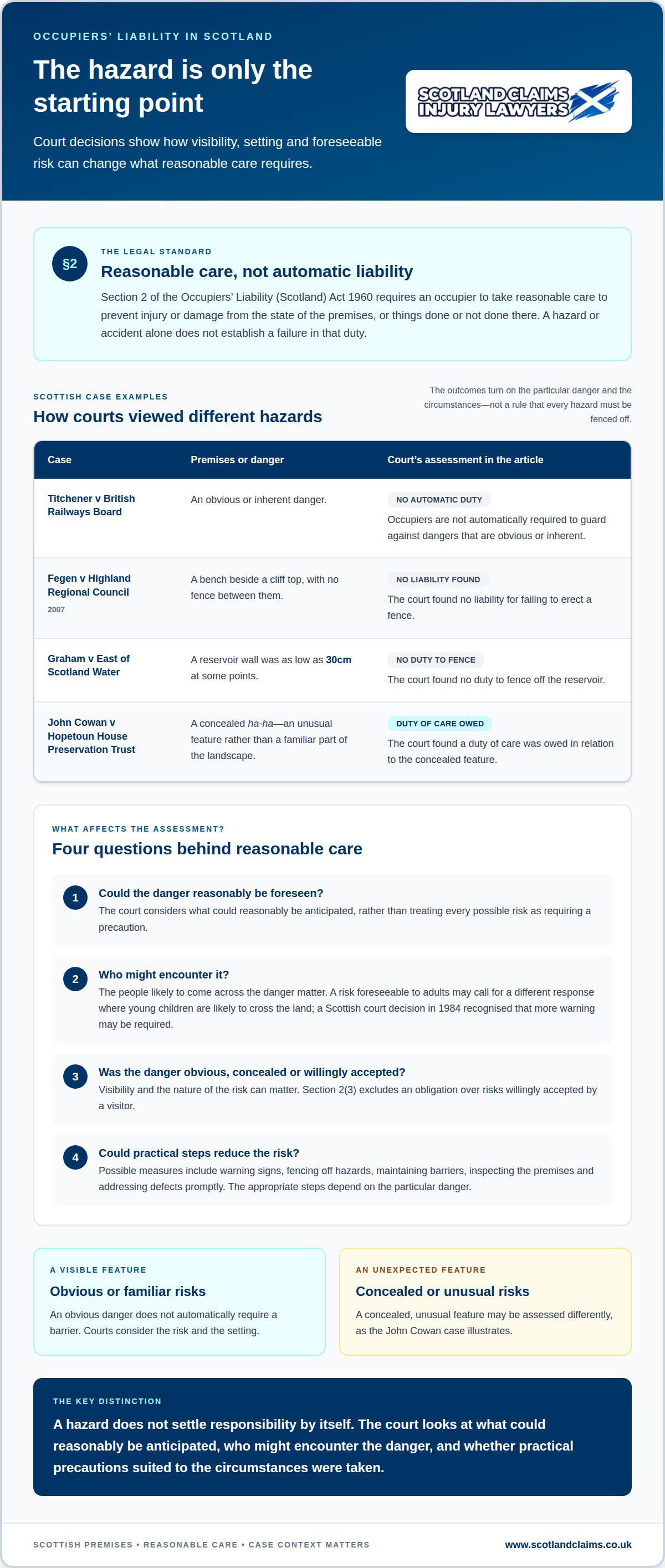
Reasonable care means taking precautions suited to foreseeable dangers and the circumstances of the premises. A hazard alone does not establish that an occupier failed in their duty. The court considers what could reasonably be anticipated, who might encounter the danger and whether practical steps could reduce the risk.
For example, an occupier may use warning signs, fence off hazards, maintain barriers, inspect the premises and address defects promptly. The right steps depend on the particular danger. A risk that is foreseeable to adults may require a different response where young children are likely to cross the land. A Scottish court decision in 1984 recognised that more warning may be required in that situation.
Courts do not treat every hazard as requiring a barrier. In Titchener v British Railways Board, Scottish courts held that occupiers are not automatically required to guard against obvious or inherent dangers. In Fegen v Highland Regional Council in 2007, the court found no liability for failing to erect a fence between a bench and a cliff top. These examples show why the danger, its visibility and the setting all matter.
Rural land also calls for a practical assessment, rather than precautions against every possible risk. In Graham v East of Scotland Water, a reservoir wall was as low as 30cm at some points, yet the court found no duty to fence off the reservoir. By contrast, John Cowan v Hopetoun House Preservation Trust concerned a concealed ha-ha, treated as an unusual feature rather than a familiar part of the landscape. The court found a duty of care was owed.
The Occupier’s Duty of Care
Section 2 of the 1960 Act sets out the core duty: take reasonable care to prevent injury or damage from the state of premises, or things done or not done there. According to the UK legislation portal, that statutory duty applies to occupiers of premises in Scotland. It gives the court a legal standard for assessing the circumstances, rather than an automatic rule that every accident means negligence.
The duty concerns people entering premises, but the risk and the precautions matter. Section 2(3) excludes an obligation over risks willingly accepted by a visitor. An occupier may therefore rely on accepted risks, alongside the obviousness of a danger, when disputing liability. A tenant’s control of a stairwell, for example, may be relevant to who carried responsibility for its condition.
The precise setting can change the assessment. A clearly marked, visible feature differs from an unexpected concealed hazard, as John Cowan illustrates. For Scottish premises, the relevant legal context is injury law in Scotland, including the statutory duty and how courts assess reasonable care.
What Is Occupiers Liability?
Occupiers’ liability is the legal responsibility connected with injury or damage caused by premises or activities there. According to the UK legislation portal, section 2 of the Occupiers’ Liability (Scotland) Act 1960 requires an occupier to take reasonable care to prevent injury or damage from the state of the premises, or things done or not done there. This statutory duty replaced the relevant common law rules with a single duty in principle.
According to the UK legislation portal, the 1960 Act applies a single duty of care in principle to anyone entering premises in Scotland, including trespassers. That does not mean every injured person can claim compensation. A claim depends on showing that the occupier failed to take reasonable care, that the failure caused harm, and that the injury or damage can be evidenced.
Time matters. According to the UK legislation portal, a person generally has three years from the date of the accident to make an occupiers’ liability claim under the Prescription and Limitation (Scotland) Act 1973. The evidence should help establish where and when the accident happened, what caused it, and how the injury affected you. Useful material may include photographs, witness details, incident records, medical notes and evidence of the hazard or its maintenance.
What evidence is needed to make a claim in Scotland? Start with records that connect the hazard to the accident: photographs, witness accounts, an incident report and medical evidence can each help explain what happened. Keep relevant messages or documents about the premises, too. Together, these details can help show the site’s condition, the injury suffered and the effect on your daily life.
Negligence claims seek compensation for losses caused by a failure to take reasonable care. Losses may include the injury and its consequences, with evidence helping establish appropriate compensation. That outcome shows the potential scale of one case, not a standard award for other claims.
Trespass does not automatically remove the duty, but the circumstances of entry and the risk remain relevant. The Evidence Act 1866 was cited as allowing a trespass case to be treated as a special cause for decision by a judge rather than a jury. So a civil jury is not inevitable; the case may instead be decided by a judge.
A supermarket fall can raise the same core issues: what caused the fall, whether the hazard could have been addressed, and whether it caused injury. A wet aisle, for example, may make photographs, witness accounts and records of the incident relevant. For an initial indication of possible injury compensation, use the personal injury compensation calculator.
Visitors’ lawful status and permission to enter
Permission to enter helps explain why someone was on the premises, but it does not settle responsibility for an injury. In Scotland, the circumstances include the visitor’s purpose and identity. A customer invited into a shop, a guest in a home, someone using responsible access and a trespasser may encounter different risks. Those details help show what danger was foreseeable and what care was reasonable in that setting.
Responsible access is recognised under the Land Reform (Scotland) Act 2003. Someone exercising that access may be on land without a personal invitation from its occupier. Their presence still matters when assessing a particular accident. A path user, for example, may face a different hazard from a contractor carrying out work nearby. The purpose of entry helps place the risk in context.
Permission can be express, such as an invitation into a building, or implied by how a place is used. A visitor who enters a business during opening hours has a different reason for being there from someone who crosses into a closed area. If either is injured, the court considers the circumstances, the danger and the occupier’s response. The label alone does not decide whether reasonable care was taken.
How does Scottish law differ from the law in England and Wales? Scotland’s Occupiers’ Liability (Scotland) Act 1960 provides a single duty in principle, including for trespassers. In England and Wales, the Occupiers’ Liability Act 1957 abolished the invitee and licensee categories, while leaving the position of trespassers unchanged.
A visitor’s status is relevant, but it does not provide a complete answer. In Scotland, a trespasser’s purpose and the specific circumstances can still affect the care expected. An obvious danger may be assessed differently from an unexpected hazard. The occupier’s knowledge of who might enter and what they might encounter can also help explain which precautions were reasonable.
The 1960 Act does not make an occupier responsible for every injury to an unauthorised entrant. The central issue remains the duty and the circumstances surrounding the danger. For example, evidence that a person entered a restricted area may matter alongside evidence about barriers, warnings and the hazard itself. Each point helps the court assess the claim, rather than turning trespass into an automatic defence.
Older legal categories can cause confusion. The English and Welsh distinction between invitees, licensees and trespassers should not be treated as Scotland’s test. For a Scottish claim, focus on why the person entered, the risk they faced and what the occupier could reasonably have done. Those facts help explain how the statutory provisions apply to visitors, access takers and trespassers in practice.
Who Counts as an "Occupier"?
In Scotland, an occupier is a person who controls the land. That may be its owner, a tenant or a contractor. Ownership alone does not show who controlled the particular area or activity connected with an injury or damage. For example, a landlord may own a building while a tenant manages the premises used by customers. The facts about control help identify whose obligations are relevant.
Control can relate to a whole site or a particular part. A contractor carrying out work may control the work area, while a tenant manages the shop floor. If someone is injured near a building entrance, the relevant question is who controlled that entrance and its condition. More than one person may manage different areas or activities. The circumstances determine which responsibilities may apply.
Premises have a broad meaning under the Occupiers’ Liability (Scotland) Act 1960. They include land and other premises, as well as fixed or moveable structures. The examples extend beyond shops and houses. A visitor’s accident on a vessel, vehicle or aircraft may also involve premises for this purpose. The setting matters because the danger may arise from the structure itself or something done there.
Consider a visitor who falls on a stair inside a rented building. The landlord’s ownership does not, by itself, establish control of that stair. A tenant may control the building’s daily use, while a contractor may control an area during repair work. These examples do not automatically settle liability. They show why identifying the place, activity and person exercising control is a useful starting point.
A practical way to analyse an accident on Scottish premises is to separate three questions:
- Where did it happen? Identify the exact area, such as a stairwell, path, vehicle or work zone.
- Who controlled it? Consider the owner, tenant or contractor connected with that place or activity.
- What caused the harm? Describe the condition of the premises or the action linked to the injury or damage.
For example, a contractor working on a shop entrance may control the repair area, while the tenant controls the rest of the shop. Evidence about who managed each area can help distinguish their roles. A property title may identify the owner, but control of the specific place and activity remains central to identifying an occupier.
That distinction matters before responsibility can be assessed. A landlord, tenant and contractor may all be connected to the same premises, but their actual control can differ. In a Scottish claim, explain where the hazard was and who managed that place or activity. This gives a clearer basis for examining the relevant obligations and any resulting injury or damage.
Examples of occupiers’ liability accidents
A fall in a stairwell, a broken gate or a hidden drop can each raise an occupiers’ liability question. The accident itself does not settle responsibility. The hazard, how it contributed to the injury and the surrounding circumstances all matter. Scottish cases show how specific features of a place can shape the assessment.
In Karla Hodgson v Castlehill Housing Association Ltd, reported as [2023] SC EDIN 5, a woman fell on a poorly lit stairwell. The handrail ended before the bottom step. The court found a breach of section 2 of the Occupiers’ Liability (Scotland) Act 1960 over inadequate stair lighting. Karla Hodgson was awarded £17,000. The case illustrates how more than one feature, including lighting and a handrail, can be relevant to the danger a person faces when entering or leaving a building.
That example does not mean every fall on stairs leads to a successful claim. The specific layout matters. A dark landing, an abrupt change in level or a handrail that ends short may each affect how someone uses the stairs. The court’s finding in Hodgson concerned the circumstances of that accident, not a fixed outcome for other stairway injuries.
Other scenarios raise different questions. A visitor who slips on a wet shop floor might need to show where the hazard was and how the accident happened. Someone injured near building work may face questions about the work area and who controlled it. On a rural path, an uneven surface may be part of the setting, while a concealed feature could present a different danger. Each case turns on its own facts.
During a leisure activity on land with a visible feature, the danger may be apparent before someone approaches it. A concealed drop beside a route presents a different situation. A warning, barrier or other measure may help explain how the risk was managed. These details do not establish liability by themselves, but they help distinguish an obvious feature from an unexpected hazard.
After an accident, a clear account can connect the place, hazard and injury. Record the precise location, describe what happened immediately before the fall and identify anyone who witnessed it. Photographs of the stair, floor or entrance may show features that changed later. In Hodgson, the relationship between stair lighting and the handrail’s position formed part of the reported circumstances.
These examples show why “accident” is only a starting point. Compare the actual hazard with the location, the activity and the steps taken there. This gives a more useful basis for understanding how Scottish occupiers’ liability may apply.
Scotland Claims Injury Lawyers
Scotland Claims Injury Lawyers helps people injured in accidents across Scotland explore whether they may have a personal injury claim. If an unsafe floor or another hazard caused a fall, the firm handles slip or trip claims. It also handles work injury and road traffic accident claims, and offers a personal injury compensation calculator to help you understand potential compensation.
Its no-win-no-fee approach includes a 100% compensation promise: fees are recovered from the at-fault party, and the full settlement is passed to you. The circumstances of your accident, the evidence and the injury all matter when assessing a claim. If you were hurt on premises in Scotland and want to discuss your situation, contact Scotland Claims Injury Lawyers.
Decide on your next step
Understanding occupiers’ liability in Scotland can help you decide whether to pursue a claim. Consider how the accident has affected you and whether you want support assessing your options. You don’t need to reach a final conclusion about responsibility before seeking advice.
Scotland Claims Injury Lawyers handles road traffic accident claims, slip or trip claims and work injury claims across Scotland. If your injury arose from one of these situations, the firm can help you understand the claims process and consider the circumstances of your accident. The right path depends on what happened and how it has affected you.
Taking advice can help you move from uncertainty towards an informed decision. Explain what happened and discuss whether a claim may be appropriate.
A clear next step can help you focus on your recovery and decide how to move forward.
Frequently Asked Questions
What is occupiers’ liability in Scotland?
It is the legal framework for assessing responsibility when someone suffers harm connected with premises. For example, if a visitor is injured by a damaged entrance step, the claim concerns the hazard, the occupier’s conduct and the resulting harm. The question is not simply who owns the building. It is whether the person responsible for the premises failed to take reasonable care and whether that failure caused injury or damage.
Which laws govern occupiers’ liability in Scotland?
The main statute is the Occupiers’ Liability (Scotland) Act 1960, which sets out the occupier’s duty. The Prescription and Limitation (Scotland) Act 1973 is relevant to the time limit for bringing a claim. For people using Scotland’s responsible access rights, the Land Reform (Scotland) Act 2003 provides relevant context. These are Scottish laws; the law in England and Wales uses different occupiers’ liability legislation.
Who counts as an occupier under Scottish law?
An occupier is someone with control over the relevant place, such as an owner, tenant or contractor. Control can relate to a specific area rather than an entire building. For example, a contractor directing repair work may control a cordoned-off entrance, while a tenant manages the shop’s usual operations. Identifying who controlled the hazard’s location or the activity connected with it helps clarify whose conduct is relevant.
What duty of care do occupiers owe to visitors in Scotland?
Section 2 of the 1960 Act requires an occupier to take reasonable care to prevent injury or damage arising from the premises or activities there. In practice, a shop with a damaged floor tile might need to consider measures addressing that particular danger. The assessment concerns what reasonable care required in the circumstances, including the condition of the premises and the risk to people using them.
How does occupiers’ liability apply to trespassers in Scotland?
The 1960 Act applies a single duty of care in principle to people entering premises, including trespassers. That does not make an occupier automatically liable whenever an unauthorised entrant is injured. The person’s reason for entering, the danger encountered and the surrounding circumstances remain relevant. Section 2(3) excludes an obligation over risks willingly accepted by a visitor, which can also affect how responsibility is assessed.
How is a visitor’s status determined under Scottish occupiers’ liability law?
The circumstances of entry help establish a visitor’s status and purpose. A customer entering a shop, a guest invited into a home, someone using responsible access and a person entering without permission are different examples. In Scotland, status does not replace the statutory duty with separate invitee and licensee rules. Instead, the reason for entering and the risk encountered help explain what care was reasonable in that situation.
How do courts assess whether an occupier took reasonable care?
Courts consider whether the danger was foreseeable and what precautions suited the particular premises. Relevant details include how visible the hazard was, who might encounter it and whether a warning or barrier could address it. A readily apparent feature differs from a concealed danger. The assessment also considers the visitor’s circumstances, so a risk affecting young children may call for different precautions from one facing adults.
What are the time limits and compensation rules for occupiers’ liability claims in Scotland?
A person generally has three years from the accident to make an occupiers’ liability claim under the Prescription and Limitation (Scotland) Act 1973. A claim seeks compensation for harm caused by the occupier’s negligence, with evidence connecting the breach to the injury or damage. Relevant information can include medical records, proof of financial losses and details of how the injury affected everyday activities. The nature and impact of the harm inform the assessment.