What if shared blame doesn’t rule out a claim? In Scotland, you may still be able to pursue motorcycle accident compensation if you were partly responsible, although any award may be reduced to reflect your share of the blame. The value depends on the evidence of what happened and how the accident affected you, not a headline figure.
It’s understandable to want clarity about what your claim could be worth and whether legal fees might reduce your settlement. An assessment considers the injury and its effects, alongside financial losses such as lost earnings, care costs and motorcycle damage. Medical records, accident evidence, receipts and earnings information can help show the full impact.
This article explains how compensation is assessed in Scotland, what evidence may support your claim and how disputed or shared fault can affect it. Scottish rules also differ from those in England and Wales. You’ll learn how Scotland Claims Injury Lawyers’ fee arrangement works: no success fee is deducted from your settlement, so 100% of any settlement belongs to you. If your claim is unsuccessful, you owe nothing. This explains deductions, not a guaranteed claim outcome or compensation amount.
Key Takeaways
- Motorcycle accident compensation reflects the injury’s impact and recovery, alongside financial losses that can be evidenced separately.
- Keep medical records, proof of lost earnings, receipts and repair documents to help show how the accident affected you.
- Disputed blame doesn’t automatically prevent a claim. The available evidence helps establish responsibility, and shared fault may reduce compensation.
- Prioritise medical care first, then record accident details and preserve relevant evidence when you’re able.
- With Scotland Claims Injury Lawyers, no success fee is deducted from your settlement: 100% belongs to you, and you owe nothing if the claim is unsuccessful. This isn’t a guarantee of compensation or a particular outcome.
What does motorcycle accident compensation cover in Scotland?
After a collision, you may be unsure what your injuries and resulting losses could mean for a claim. Motorcycle accident compensation isn’t a fixed payment or tariff. It’s an assessment of how the injury affected you, together with relevant financial losses linked to the accident. The injury element is often called general damages; evidenced financial losses are known as special damages.
Compensation is an evidence-based assessment of injury impact and relevant losses, not a guaranteed payout. Whether you can claim, and the outcome, depend on the circumstances of the collision, the evidence and how responsibility is assessed. If a claim proceeds to court, Scotland’s specialist Sheriff Personal Injury Court is one part of the Scottish system for handling personal injury cases.
Which losses may be considered after a motorcycle accident?
The injury assessment looks at symptoms, their severity and duration, your recovery and the effect on everyday life. For example, an injury might limit your ability to work, ride, sleep or manage usual activities. In Scotland, relevant guidelines can help inform the assessment, but they aren’t a fixed tariff that sets every claim’s value.
Financial losses are considered separately and need supporting evidence. Depending on your circumstances, these may include earnings lost because you couldn’t work, or reasonable expenses arising from the accident. Keep payslips, invoices, receipts and proof of time away from work. These examples aren’t automatic entitlements: the connection to the accident and the supporting evidence matter.
Why is there no single motorcycle accident compensation figure?
Two riders with apparently similar injuries may have different symptoms, recovery periods, work circumstances and day-to-day effects. The medical and financial evidence available can also differ. That’s why an online example or estimated figure can’t establish what a particular person’s claim is worth. It can offer a starting point, not a decision on eligibility or a promised settlement.
For a broad indication, use the personal injury compensation calculator. Treat its result as an estimate only. A claim assessment must consider your injury, recovery, documented losses and the circumstances of the collision to give a clearer view of your claim.
How is motorcycle accident compensation assessed?
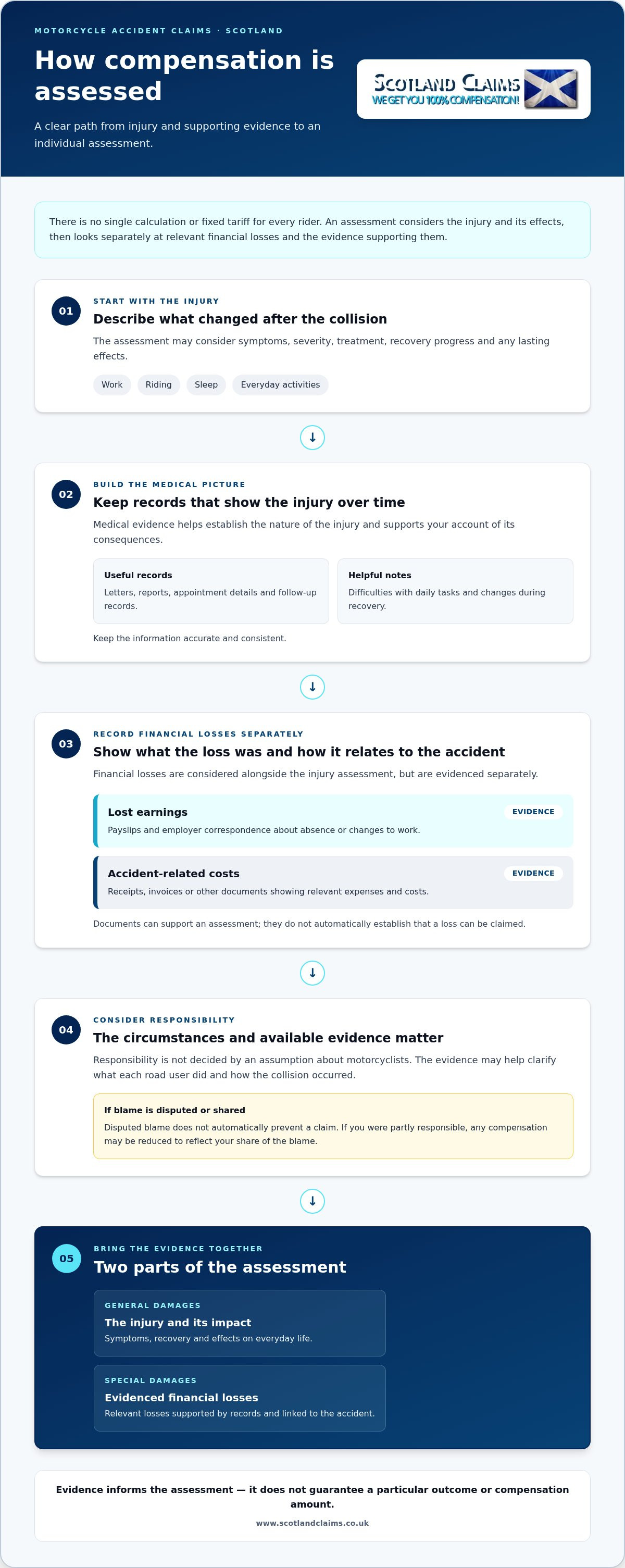
There isn’t a single calculation that fits every rider. An assessment looks at the injury and its effect on your life, then considers supported financial losses separately. Medical evidence and consistent records help build a clearer picture of what happened after the collision and how your circumstances changed.
How do injury severity and recovery affect an assessment?
The assessment may take account of your symptoms, treatment, recovery progress and any lasting effects. A brief account of pain alone may not show the full impact. Records of follow-up appointments and notes about difficulties with daily tasks, for example, can help explain how an injury affected you over time.
Medical evidence helps establish the nature of the injury and supports your account of its consequences. Keep relevant letters, reports and appointment details, and make sure the information you provide is accurate and consistent. Evidence is considered in the context of your individual circumstances; general examples or broad compensation ranges can’t determine what your claim is worth.
How are lost earnings and other financial losses evidenced?
Financial losses are considered alongside, but separately from, the injury assessment. If time away from work or accident-related spending affected you, keep documents showing what the loss was and how it relates to the collision and your recovery. Useful records may include:
- payslips and employer correspondence about absence or changes to work;
- receipts for relevant expenses; and
- invoices or other documents showing accident-related costs.
These documents don’t automatically establish that a loss can be claimed. They help explain and support the details for assessment. The personal injury compensation calculator can offer an initial indication, but it can’t review your complete records or promise the result of an individual claim.
Responsibility for the collision is also relevant to whether a claim can succeed and how it may be resolved. The Road Traffic Act 1988 forms part of the legal framework for road use in Great Britain, including Scotland. How that framework applies depends on the circumstances and evidence in the particular case.
If you want help understanding how your injury records and documented losses may fit together, you can learn about making a road traffic accident claim. An individual assessment is needed; no calculator or general example can guarantee a particular compensation outcome.
Can a motorcyclist claim if blame is disputed or shared?
Some riders worry that other road users, insurers or witnesses will assume the motorcyclist caused the collision. That assumption doesn’t decide responsibility. Riding a motorcycle alone does not determine who caused a collision. The circumstances and available evidence matter, including what each road user did and how the collision occurred.
If accounts conflict, evidence may help clarify what happened. For example, a driver might say the motorcycle appeared suddenly, while the rider recalls the car turning across their path. Photographs of the road layout, independent witness accounts or available camera footage could help assess those competing explanations. No single item necessarily settles the question on its own.
A claim may still be possible where responsibility is shared. If the evidence supports a finding that the rider was partly responsible, any compensation may be reduced to reflect that share of responsibility. The effect depends on the facts and legal assessment, so disputed blame shouldn’t be treated as an automatic reason to abandon a claim. The Scottish Government’s official government guidance on road crash compensation explains the process for seeking compensation after a road accident in Scotland.
What evidence can help establish how the collision happened?
Once you’re safe and able, preserve evidence that may help explain the incident. Depending on what’s available, this could include:
- photographs of the vehicles, damage, road layout, signs and visible conditions;
- witness names and contact details;
- dashcam or other relevant camera footage; and
- incident records, such as details recorded by the police or other responders.
Write down your own recollection promptly, while details are fresh. Keep original files where possible and note where they came from. A photograph or witness account can provide useful context, but evidence is considered together rather than treated as automatic proof of fault.
Does wearing a helmet or protective clothing determine a claim?
No. Wearing a helmet or protective clothing doesn’t, by itself, establish who caused the collision. Responsibility for the crash and evidence about the nature or cause of an injury are separate questions. If protective equipment becomes relevant to a particular injury issue, its significance depends on the evidence and circumstances. Don’t assume your clothing automatically increases or reduces compensation.
How to support a motorbike compensation claim
Take things in order. Your health comes first; you don’t need to build a legal file before seeking medical care. Once you’re safe and able, accurate notes and organised documents can help explain what happened, how you’ve been affected and what losses followed. They support an assessment, but can’t guarantee a particular outcome.
- Prioritise medical care. Get appropriate attention for your injuries and follow the advice you’re given. Keep appointment details and records of treatment.
- Record the accident details. When you can, write down your recollection, including the date, location, road conditions and events leading up to the collision.
- Preserve relevant evidence. Keep photographs, witness details, available footage and any correspondence or incident records together.
- Organise records of impact and loss. Keep medical, work and expense documents in one place, with dates where possible.
- Seek an assessment. If responsibility, injury impact or the losses you can evidence are unclear, early advice can help you understand the next steps.
Which records should you keep after the accident?
Keep records that help create a clear timeline. Relevant documents may include medical letters and appointment details, receipts for accident-related expenses, payslips and employer correspondence about time away from work, and repair-related records. A dated note of symptoms and changes to everyday activities can also help you describe how your recovery is progressing. Share an accurate account, even if some details remain uncertain. Records support an assessment; they don’t prove every point or guarantee compensation.
When should you get advice about a Scottish motorcycle claim?
Consider an assessment early if you’re unsure about fault, the effect of your injury or which losses to record. Time limits matter too. In Scotland, a personal injury claim generally has to be brought to court within three years of the accident, but exceptions and special rules can apply. Don’t rely on this general guide to calculate your deadline. The Scottish road traffic accident claims guide offers a starting point; get advice on how the rules apply to your circumstances.
With a clear record of the accident, recovery and losses, you can give a solicitor a more useful picture of your motorcycle accident compensation claim. Start with the information you have, then add relevant records as they become available.
How can Scotland Claims Injury Lawyers help with motorcycle accident compensation?
A solicitor can assess the circumstances of your collision, the available evidence and the effects of your injuries and losses. Scotland Claims Injury Lawyers handles road traffic accident claims in Scotland and can explain the steps involved in pursuing motorcycle accident compensation. An assessment helps you understand your position; it can’t guarantee that a claim will succeed or predict its value.
Scotland Claims Injury Lawyers works on a no-win-no-fee basis, so you can begin without upfront payment. The firm recovers its legal costs from the at-fault party’s insurer. If your claim is unsuccessful, you owe nothing under its no-win-no-fee arrangement.
What does 100% compensation mean for your settlement?
Here, “100% compensation” means no success fee is deducted from your settlement. If a settlement is reached, 100% of it belongs to you. This describes how deductions are handled, not a guaranteed claim outcome or compensation amount. The value and outcome depend on your individual case. Fee arrangements can differ between firms, so understand how any proposed arrangement affects your settlement.
Keeping your full settlement matters, but so does having the claim assessed carefully. Scotland Claims Injury Lawyers’ solicitors can consider the evidence and explain the funding terms before you decide whether to proceed. That gives you clearer information about both the potential claim and how legal costs are handled.
How can you start a claim assessment?
You can make an online enquiry or call the 24-hour freephone helpline on 0800 611 8132. It helps to have a brief account of the collision and any records you already hold, such as medical documents or details of financial losses. You don’t need every document before making an enquiry. The team can discuss the information available and explain what may be needed next.
Ask about the no-win-no-fee terms so you understand how costs are handled in your circumstances. Scotland Claims Injury Lawyers’ terms are straightforward: no success fee comes out of your settlement, and if the claim is unsuccessful, you owe nothing. Those terms remove a success-fee deduction from any settlement, but they don’t promise that a claim will succeed.
Take the next step with a clearer picture of your claim
Motorcycle accident compensation in Scotland is assessed on the evidence, including how your injury affected your life, your recovery and documented financial losses. Disputed or shared responsibility doesn’t automatically rule out a claim, but the circumstances and available evidence matter. Keep medical, accident and financial records together to help explain what happened.
Scotland Claims Injury Lawyers’ qualified solicitors are authorised and regulated by the Law Society of Scotland. The firm recovers legal costs from the at-fault party’s insurer, so no success fee is deducted from your settlement. 100% of any settlement belongs to you. If your claim is unsuccessful, you owe nothing. These terms explain the fee arrangement, not a guaranteed claim outcome or compensation amount.
You don’t need to have every answer before taking the next step. An assessment can help you understand your options and what evidence may be relevant. Start your free, no-obligation assessment with Scotland Claims Injury Lawyers to discuss your motorcycle accident claim.
Frequently Asked Questions
How much motorcycle accident compensation could I claim?
There’s no single figure for motorcycle accident compensation. The assessment depends on your injury, recovery, evidence and relevant financial losses, such as documented lost earnings or accident-related expenses. An online estimate can offer a starting point, but it can’t guarantee an outcome or replace an assessment of your circumstances. Keep medical records, payslips, employer correspondence and receipts together. A solicitor can consider how the accident affected you and what losses your evidence supports.
Can I claim motorcycle accident compensation if the accident was partly my fault?
Possibly. Shared or disputed responsibility doesn’t automatically rule out a claim, but the evidence and applicable Scottish law affect the outcome. If you’re found partly responsible, compensation may be reduced to reflect your share of the blame. Don’t assume that being a motorcyclist makes you responsible. Record your recollection, preserve available photographs and witness details, and seek an assessment based on the collision circumstances.
How long do I have to claim motorcycle accident compensation in Scotland?
In Scotland, a personal injury claim generally needs to be brought to court within three years of the accident. Exceptions and rules about when the time limit begins can depend on individual circumstances. For someone who was under 16 when injured, the period generally starts on their 16th birthday. Don’t rely on a general explanation to calculate your deadline. Get advice promptly so the relevant dates and rules can be considered.
What evidence do I need for a motorcycle accident compensation claim?
Useful evidence may include medical records, photographs of the scene or damage, witness details, incident records, payslips and receipts for relevant expenses. Dated notes about symptoms and changes to daily activities can help show how your recovery is progressing. Evidence varies between claims, and no single document guarantees a result. Keep original records where possible and organise them by date. A solicitor can help identify what’s relevant to your circumstances.
Can I claim if I was not wearing protective motorcycle clothing?
Not wearing protective clothing doesn’t by itself determine who caused the collision or decide the whole claim. Responsibility for the crash and evidence about how an injury occurred are separate considerations. If clothing or protective equipment is raised in relation to an injury, its relevance depends on the evidence and the particular circumstances. Don’t assume this one detail automatically prevents a claim or changes its value. Seek advice based on the facts of your case.
Will a solicitor take fees from my motorcycle accident compensation?
With Scotland Claims, no success fee is deducted from your settlement, and 100% of any settlement belongs to you. The firm recovers its legal costs from the at-fault party’s insurer. Under its no-win-no-fee arrangement, you owe nothing if your claim is unsuccessful. These terms explain how fees are handled; they don’t guarantee that a claim will succeed or determine the amount of any compensation.
Can I claim motorcycle accident compensation if I was injured as a pillion passenger?
You can seek an assessment if you were injured as a pillion passenger, but whether a claim may be available depends on the collision circumstances, responsibility and supporting evidence. Keep medical records and note what you remember about the journey and crash. Witness details or photographs may also help if they’re available. The driver’s account alone doesn’t necessarily settle the question. A solicitor can review the facts and explain your options under Scottish law.