
Table of Contents
Last Updated: September 23, 2026
What the Motor Insurance Bureau Does and Who It Protects
The Motor Insurance Bureau is the body that compensates people injured by uninsured or untraced drivers across the UK. It exists because compulsory insurance does not always work in practice. Someone drives without cover, or flees the scene, and the injured party is left with no insurer to claim against.
The Motor Insurers' Bureau was set up in 1946 as a not-for-profit company. It is funded by insurers who write motor policies in the UK. Every policyholder pays a small amount into the pot through their premium. That money pays compensation when the normal route fails.
The organisation was founded to close a gap in the law. Compulsory motor insurance became a legal duty in the UK in 1930. But a duty on paper means nothing if a driver breaks it and cannot pay. The Motor Insurers' Bureau stepped in to make sure victims still had a route to compensation.
That is the core of its role. It acts as a legal mechanism of last resort. This guide explains how the scheme works for people in Scotland, what you can recover, and where claims often go wrong.
The Two Schemes: Uninsured and Untraced Drivers
The Motor Insurers' Bureau runs two separate agreements, and knowing which one applies to your case matters from day one.
The Uninsured Drivers Agreement covers claims where you can identify the driver but they had no valid insurance. You know who hit you. You have their details. The problem is purely that no insurer stands behind them.
The Untraced Drivers Agreement covers hit and run incidents. Here you cannot identify the driver at all. There is no one to name, no policy to trace, and often no witness.
The two routes differ in what you must prove and how you submit evidence. Under the uninsured route, the Bureau steps into the shoes of the missing insurer. Under the untraced route, the Bureau assesses the claim directly, and the burden of evidence falls more heavily on you.
One practical difference catches people out. Untraced claims usually require you to report the incident to the police promptly (MIB claims process - how it works and what to expect). Uninsured claims lean more on identifying the other driver and proving they had no cover. Get the scheme wrong and your claim can stall before it starts.
How to Make an Uninsured Driver Claim in Scotland
The short answer: report the collision to Police Scotland, gather a complete evidence file, then submit your claim to the Motor Insurers' Bureau with proof the other driver was uninsured.
Start with the police. Report the road traffic collision and keep the incident reference number. In Scotland, collisions are reported to Police Scotland, and that single reference number becomes the spine of your claim. Without it, the Bureau has no independent record that the incident happened as you describe.
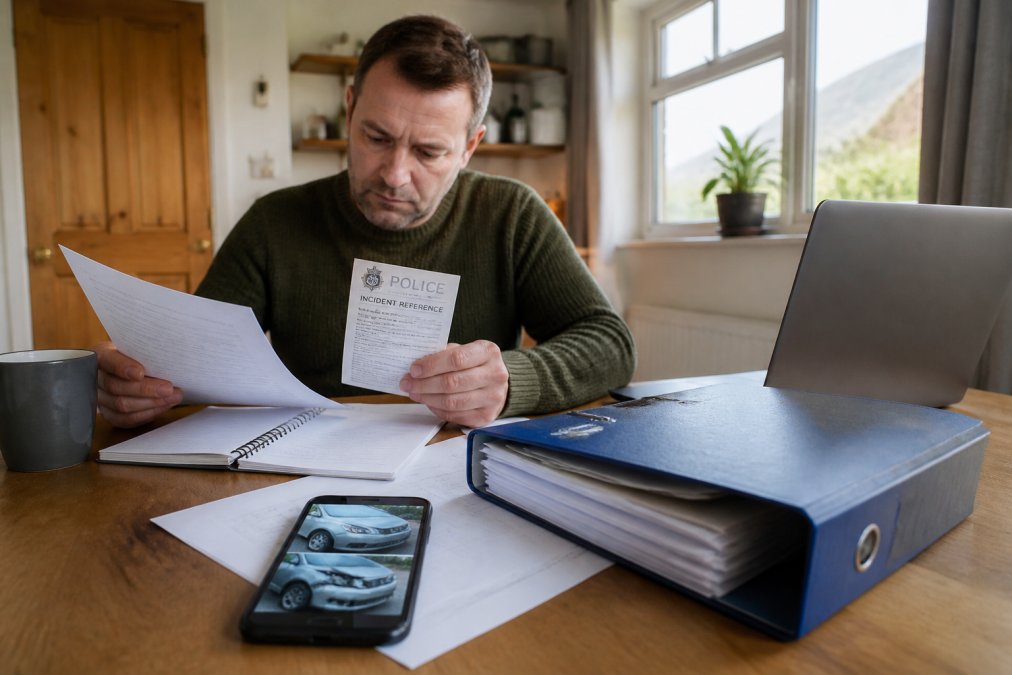 A person at a kitchen table in a Scottish home sorting paperwork, with a police incident reference note, photographs of vehicle damage on a phone, and a folder of documents beside an open laptop
The steps follow a clear order:
- Report the collision to Police Scotland and note the incident reference number
- Record the other driver's name, vehicle registration, and any witness details
- Photograph all vehicle damage and any visible injuries
- Keep receipts for repairs, travel, and medical costs
- Confirm the other driver had no insurance
- Submit your claim to the Motor Insurers' Bureau
- Respond quickly to any request for more evidence
Step-by-Step Documentation Checklist
Weak evidence is the most common reason a claim slows down. Build your file before you submit, not after. Treat this as a checklist and tick each item off as you go.
Identification and incident records
- Police Scotland incident reference number
- Date, time, and exact location of the collision
- Vehicle registration of the other car
- Make, model, and colour of the other vehicle
- Names and contact details of any witnesses
- A written timeline of what happened, in your own words
Liability and insurance evidence
- Any written confirmation that the other driver was uninsured
- Notes from any insurance verification check run by the police
- Correspondence with the other driver, if any
- Details of any admission of fault made at the scene
Injury and medical evidence
- Medical records and GP or hospital notes
- Records of any treatment, physiotherapy, or rehabilitation
- A note of symptoms and how they affect daily life and work
- Contact details of treating practitioners
Financial loss evidence
- Repair estimates and receipts
- Receipts for travel to appointments
- Payslips or accounts showing lost earnings
- Any other out-of-pocket expenses tied to the incident
A common mistake is waiting. Evidence fades, witnesses move, and memories blur. Gather everything in the first few weeks.
Watch Out
If you cannot show the other driver was uninsured, the Bureau may reject the claim outright. Confirm insurance status early rather than assuming it.
How the Bureau Weighs Your Evidence
A common pattern is that the Bureau does not treat every document as equal weight. A Police Scotland incident reference and a contemporaneous medical record carry more weight than a later written statement. Photographs taken at the scene carry more weight than photographs taken days later. Build the file so the strongest evidence sits at the front.
If the other driver turns out to have been insured after all, your claim goes to their insurer, not the Bureau. Getting this wrong wastes months, so confirm insurance status before you submit.
Hit and Run Compensation in Scotland: What You Can Recover
Hit and run compensation in Scotland can cover personal injury, and in some cases damage to your vehicle, when the driver cannot be traced.
The untraced scheme is narrower than most people expect. Personal injury sits at its heart. Property and vehicle damage is treated more strictly, and recovery is not automatic.
What you can typically pursue:
- Personal injury, including whiplash and more serious harm
- Loss of earnings where injury stops you working
- Medical and rehabilitation costs
- Out-of-pocket expenses tied to the incident
- In limited cases, vehicle damage
The evidence bar is higher here. With no driver to identify, you must show the incident happened as described and that the driver cannot be traced. A police report is close to essential.
Timelines matter too. The Motor Insurers' Bureau expects prompt reporting, and delay weakens a hit and run claim. If you were hurt and the driver fled, act quickly and keep every document.
Checking Whether a Driver Was Insured
You can check whether a vehicle is insured through the Motor Insurance Database, the record insurers use to confirm cover.
The database holds details of insured vehicles in the UK. It links a vehicle registration to an active policy. If a car does not appear, that is a strong signal it was uninsured at the time.
Here is the part most guides miss: the database is a starting point, not final proof. A vehicle can be missing for innocent reasons, such as a recent policy change. The Bureau weighs the database alongside police checks and insurer records. (Source: Road Traffic Act 1988)
For your claim, the practical move is this:
- Note the vehicle registration at the scene
- Ask the police to run an insurance verification check
- Keep any written confirmation of the result
- Flag any gaps to your solicitor early
If the driver was insured after all, your claim goes to their insurer, not the Bureau. Getting this wrong wastes months.
Get Started Today →
How Car Accident Solicitors in Glasgow Handle MIB Cases
Car accident solicitors in Glasgow handle Motor Insurers' Bureau cases by building the evidence file, proving liability, and dealing with the Bureau on your behalf.
These claims are more technical than a standard insurer claim. The Bureau applies strict rules on evidence and deadlines. A solicitor who knows the process keeps the case moving and avoids the mistakes that cause rejections.
At Scotland Claims Injury Lawyers, cases run on a No Win No Fee basis. Clients keep 100% of their compensation when they win. There is no cost if the case is lost. For anyone weighing up a claim, that removes the financial risk that stops people coming forward.
A solicitor will typically:
- Confirm which scheme applies to your case
- Gather police, medical, and repair evidence
- Prove the other driver was uninsured or untraceable
- Value your claim, including future losses
- Handle all contact with the Bureau
- Push back if an offer is too low
If you are searching for personal injury solicitors in Scotland, look for a firm that handles Bureau cases often. The rules are niche, and experience shows.
Pro Tip
Keep a single folder, digital or paper, for every document. When the Bureau asks for evidence, a fast, complete reply keeps your claim on track.
Timelines, Decisions and Appeals for Motor Insurance Bureau Claims
Motor Insurance Bureau claims take longer than standard claims, often several months, because the Bureau must verify that no insurer is liable. There is no fixed clock that fits every case, but a realistic stage-by-stage picture helps you plan.
What to Expect at Each Stage
Stage 1, Submission and initial review. Once your claim and evidence file reach the Bureau, expect an initial review. This is where the Bureau checks that the right scheme applies and that the basic evidence is present.
Stage 2, Requests for further evidence. The Bureau commonly asks for more evidence, sometimes more than once. A fast, complete reply keeps the claim on track. A slow reply is one of the most common causes of delay.
Stage 3, Liability decision. The Bureau decides whether the other driver was uninsured or untraceable, and whether liability is established. This is the pivot point of the claim.
Stage 4, Settlement offer. If the claim succeeds, the Bureau makes an offer. Review it carefully before accepting, because a low offer accepted early is hard to reopen.
A straightforward uninsured claim with clear evidence can move faster through these stages. An untraced claim with thin evidence can drag, because the burden of proof falls more heavily on you.
If Your Claim Is Rejected: The Appeals Process
If the Bureau rejects your claim, you are not always stuck. There is an appeals process, and it is worth using.
For untraced driver claims, disputes can go to an independent arbitrator. This is a formal route, and it rewards a well-organised file. For uninsured driver claims, the first step is usually to ask the Bureau to review its decision, backed by new or clearer evidence.
What strengthens an appeal:
- New evidence that was not available at the first decision
- Clearer proof that the other driver was uninsured or untraceable
- A corrected timeline that resolves any inconsistency the Bureau flagged
- A written explanation addressing the specific reason for rejection
What weakens an appeal:
- Re-sending the same evidence with no new argument
- Missing the deadline the Bureau sets for a review request
- Arguing points the Bureau did not actually rely on
The lesson is simple. Do not treat a rejection as the end. A well-argued appeal, backed by fresh evidence, can turn a case around.
Scotland's Compulsory Insurance Rules and Driver Duties
Compulsory insurance is a legal duty for anyone driving on Scotland's roads, and the rules come from UK-wide road traffic law.
Every driver must hold at least third-party cover (Vehicle insurance: Overview). That cover protects other people, their vehicles, and their property if you cause a collision. Driving without it is a criminal offence, and it is exactly the situation the Motor Insurers' Bureau was built to address.
Your duties as a driver:
- Hold valid insurance before you drive
- Keep your policy details up to date
- Stop and share details after a collision
- Report a collision to the police where required
- Never leave the scene of an incident
The statutory duty to insure sits with the driver, not the vehicle alone. Lending a car to an uninsured driver does not transfer the duty away.
When a driver breaks these rules, the victim should not pay the price. That principle is why the Bureau exists, and why claims under it are worth pursuing properly.
Common Mistakes That Weaken a Compensation Claim
The biggest one is delay. Late reporting to the police or the Bureau weakens everything that follows. Evidence disappears and questions get harder to answer.
Other mistakes that cost people money:
- Failing to report the incident to the police
- Losing the incident reference number
- Not photographing damage or injuries
- Guessing at the other driver's insurance status
- Missing deadlines set by the Bureau
- Accepting a low offer without advice
- Handling a complex claim alone
A second trap is mixing up the two schemes. Claiming under the wrong agreement wastes time and can lead to rejection. If you are unsure which route fits, get advice before you submit.
Key Takeaway
The strongest claims share three things: a police report, clear evidence, and fast action. Build all three early and the rest gets easier.
A Bureau claim is more technical than a standard one, and the rules trip up people who go it alone. Scotland Claims Injury Lawyers connects you with specialist injury lawyers who handle these cases on a No Win No Fee basis, so you keep 100% of your compensation when you win and pay nothing if the case is lost. The team offers risk-free, impartial advice. Get started with Scotland Claims Injury Lawyers and pursue the compensation you are owed.
motor insurance bureauuninsured driver claim scotlandcar accident solicitors glasgowhit and run compensation scotland