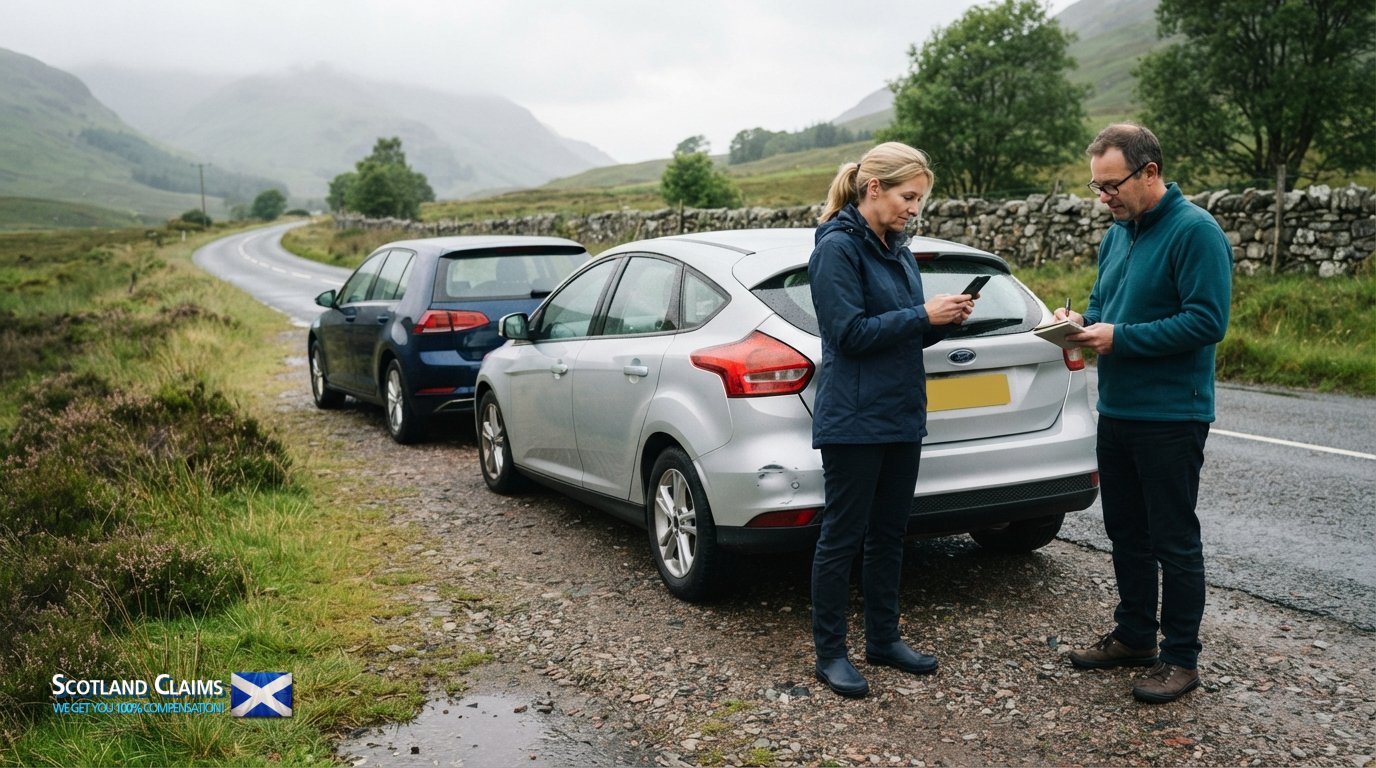
Did you know that nearly 3,500 people were reported as "slightly injured" on Scottish roads last year? Even a low-speed bump can leave you feeling shaken and confused about your next steps. Knowing exactly what to do after a minor car accident in Scotland is vital because the rules here differ significantly from those in England. You might worry about insurance premiums rising or fear that a solicitor will swallow a huge chunk of your settlement in success fees.
We agree that the legal process should be transparent and fair, not a source of further stress. This guide provides a definitive 2026 checklist to help you meet your statutory duties and secure the physical recovery you deserve. You'll learn how to navigate Scots law to ensure you retain 100% of your compensation with zero deductions. From reporting timelines to gathering digital evidence, here is everything you need to protect your claim and your pocket. We simplify the path to a resolution so you can focus on getting back on the road.
Key Takeaways
- Learn the immediate legal steps you must take at the scene to comply with the Road Traffic Act 1988 and avoid penalties.
- Follow our professional guide on what to do after a minor car accident in Scotland to ensure you meet critical 24-hour reporting deadlines.
- Understand how to gather high-quality evidence, including dashcam footage and witness details, to clearly establish liability for your claim.
- Recognise the importance of monitoring latent symptoms, as minor injuries like whiplash often take up to 48 hours to manifest fully.
- Discover how to secure 100% of your compensation by choosing a specialist model that recovers fees from the insurer instead of your payout.
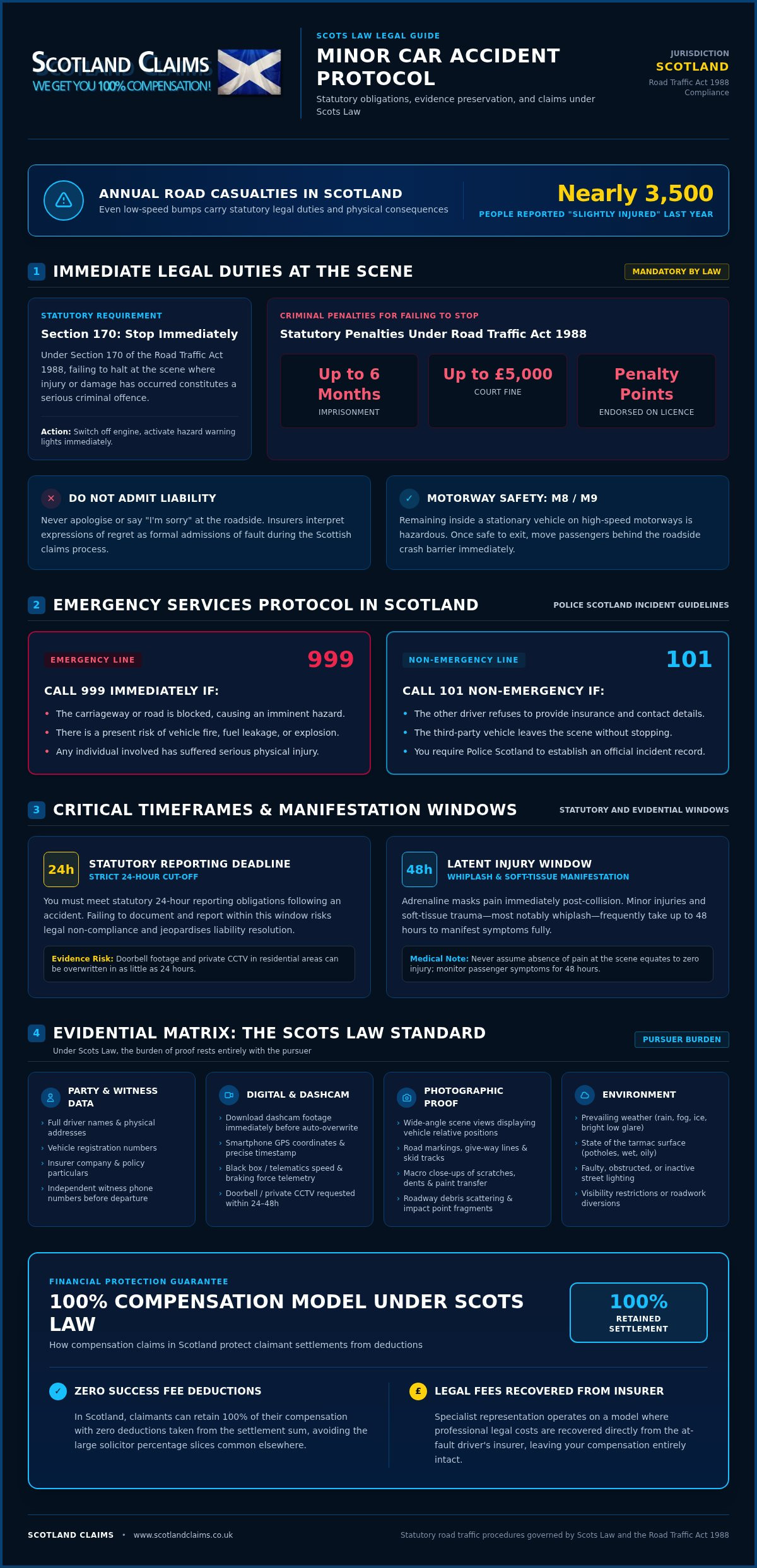
The moment the collision occurs, your first priority is to stop. It doesn't matter if the impact felt like a tiny nudge; you must bring your vehicle to a halt immediately. Under Section 170 of the Road Traffic Act 1988, failing to stop at the scene of an accident where damage or injury has occurred is a serious criminal offence. You could face up to six months' imprisonment, a £5,000 fine, and penalty points on your licence. Switch off your engine and activate your hazard lights to alert other Scottish road users. This is the first critical step in understanding what to do after a minor car accident scotland.
Check yourself and your passengers for injuries right away. Adrenaline is a powerful chemical that can mask pain, so don't assume everyone is fine just because they say they are. If you are on a busy motorway like the M8 or M9, move to a safe place behind a crash barrier as soon as it's safe to exit the vehicle. Staying inside a stationary car on a high-speed road is incredibly dangerous. Your safety is paramount, and securing your physical well-being comes before any paperwork or phone calls.
When to Call Emergency Services in Scotland
Knowing which number to dial is crucial for your legal and physical protection. Dial 999 if the road is blocked, there's a risk of fire, or someone is seriously injured. If the accident is a minor bump and details have been exchanged, you may not need the police at the scene. However, if the other driver refuses to provide their information or leaves the scene, call the 101 non-emergency number. Police Scotland acts as a protective expert in these situations. They'll secure the area and create an official record that can be vital when you later seek whiplash compensation.
Securing the Immediate Environment
Whilst you wait for assistance or prepare to exchange details, remain calm and collected. Do not admit liability at the roadside. Even a simple "I'm sorry" can be interpreted as an admission of fault by insurers during the claims process. Keep your conversation with the other driver polite but strictly factual. Focus on the exchange of names, addresses, and registration numbers. Ensure your vehicle isn't causing a secondary hazard. If it's safe and the car is moveable, get it to the hard shoulder or a lay-by to keep Scottish traffic flowing. These methodical steps are essential when considering what to do after a minor car accident scotland to protect your future claim.
Evidence Gathering for Minor Scottish Road Accidents
Once the immediate safety checks are complete, your focus must shift to data. In Scotland, the burden of proof rests with the pursuer, so the quality of your evidence dictates the strength of your claim. You must exchange names, addresses, and insurance details with everyone involved. This is a core part of GOV.UK guidance on vehicle accident obligations. Beyond the basics, look for independent witnesses. Passers-by or other drivers who stopped often provide the most objective accounts. Secure their phone numbers before they leave. Their testimony can be the difference between a disputed liability and a straightforward settlement.
Environmental factors are often overlooked in minor bumps. Note the weather, the state of the road surface, and whether any street lights were faulty. If the accident happened in a residential area, check for doorbell cameras or private CCTV. These recordings are often deleted within 24 to 48 hours, so act quickly to request a copy. Understanding what to do after a minor car accident scotland means acting like a specialist at the scene to protect your future interests. Every detail you record now prevents the other party's insurer from twisting the facts later.
The Digital Evidence Checklist
Modern technology provides undeniable proof. If you have a dashcam, download the footage immediately. Many devices overwrite older files, and you don't want to lose the visual record of the impact. Note the exact time and GPS location using your smartphone. If your vehicle uses telematics or a "black box" for insurance, contact your provider to secure that data. This information provides a precise map of speed and braking force. It is invaluable for our team when building your case for whiplash or other soft-tissue injuries.
Documenting the Damage
Visual evidence should be comprehensive. Start with wide-angle shots to show the entire scene. Include road markings and the position of the vehicles relative to each other. This context is vital for proving how the collision occurred. Then, move in for close-ups. Photograph every scratch, dent, and paint transfer, even if it looks insignificant. Don't ignore debris on the road. A broken light casing or a piece of trim can help reconstruct the impact. If you aren't sure how much your claim might be worth after gathering this evidence, use a Personal Injury Compensation Calculator to see the potential value of your 100% payout.
By being methodical at the scene, you ensure that no detail is lost. If you've been involved in a non-fault collision, Scotland Claims can help you use this evidence to secure the full settlement you deserve.
Legal Reporting Obligations Under Scots Law
Compliance with the law is your best shield against future complications. Once you are safe, you must address your legal duties. Failing to report an accident can lead to your insurance policy being invalidated or even criminal charges for leaving the scene. This is a vital part of GOV.UK guidance on accident reporting duties. Even if the damage seems trivial, the law requires action. When you are deciding what to do after a minor car accident scotland, your first legal priority is ensuring the authorities and your providers are informed.
Reporting to Police Scotland
Minor bumps with no injuries often do not require a police presence at the scene. However, if you could not exchange details with the other driver, you must report the accident in person at a police station as soon as possible. You have a strict 24-hour window to do this under the Road Traffic Act. You can use the 101 non-emergency number for initial guidance, but a station visit is often required to complete the report. Always secure a police incident number. If an officer asks, you must produce your driving documents within seven days using form HO/RT1. These steps prove you have acted responsibly and according to the law.
Notifying Your Insurance Company
You must notify your insurance provider about the accident, even if you don't plan to claim. This is a "notification for information" only. Provide a factual account of the event but avoid downplaying potential injuries. What feels like a minor jar today could be a significant whiplash injury tomorrow. Be wary if your insurer pushes you toward their "preferred" legal panels. Many of these firms deduct a success fee from your final settlement, often taking up to 20% of your money. We operate differently. At Scotland Claims Injury Lawyers, we recover our costs from the other side. This ensures you keep 100% of your award, providing the financial integrity you deserve after a stressful event.
Assessing "Minor" Injuries and Latent Symptoms
Your body's immediate reaction to a collision is to flood your system with adrenaline. This natural response often masks significant pain and discomfort. What feels like a minor bump at the roadside can result in serious soft-tissue damage that only becomes apparent once the shock wears off. This is why understanding what to do after a minor car accident scotland must involve a focus on your physical health as much as your vehicle. Your priority is to ensure that a "minor" incident doesn't lead to long-term physical or financial strain.
Symptoms of whiplash frequently take between 12 and 48 hours to manifest fully. You might leave the scene feeling fine, only to wake up the next morning with debilitating neck stiffness, lower back spasms, or persistent headaches. Do not ignore these signs. Seek medical attention from your GP or a local Minor Injuries Unit (MIU) as soon as possible. Professional documentation of these symptoms is the first step toward a full recovery and a successful claim. It establishes a clear link between the accident and your physical state.
Understanding Whiplash in Scotland
It is a common error to think whiplash is a trivial injury. In reality, it can severely impact your ability to work, socialise, and carry out daily tasks. It's important to know that Scottish law treats these injuries differently than the system in England and Wales. While English claimants face statutory fixed tariffs that cap compensation at low levels, Scottish victims retain the right to recover common-law damages. These awards are assessed under the Judicial College Guidelines, which often result in significantly higher settlements for neck and back injuries. For more details on identifying these issues, read our whiplash information.
The Importance of Medical Records
A medical report is the cornerstone of any successful personal injury claim in Scotland. If you choose to "power through" the pain without seeing a doctor, you weaken your legal position. Insurers will argue that your injuries were not serious because you didn't seek help. Be proactive. Keep a detailed diary of your symptoms, noting any pain, stiffness, or sleep disruption that develops in the days following the accident. This record provides a clear timeline for your solicitor whilst establishing the severity of your condition amongst other evidence.
Remember that you have a three-year time limit to initiate legal proceedings under the Prescription and Limitation (Scotland) Act 1973. This period, known as the triennium, starts from the date of the accident. Waiting too long can jeopardise your right to 100% compensation. Securing medical records early ensures that the link between the accident and your injury is indisputable. This methodical approach is a key part of what to do after a minor car accident scotland to protect your future interests and ensure you aren't left out of pocket.
Calculate your 100% compensation payout now
Securing 100% Compensation for Your Claim
Deciding what to do after a minor car accident scotland often leads to a crossroad: do you accept a quick offer from an insurer or seek professional help? Many drivers hesitate because they fear legal fees will consume their settlement. We operate on a model of total transparency and fairness. Unlike traditional firms that routinely deduct a 20% success fee, we recover our costs directly from the at-fault party's insurer. This ensures you receive 100% of your compensation. The financial difference is substantial. On a £5,000 minor injury award, you keep the full £5,000 with us, whereas a competitor might leave you with just £4,000. You should never be penalised for an accident that wasn't your fault.
Our framework is built on a true No Win, No Fee basis. This structure removes all financial risk from the claimant. If your case is unsuccessful, you don't owe us a penny. This level of protection allows you to pursue justice without worrying about upfront costs or hidden charges. Every solicitor in our network is authorised by the Law Society of Scotland, ensuring your case is handled with specialist expertise and high professional standards. We act as your protective advocate, standing against profit-heavy entities to prioritise your interests and deliver a complete result.
Why "Minor" Claims Benefit from Specialist Solicitors
Insurance companies often undervalue "minor" claims, hoping you will settle for a fraction of what you deserve. A specialist solicitor understands the true impact of soft-tissue injuries and ensures the settlement reflects your actual suffering and loss. You can use our compensation calculator to see what your injury could be worth before you even speak to a team member. We handle the complex legal nuances and "lawyer fee anxiety" on your behalf. This allows you to focus entirely on your physical recovery whilst we secure the financial integrity of your claim.
How to Start Your Risk-Free Claim Today
Beginning your journey to a 100% settlement is straightforward and low-friction. When you are considering what to do after a minor car accident scotland, a single phone call is the most effective next step. Our 24-hour freephone helpline is available for an immediate, no-obligation assessment of your situation. We guide you through a methodical and seamless process, from the initial evidence review to the final payout. There is no unnecessary fluff and no delay. We move quickly to ensure your rights are protected and your compensation is delivered in full. You have already dealt with the stress of the collision; let us handle the weight of the legal process.
Start your 100% compensation claim with Scotland Claims Injury Lawyers today
Take Control of Your Recovery Today
A minor collision shouldn't lead to a major financial loss. You now have the checklist needed to secure the scene, gather digital evidence, and meet your statutory reporting duties. Most importantly, you understand that "minor" injuries deserve full representation without the burden of lawyer fee anxiety. Knowing exactly what to do after a minor car accident scotland ensures you aren't left out of pocket by profit-heavy insurers.
We stand as your protective advocate to ensure you retain every penny of your settlement. Our solicitors are regulated by the Law Society of Scotland and operate with zero success fees. We recover our costs from the other side, meaning you keep 100% of your award. Whether you are dealing with whiplash or vehicle damage, our 24-hour freephone support on 0800 611 8132 is ready to help.
Get a Free Assessment and Keep 100% of Your Compensation
The path to a full resolution is clear and low-risk. Let us handle the legal complexities whilst you focus on getting back to your normal routine with confidence.
Frequently Asked Questions
Do I have to report a minor car accident to the police in Scotland?
Yes, you must report the accident to Police Scotland within 24 hours if you were unable to exchange details at the scene. This is a legal requirement under the Road Traffic Act. Even if the damage seems trivial, failing to report can lead to penalty points or a fine. Keeping a police incident number is essential for your records. It provides an official timestamp of the event, which helps protect your legal position later.
Can I claim for a minor car accident if it was partly my fault?
You can still make a claim even if you were partially responsible for the collision. In Scots law, this is known as contributory negligence. Your compensation award is simply reduced by the percentage of fault attributed to you. For example, if you were 25% at fault, you would receive 75% of the total settlement. We can assess the specifics of your accident to determine how liability might be split between the parties involved.
How long do I have to make a car accident claim in Scotland?
You generally have three years from the date of the accident to initiate legal proceedings in Scotland. This time limit is known as the triennium. If the injured person was a child, the three-year period doesn't start until their 16th birthday. It's best to act quickly while evidence is fresh and witnesses are easy to contact. Waiting too long can make it harder to secure the full 100% compensation you deserve.
Will my insurance go up if I report a minor accident that wasn’t my fault?
Reporting an accident might affect your premiums, even if you weren't at fault. Insurers often view any involvement in a collision as a change in your risk profile. However, you are contractually obligated to inform your provider about any incident. Failing to do so could invalidate your policy entirely. We focus on recovering your full losses from the at-fault driver's insurer to ensure you aren't left out of pocket by the situation.
What is the 100% compensation model and how does it work?
Our 100% compensation model ensures you keep every penny of your award. Most firms deduct a success fee of up to 20% from your settlement. We operate differently by recovering our legal costs directly from the at-fault party's insurance company. This means on a £5,000 payout, you receive the full £5,000. It is a transparent approach designed to remove lawyer fee anxiety and prioritise your financial recovery after an accident.
Do I need to see a doctor if I only have a slight neck pain after a bump?
You should always seek medical advice for neck pain, as minor symptoms often mask significant whiplash injuries. A GP or Minor Injuries Unit visit provides an official medical record of your condition. This documentation is the cornerstone of any successful personal injury claim. Without it, the other side's insurer may argue your injuries weren't serious. Seeing a professional ensures you get the right treatment and protects your right to claim.
What details should I exchange with the other driver after a minor accident?
You must exchange your name, address, and vehicle registration number with the other driver. It is also vital to get their insurance provider's name and policy details if possible. This is a core part of what to do after a minor car accident scotland to ensure a smooth claims process. Taking a photo of their insurance certificate or driving licence can prevent errors. These details allow us to identify the correct insurer and start your claim immediately.
Can I still claim if the other driver refuses to give their insurance details?
You can still pursue a claim if the other driver refuses to cooperate or leaves the scene. In these cases, you must report the incident to Police Scotland immediately to obtain a crime reference number. We can often trace the vehicle's insurance details using the registration plate. If the driver remains untraced or is uninsured, we can submit a claim through the Motor Insurers' Bureau (MIB). You are never left without a path to justice.