
What if the key to your injury claim isn’t a single medical note, but a clear timeline of your symptoms, treatment and recovery? If you’re unsure which records matter or concerned about who might see them, you’re not alone. Medical records for personal injury claim evidence can help show how an accident affected you, but that doesn’t mean every detail in your medical history is automatically relevant.
Existing GP, hospital and treatment records are different from a medical report prepared for a claim. Understanding that difference can make the process clearer and help you ask informed questions about sensitive information. In Scotland, a solicitor will generally need your signed written authority to obtain medical records on your behalf. The records may then be reviewed to assess your injuries and support the claim.
This guide explains which records may be relevant, how they can be requested and used, and what practical details you can gather or check yourself. You’ll also learn what a claim-related medical assessment involves and what to ask your solicitor about handling your information. A clear, proportionate approach can help medical evidence support your claim without leaving you in the dark.
Key Takeaways
- Learn how to judge which GP, hospital and treatment records may be relevant to your accident and injuries.
- Understand how existing healthcare records differ from a medical report prepared for a claim.
- Know what to discuss with your solicitor when gathering medical records for personal injury claim evidence, including how sensitive information is handled.
- Use a simple checklist to organise appointment details, treatment and changes in your symptoms over time.
- See how legal guidance can help address missing records or uncertainty about the evidence your Scottish injury claim needs.
What medical records mean for a personal injury claim in Scotland
Medical records are notes and documents created during your healthcare. Medical evidence for a claim is information used to assess your injuries, their effects and, where relevant, how they relate to the accident. The distinction matters. Your records may describe care as it happened, while a solicitor or medical professional considers which details help address the issues in your claim. A general overview of a medical record explains its role in documenting a person’s healthcare.
A record’s relevance depends on the accident, the injury you say you suffered and the questions that need to be considered. For example, a record of a shoulder injury may help describe your symptoms and treatment after a workplace accident. It won’t automatically establish who was responsible. Medical evidence is one part of the wider picture, not a complete answer on its own.
An injury claim is also different from PIP. A personal injury claim seeks compensation from a party alleged to be responsible for an accident and resulting injury. PIP is a disability benefit assessed under benefit rules. It focuses on how a health condition affects daily living and mobility, rather than who caused it. The purpose, process and decision-makers are different. Medical information may be relevant to both, but evidence prepared for one process doesn’t automatically determine the other.
Which healthcare records might be relevant?
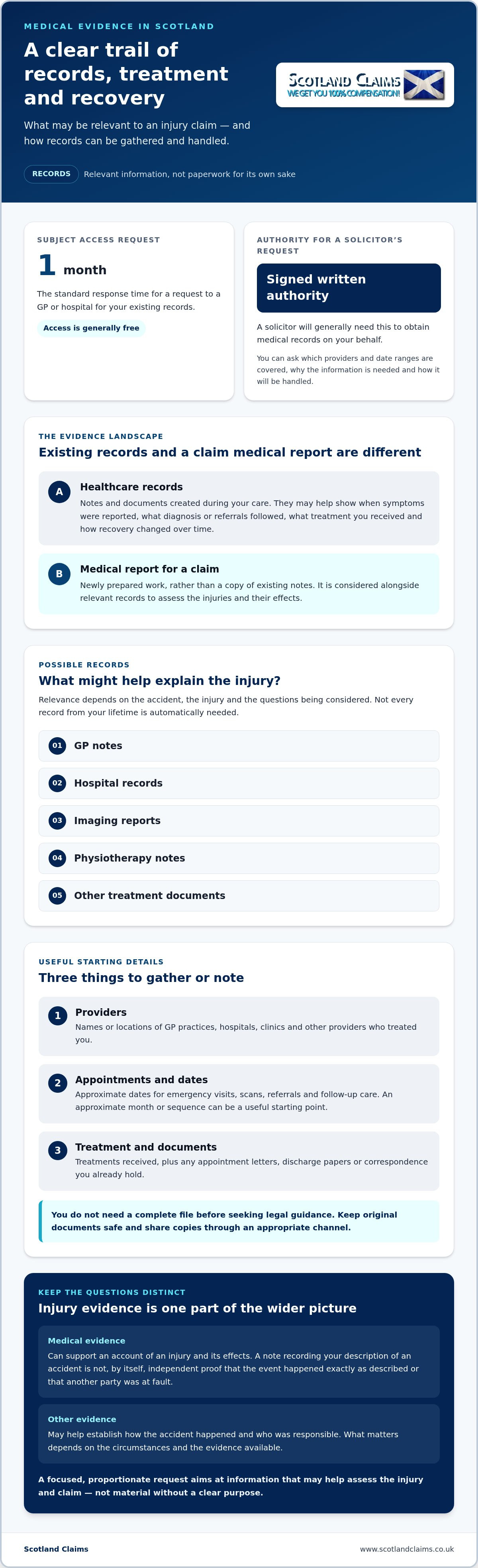
Depending on your circumstances, useful records might include GP notes, hospital records, imaging reports, physiotherapy notes or other treatment documents. They may help show when you first reported symptoms, what diagnosis or referrals followed, what treatment you received and how your recovery changed over time.
That doesn’t mean every record from your lifetime is needed. The focus should be on information that helps explain the injury or another issue in the claim. A solicitor can discuss potentially relevant providers and records with you, rather than treating a large volume of paperwork as automatically useful. If you’re unsure what may matter, personal injury lawyers in Scotland can assess the evidence in the context of an accident claim.
Do records prove how an accident happened?
Medical records can document what you told a healthcare professional about your symptoms and the care provided. They can support an account of an injury, but a note recording your description of an accident isn’t, by itself, independent proof that the event happened exactly as described or that another party was at fault.
Keep the two questions separate: medical evidence concerns the injury and its effects, while other evidence may help establish how the accident happened and who was responsible. What matters will depend on the circumstances and the evidence available. A case-specific assessment can help show how each piece fits together.
How medical records are gathered for a Scottish injury claim
There isn’t one identical records process for every claim. The records that may help depend on the injury, the treatment you received and the issues to be assessed. A solicitor can work with you to identify relevant healthcare providers and likely date ranges, then explain the proposed request before it is made. The aim is useful evidence, not paperwork for its own sake.
Record requests should be relevant and proportionate: they should focus on information that may help assess the injury and claim, rather than seeking material without a clear purpose. This is a practical principle, not a guarantee that every record within a date range will be relevant or that no other information will appear in the material received.
What information can help identify the right records?
You don’t need a complete file before getting legal guidance. Start with what you remember and already have. A short list can help your solicitor work out where to direct enquiries and what period may matter:
- Names or locations of GP practices, hospitals, clinics and other providers who treated you.
- Approximate appointment dates, including emergency visits, scans, referrals and follow-up care.
- Treatments received and any appointment letters, discharge papers or correspondence you already hold.
Dates don’t need to be exact at the outset. An approximate month or sequence of events can provide a useful starting point. Keep original documents safe and share copies through an appropriate channel. Don’t delay discussing your accident claim just because you’re still trying to locate old paperwork.
How consent and privacy fit into the process
Accessing or sharing health information involves formal procedures and appropriate authority. In a claim, a solicitor may need your signed written authority to request relevant records. Ask which providers and date ranges a request covers, why the information is needed and how it will be handled. You can raise privacy concerns before agreeing to a request.
You can also request your own existing records from a GP or hospital through a Subject Access Request under UK data-protection rules. Access is generally free, and the standard response time is one month. This is separate from a medical report, which is newly prepared work rather than a copy of existing notes. The process may vary with the request and circumstances.
This article concerns accident injury claims, not claims about the care itself. The Scottish Government’s research on medical negligence claims in Scotland relates to a separate area and does not set the process for an accident claim.
For an accident claim, specialist legal guidance can help you decide what records to pursue and how they fit with the rest of the evidence. If you’re unsure where to begin, you can discuss your injury claim with a solicitor. A conversation can clarify practical next steps before you assemble a complete file. Find out more about support with a Scottish injury claim.
Medical records versus a medical report: what is the difference?
Medical records and a claim-related medical report both concern your health, but they serve different purposes. Records are created during your healthcare. A report is prepared to address questions relevant to a claim. Clinical records document care as it happens; a claim-related medical report assesses medical information for the purposes of an injury claim.
Understanding the distinction helps explain why an assessment doesn’t simply replace your treatment history. Records may show what you reported and what care followed. A report may consider that history alongside an assessment and the questions that need answering. Which material is useful depends on the circumstances of the claim.
| Feature |
Existing medical records |
Claim-related medical report |
| Who creates it? |
Healthcare professionals and services involved in your care. |
A medical professional preparing an opinion for a claim-related purpose. |
| Purpose |
To document healthcare, treatment and follow-up. |
To address relevant medical questions about an injury in the context of a claim. |
| Typical contents |
Appointment notes, reported symptoms, examination details, diagnoses, referrals or treatment. |
An assessment and relevant medical opinion, informed by the information considered. |
What existing records can show
Notes made during an appointment may record the symptoms you described, a healthcare professional’s examination and the care provided. A sequence of entries can help show how your condition was discussed and treated over time. The detail and wording can vary between providers and appointments. A brief note, or no entry about a particular symptom, doesn’t by itself prove that the symptom wasn’t present.
What a claim-related medical report may add
A report may bring relevant medical information together and offer an opinion about the injury for the purpose of a claim. Its scope depends on the circumstances and the questions being considered. It may not address every aspect of your health or provide a definitive answer on every issue. Any diagnosis, view on recovery or other opinion depends on the evidence available and the professional’s assessment.
Think of the two sources as complementary, not interchangeable. A report may interpret information, but it doesn’t rewrite the original record or replace relevant treatment history. If your notes mention one set of symptoms at an early appointment and later entries describe changes, that chronology may matter. The report’s value depends partly on the information considered and how well it fits the issues in the claim.
For this reason, medical records for personal injury claim evidence should be understood in context. Give an accurate account of your treatment and point out any apparent gaps or details you don’t recognise. Your solicitor can consider what the existing records show and whether a claim-related report may be relevant. Neither document alone guarantees a particular conclusion or compensation outcome.
How to prepare, check and organise your medical evidence
A clear, accurate record of your own experience can make discussions about your injury more focused. You don’t need to build a complete medical file or collect sensitive information with no obvious connection to the accident. Start with practical details you know, keep relevant documents together and let your solicitor help assess what may matter. This gives them useful context without asking you to decide the legal significance of each record yourself.
For medical records for personal injury claim evidence, accuracy matters more than volume. Note what happened as you remember it, distinguish dates you know from approximate dates, and avoid guessing when you’re unsure. Your notes are a prompt for discussion, not a replacement for clinical records or a medical report.
A simple evidence-organising checklist
Choose one secure place, such as a private folder, for relevant documents and notes. A simple chronology can help you spot what to discuss with your solicitor. You could organise it around:
- Appointment dates, provider names and the type of treatment received.
- Symptoms you experienced, including when they began and how they changed.
- Letters, appointment details and treatment information you already hold.
- Questions about missing documents, unclear entries or the next steps in your claim.
Keep copies rather than sending original documents. Avoid sharing medical details through unsecured channels. If you’re unsure how to send something safely, ask your solicitor which method to use. Gather information that may relate to your injury or claim. There’s no need to collect unrelated private material simply because it exists.
If a record seems incomplete or inaccurate
Make a separate note of the specific entry and your concern. For example, you might record that a consultation date appears wrong, or that a symptom you recall discussing isn’t mentioned. Keep your explanation factual and identify what you remember, rather than rewriting the clinical note or presenting an assumption as certain.
If you believe a record contains an error, contact the treating provider to ask about its process for raising or correcting concerns. Don’t edit the original document yourself. Tell your solicitor about any relevant gap or disputed detail so it can be considered alongside the surrounding records and your account. An omission on its own may not settle what happened; context matters.
Before sharing documents, check that you’re sending the intended files and that they relate to the claim. If you keep a symptom diary, date each entry and describe practical changes plainly, such as difficulty carrying out a usual task or a change in treatment. Don’t exaggerate or try to make notes fit a particular outcome. A straightforward account gives your solicitor a sounder basis for understanding how the evidence fits together.
If you’re unsure what to organise or how a record relates to your accident, you can discuss the evidence and your injury claim with a specialist solicitor.
Getting help with medical records for your Scottish injury claim
Uncertainty about which records matter, a missing appointment note or concern about sharing sensitive information can make an injury claim feel harder to manage. Specialist legal guidance can help you understand what evidence may be relevant to your circumstances and what questions to raise. You don’t need to resolve every gap or gather a complete medical file before asking for advice.
Scotland Claims Injury Lawyers represents people in Scotland making accident injury claims, including claims after road traffic accidents, workplace injuries, and slips or trips. The firm helps you understand the claim process and how evidence, including medical information, may fit into it. This is about injuries arising from accidents, not claims about medical treatment or medical negligence.
What a solicitor can help you understand
A solicitor can discuss your account of the accident, the injury you’re claiming for and the healthcare you’ve received. Together, you can identify which providers or records may be relevant, consider whether something appears to be missing, and talk through concerns about how sensitive information may be handled. The aim is to assess the evidence in context, not to assume that every document is necessary or that any single record decides the claim.
Local knowledge can also help you understand how to progress an accident claim under the Scottish legal system. Scottish personal injury solicitors can discuss your circumstances and explain the next steps clearly. You can ask about the purpose of a records request and how medical evidence relates to the issues in your claim.
Taking the next step without fee uncertainty
Scotland Claims Injury Lawyers offers a no-obligation claim assessment and a 24-hour freephone helpline. An initial discussion can help you explain what happened and ask how your records might fit your accident injury claim. You don’t need to know which documents to request before making an enquiry. Be ready to share the basic details you do know, such as the type of accident, the injury and where you received treatment.
The firm’s no-win-no-fee model has no success fee. Its 100% compensation model means legal costs are recovered from the at-fault party’s insurer rather than deducted from your settlement. Ask for the agreement and costs to be explained so you understand how the arrangement applies to your claim. This funding model does not guarantee that a claim will succeed or produce a particular compensation outcome.
If uncertainty about your records is holding you back, make a no-obligation enquiry. The team can discuss your accident claim and help you understand what to do next.
Start a claim enquiry
Take the next step with confidence
You don’t need to have every detail resolved before asking for guidance. If you’re unsure how medical records for personal injury claim evidence may fit your circumstances, a conversation can help you identify the questions that matter and decide what to do next.
Scotland Claims Injury Lawyers is authorised and regulated by the Law Society of Scotland. It offers no-obligation claim assessments and a 24-hour freephone helpline. Under its stated model, clients keep their full settlement and legal costs are recovered from the at-fault party’s insurer. No claim outcome is guaranteed, but clear information can help you make an informed decision.
Start with the information you have. A clear next step can make the process feel more manageable, and you don’t have to work out the evidence alone.
Frequently Asked Questions
Can I request my own medical records for a personal injury claim?
Yes. You can ask your GP practice or hospital for copies of your records by making a Subject Access Request (SAR). Access is generally free, and the usual response time is one month. This gives you existing records, not a new medical report or opinion for a claim. You don’t need to obtain everything before seeking advice; a solicitor can help you decide what may be useful.
Which medical records are used in a personal injury claim?
There’s no fixed set for every claim. Relevant material may depend on the injury and the questions being assessed. For example, if an accident worsened an existing back problem, records about that condition before and after the accident may help explain the change. Other records might relate to emergency treatment, scans or rehabilitation. The focus is useful context, not collecting every health document you have.
Do medical records prove that an accident caused my injury?
Not by themselves. A record can show that you reported pain or received treatment, and when that happened, but it may not independently establish how the accident occurred or who was responsible. A note made soon after an incident can help with the timeline, while other evidence may be needed to explain the circumstances. How the evidence fits together depends on the facts of your claim.
What is the difference between medical records and a medical report?
Medical records are created as part of your care, such as notes from appointments or hospital treatment. A medical report is prepared to address questions relevant to a claim and may include a medical professional’s opinion. A report can consider existing records, but it serves a different purpose from the original notes. Whether a report is needed, and what it should cover, depends on the individual claim.
Can a pre-existing condition affect a personal injury claim?
It can be relevant, but having a condition before an accident doesn’t automatically rule out a claim. For instance, the issue may be whether an accident caused a new injury or made existing symptoms worse. Be open about your health history and any earlier treatment. The evidence may need to distinguish your condition before the accident from what changed afterwards, and that assessment depends on the medical information and circumstances.
What should I do if my medical records contain a mistake?
Note the specific entry, including its date and what you believe is inaccurate. Contact the healthcare provider and ask how to raise a correction request. Explain the factual concern clearly, such as a wrong appointment date, and keep a copy of your correspondence. Don’t amend the record yourself. If the point relates to your injury claim, tell your solicitor so they can consider it alongside the other evidence.
Will the other party see all of my medical records?
Not necessarily, but don’t assume that information shared for a claim will remain private from the other side. Relevant medical evidence may be disclosed to the opposing party or their representatives as the claim progresses. The scope depends on the circumstances and applicable procedures. Ask your solicitor what information is being requested, why it is relevant and how it may be used. Raise concerns about sensitive or unrelated details before records are shared.