Keep 100%: Scotland Claims Lawyers for Car Accidents

If you have been hurt in a car accident that was not your fault, the right move is to contact a specialist personal injury solicitor rather than trying to negotiate with an insurer yourself. Scotland Claims Injury Lawyers offers a free claim assessment and a compensation calculator with no upfront cost, and you keep 100% of any award if the claim succeeds.
TL;DR:
- For complex injuries like fractures or ongoing pain, instructing a specialist solicitor significantly improves liability proof and claim valuation compared to managing it alone.
- Evidence preservation, including police reports, witness details, dashcam footage, and medical records, is crucial and must be gathered promptly within a strict three-year Scottish deadline.
- A solicitor’s expertise in assessing long-term loss, including future medical costs and reduced earning capacity, can increase the compensation amount beyond initial estimates from online calculators.
- Scotland Claims Injury Lawyers offers a free, no-obligation case assessment with a compensation calculator and operates on a no win, no fee basis, with no success fee deducted from your award.
- The claim process varies from a few months for minor injuries to over a year for serious or disputed cases, emphasizing the importance of quick action to preserve evidence and meet deadlines.
Table of Contents
Not every road accident needs a solicitor from day one. If your injury is genuinely minor, such as a short bout of whiplash with no lasting symptoms, the Official Injury Claim portal exists as a free government route for claimants to pursue compensation without legal representation. It works reasonably well for straightforward, low-value whiplash cases where liability is not disputed.
Anything more complicated, and it stops being straightforward fast. Fractures, ongoing pain, time off work, a dispute over who caused the crash, or injuries that might affect you for months rather than weeks all point towards instructing a specialist car accident injury lawyer instead. Insurers negotiate claims for a living. You do not, and going it alone against a trained claims handler rarely ends well for the claimant.
This is where Scotland Claims Injury Lawyers’ offer becomes relevant. The core proposition is simple: a free assessment of your case, a compensation calculator to give you an early indicative figure, and a no win, no fee arrangement where you retain 100% of your compensation. That last point matters more than it might sound. Scotland Claims takes none of it.
Before you pick up the phone, gather what you can. It speeds up the first conversation and helps the solicitor gauge the strength of your case immediately.
- Photographs of the vehicles, road position, and any visible injuries
- Names and contact details of witnesses at the scene
- A copy of the police reference number, if officers attended
- Any medical notes, GP letters, or hospital discharge paperwork
- Details of the other driver’s insurer, if known
Pro Tip: Even if you feel fine the day after the crash, get checked by a GP anyway. Whiplash and soft tissue injuries often take 24 to 72 hours to fully surface, and a documented medical visit close to the accident date strengthens your claim considerably.
What does a specialist solicitor actually do for you?
A specialist car accident solicitor earns their place by doing three things you almost certainly cannot do as well yourself: proving liability, negotiating with insurers, and valuing your claim properly.
Liability sounds simple until the other driver’s insurer disputes it, which happens more often than people expect. A specialist gathers dashcam footage, CCTV, witness statements, and vehicle damage reports to build a case that holds up. Given how many road injuries occur across Great Britain each year according to official reported road casualty statistics, insurers see disputed liability claims constantly and have well-rehearsed tactics for minimising payouts.
The second job is quantifying your loss properly, not just for today but for months or years ahead. A solicitor experienced in road traffic claims accounts for:
- Ongoing physiotherapy or rehabilitation costs
- Reduced earning capacity if your injury affects your job long-term
- Future medical treatment, including specialist consultations
- Care and assistance needed at home during recovery
Citizens Advice points out that getting a specialist solicitor involved early also helps preserve evidence and can speed up access to rehabilitation, which affects both your recovery and the eventual value of your claim.
When you are checking credentials, look for solicitors accredited under the Law Society’s personal injury accreditation scheme, or membership of the Association of Personal Injury Lawyers (APIL) or the Motor Accident Solicitors Society (MASS). These bodies vet solicitors for genuine expertise in road traffic and personal injury claims, so accreditation is a reasonable proxy for competence when you are choosing between firms.
How do you choose the right car accident lawyer?
Choosing a solicitor under pressure, often while still recovering from an injury, is not easy. A short structured checklist during your first call or enquiry cuts through most of the guesswork.
- Ask about their road traffic claims track record. How many similar cases have they handled? Do they specialise in personal injury, or is it one service among many?
- Get the fee structure in writing before you sign anything. Ask exactly how any success fee is calculated and deducted, and whether that percentage comes off the final compensation figure or is charged separately. The Law Society itself flags that no win, no fee terms vary between firms, so this question is worth asking directly rather than assuming.
- Ask how they handle medical evidence. A good solicitor arranges an independent medical assessment early, not months into the process, because this shapes both treatment recommendations and the final valuation.
- Check accreditation. Law Society personal injury accreditation, APIL, or MASS membership are the three markers worth checking before instructing anyone.
- Ask what happens if the case doesn’t settle. Can they take it to court if the insurer refuses a fair offer? Solicitors handling claims under Scottish guidance from Mygov can escalate to court where necessary, and you want confirmation your solicitor will actually do this rather than pressuring you into a low settlement.
Red flags are usually easy to spot once you know what to look for. A pushy sales approach that rushes you into signing before you have asked questions is one. Any solicitor unwilling to explain their process clearly in plain language during the first conversation is probably not the right fit.
Pro Tip: Ask directly: “If I win, what percentage of my compensation do you keep?” A solicitor with nothing to hide will answer in one sentence. Hesitation or vague deflection is usually a sign to look elsewhere.
Every claim follows a broadly similar path, though the exact timeline depends heavily on how quickly liability is agreed and how severe the injuries are.
- Initial assessment. You describe what happened, when, and how you were injured. A specialist solicitor at Scotland Claims Injury Lawyers reviews the details free of charge and tells you honestly whether you have a viable claim. This stage typically happens within days of first contact.
- Evidence gathering. Your solicitor requests the police report if one exists, contacts witnesses, and secures CCTV or dashcam footage before it gets deleted or overwritten (many systems only retain footage for 30 days). They also request your medical records from your GP or hospital.
- Medical assessment. You are usually referred to an independent medical expert who examines your injuries and produces a report. This report becomes central to valuing your claim, since it sets out prognosis, expected recovery time, and any long-term impact.
- Notifying the other party. Your solicitor sends formal notification to the at-fault driver’s insurer, or, if the driver was uninsured or unidentified, pursues compensation through the Motor Insurers’ Bureau instead.
- Liability negotiation. The insurer either accepts liability, disputes it, or offers a partial admission (sometimes called contributory negligence, where they argue you share some blame). Straightforward cases with clear liability move faster here; disputed cases take longer and may need additional evidence.
- Rehabilitation and interim payments. For more serious injuries, your solicitor can often arrange interim payments before the claim settles, helping cover lost income or treatment costs while the case continues.
- Settlement negotiation. Once your medical prognosis is clear, your solicitor uses the medical report, financial losses, and case precedent to negotiate a fair settlement figure with the insurer. Most claims settle at this stage without ever reaching a courtroom.
- Court proceedings, if necessary. If the insurer refuses to offer a reasonable settlement, your solicitor can raise court proceedings. This is relatively rare in practice, since insurers generally prefer to settle rather than risk a court-awarded figure plus legal costs.
Timelines vary enormously depending on complexity. A straightforward whiplash claim with accepted liability might settle within a few months. A serious injury claim involving long-term care needs, disputed liability, or ongoing medical treatment can take well over a year, sometimes longer, because settling too early risks undervaluing future losses. A detailed breakdown of typical claim durations is worth reading if you want a fuller picture of what affects the timeline in your specific case. For a wider view of how the process typically unfolds from the first call to final payment, this claim timeline resource covers the general stages in more depth.
How does no win, no fee actually work?
Most solicitor firms and claims brands in Scotland operate on a conditional fee agreement, commonly known as no win, no fee. In practice, this means you pay nothing upfront and your solicitor only gets paid if the claim succeeds.
Scotland Claims Injury Lawyers works differently. There is no success fee charged against your compensation at all. Costs are instead recovered from the losing party’s insurer as part of the settlement, which is standard practice across the industry. but Scotland Claims does not additionally deduct a percentage from your own award on top of that.
Most solicitor firms and claims brands in Scotland deduct a success fee from a portion of your compensation. Scotland Claims Injury Lawyers does not deduct a success fee, so successful claimants keep all of what they are awarded.
Legal aid is not generally available for personal injury claims of this kind in any case, so a genuine no success-fee, no win no fee arrangement is usually the most cost-effective route available to claimants. The details of how this funding model works, including what happens if a claim is unsuccessful, are set out clearly on the no win, no fee page.
A few practical points worth knowing:
- You pay nothing if your claim does not succeed
- No upfront fees or hidden charges apply at any stage
- Costs are recovered from the at-fault party’s insurer, not from your award
- Ask any solicitor directly how their fee is calculated before signing, since the Law Society notes these arrangements vary between firms
Why acting quickly protects your claim
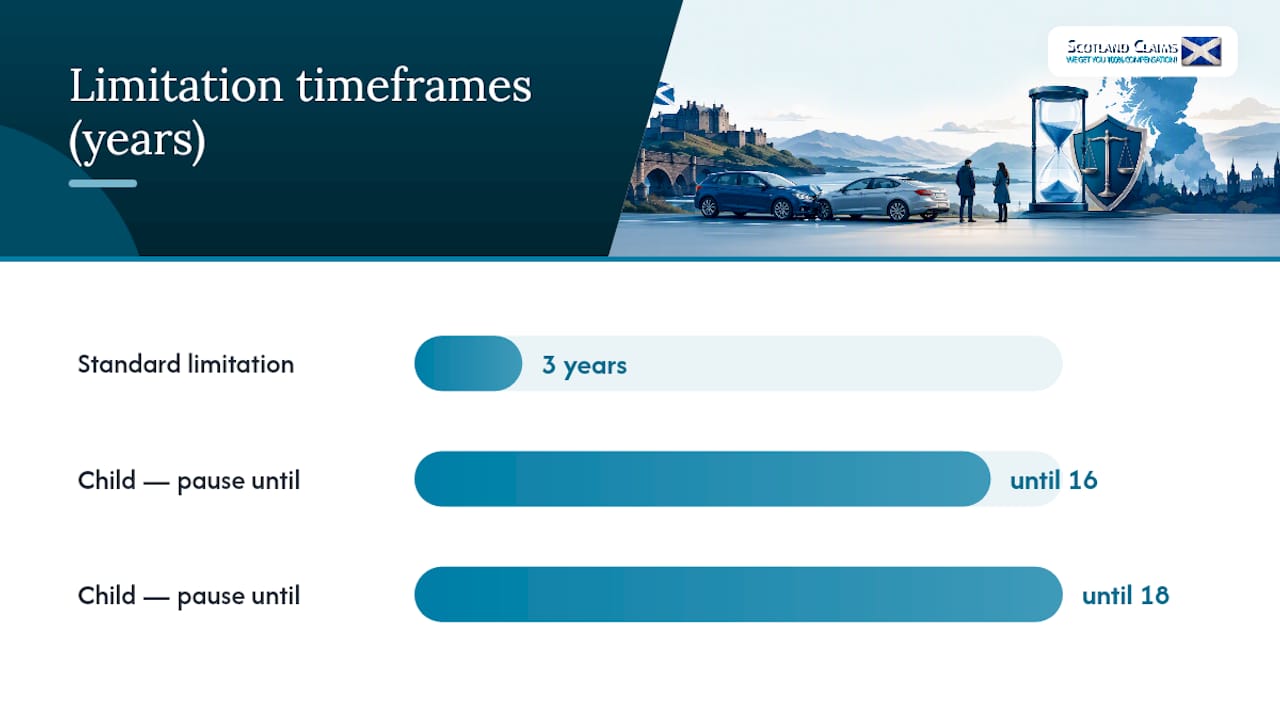
Personal injury claims in Scotland are generally subject to a three-year limitation period from the date of the accident, or from the date you became aware your injury was linked to it. There are exceptions. Claims involving children typically have the clock paused until the child turns 16 or 18, depending on the specific circumstances, and cases involving delayed diagnosis can sometimes extend the starting point. Citizens Advice recommends contacting a specialist solicitor promptly precisely because these time limits are strict and exceptions are not automatic.
Three years sounds like plenty of time until you consider how quickly evidence disappears. Dashcam footage gets overwritten. Witnesses move, forget details, or become harder to trace. Vehicle repair records get archived or lost. The sooner a solicitor is instructed, the more evidence they can actually preserve.
Practical steps worth taking in the first days after a crash:
- Photograph everything: vehicle damage, road markings, weather conditions, and visible injuries
- Get contact details from any witnesses before they leave the scene
- Request your GP or hospital medical notes early and keep copies
- Check whether your vehicle’s dashcam footage has been backed up before it’s overwritten
- Keep receipts for any accident-related costs, including taxis, prescriptions, or vehicle repairs
For a fuller explanation of why speed matters so much and what specifically can go wrong if you delay, Scotland Claims Injury Lawyers has published detailed guidance on why acting quickly after an accident matters and a separate breakdown of the statutory time limits that apply to personal injury claims in Scotland.
What does compensation actually cover?
Compensation in a road traffic claim is rarely a single figure plucked from a table. It is built from several distinct heads of claim, each valued separately before being added together.
- General damages for pain, suffering, and loss of amenity, covering the physical and psychological impact of the injury itself
- Loss of earnings, both what you have already lost and, in serious cases, future earning capacity
- Care and assistance costs, whether provided by family members or paid carers during recovery
- Medical and rehabilitation costs, including physiotherapy, private treatment, and any specialist equipment needed
- Travel expenses for medical appointments and any adapted transport required
Several factors shift where a claim lands within these categories. Injury severity and prognosis matter most: a whiplash injury that resolves within three months is valued very differently from one causing chronic pain years later. Age matters too, since a younger claimant facing decades of reduced earning capacity typically has a higher future loss calculation than someone closer to retirement. Contributory negligence, where you are found partly at fault, reduces the final award proportionally, even in cases where the other driver bears most of the blame.
A compensation calculator gives a useful early indicator of what a claim might be worth, but it cannot capture the full picture. Guidance from mygov.scot makes clear that solicitors adjust these initial estimates to reflect long-term needs and less obvious financial losses that a calculator simply cannot account for.
This is precisely why a specialist solicitor’s involvement changes the outcome. A calculator gives you a starting point. A solicitor who has handled dozens of similar road traffic claims knows how to argue for the true long-term cost of an injury, not just the obvious, immediate one.
How does Scotland Claims handle your claim from start to finish?
Scotland Claims Injury Lawyers connects claimants with specialist solicitors experienced specifically in road traffic accident claims, workplace injuries, and slips or trips across Scotland. The process starts with a free, no-obligation assessment of your case, followed by access to the compensation calculator so you get an early indicative figure before committing to anything.
The guarantees are straightforward and worth restating plainly: no win, no fee, no success fee taken from your compensation, and no upfront costs at any stage. If your claim is unsuccessful, you owe nothing.
- Free case assessment with no obligation to proceed
- Compensation calculator for an early indicative estimate
- Specialist solicitor allocation matched to your specific injury type
- No win, no fee, with zero success fee deducted from compensation
- Transparent process from first contact through to settlement or court
Beyond the legal process itself, organisations such as RoadPeace offer emotional support and helplines for anyone affected by a serious road collision, which sits alongside the legal support a solicitor provides rather than replacing it. Roger, whose editorial analysis informs this guide, has drawn on published guidance from the Law Society, Citizens Advice, and Scottish government sources to make sure the practical steps outlined here reflect what actually happens during a real claim, not a simplified version of it.
What other costs and fees might apply beyond no win, no fee?
Even under a genuine no win, no fee arrangement, it is worth understanding what “no fee” actually excludes, because not every firm is equally transparent about it. Some solicitors charge for disbursements, which are third-party costs such as obtaining medical records, court filing fees, or expert witness reports, separately from their own fee. These are sometimes covered by an “after the event” insurance policy arranged at no cost to you, which protects against the (rare) risk of losing and being ordered to pay the other side’s costs.
Ask specifically whether disbursements are covered within the agreement or billed separately, and whether any insurance premium is deducted from your award or paid another way. This is exactly the kind of detail that catches claimants out when they assume “no win, no fee” means genuinely zero cost under every circumstance, when in reality some firms structure things so a small percentage still comes off the top for administrative costs even when they call it a fixed fee rather than a success fee.
On a £15,000 award, that difference is £3,000 you would otherwise never see.
How do solicitors investigate and build a car accident case?
Building a strong case starts well before any negotiation with an insurer begins. Solicitors typically request the police accident report first, if officers attended the scene, since this often contains an initial assessment of fault based on statements taken at the time. Where no police report exists, witness statements and dashcam or CCTV footage become the primary evidence for establishing what happened.

Vehicle damage assessment plays a bigger role than most claimants expect. An engineer’s report on impact patterns and damage location can corroborate or contradict a driver’s account of events, which matters enormously in disputed liability cases. Solicitors also request the other driver’s insurance details and, where necessary, involve the Motor Insurers’ Bureau if the at-fault driver turns out to be uninsured or cannot be traced.
Medical evidence forms the second pillar of the investigation. An independent medical expert examines the injury, reviews GP and hospital records, and produces a report covering prognosis and expected recovery time. This report is then cross-referenced against financial evidence, such as payslips showing lost earnings or receipts for treatment and travel costs, to build a complete, evidenced picture of both liability and loss before any settlement figure is proposed to the insurer.
Where can you find official guidance?
A few independent, non-commercial sources are worth bookmarking alongside any solicitor’s advice. Gov explains how the Motor Insurers’ Bureau steps in when the at-fault driver has no valid insurance.
What this guide gets right that most advice misses
Most articles on this topic bury the actual decision under paragraphs of legal theory before ever mentioning fees plainly. That is backwards. The single detail that changes outcomes most for claimants is the fee structure, not the legal process itself, and it is the one thing most firms are least forthcoming about upfront.
The conventional advice, “shop around, compare solicitors,” is fine as far as it goes, but it rarely tells readers what to actually compare. Track record and accreditation matter, certainly. What matters more, in pounds and pence, is whether a firm takes a chunk of your award as a success fee or not.
Prioritise the fee conversation first, not last. Ask it in the first phone call, get it in writing, and treat any hesitation as your answer.
— Roger
Get a free assessment from Scotland Claims Injury Lawyers
If you have read this far, you already know the two things that matter most: speed and fee transparency. Scotland Claims Injury Lawyers is built around both.
Whether you were injured as a driver or passenger in a road traffic accident, suffered whiplash, or were hurt in a workplace incident or a slip or trip, the process starts the same way: a free, no-obligation case assessment. From there, you can check an early indicative figure using the compensation calculator, or go straight to the injury lawyers network page to see how a specialist solicitor is matched to your case.
This article is general information, not a substitute for advice from a qualified lawyer. Consult a qualified legal professional about your own circumstances before acting on anything here.
Sources
FAQ
How much are court fees for a car accident claim?
Most road traffic claims settle before reaching court, so court fees rarely apply directly to the claimant. Where court proceedings do become necessary, costs are typically recovered from the losing party, and under a genuine no win, no fee arrangement like the one Scotland Claims Injury Lawyers offers, you are not left covering these costs yourself if the claim succeeds.
How long does it take to get compensation from a car crash?
Straightforward claims with accepted liability and minor injuries can settle within a few months, while more serious injuries involving long-term prognosis or disputed liability often take over a year. The exact timeline depends heavily on how quickly medical evidence is finalised and whether the insurer disputes fault.
How much compensation will I get for a car accident?
There is no fixed figure, since compensation depends on injury severity, prognosis, lost earnings, care needs, and whether contributory negligence applies. A compensation calculator gives an early indicative estimate, but a specialist solicitor refines that figure once your medical report and financial losses are fully assessed.
What counts as a minor car accident injury?
A minor injury typically means short-term whiplash or soft tissue damage that resolves within a few months with no lasting impact, which is the category the Official Injury Claim portal is designed to handle. Anything involving fractures, ongoing symptoms, time off work, or disputed liability generally requires a specialist solicitor rather than the self-service portal route.
Do I need a solicitor for every car accident claim?
Not necessarily. Very minor whiplash claims with accepted liability can sometimes be pursued through the free Official Injury Claim service, but anything more complex, more painful, or involving a dispute over fault is best handled by a specialist solicitor who can properly value long-term losses and negotiate with the insurer on your behalf.
Recommended