Why should a solicitor take a 25% cut of your compensation when their fees are already covered by the at-fault party? Most people assume that pursuing knee injury claims in Scotland means losing a significant portion of their payout to legal success fees. It's an unfair industry standard that leaves injured people short-changed when they need financial support the most. You deserve the full value of your settlement to cover your recovery, medical costs, and lost wages.
We know the stress you're under whilst you're unable to walk or drive. Between the anxiety of hidden legal costs and the ticking clock of Scotland's three-year time limit, the process feels overwhelming. You shouldn't have to choose between legal help and your financial stability. This guide explains how to navigate the 2026 legal landscape to secure a settlement that stays entirely in your pocket.
We'll preview the latest Judicial College payout ranges for everything from minor ligament tears to severe fractures. You'll also learn how our specialist approach eliminates success fees entirely. By the end of this article, you'll have a clear, risk-free path to recovering 100% of the compensation you are owed.
Key Takeaways
- Understand the strict three-year time limit for starting knee injury claims in Scotland to ensure your right to legal action is protected.
- Discover how the 100% compensation model allows you to retain every penny of your settlement without losing a portion to success fees.
- Learn the difference between "solatium" for your pain and suffering and the separate calculation for lost wages and medical expenses.
- Identify the 2026 payout benchmarks for knee injuries, ranging from minor soft tissue damage to severe mobility restrictions.
- Get a clear, step-by-step roadmap for proving liability and instructing a qualified Scottish solicitor for a risk-free claim process.
Understanding Knee Injury Claims within the Scottish Legal System
You have been injured. Now you need to understand the rules of the game. A knee injury claim is more than just paperwork. It is a formal legal process used to hold a negligent party accountable for your physical pain and financial loss. In Scotland, this process is built on the Scots law of delict. This framework ensures that if a duty of care was breached, you have the right to be restored to the position you were in before the accident. Whether your injury happened at work, in a public place, or on the road, the goal is total financial recovery.
Expertise matters when challenging insurance companies. Scotland Claims Injury Lawyers is a trading style of Kerr Brown Solicitors, a firm fully authorised and regulated by the Law Society of Scotland. This regulation is your guarantee of professional integrity. It ensures your knee injury claims are handled by specialists who adhere to the highest legal standards in the country. We don't just process claims; we protect your interests against those who would prefer to pay you less than you deserve.
The 3-Year Time Limit for Personal Injury in Scotland
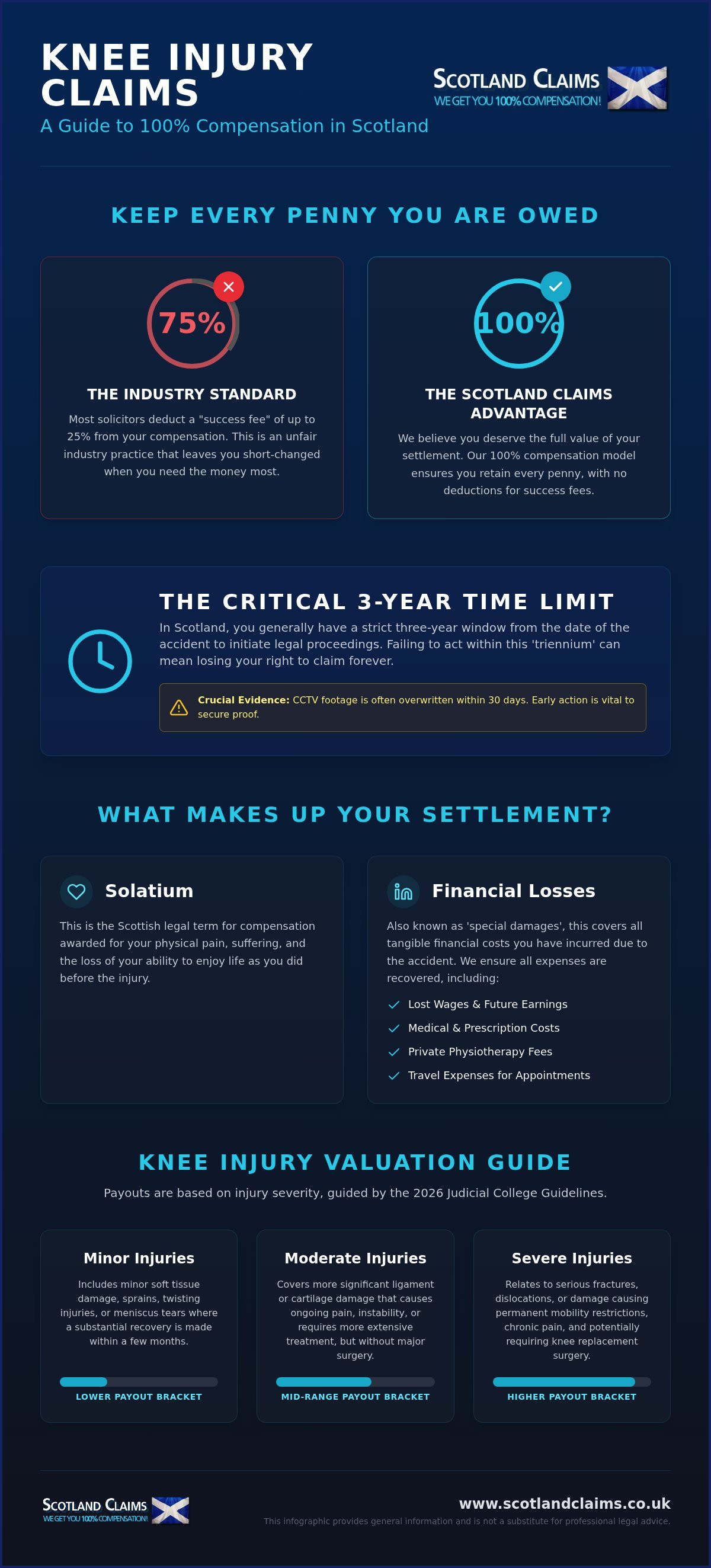
The clock is ticking on your right to justice. Under the Prescription and Limitation (Scotland) Act 1973, you generally have a strict three-year window to initiate legal proceedings. This period is known as the triennium. If you fail to raise your claim within this timeframe, your right to seek compensation is usually lost forever. There are very few exceptions to this rule:
- Children: The three-year limit only begins on the individual's 16th birthday.
- Diminished Capacity: The clock may be paused if the injured person is legally unable to manage their own affairs.
- Date of Knowledge: If the injury or its cause was not immediately apparent, the limit may start from the date you became aware of the negligence.
Early action is vital. Evidence for knee injuries can be fragile. Witnesses move away and memories fade. Crucially, CCTV footage of a slip or trip is often overwritten within 30 days. By contacting injury lawyers in Scotland immediately, you ensure that vital proof is secured whilst it is still fresh.
Why Scottish Law Differs from England and Wales
Scotland has its own distinct legal identity. You shouldn't rely on generic UK advice that ignores our unique court structures. Most Scottish claims are handled in the Sheriff Court, though high-value or complex cases may go to the Court of Session in Edinburgh. These courts operate under different procedural rules than those found south of the border.
The calculation of your settlement also follows Scottish tradition. We use the term "solatium" to describe compensation for your pain, suffering, and loss of amenity. Our specialists work with a network of local medical assessors and expert witnesses who understand the specific reporting requirements of the Scottish courts. This local focus ensures your injury is documented accurately, supporting a claim for 100% of the compensation you are owed.
Evaluating Your Claim: Common Knee Injuries and Payout Ranges
Calculating the value of knee injury claims requires a detailed assessment of your medical prognosis. In the Scottish legal system, your compensation is split into two distinct parts. First is "solatium", which compensates you for your physical pain and the loss of your ability to enjoy life. Second is "special damages", which covers tangible financial losses like lost wages and travel costs. We also factor in the cost of private physiotherapy to ensure your physical recovery isn't delayed by long waiting lists. The meniscus is a piece of C-shaped cartilage that acts as a shock absorber between your shinbone and thighbone, providing essential stability to the knee joint. If this is damaged, your mobility is immediately compromised.
The 18th Edition of the Judicial College Guidelines, published in April 2026, provides the benchmark for these valuations. These figures reflect an 8.26% inflation uplift to ensure settlements remain fair in the current economy. You can use our personal injury compensation calculator to get a preliminary estimate based on your specific symptoms.
Minor Soft Tissue and Meniscus Tears
Minor injuries often involve twisting, sprains, or lacerations. If your injury largely recovers within a few months, it is categorised as minor or moderate. Under the 2026 guidelines, these claims can attract up to £18,150 for solatium alone. We look at how the injury has disrupted your daily routine. If you've been unable to drive or perform basic household tasks, the valuation increases. Even if the recovery is relatively quick, you are still entitled to recover 100% of the wages you lost whilst you were off work.
Serious Ligament Damage: ACL, PCL, and MCL
Serious injuries involve ruptures or cartilage damage that leaves you with permanent symptoms. This might include ongoing instability, weakness, or a significant limitation in your range of movement. The payout ranges for these injuries are substantial:
- Moderate Injuries: Between £19,610 and £34,600 for torn cartilage or dislocations that cause long-term instability.
- Severe Injuries: Between £34,600 and £127,110 for chronic pain, significant mobility restrictions, or injuries that will eventually require a total knee replacement.
If your injury leads to the early onset of osteoarthritis, your claim must account for a lifetime of restricted activity. We ensure every future cost is documented. This includes the potential need for home adaptations or ongoing private medical care, ensuring your final settlement provides complete financial security.
How to Prove Liability for a Knee Injury in Scotland
Winning your case depends on the burden of proof. To succeed in knee injury claims, you must demonstrate that a third party owed you a duty of care and that their negligence caused your injury. This is not always straightforward. Insurance companies often try to shift the blame or argue that the accident was unavoidable. We specialise in building an evidence-based narrative that leaves no room for doubt. Our role is to prove that the defender failed in their legal obligations, whether that was a shop manager failing to clear a spill or a council ignoring a dangerous pavement defect.
Evidence is the foundation of every successful settlement. You need concrete proof to back up your version of events. We recommend securing the following as soon as possible:
- CCTV Footage: Many businesses overwrite their security tapes every 30 days. We act quickly to legally request this footage before it's lost.
- Witness Statements: Independent accounts from people who saw the accident are incredibly persuasive in court.
- Medical Reports: We organise expert medical testimony from specialists who can confirm exactly how the accident caused your specific knee damage.
Sometimes, the defender might claim "contributory negligence". This is a legal argument suggesting you were partially responsible for your own injury. For example, they might claim you weren't looking where you were going or were wearing unsuitable footwear. If proven, this can reduce your settlement by a percentage. We are experts at countering these tactics to ensure you keep the maximum amount of compensation possible.
Accidents at Work and Employer Negligence
Employers in Scotland have a strict legal duty to keep you safe. Many knee injuries in the workplace are caused by poor manual handling practices or lack of proper training. If you were forced to lift heavy loads without assistance or weren't provided with protective knee pads for floor work, your employer may be liable. They must also ensure all walking surfaces are free from obstructions and spills. If you've been hurt on the job, you can find more specific guidance on our Injury at Work Scotland page.
Slips, Trips, and Public Liability
Public spaces must be maintained to a safe standard. In supermarkets and shops, this means having a robust cleaning and inspection regime. On public streets, the local council is responsible for pavement safety. Scotland generally follows the "pothole rule", where a defect must usually be at least 20mm deep to trigger liability. Proving a council was aware of a defect but failed to fix it is a complex task that requires specialist legal knowledge. You can learn more about this process by visiting our section on Slip or Trip Claims.
Maximising Your Payout: The 100% Compensation Advantage
Most legal firms in Scotland operate on a standard "No Win, No Fee" basis. Whilst this removes the upfront risk, it often comes with a significant hidden cost. At the end of your case, these firms typically deduct a "success fee" of up to 25% from your final settlement. We believe this practice is unfair. Your compensation is designed to cover your specific needs; it shouldn't be treated as a profit margin for your solicitor. We operate a 100% compensation model that ensures every penny of the award stays with you. This applies to all knee injury claims we handle, regardless of the complexity of the accident.
Let's look at a comparative example. If your claim results in a £12,000 settlement for your pain and lost wages, a traditional firm might take £2,400 as their fee. You are left with only £9,600. With our specialist approach, you keep the full £12,000. This isn't just about numbers. It's about ensuring you have the financial resources to pay for private medical treatment or to bridge the gap in your household budget whilst you recover. We don't believe you should be penalised for seeking justice.
Why We Do Not Charge a 20% Success Fee
The traditional legal model prioritises the solicitor's bottom line. Our client-first model prioritises your recovery. We have removed "lawyer fee anxiety" by providing total transparency from the very first phone call. There are no hidden charges, no surprise deductions, and no administrative fees tucked away in the small print. You shouldn't have to worry about how much of your payout will be clawed back at the final hurdle. By choosing a firm that guarantees 100% compensation, you can focus entirely on your physical rehabilitation without the stress of calculating legal costs.
Cost Recovery from Insurers Explained
You might wonder how we get paid if we don't take a cut from your settlement. The answer lies in the Scottish legal framework. We recover our legal fees and outlays directly from the at-fault party's insurance company. This is a separate payment from your compensation award. This model is inherently safer and fairer for victims of negligence. It places the financial burden on the party responsible for the accident, rather than the person who suffered the injury. To understand more about how this system protects your interests, read our No Win No Fee Scotland Guide.
Start your 100% compensation claim today
Step-by-Step: How to Start Your No-Win-No-Fee Knee Claim
Starting your journey toward a full settlement is straightforward. We've designed our process to be as low-friction as possible because we understand the physical and financial pressure you're under. You shouldn't have to deal with a complex administrative burden whilst you are trying to recover. Our team handles the heavy lifting, ensuring the legal process remains transparent and predictable. Every step we take is focused on one goal: securing 100% of the compensation you deserve.
The Initial Consultation and Claim Assessment
Your first move is a simple conversation. You can use our 24-hour freephone helpline to get immediate advice at any time of the day or night. During this initial assessment, we'll determine if your claim has a reasonable chance of success. We value your time and will provide a blunt, honest appraisal of your situation. This consultation is entirely free and carries no obligation to proceed. If you want a quick estimate before you call, you can use our Compensation Calculator to see what your injury might be worth under the 2026 guidelines.
Once we've confirmed the merits of your case, you can formally instruct your qualified Scottish solicitor. We'll explain the zero success fee model in detail, giving you total peace of mind that your payout remains yours. From this point on, we take over all communication with the at-fault party and their insurers.
Gathering Medical Evidence for Your Solicitor
Objective proof is the foundation of all successful knee injury claims. Whilst a note from your GP is a good start, it's rarely enough to secure a maximum payout. We arrange for you to see an independent medical specialist who understands the nuances of knee trauma. This expert will assess the full extent of your injury, including any potential long-term complications like instability or the future need for surgery.
These detailed medical reports are the primary tools we use to translate your physical suffering into concrete financial settlement figures. They provide the leverage needed to force insurers to pay the full value of your claim. We then enter the negotiation phase, where our seasoned solicitors demand the total amount you are owed for your pain, medical costs, and lost wages. Because we recover our fees separately from the insurer, you keep every penny of the final award. To begin the process, you can start your claim online today and take the first step toward your total financial recovery.
Secure Your Full Financial Recovery Today
You now have the roadmap to navigate knee injury claims in Scotland with total confidence. You've learned how the 2026 Judicial College Guidelines protect your payout and why the strict three-year legal limit makes early action essential. Most importantly, you now understand that you don't have to sacrifice a quarter of your settlement to success fees whilst seeking justice. Your recovery should be about your health; it shouldn't be treated as a profit margin for a solicitor.
Our firm is authorised by the Law Society of Scotland and operates with a clear client-first ethos. We ensure you keep every penny of your award by recovering our costs directly from the at-fault party's insurer. This zero-fee model removes the financial risk and allows you to focus entirely on your physical rehabilitation. With our 24-hour freephone support available on 0800 611 8132, specialist guidance is always available. Help is just a call away.
Secure your 100% compensation—start your knee injury claim now
Take the first step toward reclaiming your independence and financial stability today. We are ready to stand as your protective expert and fight for the full value of your recovery. You deserve a legal process that is fair, transparent, and results-oriented.
Frequently Asked Questions
How much compensation will I get for a knee injury in Scotland?
Payouts are determined by the 18th Edition of the Judicial College Guidelines. Minor injuries can attract up to £18,150, whilst severe cases involving chronic pain or future osteoarthritis may reach £127,110 for solatium alone. Your final award also includes separate compensation for lost wages and medical expenses. We use these benchmarks to ensure your knee injury claims are valued accurately and fairly from the very start.
Can I claim for a knee injury if it happened at work?
Yes, you can pursue a claim if your employer failed in their duty of care. Common workplace negligence includes lack of proper manual handling training, failure to provide protective equipment, or ignoring obvious trip hazards. Employers are legally required to have insurance to cover these incidents. Claiming won't affect your employment rights; it simply ensures you recover 100% of the wages you lost whilst unable to work.
What is the time limit for making a knee injury claim in Scotland?
In Scotland, you generally have a strict three-year window to initiate legal proceedings. This is known as the triennium and is governed by the Prescription and Limitation (Scotland) Act 1973. For children, the clock starts on their 16th birthday. Because evidence like CCTV footage and witness memory can fade quickly, it's vital to contact a specialist solicitor as soon as possible to protect your right to seek justice.
Do I have to pay anything if my knee injury claim is unsuccessful?
No, you won't owe a penny if your case is lost. We operate on a true No Win, No Fee framework, which removes all financial risk from the claimant. This means there are no upfront costs and no hidden charges if the claim doesn't result in a settlement. This model ensures that justice remains accessible to everyone, regardless of their financial situation, by shifting the risk away from the injured person.
Will I really keep 100% of my knee injury compensation?
Yes, you keep every penny of the award. Unlike many firms that deduct a success fee of up to 25%, we recover our legal costs directly from the at-fault party's insurance company. This is a core part of our 100% compensation guarantee. Whether your settlement is for £5,000 or £50,000, the full amount is paid to you for all successful knee injury claims handled by our specialist team.
How long does a knee injury claim take to settle?
Settlement timelines vary based on the complexity of the injury and whether liability is admitted. Straightforward cases under the Compulsory Pre-Action Protocol often take between six and nine months. If the at-fault party disputes the claim or if your medical prognosis is unclear, the process can take longer. We prioritise efficiency to ensure you receive your funds as quickly as possible without compromising the final settlement value.
Can I claim for a knee injury if I was partially at fault?
Yes, you can still claim even if you share some responsibility. This is known as contributory negligence. In these cases, a court or insurer may reduce your final payout by a percentage that reflects your level of fault. For example, if you are found 20% responsible, you would receive 80% of the total claim value. Our role is to challenge these arguments to ensure your settlement remains as high as possible.
Do I need to go to court for a knee injury claim?
It's very unlikely that you'll need to step into a courtroom. The vast majority of claims are settled through negotiation before any court proceedings are necessary. We use the Compulsory Pre-Action Protocol to encourage early settlements with insurance companies. If a fair offer isn't made, we'll handle all the legal filings on your behalf. You'll be kept informed at every stage without the stress of a trial.