
A rejected injury claim isn’t automatically the end of the matter. If you’re deciding what to do if your injury claim is rejected, start by asking for the reasons, reviewing the decision and gathering evidence that addresses the insurer’s concerns. According to UK Parliament, the time limit for most personal injury claims in the UK is three years, so act promptly.
A rejected injury claim can feel final, especially when you’re coping with an injury and its effects. But the next step is to understand whether the dispute concerns responsibility, evidence or the value of your losses. This article explains how to respond, what evidence may clarify disputed liability, and how negotiations or court proceedings may follow. You’ll also learn when a fresh legal assessment could help you decide whether to continue.
Key Takeaways
- Start by understanding why the insurer rejected the claim, then focus on the specific points its decision disputes.
- Medical records, accident evidence and witness accounts can help clarify what happened and how the injury affected you.
- A disagreement about responsibility doesn’t automatically end a claim; the evidence can help establish each party’s role.
- Negotiations may resolve a dispute, while court proceedings can become relevant if liability or compensation remains contested.
- Getting a legal review promptly can help you assess your options and protect your position before time limits become an issue.
What should I do if my personal injury claim is turned down?
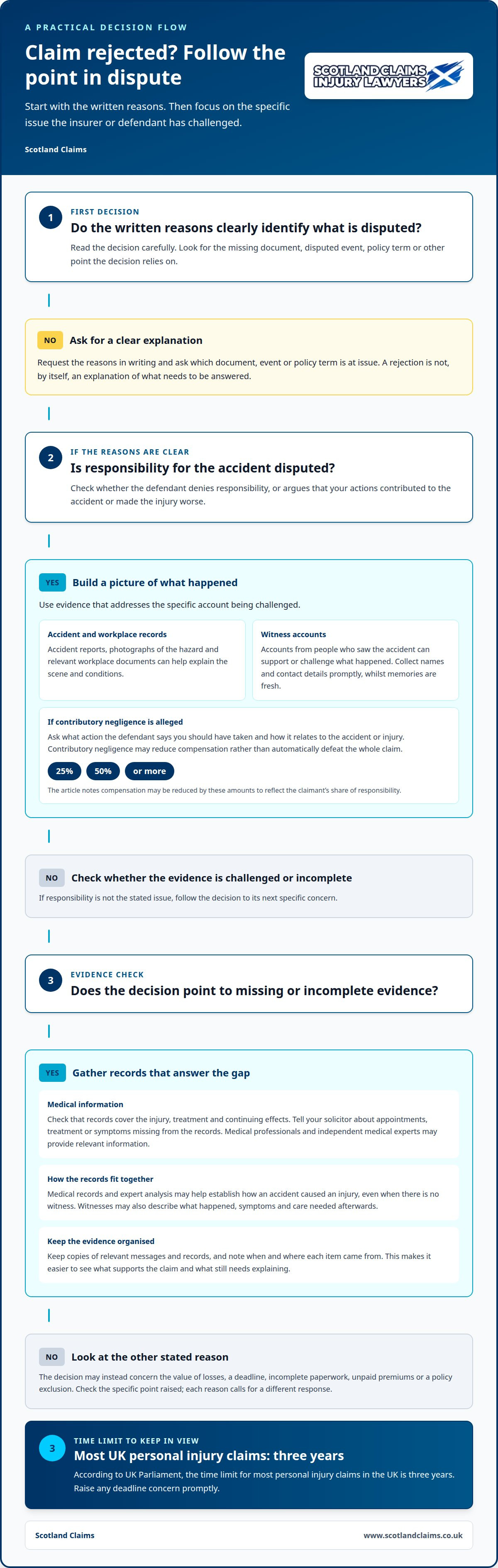
Ask for the reasons for rejection in writing, then read the decision carefully. The explanation can show whether the dispute concerns evidence, responsibility, deadlines or the value of your losses.
Common reasons claims are rejected
A rejection means the insurer or defendant disputes an important part of your case, not simply that they disagree with your account. An employer might deny that unsafe conditions caused the accident, argue that you contributed to it, or say there is not enough medical or witness evidence. An insurer may also point to missed deadlines, incomplete paperwork, unpaid premiums or a policy exclusion. Each reason calls for a different response.
Check whether the decision identifies the missing document, disputed event or policy term. For a workplace accident, a claim may be challenged because the employer says you were trained or followed an unsafe procedure. A solicitor may decline a case if the evidence does not support reasonable prospects, generally assessed as a better than 50:50 chance of success in court. Ask for a clear explanation before deciding what to do if your injury claim is rejected.
Funding a rejected injury claim
Legal aid and no-win-no-fee agreements are different ways to fund legal help. A solicitor can explain which arrangement may apply to your case. Don’t assume legal aid will fund a personal injury claim: ask specifically about the available funding basis before proceeding.
A no-win-no-fee agreement can let you pursue a claim without paying legal fees upfront. Read the terms carefully, including what happens if the claim is unsuccessful and whether a deduction applies to compensation. A rejection does not automatically determine whether a solicitor will take your case. They assess the evidence, the reason for denial and the time left to bring the claim.
Contributory negligence and rejected claims
Contributory negligence means the defendant argues that your actions helped cause the accident or made your injury worse. It may reduce compensation rather than automatically defeat the whole claim. According to UK Parliament, compensation may be reduced by 25%, 50%, or more to reflect the claimant’s share of responsibility.
Ask what action the defendant says you should have taken and how it relates to the accident or injury. For example, an employer might argue that a worker ignored training, while the worker may point to an unsafe system of work. The evidence helps establish responsibility. In most UK personal injury claims, the time limit is three years, according to UK Parliament, so raise any deadline concern promptly.
Evidence for disputed workplace accident claims
Workplace accident disputes often turn on what caused the injury and whether the evidence supports your account. A clear record can help address gaps in the employer’s or insurer’s explanation.
Types of supporting evidence
Supporting evidence helps explain how the accident happened, who was responsible and what injury followed. Each item can support or challenge a specific part of your claim.
Useful records may include accident reports, photographs of the hazard, relevant workplace documents and medical records. Witnesses may include people who saw the accident and family members who cared for you afterwards. Their accounts can describe what happened, your symptoms and changes to your daily activities. Collect names and contact details promptly, while memories are fresh.
For example, a workplace accident report may describe a ladder’s position, while a photograph shows the surrounding access area. Together, they may help explain whether the equipment was stable and suitable. Keep copies of relevant messages and records, and note when and where each item came from. Organised evidence makes it easier to see what supports your claim and what still needs explaining.
Incomplete medical information
Medical evidence records the injury, treatment and effects that followed the accident. Missing information can make it harder to connect the incident to your condition or assess the compensation sought.
For instance, if your records describe an ankle fracture but omit continuing symptoms, they may not show the full effect on everyday life. Tell your solicitor about appointments, treatment and symptoms missing from the records. Medical professionals can provide relevant information, and independent medical experts may assess injuries in personal injury claims. A consistent account helps connect the accident, diagnosis and ongoing effects.
When liability is disputed, evidence can address the specific point the employer contests. If the employer says there was no witness, that does not automatically leave a workplace claim unsupported. Medical records and expert analysis may help establish how the accident caused the injury. Witness statements can support your account or explain the care you needed afterwards.
In one reported workplace accident, a worker fell approximately 10 feet from a ladder while accessing a mezzanine. The worker sustained a minor traumatic brain injury, ongoing post-traumatic migraines and a fractured ankle. Forensic engineering evidence found that the ladder was too short, required unsafe manoeuvres and was unstable because it rested on stairs. This shows how technical analysis can test whether equipment and access arrangements were safe.
A solicitor can gather supporting records and witness statements, then present them to the defendant to address a denial. If your dispute concerns workplace evidence, a workplace injury claim review can help assess how the evidence relates to your case.
Disputed liability
A liability dispute means the defendant does not accept responsibility for your accident. The outcome depends on whether the evidence establishes how the injury happened and who was responsible.
What a denial of liability means
A denial of liability means the defendant says they did not cause your injury or breach a duty of care. In a personal injury claim, you must show, on the balance of probabilities, that the defendant owed you a duty, breached it and caused your injury. Each part matters: evidence that an accident happened alone may not establish who was legally responsible.
For example, a worker may be injured using equipment at work, but the employer may dispute whether its system caused the accident. The claim needs evidence linking the working conditions to the injury. A previous account, workplace records and medical information can help explain that connection. A serious injury does not, by itself, prove the defendant was at fault.
Separate the disputed points. Does the defendant deny that the hazard existed, argue that someone else controlled the premises, or say your actions caused the accident? Each position calls for different evidence. Clarifying the exact denial helps focus your response on the issue that could change the outcome.
Insurer denials of liability
An insurer’s denial means it rejects responsibility on behalf of the party it insures. It may argue that its policyholder did not cause the accident, that another party was responsible, or that your actions contributed. Ask for the reasons in writing, then compare each point with the evidence and the events recorded at the time.
In a workplace case, an employer may say you received training and should have followed a procedure. Training alone does not remove an employer’s responsibility to provide a safe system of work. The relevant questions are whether the system was safe and whether a failure caused your injury. Evidence about instructions, equipment and the task can address the insurer’s argument.
A denial may involve more than one defendant. For example, an employer and the occupier of premises may each dispute responsibility, leaving you to establish which party controlled the relevant risk. A solicitor can assess each party’s role and present supporting evidence to the defendant. This may prompt a change in position, although the parties may still disagree.
Read the insurer’s explanation point by point. Identify what it accepts, what it disputes and what evidence it relies on. Addressing those specific issues is more useful than simply repeating your account. If the insurer argues that you share responsibility, distinguish this from a complete denial, as it may affect compensation differently.
Court proceedings and settlement negotiations
Court proceedings are one possible route if negotiations do not resolve a rejected claim. A court may decide liability or compensation if the parties cannot agree.
Starting court proceedings
Starting proceedings means formally asking a court to determine the dispute. It matters because a defendant may reconsider its position once a claim is brought before the court.
Your solicitor assesses the evidence, the defendant’s response and whether proceedings are appropriate. In England and Wales, formal pre-action steps usually come first. If the defendant still denies liability or does not respond, a solicitor may issue proceedings. The case can then proceed towards a hearing, or the parties may settle before a judge decides it.
For an accident at work, the evidence may address the employer’s safety arrangements and how the injury occurred. You do not necessarily have to attend a trial: negotiations can continue after proceedings begin. If the parties cannot agree, a judge decides the disputed issues.
Court appeals and settlement negotiations
An appeal challenges a court’s decision, while settlement negotiations seek an agreement between the parties. An appeal is not simply another chance to present the whole case.
In England and Wales, an appeal application generally must be made within 21 days of the decision. An appeal usually focuses on whether the lower court made an error, rather than hearing witnesses or receiving new evidence. The court may uphold, change or set aside the decision, send an issue back, or order a new hearing.
Appeal procedures differ in Scotland and Northern Ireland. Don’t assume the England and Wales deadline or process applies there: act promptly to establish the correct route. Settlement discussions can continue if both sides are willing to negotiate. A settlement avoids a judge deciding the dispute, but its terms should reflect the injury and the evidence.
Time limits for challenging a rejection
A time limit sets the latest point for starting a claim, not simply for replying to a rejection. Negotiations or an appeal may not preserve your right to begin proceedings.
In England and Wales, court proceedings for most personal injury cases must start within three years of the injury or date of knowledge. If a claim remains unsettled, proceedings must begin before the applicable limitation period expires. An appeal against a court decision has a separate deadline: generally 21 days in England and Wales. Do not treat an insurer’s review as extending either limit.
Costs of challenging a rejected claim
The cost depends on the case and funding arrangement, and is provided after a quote request. Factors include the work needed to assess evidence, respond to the denial, negotiate and prepare proceedings.
Before proceeding, understand the funding terms and what costs may arise if the claim succeeds or fails. An appeal can require additional legal work, and court proceedings may have cost consequences. Ask for a clear explanation of the arrangement so you can weigh the financial implications against the evidence and proposed next steps.
When a firm may review a rejected claim
A firm may review a rejected claim when the decision, evidence or previous legal advice merits a fresh assessment. A second opinion can help you understand whether further action is supported and what deadlines remain.
Consider another solicitor’s view if your current solicitor says the claim is not worthwhile, progress has stalled or you’re dissatisfied with a settlement offer. A review may also help if you believe your case was mishandled or key evidence overlooked. Explain what happened and provide the rejection letter, previous correspondence and available case papers.
A review should test the reasons for denial against the evidence, not simply repeat the original argument. For example, if an employer denies negligence because you received training, the assessment can consider whether the system of work was safe and whether the training covered the task. If an insurer disputes medical causation, the reviewer can consider whether the records and medical evidence address that issue.
A solicitor may decline a case if the evidence does not support reasonable prospects of success or important information is missing. The decision may reflect the strength of the evidence, the defendant’s position and the work needed to establish liability. Ask the solicitor to explain the specific concern. A clear reason helps you distinguish a genuine evidential problem from an issue further investigation might address.
Timing matters. The usual time limit for most UK personal injury claims is three years, according to UK Parliament, but exceptions can affect when it starts. A fresh review takes time, and negotiations do not necessarily protect your right to start proceedings. Some solicitors also set their own cut-off for taking on new claims, which may be months before the legal deadline. Ask the reviewer to identify the relevant limitation date early.
If you already have representation, you can ask another solicitor whether they can take over. The new firm will need enough information to assess the claim and coordinate the transfer. Changing solicitors does not remove the need to protect the limitation date. Share any court documents, insurer deadlines and recent updates so the review focuses on urgent issues.
A second opinion is most useful when it answers a specific question: was evidence missed, was the proposed settlement too low, or does the rejection have a sound basis? The reviewer can advise whether further evidence, renewed negotiations or court action is appropriate. A careful assessment may also conclude that the claim cannot reasonably proceed. That gives you a clearer basis for deciding what to do next.
Request a review of your injury claim
Scotland Claims Injury Lawyers: Work Injury Claims
Scotland Claims Injury Lawyers handles Work Injury Claims for people injured at work in Scotland. If an employer or insurer has denied your claim, the firm can assess the rejection, available evidence and next steps for pursuing compensation. Its work injury service covers accidents in Scotland within the past three years.
The firm works on a no-win-no-fee basis and promises 100% compensation. This means it recovers its fees from the at-fault party and passes the entire settlement to you. A review can help clarify whether the evidence supports challenging the denial, continuing negotiations or considering court proceedings.
Contact Scotland Claims Injury Lawyers to discuss your rejected work injury claim.
Choose your next step with confidence
Knowing what to do if my injury claim is rejected starts with a decision suited to your circumstances, not pressure to accept the first response. Consider whether pursuing the claim supports your recovery and financial needs. A clear legal assessment can help you understand your options and decide how to proceed.
Scotland Claims Injury Lawyers handles Road Traffic Accident Claims, Slip or Trip Claims and Work Injury Claims. If your injury arose from one of these incidents in Scotland, its team can assess your claim and explain the available route forward.
A rejection can make the next step feel uncertain, but you can approach it with a clear plan and make an informed decision about your claim.
Frequently Asked Questions
What should you do if your serious injury claim has been rejected?
Ask for the reasons for rejection in writing, then identify which part of your claim is disputed. For a serious injury, organise medical records, treatment details and information about effects on work or daily life. A solicitor can assess whether the evidence addresses the insurer’s concerns and whether further medical information is needed. According to UK Parliament, most UK personal injury claims have a three-year time limit, so act promptly.
How do I get a second opinion about my claim?
Contact another personal injury solicitor and explain why the claim was rejected or why you’re dissatisfied with its handling. Share the rejection letter, relevant correspondence and any advice or settlement offer you received. Ask the solicitor to assess the specific issue, such as disputed responsibility or missing evidence. You can also ask whether they can take over the case and what information they need to review its progress and deadlines.
Can You Help After Another Solicitor Turned Me Down?
Scotland Claims Injury Lawyers assesses personal injury claims arising from road traffic accidents, workplace injuries and slips or trips in Scotland. A previous solicitor’s decision does not determine whether another firm can take the claim: the evidence and circumstances need to be assessed. The firm offers a free, no-obligation assessment and true no-win-no-fee representation, with no fee if the claim is unsuccessful. It is regulated by the Law Society of Scotland. The service covers accidents in Scotland within the relevant claim period.
Why might a personal injury claim be rejected in the UK?
A claim may be rejected because the insurer disputes who caused the accident, says the evidence does not establish the injury’s cause, or argues that you contributed to what happened. Administrative issues can also matter, such as incorrect paperwork or a missed time limit. For an insured claim, the insurer may rely on a policy exclusion or missed premium payments. The rejection letter should identify the specific reason.
How do I appeal or challenge a rejected injury claim in the UK?
First establish whether you’re challenging an insurer’s decision or appealing a court judgment. For an insurer’s rejection, ask for its reasoning and address each disputed point with relevant evidence. A solicitor may negotiate with the defendant or consider court proceedings if the dispute remains unresolved. A court appeal is a separate process with its own rules and deadlines. The correct route depends on where the claim is being heard.
What should I do if an insurer rejects my injury claim?
Request a written explanation from the insurer and note the facts or policy terms it relies on. Compare its position with your account, correspondence and available records. If the insurer says a document is missing, identify what it needs and whether you can provide it. Keep copies of communications and note dates. If the explanation is unclear or the dispute concerns liability, seek legal advice before accepting the insurer’s position.
What evidence is needed to dispute a rejected personal injury claim?
The relevant evidence depends on the reason for rejection. A workplace dispute might involve the incident book, shift records, training documents or messages about a reported hazard. A road accident might involve dashcam footage or correspondence about the collision. Medical records help establish treatment and symptoms, while a dated account can clarify how events unfolded. Preserve original files and note where each record came from, so its context remains clear during review.