
Can an injury claim calculator tell you what your Scottish claim is really worth? It can provide a starting indication, but it cannot promise a settlement or account for every detail of your case.
An online estimate is only as useful as the information behind it. Injury severity, recovery time and financial losses you can evidence may all affect an assessment. Scotland also has its own legal system, so guidance based on the rules in England and Wales may not apply to your situation.
This guide explains what a calculator can and cannot estimate, what information to gather and why evidence matters. You’ll also learn how an individual assessment can consider details an online tool may miss. If legal fees are a concern, Scotland Claims Injury Lawyers states that clients keep 100% of their compensation under its no-win, no-fee model, with legal fees recovered from the at-fault party’s insurer. Use a calculator as a first step towards understanding your circumstances, not as a guarantee of what you’ll receive.
Key Takeaways
- Use an injury claim calculator as a guide, not a promise of a particular settlement.
- Gather accident details, medical information and records of financial losses before entering figures.
- Injury severity, recovery time and effects on work or everyday life can shape an assessment.
- Compare an online estimate with an individual assessment. Missing details or outdated information can make a result less useful.
- Scotland Claims Injury Lawyers states that clients keep 100% of their compensation under its no-win, no-fee model, with legal fees recovered from the at-fault party’s insurer.
What can an injury claim calculator tell you about compensation?
An injury claim calculator uses the injury and case details you enter to produce an initial estimate. It can help you explore a possible value, but it cannot confirm what you’ll receive or whether a claim will succeed.
An estimate is a starting point, not a confirmed settlement. It is not an offer, a guaranteed award or a substitute for individual legal advice. Use it to prepare questions, rather than making decisions as if the result were final.
What does an online injury claim estimate represent?
A calculator reflects the information supplied and the assumptions built into its method. Missing or inaccurate details can make the result less useful. Some tools may indicate the injury-related element, known in Scotland as solatium, which relates to pain and suffering.
That may not represent the full claim. A case may also involve patrimonial loss, meaning financial losses such as lost earnings or expenses. An online tool may not capture the evidence behind those losses or the full circumstances of your case. Scotland Claims Injury Lawyers’ personal injury compensation calculator can provide an initial indication, not a decision on your individual case.
Why can the final assessment differ from a calculator result?
People with similar injuries can have different recovery experiences and different effects on their work or everyday activities. One person injured in a road accident may recover quickly, while another with a similar injury may have continuing symptoms that affect their job or usual routine. Those differences can matter when a case is assessed.
Medical evidence can help explain the injury, its progress and its effects. An assessment may change as recovery develops or supporting evidence becomes available. The circumstances of the accident and records of financial losses can also provide context that a calculator cannot reliably infer from a few selected details.
A calculator cannot tell you how a claim would proceed if it reached court. In Scotland, some personal injury cases may be heard in the Sheriff Personal Injury Court. That possibility does not make an online estimate a court valuation or predict the outcome. For a clearer view, have the facts and available evidence assessed individually.
How are injury claim calculator estimates worked out?
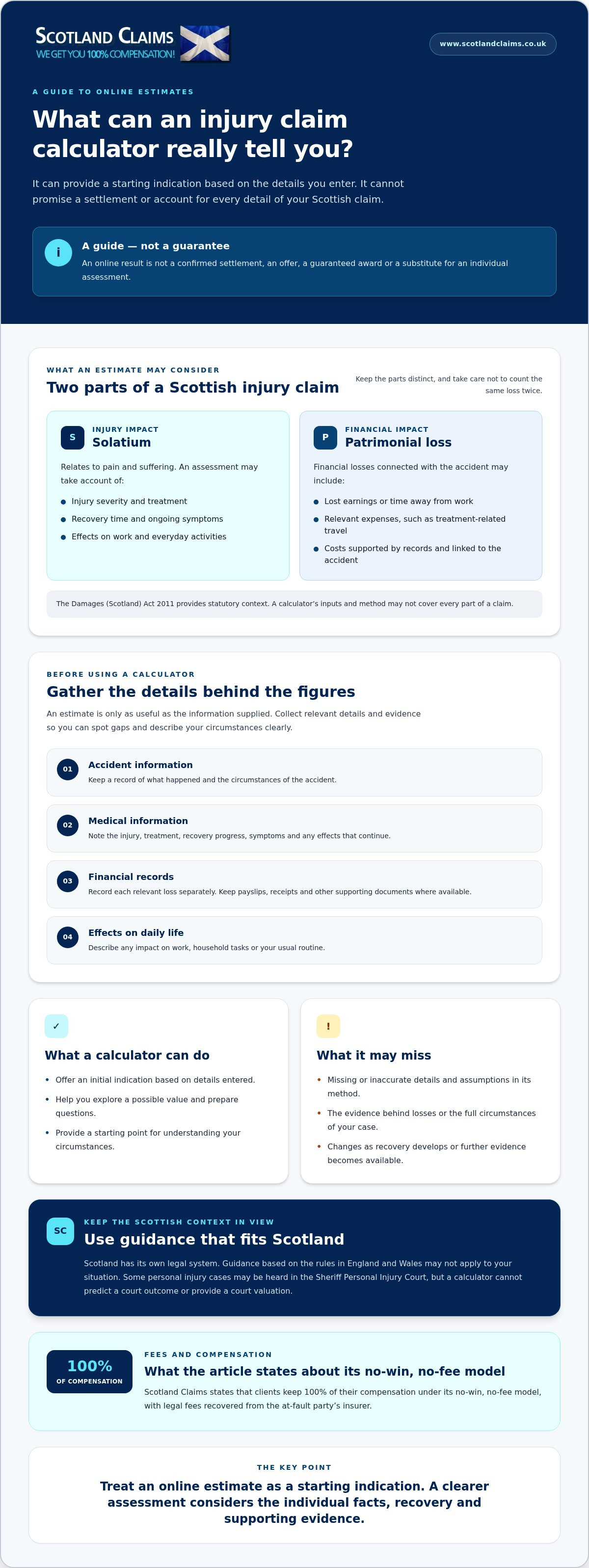
An estimate may consider two parts of a personal injury claim in Scotland: the impact of the injury and financial losses connected with the accident. These are assessed separately, so take care not to count the same loss twice when considering them together.
The injury element, often called solatium, relates to pain and suffering. Financial losses, known as patrimonial loss, may include lost earnings or relevant expenses. The Damages (Scotland) Act 2011 provides statutory context, but you should check a calculator’s inputs and valuation method rather than assume they cover every part of a claim. An online result is not a complete legal assessment.
Which injury details can affect an estimate?
Record what was injured, the treatment you received, how recovery has progressed and whether symptoms remain. An injury label alone does not determine an assessment. Severity, recovery time and the effects on work, household tasks or other everyday activities can help explain the impact.
Medical evidence may help clarify the diagnosis, likely recovery and any lasting effects. Keep relevant records and describe symptoms honestly, including how they change over time. If recovery is ongoing or further evidence becomes available, an early estimate may not reflect the eventual position.
Which financial losses may need to be considered?
Keep a clear record of income you have lost and expenses you believe resulted from the accident. Depending on your circumstances, this might include time away from work or travel connected with treatment. Keep payslips, receipts and other supporting documents where available. Each item should relate to the accident. Do not include an expense simply because it occurred around the same time.
Record each loss separately, along with the evidence for it. For example, note the dates you were unable to work and the income affected, rather than combining this with unrelated costs. This makes it easier to spot gaps and avoid counting one loss twice. Whether a particular item can be included depends on the facts and evidence.
Calculator methods and valuation references can differ, and guidance used in one part of the UK may not apply in the same way to a Scottish case. Treat the result as an indication based on the details entered, not a complete valuation. For further context, use Scotland Claims’ Scottish injury compensation calculator, then consider asking for an assessment of your circumstances and supporting information.
Accurate details can make an online estimate more useful. You do not need a complete file before you begin, and you should not delay seeking advice just because you are still collecting paperwork. Start with what you know, note anything you are unsure about and update your records as your recovery progresses.
Before using an injury claim calculator, work through this checklist:
- 1. Note the accident details. Record the date, location and basic circumstances, such as a road collision, an incident at work or a fall in a public place.
- 2. Describe the injury and treatment. Write down the affected areas, symptoms, treatment received and any relevant appointments or medical documents.
- 3. Track your recovery. Note how symptoms change over time and whether they affect work, sleep, household tasks or other everyday activities.
- 4. List possible financial losses. Keep relevant receipts and records of income affected or time away from work. Record each item separately and explain why you believe it relates to the accident.
- 5. Gather supporting records. Save relevant correspondence and any accident, medical or employment documents available to you.
Which accident and injury details should you record?
Use the most accurate date and location you can, then describe what happened in plain language. If you cannot remember a detail, avoid guessing. Record the injury, treatment and current recovery position honestly, including symptoms that continue or change. For a Scottish road accident, details such as the vehicles involved and any available incident records may help explain the circumstances. Scotland Claims’ information on road traffic accident claims may provide relevant context.
What evidence can help explain losses and recovery?
Keep receipts for relevant expenses, wage information and records showing when you were unable to work or your duties were affected. Save correspondence and documents connected with the treatment and accident. These records can help clarify what happened and how it affected you, but you do not need to decide for yourself which items are legally relevant.
Clear, accurate details matter more than a polished account. Do not minimise symptoms or exaggerate them. If a date or amount is uncertain, mark it as an estimate rather than presenting it as confirmed. A solicitor can review the information you have, explain what may be relevant to your circumstances and identify what else could help. You can ask for guidance before you have every document.
How should you interpret an injury claim calculator result?
Read the result as a snapshot based on the details entered, not a figure checked against all the evidence. An injury claim calculator may not account for missing information, a changing recovery or the full circumstances of the accident. Liability matters too: an estimate of the injury’s impact does not establish who was responsible or whether compensation will be agreed.
This comparison shows what each stage can tell you:
| Stage |
What it means |
| Online estimate |
An indicative figure generated from selected details and the calculator’s assumptions. |
| Solicitor’s assessment |
An individual review of the circumstances and available evidence. This view may change as medical or case information develops. |
| Final settlement |
An agreed resolution of the claim, reached after the relevant issues and evidence have been considered. |
A solicitor’s assessment is not a guarantee that a claim will be accepted or that a particular award will be made. It is more specific to your case than an online estimate because it considers the information available at that point. The final settlement may differ as facts are established and the parties consider the case.
Estimate versus solicitor assessment versus settlement
A calculator offers a starting indication. A solicitor considers the individual circumstances, including the evidence and questions about responsibility. A settlement is an agreed outcome, not a calculator prediction. If your recovery is ongoing or records are incomplete, the assessment may need to be revisited as relevant information becomes available.
What should you do if the estimate seems too high or too low?
Start by checking what you entered. Confirm the dates, injury details and recovery progress. Consider whether you have missed relevant financial losses, and check whether the tool asks about them. If a detail is only an estimate, treat the result cautiously. Do not change accurate inputs just to produce a preferred figure, as that makes the output less useful.
If you are still unsure, seek an individual assessment rather than relying on the number alone. Scotland Claims Injury Lawyers offers a no-obligation assessment to consider case-specific information. Its Personal Injury Compensation Calculator can be a useful starting point, but its result remains an indication, not a confirmed settlement.
What happens after using an injury claim calculator in Scotland?
Use the calculator result as a prompt to check your circumstances, not as a decision about your claim. For a clearer view, request an assessment and explain what happened, how you were injured and how recovery is affecting you. Share the evidence you already have, such as relevant medical, accident, work or expense records. You do not need every document before asking for guidance.
What happens during a no-obligation claim assessment?
A solicitor can consider the facts you provide and the evidence available, then discuss what may matter in your situation. Ask questions about the assessment, what information could help and what the possible next steps are. The discussion can help you understand your options, but it is not a promise that a claim will be accepted or achieve a particular outcome. Before deciding how to proceed, ask how the no-win, no-fee arrangement applies to your case.
How does Scotland Claims explain legal fees and next steps?
Scotland Claims, a trading style of Kerr Brown Solicitors, states that it operates on a no-win, no-fee basis. Under its stated model, clients keep 100% of their compensation: legal fees are recovered from the at-fault party’s insurer rather than deducted from the client’s settlement. The firm also states that clients owe nothing if a claim is unsuccessful within this framework. These terms do not guarantee that you are eligible to claim or that compensation will be awarded, so ask how they apply to your circumstances.
Kerr Brown Solicitors is authorised and regulated by the Law Society of Scotland. Scotland Claims also provides a 24-hour freephone helpline for initial enquiries. If you are considering what to do after using an injury claim calculator, request a no-obligation assessment to discuss the accident, your recovery and the evidence you have.
Take your next step with a clearer picture
An injury claim calculator can help you organise your thinking, but its result is only an indication. Your recovery, available evidence and losses connected with the accident all matter when your circumstances are assessed. Use the estimate as a starting point, then seek guidance tailored to your situation.
Scotland Claims states that clients keep 100% of their compensation, with legal fees recovered from the at-fault party’s insurer. Under its no-win, no-fee model, the firm says clients owe nothing if a claim is unsuccessful. Scotland Claims is a trading style of Kerr Brown Solicitors, authorised and regulated by the Law Society of Scotland.
You do not need every answer before asking a question. A case-specific assessment can help you understand possible next steps and decide how to proceed with greater confidence.
Frequently Asked Questions
Is an injury claim calculator accurate?
An injury claim calculator can provide an initial indication, but it cannot confirm your compensation or predict a final settlement. Its result depends on the information entered and the assumptions used by the tool. It may not reflect medical evidence, a changing recovery, financial losses or questions about responsibility. Check the inputs carefully, then use the figure as a guide for discussion rather than a decision about your case.
How does an injury claim calculator work?
A calculator uses selected details, such as the type of injury and expected recovery time, to generate an estimate. Some tools may ask about other aspects of the accident or its effects, but the inputs vary. The result can only reflect the information provided and the calculator’s method. It is not an offer from an insurer, a guaranteed award or an individual legal assessment.
What information do I need to use an injury claim calculator?
Gather the accident date and basic circumstances, details of the injury and treatment, and an honest account of your symptoms and recovery. Note how the injury affects work and everyday activities. If available, keep relevant medical records, wage information, receipts and accident correspondence nearby. You can still seek advice if details or documents are missing. Mark anything uncertain clearly rather than guessing.
Can an injury claim calculator include lost wages and expenses?
Some calculators may ask about financial losses, but do not assume every tool includes them or calculates them fully. Lost earnings and relevant expenses are separate from the injury-related assessment and may need supporting records, such as wage information or receipts. Check what the calculator asks for and what its result covers. A solicitor can consider whether documented losses relate to your accident and circumstances.
How much compensation will an injury claim calculator show?
There is no reliable figure to give without the calculator’s inputs and your individual circumstances. The estimate may reflect an injury element, financial losses, both or neither in full. Recovery, medical evidence, effects on daily life and responsibility for the accident can all matter. Do not treat an online figure as a promised settlement. An individual assessment is needed to consider the available facts and evidence.
Do I have to pay Scotland Claims if my injury claim is unsuccessful?
Scotland Claims says that clients owe nothing if a claim is unsuccessful under its no-win, no-fee model. If a claim succeeds, the firm states that it recovers its legal fees from the at-fault party’s insurer, so clients keep 100% of their compensation. Ask for the agreement’s terms to be explained in relation to your circumstances before proceeding. This funding arrangement does not guarantee that a claim will succeed.
How long do I have to make an injury claim in Scotland?
Generally, a personal injury claim in Scotland must be brought within three years of the accident. In some cases, the period may run from the date you became aware, or reasonably should have become aware, that you were injured and that someone else’s negligence caused it. For a child, the three-year period generally starts on their 16th birthday. Time-limit rules depend on the circumstances, so seek advice promptly rather than relying on a general guide.