
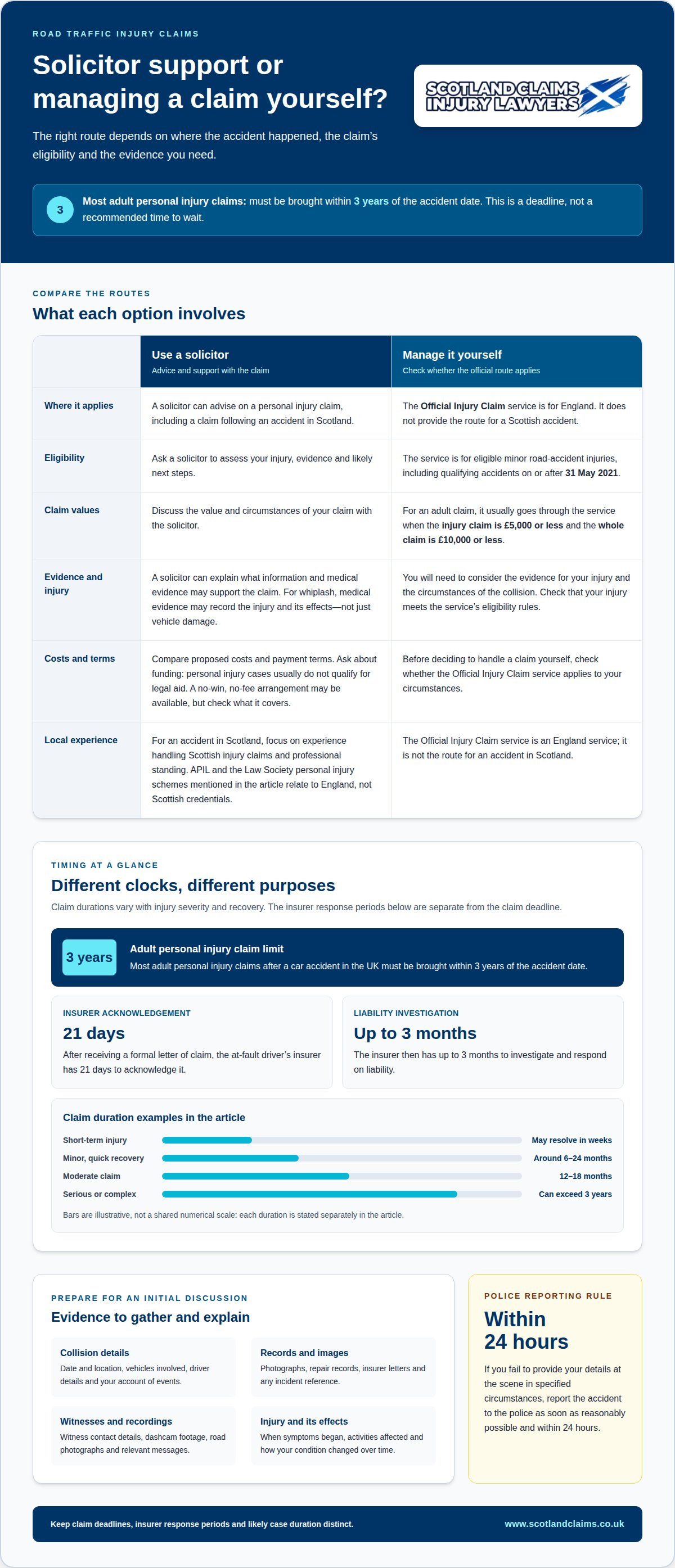
The accident date can matter long after the damaged car is repaired. If you’re deciding when to get a solicitor after a car accident, contact one as soon as you can: according to the UK legislation register, most adult personal injury claims after a car accident must be brought within three years of the accident date.
You may feel able to manage a straightforward claim, but injuries can take time to become clear and evidence can be harder to gather as time passes. Getting legal advice early can help you understand what information and medical evidence may support your claim, and what to do next.
This article explains the time limit, when a solicitor can help and what to do about reporting the collision. It also covers a key reporting rule: if you fail to provide your details at the scene in specified circumstances, you must report the accident to police as soon as reasonably possible and within 24 hours, according to the UK legislation register.
Key Takeaways
- Find out when a minor or whiplash injury claim may still benefit from legal support.
- Understand how injury details, medical assessments and available evidence can affect a claim.
- Learn what to report after a collision and how a solicitor can help with the process.
- See how a solicitor can assess your case, gather evidence and deal with the insurer.
- Discover when specialist support with a road traffic accident claim could be the next step.
Can I make a small personal injury or whiplash claim through a lawyer?
Yes, a solicitor can advise on a small injury or whiplash claim, including the evidence needed. In 2024, the Department for Transport reported 128,272 people killed or injured on Great Britain’s roads, including 70,089 car occupants.
-
Choosing a solicitor for a personal injury claim
Speak to a solicitor who handles personal injury claims and ask how they would assess your injury, evidence and likely next steps. Compare the proposed costs and payment terms before agreeing to proceed. A solicitor should explain these clearly. For example, a whiplash claim may need medical evidence that records the injury and its effects, not just details of the vehicle damage.
-
Checking a solicitor’s accreditation and local experience
Ask about relevant personal injury accreditation and experience with claims in the jurisdiction where the accident happened. Accreditation schemes differ across the UK: APIL accreditation and the Law Society’s personal injury schemes relate to England, so don’t treat them as Scottish credentials. If the accident happened in Scotland, focus on a solicitor’s experience handling Scottish injury claims and their professional standing.
-
Consider claiming without a solicitor
Check whether the Official Injury Claim service applies before choosing to handle a claim yourself. It is an England service for eligible minor road-accident injuries, including qualifying accidents on or after 31 May 2021. An adult claim usually goes through it when the injury claim is £5,000 or less and the whole claim is £10,000 or less. It does not provide the route for a Scottish accident.
- Ask about legal aid and funding before deciding. Personal injury cases usually do not qualify for legal aid, so ask the solicitor to explain any proposed agreement and possible costs. A no-win, no-fee arrangement may be available, but check its terms rather than assuming every expense is covered. This helps you understand the financial position before instructing a lawyer.
- Ask how the injury’s severity and recovery affect the likely timetable. A short-term injury case may resolve in weeks; a moderate car accident claim may take 12 to 18 months. Minor injuries with a quick recovery may take around 6 to 24 months, while serious or complex cases can take over 3 years. These differences make early advice useful, even for a small claim.
Personal injury claim deadlines
Act promptly after a road traffic injury, especially if fault is disputed or the other driver is uninsured. Most adult personal injury claims after a car accident in the UK must be brought within 3 years of the accident date, according to the UK legislation register.
- Ask a solicitor to assess the deadline and start the claim process early. The three-year limitation period is not a recommended waiting period: gathering records, clarifying injuries and negotiating liability all take time. If you’re unsure how the date applies to your circumstances, get advice before delaying. Missing a deadline can affect your ability to bring a personal injury claim.
- Contact a solicitor promptly if the other driver disputes fault or is uninsured. A solicitor can review the available evidence, identify the issues affecting liability and explain the next steps. An uninsured driver does not remove the need to act quickly. The appropriate route depends on the circumstances, so share the accident details and any insurer correspondence early.
- Ask how the solicitor will handle the letter of claim and insurer response. After receiving a formal letter of claim, the at-fault driver’s insurer has 21 days to acknowledge it and up to 3 months to investigate and respond on liability. These response periods are separate from the claim deadline. Keep the correspondence together so your solicitor can track replies and address delays.
- Explain any evidence that suggests you may have shared responsibility. For example, the other driver may accept that a collision happened but dispute how it occurred. Your solicitor can examine the accounts and evidence, then negotiate the disputed share of responsibility with the insurer. This matters because an agreed share of fault can affect the compensation sought, not just how quickly the claim progresses.
- Use legal support to keep negotiations focused on the whole personal injury claim. A solicitor can set out the injury’s effects, present supporting evidence and respond to the insurer’s position. If negotiations do not resolve liability, they can advise on the next procedural steps within the limitation period. For advice on a Scottish case, you can explore Scottish personal injury lawyers.
How long after a car accident can you claim?
- Start gathering evidence as soon as you can, then share it during your initial discussion with a solicitor. Include the collision date and location, the vehicles involved, driver details and a clear account of events. Add photographs, insurer letters, repair records and any incident reference. If someone witnessed the crash, provide their contact details and explain what they saw. These details help identify evidence gaps early.
- Bring any recordings or documents that help show how the collision happened. Examples include dashcam footage, photographs of the road and vehicle damage, and messages exchanged after the accident. If you have a video of yourself driving or cycling, it may help show the circumstances before impact. Keep original files where possible, and tell your solicitor when and how each item was created.
- Explain your injury and its effects in practical terms, not just by naming a diagnosis. Tell the solicitor when symptoms began, which activities became difficult, and whether your condition changed over time. For example, describe problems with driving, sleeping, household tasks or returning to work. Include effects on family life, social activities and participation in society. This account helps connect the injury to its consequences.
- Share relevant medical information and attend the assessment arranged for your claim. A solicitor can advise what medical evidence is needed to support your case. Tell the assessing professional about your symptoms, treatment and recovery, and correct any factual errors in your account. Medical evidence helps establish the nature and impact of an injury. Your solicitor can explain how the report fits with other records and the claim.
- Ask your solicitor to explain the evidence plan before signing an agreement. The claim’s progress can depend on how quickly records arrive, whether the medical picture is clear, and whether the other side disputes what happened. A serious injury may need further assessment if its lasting effects remain uncertain. Your solicitor can coordinate relevant evidence and explain what is outstanding, so you understand why the next step matters.
- Keep a simple record of changes while evidence is being gathered. Note appointments, treatment, missed work and practical difficulties, then share relevant updates with your solicitor. For instance, a new medical opinion or a change in your ability to drive may affect how the injury is described. Provide documents promptly when requested. A complete, consistent record helps your solicitor present the claim clearly and identify what further evidence may be needed.
How a solicitor can help with reporting an accident to the police and insurers
Keep police reporting and insurance notification as separate steps. A solicitor can help you understand what information to provide and how reports may affect your claim.
- Tell your solicitor whether the police attended, whether anyone was injured and whether drivers exchanged details. Drivers in the UK who fail to provide their details at the scene in specified circumstances must report the accident to police as soon as reasonably possible and within 24 hours, according to the UK legislation register. A solicitor can help clarify which facts to include in your account, but don’t delay a required report while seeking advice.
- Notify your own insurer about the collision, even if you don’t intend to claim through that policy. Give an accurate account of the date, location, vehicles involved and any damage or injury. If you’re uncertain how to describe a disputed detail, tell your solicitor what you remember and what remains unclear. They can help keep your account consistent with the evidence, such as photographs or a witness’s description.
- Ask your solicitor to review any police or insurer correspondence before you respond to a disputed allegation. For example, the other driver may accept that a collision happened but disagree about how it occurred. Your solicitor can explain what the correspondence says, identify questions that need answers and help you respond clearly. Keep copies of reports, letters and claim references together so each new communication can be considered in context.
- For a hit-and-run, tell your solicitor promptly and report the incident to police. The Motor Insurers’ Bureau asks hit-and-run victims in the UK to report the accident to police within 14 days. Share any registration details, vehicle description, location and witness information you have. A solicitor can help organise these details for the claim and explain how missing driver information affects the evidence available.
- Agree with your solicitor who will handle each communication before a formal claim progresses. They can explain what they will do for you, what information you need to supply and when the insurer should receive it. Ask them to distinguish a police report from an insurance notification, as each serves a different purpose. If you need to find out whether a solicitor can represent you in a particular matter, ask directly and clarify the scope of the agreement.
What a solicitor does after a road accident
A solicitor turns the details of your collision into a structured personal injury claim. Their work goes beyond sending forms: they assess liability, build supporting evidence and negotiate with the insurer on your behalf.
- Assess the claim and explain the next steps. The solicitor reviews how the collision happened, the injury you suffered and the losses you describe. They identify what needs evidence and explain the process before you agree to proceed. For example, if the other driver disputes responsibility, they can assess which accounts, photographs or records may help address that dispute.
- Collect and organise supporting evidence. Your solicitor gathers relevant records, including medical information, accident details and insurer correspondence. They can also seek evidence from other sources where appropriate, such as witness accounts or available footage. The aim is to present a clear account that connects the collision to your injury and its effects, rather than leaving important details scattered across separate documents.
- Arrange medical evidence and explain its role. A solicitor can advise what medical evidence is needed to support the claim and arrange an assessment. The resulting report helps describe the injury, treatment and likely recovery. If your symptoms affect work, driving or everyday activities, explain those effects clearly. Your solicitor can consider them alongside the medical evidence when setting out the impact of the accident.
- Present the claim and handle insurer negotiations. The solicitor prepares the claim, sets out the evidence and communicates with the relevant insurer. If the insurer challenges the account, the solicitor can respond using the available records and explain where the disagreement lies. They can also discuss any proposed settlement with you, so you understand what it covers before deciding whether to accept it.
- Keep you informed about decisions and expenses. Ask your solicitor to explain the funding agreement, any possible expenses and what happens at each stage. They should make the costs clear before you agree to instruct them. You remain involved in important decisions, including whether to accept a settlement. A clear explanation helps you weigh the offer against the injury and losses included in the claim.
Discuss your road accident claim
Scotland Claims Injury Lawyers: Road Traffic Accident Claims
Scotland Claims Injury Lawyers handles Road Traffic Accident Claims for people injured in collisions in Scotland. If you’re weighing up legal support, turn to the firm when you need help assessing the claim, presenting evidence or dealing with the at-fault party’s insurer. Its no-win-no-fee basis means the firm recovers its fees from the at-fault party and passes your entire settlement to you, under its 100% compensation promise.
Scotland Claims Injury Lawyers handles personal injury claims arising from accidents in Scotland within the past three years. If your circumstances fit, you can discuss the accident and the evidence you have so far, then consider whether to proceed.
Contact Scotland Claims Injury Lawyers to discuss your road traffic accident claim.
Take your next step with clarity
Deciding when to get a solicitor after a car accident is about recognising when legal uncertainty is affecting your choices. If responsibility is contested, your symptoms are changing or an insurer asks you to respond before you understand the position, seek advice focused on your circumstances. A clear explanation can help you decide what action makes sense next.
Before moving forward, consider what you need from legal support: an assessment of the evidence, an explanation of correspondence or guidance on the claim process. Ask what the solicitor would handle on your behalf, which decisions remain yours and how the funding agreement works. You should understand those points before deciding whether to proceed. The aim is a practical plan based on your case, not assumptions drawn from someone else’s experience.
A considered next step can help you move forward with greater confidence and control.
Frequently Asked Questions
Can car accident lawyers still help if you're partly at fault?
Yes, a solicitor can assess a claim even if you may share responsibility. Explain what happened from your perspective and provide evidence that supports your account, such as photographs or witness details. The insurer’s view of fault may differ from yours, so ask the solicitor to explain how disputed responsibility could affect negotiations. Don’t assume you have no options before your evidence and circumstances have been reviewed.
Do I have to use the car accident law firm recommended by my insurance company?
No, you can choose who represents you. Your insurer may recommend a panel solicitor, but you can consider another firm before agreeing to legal representation. Read any documents you receive and clarify whether accepting a recommendation affects your policy or claim arrangements. If you have already spoken to a solicitor, ask what steps are needed to change representation and whether any existing agreement affects the transfer.
How do I choose a car accident solicitor?
Choose a solicitor who handles personal injury claims in the part of the UK where your collision happened. Ask how they will assess disputed fault, obtain medical evidence and keep you informed. Check the funding agreement and ask for a clear explanation before you agree. Scotland Claims Injury Lawyers handles claims across Scotland and is regulated by the Law Society of Scotland.
Injured in a Car Accident?
If you were injured in a collision in Scotland, you can seek legal advice about whether a personal injury claim may be appropriate. For example, tell the solicitor if neck pain began after the crash but worsened later, or if it affected your ability to work. Scotland Claims Injury Lawyers handles road traffic accident claims across Scotland. Share the accident circumstances and injury details to discuss possible next steps.
What can I expect from the first consultation?
Expect to explain how the collision happened, what injury you suffered and what contact you’ve had with insurers. The solicitor may ask about medical treatment, witnesses and any photographs or correspondence you hold. Use the discussion to ask who will handle your claim, what information is needed next and how the funding agreement works. The initial claim assessment is free and carries no obligation.
How can a solicitor help after a car accident or other road accident?
A solicitor can assess the claim, organise relevant evidence and communicate with the insurer on your behalf. For example, they can consider whether a witness account supports your description of a junction collision, or whether medical records explain when symptoms began. They can also clarify insurer correspondence and discuss a settlement offer with you, so you understand the issues before deciding how to respond.
Why should I claim compensation through a solicitor?
A solicitor can help you understand the evidence and process, particularly if the insurer disputes fault or the injury’s effects. They can organise relevant records, present your account and explain settlement communications in practical terms. A solicitor isn’t essential for every claim, and eligible minor injuries in England may use the Official Injury Claim service. That service does not apply to accidents in Scotland.
When should I contact a solicitor after a car accident in the UK?
Contact a solicitor promptly if you were injured, fault is disputed, the other driver is uninsured, or the insurer’s position is unclear. Early advice helps identify useful evidence and the steps needed for your circumstances. Scotland Claims Injury Lawyers handles claims arising from accidents in Scotland within the past three years. Don’t wait until negotiations stall before asking what options may be available.