
Agreeing a settlement doesn’t mean the money will appear in your bank account straight away. If you’re asking “how long after settlement do i get paid scotland?”, a typical estimate is 14 to 28 days, but the exact timing depends on what needs to happen before the funds can be released.
It’s understandable to want a clear date, especially when you’re unsure whether deductions will reduce your compensation or whether a delay signals a problem. Once the settlement is agreed, the insurer usually processes payment to your solicitor. They then complete any necessary checks and arrange the transfer to you. That means there can be several steps between accepting an offer and receiving the money.
This guide explains what happens after settlement, why payment times vary and what you can do if your compensation seems delayed. You’ll also learn what to ask your solicitor and how deductions may apply. At Scotland Claims Injury Lawyers, clients keep 100% of their compensation, with no success fee deducted from their settlement. Knowing what to expect can help you follow the process with confidence and spot when it’s time to ask for an update.
Key Takeaways
- If you’re wondering “how long after settlement do i get paid scotland?”, remember that agreeing the terms and receiving the money are separate steps, and timing can vary.
- Find out which paperwork and payment-processing steps must be completed before funds can be released to you.
- Separate delays in reaching a settlement from delays after an agreement has been confirmed; they may have different causes.
- If payment seems late, check your written settlement confirmation and ask which step is pending and whether anything is needed from you.
- Scotland Claims states that legal costs are recovered from the at-fault party’s insurer, so clients keep 100% of their compensation with no success fee.
How long after a settlement do you get paid in Scotland?
There’s no single payment date that applies to every personal injury claim. A period of 14 to 28 days is sometimes given as a general estimate after settlement, but it isn’t a guaranteed deadline for your case. If you’re asking “how long after settlement do i get paid scotland?”, the most reliable guide is the payment wording in your settlement confirmation and an update from the person handling your claim.
Accepting the settlement terms and receiving the compensation are separate events. The insurer may need to process payment through your solicitor, and the solicitor may need to complete paperwork or confirm that any conditions have been met before sending money on to you. The agreed terms and payment route can therefore affect how long the next steps take.
For context, personal injury claims in Scotland may involve the Sheriff Personal Injury Court. A claim’s route through the legal process can differ, but a court connection alone doesn’t tell you when funds will reach your account. If you’re looking for guidance on personal injury lawyers in Scotland, the key question is still what your own settlement confirmation says.
Short answer: Treat 14 to 28 days as a general estimate, not a promised arrival date. Your confirmed payment terms and any outstanding steps determine the expected timing for your claim.
When does the settlement payment clock start?
For a practical estimate, start from the point when the settlement terms have been agreed and accepted, not from the day negotiations began or an offer was first made. Even then, payment processing may not begin immediately. Required forms, identity or bank details, signed documents, or other conditions may still need to be completed, depending on the case and the terms agreed.
Read the written settlement confirmation carefully. Look for the agreed amount, any conditions, the payment route and any stated timescale. If the confirmation doesn’t give a clear date or explains that a step remains outstanding, ask your solicitor what needs to happen before payment can be processed.
Is a general payment estimate a promise?
No. The often-quoted 14 to 28 days is a broad estimate, not a fixed deadline that applies to every Scottish personal injury settlement. It may not reflect your particular payment route, the time needed to complete paperwork, or an issue that arises during processing. Don’t treat an estimate as confirmation that the funds will arrive on a specific day.
Your claim’s written terms are more useful than a general online estimate. If they state a payment date or timeframe, use that as your reference. If they don’t, ask the claims handler when payment is expected and whether anything remains outstanding. That gives you a claim-specific update without mistaking a typical estimate for a guarantee.
What happens between agreeing a settlement and receiving compensation?
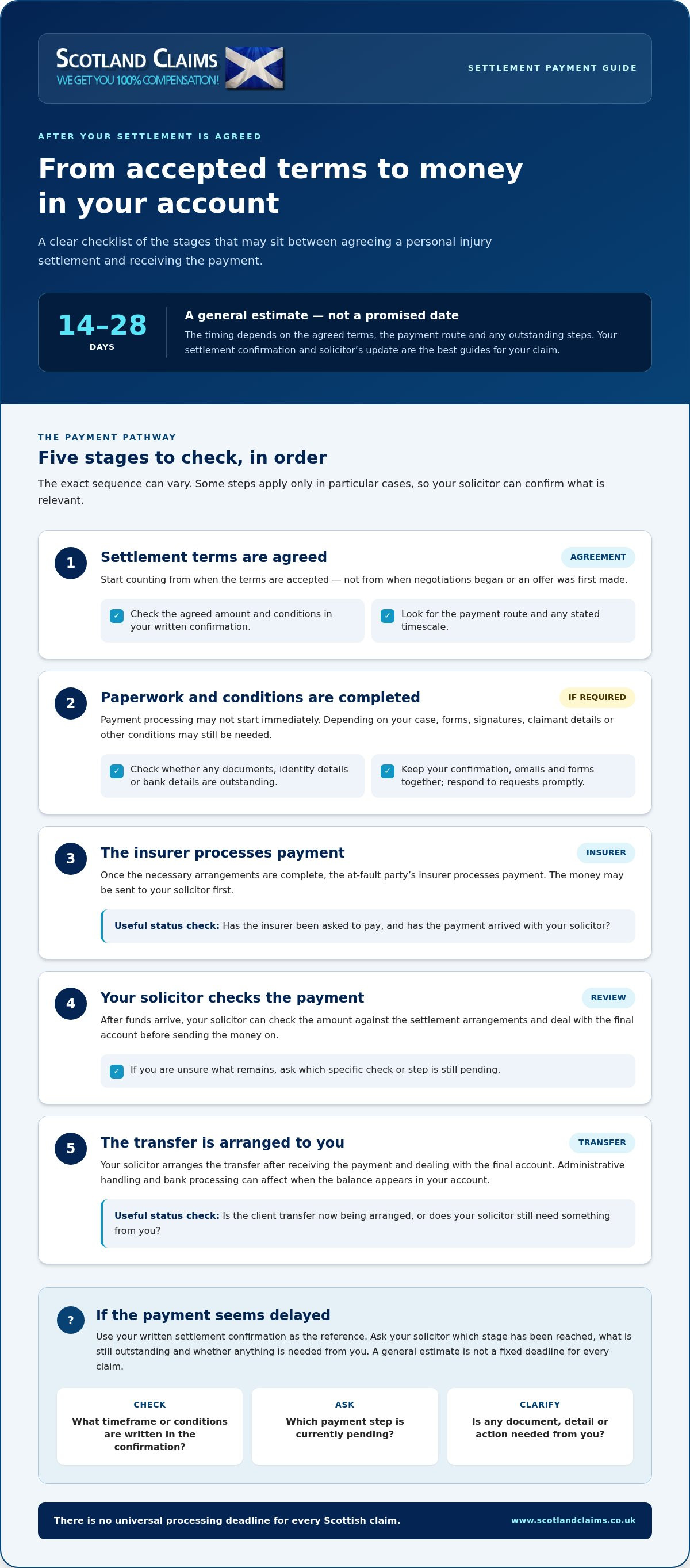
After you accept a personal injury settlement, several practical steps can sit between the agreement and the money reaching your account. The exact sequence depends on the terms and how the claim has been handled. Some steps apply only in particular cases, so your solicitor is best placed to explain what is happening with your payment.
In broad terms, the process moves from confirming the agreement, to completing any necessary paperwork, to payment by the at-fault party’s insurer. Once funds arrive with your solicitor, they can check the amount against the settlement arrangements and arrange the transfer to you. There is no universal processing deadline that applies to every Scottish claim.
From accepted terms to payment authorisation
The agreed terms need to be clear before payment can be processed. Your solicitor will confirm what has been accepted and tell you if any forms, signatures or claimant details are still needed. Depending on the case, there may also be conditions to complete before the insurer is asked to release funds. Responding promptly to a request can help avoid an unnecessary pause.
Keep the settlement confirmation, related emails and any forms together. This makes it easier to check what was agreed and answer questions about the amount, conditions or payment instructions. If you’re unsure whether a document is outstanding, ask your solicitor to identify the specific step holding things up.
From insurer processing to money reaching your account
Once the arrangements are complete, the at-fault party’s insurer processes payment. The money may be sent to your solicitor first, then transferred to you after the payment is received and the final account is dealt with. Bank processing and administrative handling can affect when the balance appears in your account. The stages don’t happen at the same speed in every claim.
A useful way to follow progress is to ask which stage has been reached, rather than relying on a general estimate. For example, has the insurer been asked to pay, has the money arrived with your solicitor, or is the client transfer being arranged? Your solicitor can explain the status of your individual payment and tell you whether they need anything from you.
Some claims involve court proceedings, while others are resolved without a court hearing. The Scottish Courts and Tribunals Service explains the role of Scotland’s Personal Injury Court; court involvement may affect the process in a particular case, but it doesn’t create one payment timetable for all claims.
Knowing the stages can make it easier to understand how long after settlement do i get paid scotland in your circumstances. If you need help understanding a personal injury claim or its settlement process, you can find out more about personal injury claims in Scotland.
Why can a personal injury settlement payment be delayed?
A delay can occur for different reasons, and it doesn’t automatically mean there’s a problem with your claim. The first thing to establish is whether the settlement has actually been agreed, or whether negotiations are still ongoing. If an offer is being discussed or its terms haven’t been accepted, the delay is in reaching a settlement. If the terms have been confirmed, the question is which payment step is still outstanding.
The most useful first question is: “What step is still outstanding, and who needs to complete it?” That helps turn a vague wait into something you can follow up on, whether the issue is paperwork, payment processing or another case-specific requirement.
Paperwork, payment details and outstanding steps
Incomplete paperwork or missing details can hold up the next step. For example, a form may still need a signature, or a payment instruction may need clarification. In some cases, information from another organisation may be required before the final figures can be confirmed. These are possibilities, not reasons to assume that something has gone wrong in your claim.
Ask your solicitor to identify exactly what remains outstanding, whether they need anything from you, and whether they’re waiting for someone else. Keep copies of your settlement confirmation, forms and relevant correspondence together. You can then refer to the same agreed terms and dates when you follow up, rather than relying on memory or scattered messages.
Insurer, court or banking delays
Once the settlement arrangements are complete, payment still has to move through the agreed route. The insurer may need time to process the payment, and a transfer to your solicitor and then to you can involve separate administrative and banking steps. If the bank details are incorrect or a payment can’t be matched to the right claim, the parties may need to resolve that before funds can reach you.
The route can also differ between claims. A matter involving court proceedings may have additional steps compared with one settled through negotiation. The particular process depends on the circumstances, so avoid assuming that a court-related step, insurer or bank is responsible without an update about your case. Your solicitor can check where the payment is and explain what is known.
- Still negotiating? Ask whether the offer has been formally accepted and whether any terms remain unresolved.
- Terms confirmed? Ask whether paperwork, figures or payment details are outstanding.
- Payment sent? Ask when it was issued, where it was sent and whether any transfer information needs checking.
If you’re asking “how long after settlement do i get paid scotland?”, the cause of a delay matters more than a general estimate. Get a clear status update first. That will show whether you need to provide something, wait for a processing step, or ask for further action.
What should you do if your settlement payment is late?
A payment that hasn’t arrived by the date you expected can be stressful. Don’t guess at the cause or assume the settlement has changed. Start with the written confirmation, then ask for a clear update on the payment’s progress. The answer should identify the current step and whether anyone needs to do anything before the money can be transferred.
Check the terms and ask for a payment update
Use this checklist to make your follow-up focused and easy to answer:
- Review your written settlement confirmation. Check when the terms were agreed, whether the document states a payment date or timeframe, and whether it lists any conditions or paperwork still to complete.
- Gather the key details. Have the settlement date, agreed terms and relevant letters or emails to hand. If you have a reference number for the claim, include it in your message.
- Ask the claims handler for the current stage. Find out whether payment is awaiting action by the insurer, has been sent to your solicitor, or is being prepared for transfer to you. Ask directly whether anything is needed from you.
- Keep a record of the response. Note the date you followed up, who replied and what they said would happen next. This gives you a clear point of reference if you need to ask again.
Be specific. “Has payment been issued, and is any paperwork or information still outstanding?” is more useful than asking only when the money will arrive. If the person handling the claim needs to check with another party, ask when you should expect a further update.
Know when to seek a clearer explanation
If the timeframe in your written confirmation has passed, request a specific status update rather than relying on a general estimate. Ask what is causing the wait, who is dealing with the outstanding step and what is expected to happen next. A clear explanation helps you understand whether the delay is administrative or whether action is needed.
If the amount you expect differs from the figure discussed, raise the concern with the solicitor handling your claim. Ask for a clear breakdown of the settlement and any relevant deductions. Don’t assume a difference is an error until it has been explained. The solicitor managing your case can clarify how the figures relate to the agreed terms.
For road accident claims, keep the settlement correspondence alongside documents about your claim so you can refer to the same facts when following up. If you need guidance about representation for an injury claim, Scottish personal injury solicitors can help explain the claims process in Scotland.
If you’re still unsure what’s holding up payment, an experienced personal injury team can help you understand what to ask and what the next step may be.
How Scotland Claims handles settlement payment and your compensation
Once you understand the steps between agreeing a settlement and receiving the funds, the next question is how much of your compensation you’ll keep. Scotland Claims’ approach is straightforward: the firm states that clients receive 100% of their compensation, with no success fee taken from the settlement. This is separate from the payment timetable. It doesn’t mean the money arrives on a guaranteed date.
If Scotland Claims is handling your personal injury claim, your solicitor can explain what has been agreed, what stage payment has reached and whether anything remains outstanding. If your payment seems delayed, having your written settlement confirmation and recent correspondence ready can help focus the discussion on the status of your case.
What 100% compensation means when your claim settles
Scotland Claims says it does not deduct a success fee from a client’s compensation. Instead, the firm recovers its legal costs from the at-fault party’s insurer. The stated result is that clients keep the full settlement amount as compensation, rather than having a success fee taken from it.
That clarity matters when you’re checking the final figures. If you have a question about the amount due or how it has been calculated, ask the solicitor handling your claim to explain the settlement statement. A clear explanation helps you understand what the agreed compensation covers and what you should expect to receive.
The firm’s no-win, no-fee approach also means Scotland Claims states that clients owe nothing if their claim is unsuccessful. The key point here is the firm’s stated payment model: legal costs are recovered from the at-fault party’s insurer, and no success fee is taken from the client’s settlement. This does not change the separate steps involved in processing and transferring payment.
Get help with a settlement or a new Scottish claim
If you’re still asking “how long after settlement do i get paid scotland?”, a claim-specific update is more useful than assuming a standard date. If Scotland Claims is handling your matter, raise any delay directly with the team and ask which step remains outstanding. If you’re considering a new personal injury claim, getting advice early can help you understand the process and what information may be relevant.
Bring together your settlement confirmation, the date the terms were accepted and any messages about payment. These details can help make a discussion more focused, whether you want to understand an agreed settlement or explore a new claim. You don’t need to work out the payment route alone; ask for a plain explanation of the next step and what to expect.
For a calm, straightforward discussion about your settlement or a Scottish personal injury claim, speak to Scotland Claims.
Take the next step with confidence
If you’re still wondering “how long after settlement do i get paid scotland”, focus on what you can clarify today. Keep your settlement documents together and ask for a clear update on your own claim. Knowing which step is pending can make the wait easier to manage and help you decide what to do next.
If you’re considering a personal injury claim, you deserve to understand the financial arrangement before moving forward. Scotland Claims states that clients keep 100% of their compensation, with legal costs recovered from the at-fault party’s insurer. The firm is authorised and regulated by the Law Society of Scotland.
Whether you need help understanding an existing settlement or want to discuss starting a claim, a direct conversation can help you make an informed decision about your next step.
You don’t have to face the process without clear answers. Take the next step when you’re ready.
Frequently Asked Questions
How long after accepting a personal injury settlement will I get paid in Scotland?
There’s no guaranteed timeframe that applies to every Scottish personal injury claim. For “how long after settlement do i get paid scotland”, check the written confirmation for any payment terms, then ask your solicitor what is happening in your case. For example, find out whether the payment request has been sent or whether a condition in the agreement still needs to be met. That gives you a more useful expectation than a general estimate.
Does the insurer have a set number of days to pay a settlement in Scotland?
Don’t assume a single number of days applies to every personal injury settlement in Scotland. The written terms and payment route are important, and any specific legal deadline should be checked against current Scottish guidance. If your confirmation gives a timeframe, use it as your reference. If it doesn’t, ask your claims handler to explain the expected timetable for your case and what event starts that period.
Can I receive my compensation before the settlement is finalised?
Yes, an interim payment may be made in some claims before a full-and-final settlement, but it isn’t the final compensation payment. Whether one is appropriate depends on the circumstances and arrangements for your claim. Ask your solicitor whether an interim payment has been agreed, what losses or needs it is intended to cover, and how it will be accounted for when the final settlement is reached.
Why has my personal injury settlement not reached my bank account yet?
It may be that payment is still being processed, a required detail needs checking, or the transfer hasn’t appeared in your account yet. The cause can’t be established from the delay alone. Compare your bank details with the information used for payment, then ask your claims handler whether funds have been issued and to which account. Keep the reply and date, so you can refer to the update if you need to follow up.
Will a solicitor deduct fees from my settlement in Scotland?
That depends on the agreement you have with your solicitor. Scotland Claims states that it charges no success fee and recovers its legal costs from the at-fault party’s insurer, so clients keep 100% of their compensation. If you’re represented by another firm, read your signed agreement to see what deductions or charges may apply. Ask the solicitor to explain any amount shown on your settlement statement before funds are transferred.
What should I do if my settlement payment is overdue?
Start with the written settlement terms and note any payment date or timeframe stated. Then contact the solicitor or claims handler managing your case. Give them the date you accepted the settlement and ask what step remains, whether they need anything from you, and when they expect to update you. Keep copies of messages and replies. If Scotland Claims is handling your claim, contact the firm to discuss the payment status.