Make a prenup hold in the UK: How they work and the 28 days safeguard

A prenuptial agreement sets out how a couple’s money and property will be dealt with if the marriage ends. In England and Wales, courts will usually give it weight if it was freely signed with full financial disclosure; in Scotland, it is generally enforceable subject to a fairness test under statute. No prenup, anywhere in the UK, can remove a court’s power to protect children’s needs.
TL;DR:
- A prenup must be signed freely, with full financial disclosure and independent legal advice, at least 28 days before the wedding to be more likely upheld.
- Courts refuse to enforce any clauses related to child maintenance, welfare, or personal behavior, regardless of how the agreement is worded.
- Scotland enforces prenups more strictly under statute, but both jurisdictions can set aside agreements if they are deemed unfair at the time they were made.
- Challenges to prenups often occur when one party didn’t disclose assets, felt pressured, or signed just before the wedding without proper legal advice.
- The upcoming 2026 reforms propose making qualifying nuptial agreements automatically binding if signed as a deed, with safeguards like independent advice and full disclosure.
Table of Contents
What a prenuptial agreement actually covers
A prenup is a written agreement, signed before marriage, that records how a couple wants their finances handled if they later divorce or separate. It doesn’t replace a will, and it can’t bind a court completely, but it gives both parties a clear reference point and, if drafted properly, real persuasive weight.
Most agreements deal with a fairly predictable list of issues:
- Division of property owned before the marriage, including houses, savings and investments
- Business interests one party built up alone and wants to keep separate
- Inheritances received (or expected) from family, ring‑fenced from the matrimonial pot
- Pension rights and how they’d be treated on separation
- Debts brought into the marriage, so one party doesn’t inherit the other’s liabilities
- Arrangements for shared property bought during the marriage
Couples typically start thinking about a prenup when there’s a meaningful imbalance in wealth, when one person is entering a second marriage with children from a previous relationship, or when a family business is involved. It’s rarely about distrust. It’s about clarity before the stakes get emotional.
Are prenups legally binding? Radmacher, Scotland’s Act 1985, and what actually happens
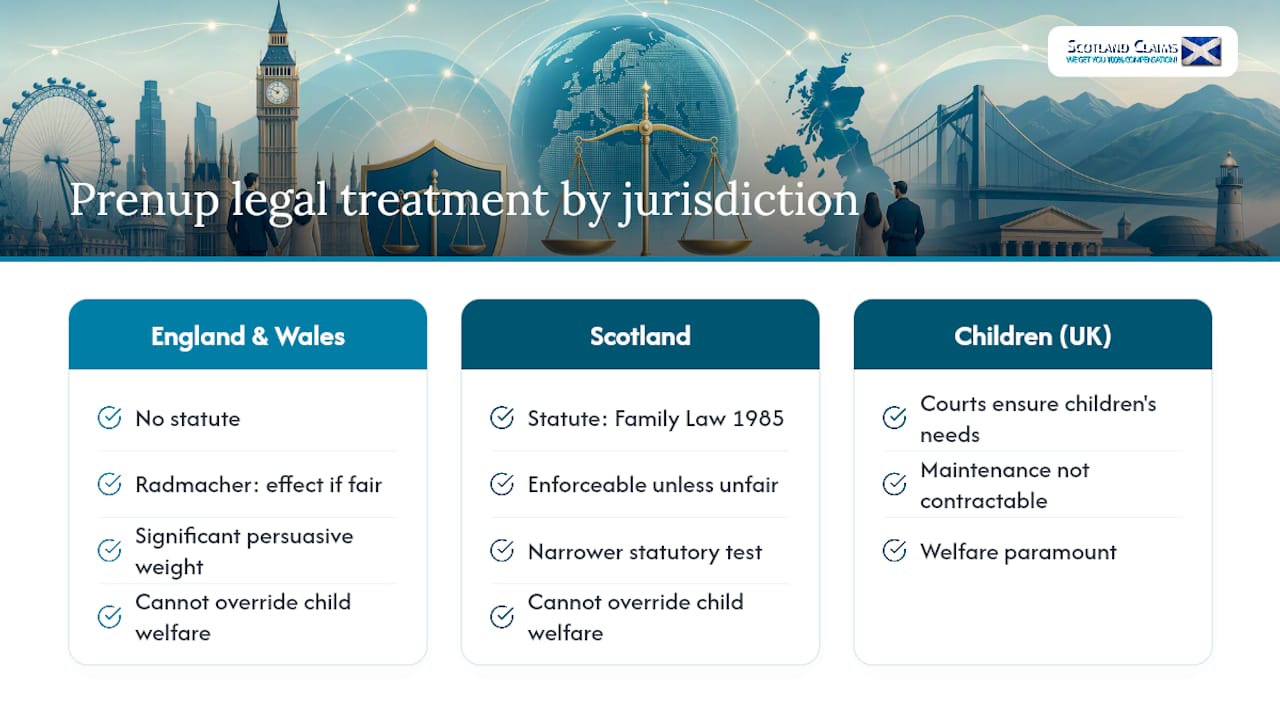
England and Wales don’t have a statute that makes prenups automatically binding, but the leading case changed the practical reality entirely. In Radmacher v Granatino, the Supreme Court ruled that courts should give effect to an agreement freely entered into with full appreciation of its implications, unless holding the parties to it would be unfair. That single principle now shapes how every English and Welsh court approaches a prenup dispute.
Courts should give effect to a nuptial agreement freely entered into by each party with a full appreciation of its implications, unless in the circumstances prevailing it would not be fair to hold the parties to their agreement.
The House of Commons Library’s research briefing confirms that prenups still aren’t automatically enforceable in England and Wales, but a properly executed agreement carries significant weight following Radmacher.
Scotland works differently, and more precisely. Under section 16 of the Family Law (Scotland) Act 1985, a prenup is generally enforceable, but a Scottish court can set it aside if it wasn’t fair and reasonable at the time it was made. That’s a narrower, statute-based test rather than a broad judicial discretion built case by case, which gives Scottish couples a slightly clearer sense of where the line sits.
What neither jurisdiction allows is a prenup that decides child maintenance or overrides a child’s welfare. Courts across the UK retain a duty to ensure children’s needs are met, and that duty simply cannot be contracted away, however carefully the agreement is worded.
Checklist: the safeguards that make a prenup more likely to be upheld
A prenup isn’t judged on paperwork alone. Courts look at how it was made, not just what it says. Five factors consistently decide whether an agreement gets respected or picked apart.
- Free consent. Neither party was pressured, rushed, or threatened into signing. Evidence of genuine willingness matters more than most people expect.
- Independent legal advice. Each partner instructs their own solicitor, separately. One lawyer advising both sides is a red flag that undermines the whole document.
- Full financial disclosure. Both parties lay out their assets, debts, and income honestly. Hiding a business interest or an inheritance can unravel the agreement entirely later.
- Timing. Sign well before the wedding, not the week of it; see our step-by-step guide for planning your wedding timeline effectively. A common guideline suggests allowing at least 28 days before the ceremony, so nobody can later argue they felt cornered by an approaching date.
- Fairness and needs. The terms must leave both parties, and especially any children, with reasonable provision. An agreement that strips one party of everything rarely survives scrutiny.
Pro Tip: Book your solicitor appointments the moment you set a wedding date, not two months before. Rushed drafting is the single most common reason agreements get challenged later.
What a prenup can and cannot include
A prenup works within limits, and knowing them saves arguments later. It can cover the division of assets built up individually or jointly, protect a business from being split on divorce, ring‑fence inheritances, allocate debts fairly, set out how pensions get treated, and even address spousal maintenance.
It cannot decide child maintenance or child arrangements. Those stay with the court, whatever the couple agreed beforehand. It also cannot include anything unlawful, and it shouldn’t try to control personal behaviour, things like weight clauses or fidelity penalties carry no legal force and tend to make the whole agreement look less serious.
A typical example: a couple agree the family business stays with the founding partner, savings built before marriage stay separate, but anything acquired jointly during the marriage gets split. That’s the kind of clause courts tend to respect.
How to create a prenuptial agreement: the practical steps
Setting one up follows a fairly predictable path, and knowing it in advance stops the process feeling rushed.
- Initial meeting. Each partner instructs a separate solicitor and discusses what they want the agreement to achieve.
- Financial disclosure. Both sides prepare full statements of assets, debts, pensions, and income, often with formal valuations attached.
- Drafting. One solicitor prepares a first draft based on both parties’ instructions and disclosed finances.
- Negotiation. Solicitors exchange comments and refine terms until both sides are comfortable.
- Independent advice confirmation. Each solicitor confirms their client understood the agreement before signing.
- Sign and store. The agreement is signed, dated well ahead of the wedding, and kept safely, ideally alongside copies of both parties’ wills.
Prepare asset lists, property valuations, pension statements, and existing wills before the first meeting; it speeds everything up considerably. Costs vary with complexity: a straightforward agreement between two people with modest assets costs less than one involving a business, overseas property, or a blended family with children from a previous relationship. Booking solicitors early, ideally months rather than weeks before the wedding, also keeps costs down by avoiding rushed drafting fees.
What happens at divorce: enforcement, challenges and likely outcomes
A court treats a valid prenup as the starting point when dividing finances, not the final word. Judges can and do depart from its terms where following it strictly would leave someone, or their children, without enough to meet basic needs.
Challenges tend to fall into a handful of familiar categories: one party didn’t disclose assets fully, one party felt pressured or didn’t get independent advice, the agreement’s terms are unfair on their face, or circumstances have shifted so dramatically since signing (a serious illness, a child with additional needs) that holding to the original terms would cause real hardship.
In practice, outcomes vary with how carefully the agreement was built. A prenup signed with full disclosure, separate solicitors, and reasonable terms tends to survive intact. One signed the week before the wedding, with one party unrepresented and no financial disclosure, is far more vulnerable to being set aside or heavily revised.
Postnuptial agreements: the same idea, after the wedding
A postnuptial agreement does the same job as a prenup, but it’s signed after the marriage has already taken place, often when circumstances change, a business is started, an inheritance arrives, or a couple simply never got round to it beforehand. Courts apply broadly the same fairness and disclosure tests to postnups as they do to prenups. Couples sometimes choose a postnup deliberately, using it to formalise an understanding once life has settled rather than rushing terms before the ceremony.
The government’s 2026 consultation, ‘A Fairer End to Relationships’, proposes a new category called ‘qualifying nuptial agreements’. These would become binding, without the current level of judicial discretion, where couples meet strict safeguards: executing the agreement as a deed, taking independent legal advice, providing full financial disclosure, and signing at least 28 days before the wedding.
The Law Commission’s work on matrimonial property, needs and agreements has fed directly into this direction of travel, and the proposal deliberately keeps one limit fixed: children’s needs stay outside any agreement’s reach, whatever safeguards are met.
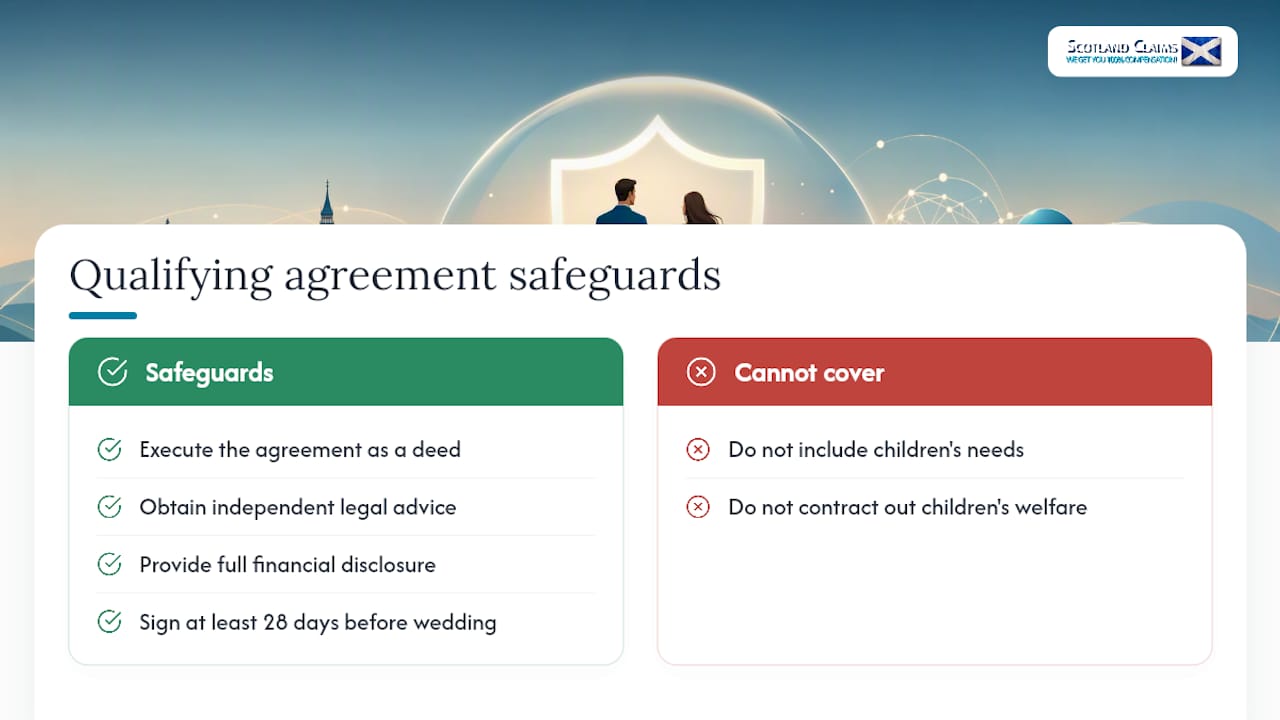
For couples planning a prenup now, the sensible approach is to draft as though these safeguards already apply. An agreement built on proper disclosure, separate advice, and generous timing will hold up whether the current discretionary approach continues or the qualifying agreement model becomes law.
Practical tips and red flags before you sign
Watch for pressure to sign quickly, secrecy about finances, or a partner suggesting you both use the same solicitor to “save money.” Each is a warning sign that could undermine the agreement later.
- Instruct separate solicitors from the outset, never a shared one
- Disclose every asset, debt, and pension honestly, even the awkward ones
- Keep copies of correspondence and drafts showing the process was unhurried
- Update your will alongside the prenup, since the two documents should tell the same story
Pro Tip: If your partner mentions the prenup for the first time less than a month before the wedding, treat that as a conversation starter, not a document to sign that week. Speak to a specialist family solicitor about your options before agreeing to anything.
Impact of prenups on spousal support beyond assets
Most people think about prenups purely in terms of property and savings, but a well‑drafted agreement can also shape spousal maintenance, sometimes called alimony in other jurisdictions. A prenup can set out whether one party will receive ongoing maintenance after divorce, for how long, and roughly how much, alongside the usual asset division.
Courts treat maintenance clauses with the same fairness lens applied to everything else in the agreement. A clause that leaves a lower-earning spouse with nothing, particularly one who gave up a career to raise children, is far more likely to be challenged successfully than one that provides reasonable, if modest, support.
This matters most in marriages with a significant income gap or where one partner stepped back from work. A prenup that ignores this entirely often ends up rewritten by a judge anyway, which defeats the purpose of agreeing terms in advance. The better approach builds in a maintenance review point, acknowledging that a couple’s circumstances ten years into a marriage may look nothing like they did on the wedding day, and that rigid terms drafted early can become unworkable later.
Publisher perspective: when to seek legal help and where to start
If you’re weighing up a prenup, get advice the moment serious conversations start, not once a date is booked. Timing and independent advice do more for enforceability than clever wording ever will. Family law sits outside our specialism at Scotland Claims Injury Lawyers, where our focus is personal injury claims across Scotland, but the same principle holds in our own field: proper advice early beats damage control later. If you’re separately dealing with an injury claim, our free legal advice resources explain what to expect and when to bring in a specialist.
— Roger
This article is general information, not a substitute for advice from a qualified lawyer. Consult a qualified legal professional about your own circumstances before acting on anything here.
Sources
FAQ
Who benefits most from a prenup?
Anyone with significant assets before marriage benefits, particularly business owners, people expecting an inheritance, and those entering a second marriage with children from a previous relationship.
Why aren’t prenups automatically legal in the UK?
England and Wales have no statute making prenups automatically binding; instead, courts follow the principle from Radmacher v Granatino, giving weight to freely made agreements unless enforcing them would be unfair. Scotland uses a statutory fairness test under section 16 of the Family Law (Scotland) Act 1985 instead.
Is the divorce rate higher with a prenup?
There’s no reliable evidence that signing a prenup causes divorce; couples who choose one tend to be those already managing complex finances, business interests, or blended families, not couples more prone to separating.
How does a prenup work in the UK?
A prenup records how assets, debts, and sometimes maintenance will be handled if a marriage ends. Courts in England and Wales usually respect it if signed freely with full disclosure and independent advice; Scottish courts enforce it unless it wasn’t fair and reasonable when made.
Can a prenup override child maintenance?
No. Courts across the UK retain the power to decide child maintenance and arrangements regardless of what a prenup states, and this limit isn’t expected to change under the proposed 2026 reforms.