
A compensation award does not have one universal effect on benefits in Scotland. How compensation affects benefits in Scotland in 2026 depends on the benefit you receive and the nature of the award. Benefit transfers matter too: from 6 November 2025, people in Scotland still receiving Personal Independence Payment must make a new application for Adult Disability Payment, and those still receiving Carer’s Allowance must apply for Carer Support Payment.
It’s understandable to worry that compensation could affect payments you rely on, particularly while disability and carer benefits are moving from the Department for Work and Pensions to Social Security Scotland. Keep the two issues separate: one is how a particular benefit treats an award; the other is which Scottish payment replaces an existing benefit. This article explains what to consider when compensation is paid, which disability and carer benefits are transferring, and what the changes mean for people receiving Universal Credit.
Key Takeaways
- Scottish benefits include devolved payments as well as benefits administered across the UK, so identify which system pays your benefit.
- Compensation can affect Universal Credit differently depending on how it is treated, making the distinction between income and capital important.
- Disability benefits are not all assessed in the same way as means-tested benefits; the type of payment matters.
- Personal injury trusts may be relevant when considering how to manage a settlement and its effect on means-tested benefits.
- Understand the benefit rules and transfer process alongside your compensation claim, so you can make informed decisions about your award.
Scottish benefits and how they differ from UK-wide benefits
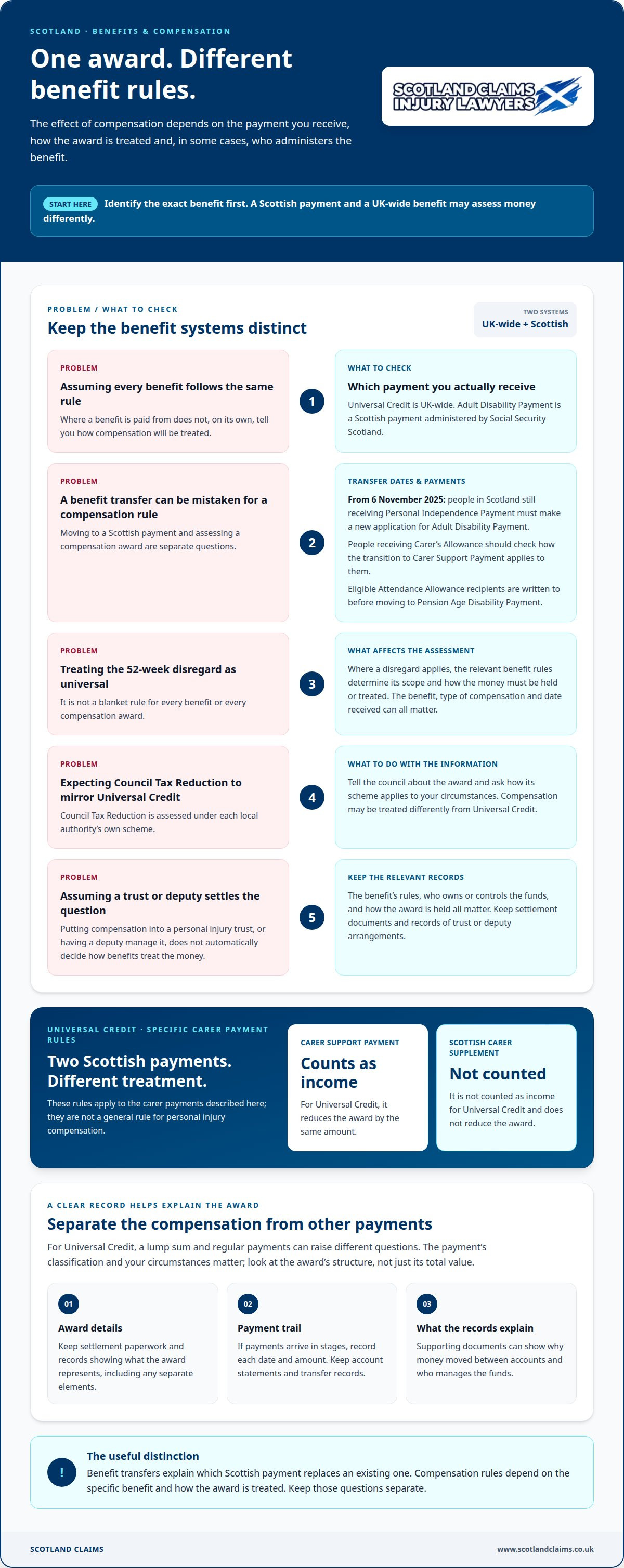
In Scotland, some benefits are devolved and administered by Social Security Scotland, while others remain UK-wide. That distinction matters because compensation rules depend on the benefit involved, not simply where you live. Universal Credit, for example, is a UK-wide benefit, while Adult Disability Payment is a Scottish payment.
Transfers are changing which organisation pays certain disability and carer benefits. From 6 November 2025, people in Scotland still receiving Personal Independence Payment must make a new application for Adult Disability Payment. If you receive Carer’s Allowance in Scotland, check how the transition to Carer Support Payment applies to you. Social Security Scotland writes to eligible Attendance Allowance recipients before moving them to Pension Age Disability Payment.
Carer Support Payment is Scotland’s equivalent of Carer’s Allowance. Carer Support Payment has its own eligibility conditions, so check the rules that apply to your circumstances. These are distinct from UK-wide benefit rules, so check which payment you receive before considering how a compensation award may affect your finances.
A 52-week disregard is not a blanket rule for every benefit or every compensation award. Where a disregard applies, the relevant benefit rules determine its scope and how the money must be held or treated. Identify the benefit, the type of compensation and the date it was received; those details can affect the assessment.
Council Tax Reduction is assessed by your local authority under its own scheme, so compensation may be treated differently from Universal Credit. Tell the council about the award and ask how its rules apply to your circumstances. Scottish benefits can have their own eligibility and assessment conditions rather than following one UK-wide formula.
Putting compensation into a personal injury trust or having a deputy manage it does not automatically determine how benefits will treat the money. The relevant benefit’s rules, who owns or controls the funds, and how the award is held all matter. Keep the settlement documents and records of any trust or deputy arrangements for the assessment.
To understand personal injury claims in Scotland, consider how the circumstances of the injury and the settlement may affect your wider finances. Separating the Scottish transfer process from each benefit’s compensation rules helps you identify which questions to address.
Other Carer Support Payment provisions may also be relevant when reviewing a change in circumstances. In Scotland, eligible carers can receive Carer Support Payment for 12 weeks after the death of the person they care for.
From 15 March 2026, Scotland removes the requirement to have provided care for 14 or 22 weeks out of the previous 26 weeks to be paid during a break in care. These provisions concern eligibility and payment periods, so check which applies to your circumstances alongside the compensation rules for the benefit you receive.
How compensation affects Universal Credit in Scotland 2026
Understanding how compensation affects benefits in Scotland in 2026 starts with identifying how Universal Credit treats the award. Universal Credit is a UK-wide benefit, including in Scotland, but compensation does not have one fixed effect on every claim. The payment’s classification and the claimant’s circumstances matter. A lump sum and regular payments can raise different questions, so look at the award’s structure, not just its total value.
Keep compensation paperwork separate from documents about Scottish benefit transfers. If you receive Universal Credit in Scotland, tell Universal Credit when your benefit moves so payments can continue. This step relates to transferring to a Scottish payment. It does not, by itself, establish how a compensation award will be assessed or change the rules that apply to it.
For a compensation payment, keep the settlement paperwork and records showing when and how the money was paid. Check what the award represents and whether it has separate elements. If payments arrive in stages, record each date and amount. These details explain the award more clearly than a bank statement alone, which may not show what a payment was for.
Carer payments show why Universal Credit treatment needs to be considered payment by payment. In Scotland, Carer Support Payment counts as income for Universal Credit and reduces the award by the same amount. The Scottish Carer Supplement is not counted as income for Universal Credit and does not reduce the award. These specific rules do not establish a general rule for personal injury compensation.
Record how the compensation is held and what happens to it. The payment date, settlement documents, account statements and transfer records help explain the financial history. For example, a statement may show money moving between accounts, while supporting records can explain why it moved and who manages the funds.
For anyone asking how compensation affects benefits in Scotland in 2026, the central point is to distinguish the compensation award from other income and payments. Consider Universal Credit separately from any Scottish benefit that transfers. If an award or another payment is relevant to the claim, organise its supporting documents so the different payments are clearly identifiable.
If a Universal Credit decision changes after a payment, read the decision and identify which income, capital or household detail it addresses. Compare the explanation with your settlement documents and payment history. This helps clarify what the decision concerns without assuming the compensation alone caused the change.
For injury claimants, compensation valuation and Universal Credit assessment are separate questions. A personal injury compensation estimate can help you consider a claim’s value, but it does not determine how Universal Credit treats the payment. Keep the settlement information and benefit paperwork organised to understand each issue on its own terms.
Does personal injury compensation count as capital for means-tested benefits in Scotland?
A personal injury award can affect means-tested benefits if it is treated as capital. The key distinction is whether money is received as a lump sum or treated as income. The rules of the benefit in question determine how an award is assessed. Do not assume that Universal Credit and Council Tax Reduction use identical assessments.
Capital means money or assets available to you, rather than regular income paid for a particular period. A settlement paid into your bank account can therefore raise a question about capital. The assessment considers the nature of the payment, how it is held and whether you can access it. Calling the money compensation does not, by itself, determine how it is treated.
Start with the award documents. Identify what the settlement covers, when it was paid and whether it includes separate elements. Keep the settlement breakdown with your bank records. If the money is paid in stages, record each payment date and amount. This helps distinguish a lump sum from any continuing payment.
The impact depends on the means-tested benefit involved and its capital rules. An award may affect eligibility or the amount payable if the assessment counts it as available capital. The same settlement may therefore need separate consideration under Universal Credit and your local Council Tax Reduction scheme. A decision about one benefit does not automatically settle the other.
What happens to the funds after payment can also matter. Spending compensation on ordinary living costs or necessary items changes the balance held. Keep receipts and a clear record of significant spending. If you transfer money to another person or account, record the reason and who controls it. The assessment considers the actual arrangement, not just its label.
Do not treat a 52-week disregard as a universal protection for every award and benefit. The applicable disregard depends on the benefit’s rules and the circumstances in which compensation is held. Check the specific decision against the award paperwork, and keep correspondence about how the payment has been assessed.
A personal injury trust is one arrangement to consider when planning how compensation is held. Its existence alone does not determine how every benefit will treat the funds. The trust documents, control of the money and relevant benefit rules all matter. If a deputy manages the award, keep clear records of who manages the funds and for whose benefit.
Keep a simple file with the settlement breakdown, payment dates, account statements, and records of spending or transfers. These details help explain the award if a benefit assessment changes. For a Scottish claim, understanding the settlement and how it is paid is part of considering your financial position alongside any means-tested support.
How does compensation affect Adult Disability Payment, Personal Independence Payment and Child Disability Payment
Adult Disability Payment (ADP), Personal Independence Payment (PIP) and Child Disability Payment (CDP) are disability benefits. Personal injury compensation is a separate payment. Keep the two matters distinct when reviewing your finances: award documents explain what compensation was paid for, while benefit paperwork relates to the disability payment and its assessment.
For ADP, PIP and CDP, focus on the information used to assess the disability benefit, rather than assuming a compensation settlement changes the person’s needs. Keep evidence about the injury, its effects and any support required. A settlement does not, by itself, describe day-to-day needs or explain how those needs affect the person receiving the benefit.
The transfer from PIP to ADP is a separate issue. From 6 November 2025, people in Scotland still receiving PIP must make a new application for ADP. If compensation is paid around the same time, keep the transfer paperwork and settlement records separate. This makes it clearer which documents relate to the benefit move and which describe the injury award.
CDP concerns support for a child with a disability, so organise records around the child’s needs and the compensation award. For example, keep the settlement breakdown separate from documents describing the child’s daily support requirements. The award paperwork can explain the purpose of the compensation; disability evidence can describe the child’s circumstances.
Do not treat a change in the compensation balance as proof that a disability benefit decision should change. Consider three separate questions: what the settlement covers, what the disability benefit assessment considers, and whether a transfer or review is underway. If the recipient receives both a disability payment and a means-tested benefit, assess each under its own rules.
When a decision letter arrives from Social Security Scotland or the Department for Work and Pensions, identify the benefit named and the issue it addresses. A letter about moving from PIP to ADP is different from a decision about compensation. File each notice with its supporting documents and note any request for information or response deadline stated in the letter.
For an injury claim, a clear account of the injury and its effects helps distinguish the compensation matter from disability-benefit paperwork. Record the settlement purpose, any transfer correspondence and the evidence supporting the person’s needs. This is especially useful when the same injury is relevant to both the compensation claim and a benefit review.
In short, keep ADP, PIP or CDP records focused on disability support, and keep settlement documents focused on compensation. The PIP-to-ADP application requirement from 6 November 2025 is a transfer step, not a description of how an injury award is assessed. Keeping the two records organised makes each decision easier to understand.
Protecting benefits with personal injury trusts in Scotland
A personal injury trust can hold compensation separately, but setting one up does not automatically protect means-tested benefits. The effect depends on the benefit involved and the trust’s terms and operation. Treat the trust as part of careful settlement planning, not as a guaranteed way to preserve every payment.
Before compensation is paid, clarify what the proposed trust would do. Consider who would manage the funds, how decisions would be made and how the money could be accessed. These details help explain the arrangement if a benefit assessment asks who controls the compensation. The trust document alone may not describe every practical detail.
Keep trust funds separate from everyday spending wherever the arrangement requires it. Retain the settlement breakdown, trust documents, account statements and payment records. For example, if a trustee pays for an item from the fund, keep the invoice and note its purpose. Clear records show how the award has been handled.
Different benefits may assess compensation under different rules, so consider Universal Credit and Council Tax Reduction separately. A decision about one payment does not establish how another will treat the same trust. Identify each means-tested benefit in your household and understand what information its assessment requires.
A trust should reflect the actual arrangements for managing compensation. The people named to manage the fund, their powers and the beneficiary’s access all matter when explaining how it works. If a deputy manages the award, keep clear records of the deputy’s role and decisions. The trust’s title alone does not explain ownership or control.
Timing matters when planning. Discuss the proposed arrangement before settlement funds arrive so the trust documents and payment route can be considered together. If compensation has already arrived, keep a precise record of where it is held and any transfers. Avoid unexplained movements between accounts, which can make the financial history harder to follow.
If a benefit decision refers to compensation held in trust, compare its reasoning with the trust documents and transaction records. Identify whether the decision concerns access, control or another feature of the arrangement. Keep copies of correspondence and provide relevant documents in response to requests, rather than assuming the trust automatically resolves the assessment.
In Scotland, a personal injury trust may form part of planning around a settlement and means-tested support. Its effect depends on the benefit involved and how the trust operates. A clear paper trail helps explain the facts, but the trust is not a universal exemption from benefit rules.
Estimate your personal injury compensation
Scotland Claims Injury Lawyers: Road Traffic Accident Claims
Scotland Claims Injury Lawyers can help if you’ve been injured in a road traffic accident in Scotland and want to pursue compensation. Its Road Traffic Accident Claims service is relevant when you’re considering a claim and need support with the compensation process. The firm’s 100% compensation promise means it recovers its fees from the at-fault party and passes the full settlement to you.
Compensation and benefit assessments are separate matters. Keep your settlement documents and benefit records organised so you can explain the award and how it is held. If an accident at work or a slip or trip caused your injury, those claim routes may also be relevant.
Contact Scotland Claims Injury Lawyers to discuss a road traffic accident claim, or visit its Scotland injury lawyers page.
Make your next decision with a clear picture
Understanding how compensation affects benefits in Scotland in 2026 is not only about the final award. The way a settlement is described, paid and managed can shape the questions you need to consider alongside your benefit arrangements. Before making decisions, bring together your settlement paperwork, benefit letters and records of where the money is held. A clear timeline can help you explain what happened and when.
If an injury has left you considering a claim, Scotland Claims Injury Lawyers handles road traffic accident, slip or trip, and work injury claims across Scotland. The firm can help you pursue compensation for an eligible personal injury while you consider any benefit implications. A claim may be a useful next step if an accident caused an injury and you want to understand your options.
Take the next step at a pace that suits you. A clear account of your circumstances is a practical place to start.
You can move forward with greater confidence by considering your claim and benefit questions carefully.
Frequently Asked Questions
What are the rules for disregarding compensation for 52 weeks after receipt?
A 52-week disregard is not a blanket rule for every benefit or compensation award. The relevant benefit’s rules determine whether it applies, its scope, and how the money must be held or treated.
What are the risks of deliberately spending or giving away compensation to qualify for benefits?
Spending compensation changes the balance held. If you transfer it to another person, record the reason and who controls the funds. Keep receipts and clear records, because the assessment considers the facts of the arrangement, not just its label.