Based on reporting by STV News, 2 October 2026. All rights in the original report remain with the publisher.
What was reported
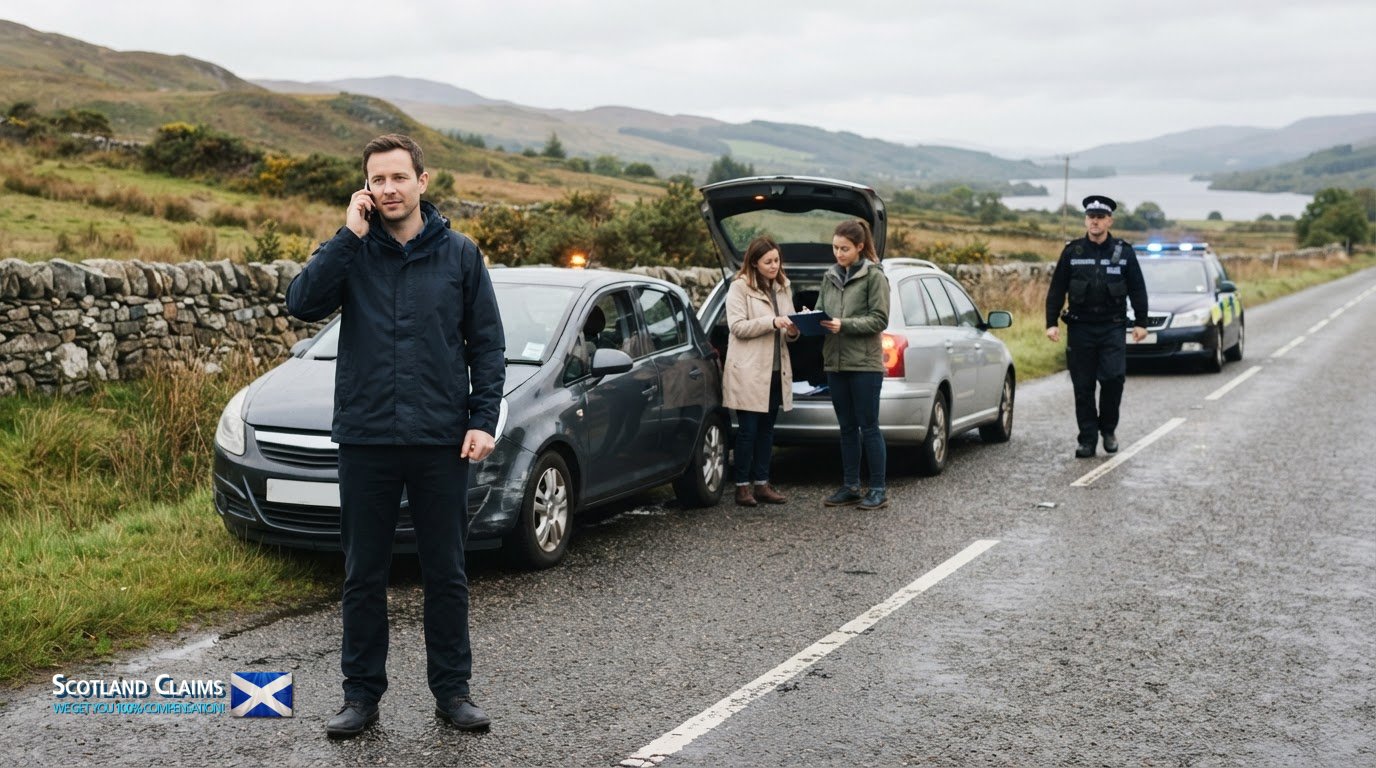
According to STV News, police were called to the A867 near Loch A'Bhruid on North Uist on the evening of Wednesday 30 September 2026, following a collision between two cars. A man in his early forties, who had been driving one of the vehicles, was airlifted to the Queen Elizabeth University Hospital in Glasgow, where he died shortly after arriving. A second man, in his mid-thirties, was taken to Benbecula Hospital for treatment, as reported by STV News.
The road was closed for approximately 24 hours while police carried out their investigations, reopening the following evening. Police Scotland has appealed for witnesses to come forward and is asking anyone who was in the area and may have dash-camera footage to contact officers, quoting the relevant incident reference.
A Police Scotland sergeant was quoted by STV News as extending condolences to the family and friends of the man who died, and confirming that enquiries to establish the full circumstances of the crash remain ongoing.
Road traffic accident claims in Scotland
When a person is killed or seriously injured in a road traffic collision in Scotland, the law provides a framework through which compensation may be sought. Claims of this kind are typically brought against the insurer of the vehicle whose driver is found to have been at fault. In incidents involving two or more vehicles, establishing liability requires a careful examination of the circumstances, which may include witness accounts, police reports, forensic evidence and any available camera footage.
In incidents of this kind, liability often rests with the driver, or drivers, whose actions are found to have contributed to the collision. Scotland operates a system of contributory negligence, meaning that if more than one party bears some responsibility, compensation can be apportioned accordingly. Where a driver is uninsured or cannot be traced, the Motor Insurers' Bureau may meet a valid claim on behalf of the injured or bereaved party.
Fatal accident claims in Scotland are governed principally by the Damages (Scotland) Act 2011. This legislation sets out who is entitled to claim and what losses can be recovered. Close relatives of a person who has died as a result of another party's negligence may have a right to compensation, and it is important that those affected understand that entitlement before making any decisions about whether to pursue a claim.
Time limits
Under the Prescription and Limitation (Scotland) Act 1973, a claim arising from a personal injury or a death caused by negligence must ordinarily be raised within three years. In a fatal case, that three-year period typically runs from the date of the death. Where a person was injured and later died from those injuries, the limitation period for the deceased's own claim runs from the date of death rather than the date of the collision.
There is no obligation to act immediately. The law recognises that those who have suffered bereavement need time to grieve and to make considered decisions. However, waiting beyond the three-year period will normally extinguish the right to bring a claim entirely, so it is wise to seek advice at a point that feels appropriate, and well within that limit.
The court retains a discretion to allow a late claim in exceptional circumstances, but this is not something that can be relied upon, and the threshold for exercising that discretion is high.
What compensation can cover
Under the Damages (Scotland) Act 2011, qualifying relatives of a person who has died as a result of negligence may be entitled to several heads of compensation. These include the following.
- Loss of support: where the deceased provided financial support to family members, those dependants may be able to recover the value of that support for the period they would have continued to receive it.
- Funeral costs: reasonable funeral and burial or cremation expenses are recoverable.
- Grief and loss of society: the Act provides for a sum to acknowledge the grief suffered by close relatives and the loss of the deceased's companionship, care and guidance. This is sometimes referred to as a loss of society award.
- Services: where the deceased provided practical services in the home, such as childcare or household tasks, the value of those services may also be recoverable.
Where the injured person survived for a period before dying, a separate claim may exist in respect of the pain, suffering and loss of earnings experienced during that time. That claim passes to the deceased's estate.
It is worth noting that personal injury claims in Scotland are commonly handled on a no-win, no-fee basis, and any fees are not deducted from the compensation itself.
Frequently asked questions
Who can bring a compensation claim after a fatal road accident in Scotland?
Under the Damages (Scotland) Act 2011, a defined group of close relatives can bring a claim. This typically includes a spouse or civil partner, a cohabiting partner, children, parents and siblings of the deceased. Each qualifying relative's entitlement is assessed individually, and the claim is usually coordinated through a single legal process.
How long does a fatal accident claim in Scotland typically take to resolve?
The length of time varies considerably depending on how complex the circumstances are, whether liability is disputed and how long it takes to gather evidence. Some straightforward claims are resolved within twelve to eighteen months, while others involving disputed liability or complex financial losses can take longer. Police investigations running alongside a civil claim can also affect timing.
Does the police investigation affect whether a civil claim can succeed?
A civil claim and a criminal or fatal accident investigation run separately. A civil claim does not depend on a criminal conviction, and evidence gathered during a police investigation can be relevant to a civil case. However, the standard of proof in a civil claim is lower than in criminal proceedings, meaning a claim can succeed even if no one is prosecuted.
What if the collision involved two vehicles and fault is not yet clear?
It is not uncommon for liability to be contested or unclear in the early stages after a collision. Relatives are not required to wait until fault has been fully determined before seeking advice. A legal adviser can begin gathering evidence and advising on prospects while investigations continue. The three-year time limit applies regardless of how long any separate investigation takes.
What happens if the driver responsible was uninsured?
If the driver found to be at fault was uninsured, or if their identity cannot be established, the Motor Insurers' Bureau operates schemes to compensate those who have suffered injury or bereavement. Specific procedural rules apply to these claims and it is important to follow them carefully, which is another reason why early advice is beneficial.
Based on reporting by STV News, 2 October 2026. All rights in the original report remain with the publisher.