
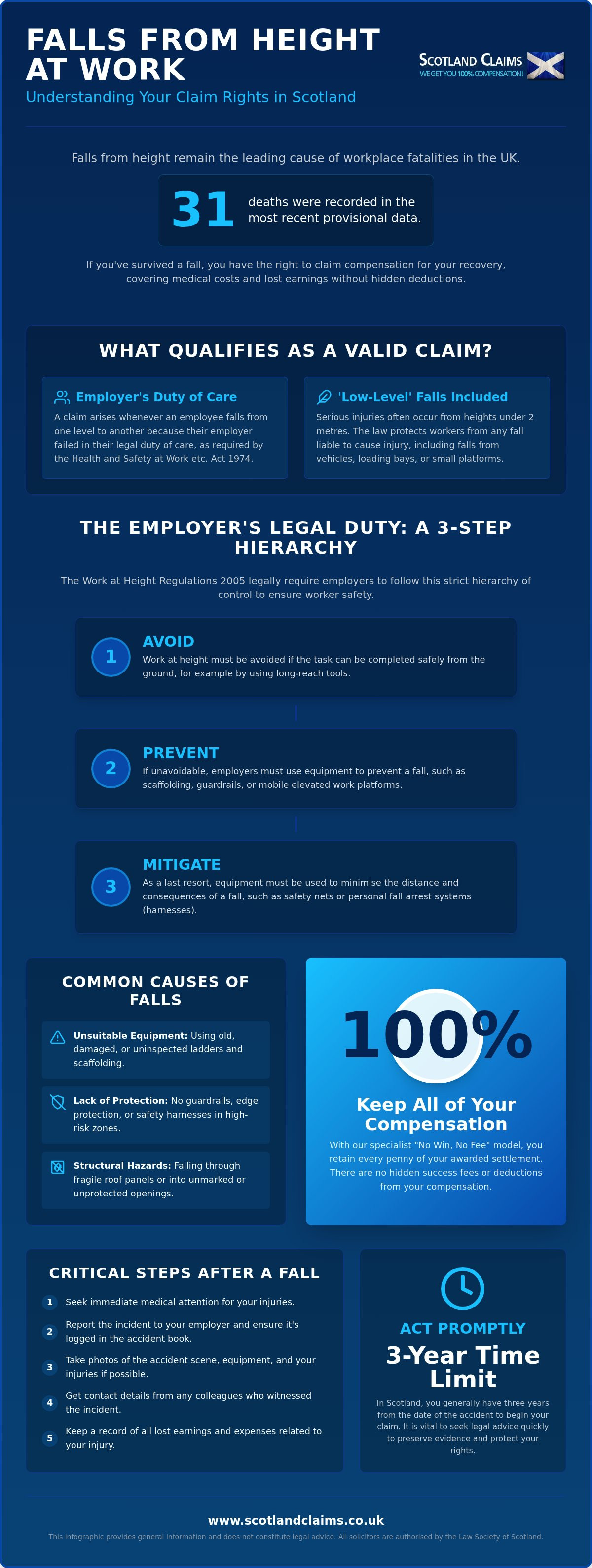
Did you know that falls from height remain the leading cause of workplace fatalities in the UK, with 31 deaths recorded in the most recent provisional data? If you have survived such an incident, you are likely facing significant stress regarding lost wages and your future. You shouldn't have to sacrifice a large portion of your settlement to a solicitor just to get the justice you deserve. Making a fall from height at work claim Scotland should be about your recovery, not your lawyer's profit margin.
It's natural to feel hesitant. You may worry about employer retaliation or feel confused by the fine print of "No Win No Fee" agreements that often hide success fees. The Scottish legal system offers a path where you don't have to settle for less. We're here to ensure you understand your rights and the protections available to you under the Work at Height Regulations 2005.
This guide explains how to secure 100% of your compensation for medical costs and lost earnings without hidden deductions. You'll discover the exact steps to navigate the legal process and why our specialist approach keeps every penny in your pocket. We will break down the three-year time limit and how to protect your financial future today.
Key Takeaways
- Learn what qualifies as a valid legal claim, covering everything from scaffolding incidents to low-level falls in loading bays.
- Understand how the Work at Height Regulations 2005 protect you by requiring employers to avoid or prevent all risks of falling.
- Discover how to successfully navigate a fall from height at work claim scotland while retaining every penny of your awarded settlement.
- Identify the critical steps to take immediately after an accident, including how to secure vital medical and workplace evidence.
- Find out how our "No Win No Fee" model ensures you have risk-free access to expert solicitors authorised by the Law Society of Scotland.
What Qualifies as a Fall from Height at Work Claim in Scotland?
A fall from height at work claim scotland arises whenever an employee falls from one level to another because their employer failed in their duty of care. This isn't just about falling from a roof. It applies to any scenario where your safety was compromised by negligence. If your employer didn't provide the right equipment or skipped vital training, they are likely liable for your injuries. You deserve a settlement that covers every aspect of your recovery.
The legal foundation for these claims rests on the Health and Safety at Work etc. Act 1974. This act mandates that employers take all reasonably practicable steps to ensure your safety. In Scotland, the legal system follows specific protocols designed to streamline personal injury cases. These rules ensure that victims of negligence can access justice quickly, provided the fall was preventable. We focus on proving this preventability to secure your full compensation.
Common Causes of Workplace Falls
Many people assume accidents are just bad luck. The reality is usually different. Most falls are the direct result of systemic failures in the workplace. We frequently see claims involving:
- Unsuitable equipment: Using old, damaged ladders or scaffolding that hasn't been properly inspected by a competent person.
- Lack of protection: Working in high-risk zones without guardrails, edge protection, or suitable safety harnesses.
- Structural hazards: Falling through fragile roof panels or into "hidden" drops on construction sites and warehouses.
If you've experienced any of these, you may be eligible for work injury compensation. Our role is to prove that the risk was identifiable and the fall was avoidable. We stand as a protective advocate to ensure your employer's insurer takes your claim seriously.
The Reality of 'Low-Level' Falls
You don't need to fall from a skyscraper to have a valid case. In fact, many serious injuries occur from heights of less than two metres. According to HSE 2026 guidelines, work at height is defined as work in any place where, if precautions were not taken, a person could fall a distance liable to cause personal injury. This definition is deliberately broad to protect you in varied environments.
We handle many claims involving falls from vehicles, loading bays, or even single steps. A fall from a tail lift or a small platform can cause broken bones or spinal damage just as easily as a fall from a ladder. The law doesn't care about the number of metres; it cares about the failure to prevent the drop. If the equipment was faulty or the area was unsafe, the height is irrelevant to your right to claim.
The Scottish civil courts use a specific pre-action protocol for these cases. This ensures that insurers must respond to your claim within fixed timeframes. By choosing a specialist who understands these nuances, you ensure that your fall from height at work claim scotland is handled with the efficiency it requires, resulting in a 100% compensation award.
Employer Duties Under the Work at Height Regulations 2005
Employers in Scotland must follow a strict "hierarchy of control" to keep you safe. This isn't a set of suggestions; it's a legal requirement under the Work at Height Regulations 2005. The first step is avoidance. If a task can be completed from the ground using long-reach tools, your employer shouldn't ask you to climb. If they ignore this and you're injured, your fall from height at work claim scotland becomes significantly stronger.
When working at height is unavoidable, prevention and mitigation become the priorities. Prevention involves using collective equipment like guardrails or scaffolding to stop a fall before it happens. Mitigation is the final safety net. It involves using equipment like safety bags or nets to minimise the distance and consequences of a fall. If your employer skipped these steps to save time or money, they've breached their duty of care. Every staff member must also be competent and authorised, meaning they need specific training before they ever leave the ground.
The Importance of Risk Assessments
A "generic" risk assessment is often a clear sign of employer negligence. Every job at height requires a specific, documented plan that accounts for the unique hazards of the site. This includes checking maintenance logs and ensuring equipment inspections are up to date. In Scotland, weather conditions like high winds, sleet, or ice on walkways are critical factors. If your employer forced you to work on an icy roof without extra precautions, they are liable for the results. We look for these gaps in documentation to prove your case and secure your award.
Employee vs Employer Responsibilities
Insurers often try to shift the blame onto the injured worker. They might claim you were "clumsy" or didn't follow a specific verbal instruction. This is known as contributory negligence, but it's often a myth used to reduce your payout. Whilst you're expected to follow your training, the ultimate legal responsibility for safety rests with the boss. If they didn't provide a safe environment, your own minor error doesn't wipe out their liability. Scotland Claims Injury Lawyers assesses liability for free, so you can find out if you have a case without any upfront cost. We don't let insurers bully our clients into accepting blame for an employer's failure.
Calculating Your Payout: Why 100% Compensation Matters
Most firms in the UK operate on a model that prioritises their profit over your recovery. They often take a "success fee" of 20% or more from your final award. This means that even if you win your case, you still lose a significant chunk of your money to your own solicitor. We believe this is inherently unfair. Your compensation is designed to restore your life, not to fund a law firm's overheads. When you pursue a fall from height at work claim scotland with us, we recover our legal fees directly from the at-fault insurer. This leaves your award completely untouched and in your pocket.
In the Scottish legal system, your claim is split into different categories to ensure total coverage of your losses. The most common is "solatium." This is the specific term for the money awarded for your actual pain and suffering. It's not just a gesture; it's a calculated value based on the severity of your physical or psychological trauma. Beyond solatium, we fight for your economic protection. This includes every penny of lost wages, future earnings if you can't return to your trade, and the cost of private physiotherapy to speed up your recovery. We ensure every financial vulnerability is addressed by the insurer.
The Financial Difference: 100% vs 80%
The impact of a success fee becomes clearer when you look at the real-world numbers. In a scenario where you suffer a minor fall and are awarded £5,000, a standard firm might only pay you £4,000 after deductions. With us, you keep the full £5,000. If you suffer a serious injury, such as a spinal fracture, and receive £30,000, a success fee would strip £6,000 from that award. We ensure you keep every penny of that £30,000. Scotland Claims Injury Lawyers never charges a success fee.
What Factors Affect Your Settlement Value?
Determining the value of your case isn't guesswork. It's based on concrete evidence provided by medical experts and financial records. The court looks at the severity of your injury and how long your recovery is expected to take. If a fall from a ladder has ended your career in construction or another physical trade, your payout will reflect that lifelong loss of income. We also account for any modifications you might need for your home or car. To get a better idea of what your specific case is worth, you should use our Compensation Calculator. This tool provides an estimate based on current Scottish judicial guidelines, giving you a clear starting point for your recovery.
Steps to Take After a Fall at Work in Scotland
The moments following a workplace accident are critical. Your first priority must be your health. Seek medical attention immediately at an A&E department or with your GP. These medical records serve as the primary evidence for your fall from height at work claim scotland. They provide an objective account of your injuries and the treatment required from day one. Without this documentation, insurers will likely dispute the severity of your condition.
Once you are stable, ensure the incident is reported. Every workplace must maintain an accident book. Recording the fall here creates a formal paper trail that your employer cannot easily ignore later. Take clear photographs of the scene and any faulty equipment, such as a broken ladder or unsecured scaffolding. If colleagues saw what happened, get their contact details. Witness statements are often the deciding factor in proving negligence in the Scottish courts.
You must also be aware of the strict time limits involved. Under the Prescription and Limitation (Scotland) Act 1973, you generally have three years from the date of the accident to initiate legal proceedings. If you miss this deadline, you lose your right to compensation entirely. Don't wait until the final months to act. Starting early allows your solicitor to gather fresh evidence and build a robust case while the details are still clear in everyone's minds.
Gathering Evidence for a Scottish Claim
Evidence is time-sensitive. CCTV footage in warehouses or construction sites is often overwritten within 30 days. We act quickly to secure these recordings before they vanish. We also arrange for you to see independent medical experts who understand the Scottish court process. They provide the detailed reports needed to value your claim accurately. Remember to keep every receipt for "out of pocket" expenses, including travel to hospital and prescription costs. These are fully recoverable as part of your settlement.
Dealing with Employer Retaliation
Many workers fear they will lose their job if they claim. This is a common misconception. You have a legal right to seek compensation without being dismissed or treated unfairly. Your claim is not paid out of your employer's personal pocket; it is handled by their compulsory Employer's Liability Insurance. Most businesses expect these claims and are prepared for them. If you want to learn more about your protections, read our guide on Accident at Work Scotland for a deeper look at your rights.
Start your 100% compensation claim today
Start Your No Win No Fee Fall Claim with Scotland Claims Injury Lawyers Today
You deserve justice without financial risk. Our "No Win No Fee" model ensures that if we don't win your case, you don't owe us a single penny. This removes the barriers that often prevent injured workers from seeking the settlement they are legally entitled to. Every fall from height at work claim scotland we manage is handled by solicitors authorised by the Law Society of Scotland. You aren't dealing with a generic call centre. You're working with protective experts at Scotland Claims Injury Lawyers who have a 20-year heritage through Kerr Brown Solicitors.
We provide unwavering advocacy for individuals against large insurance entities. This isn't just about winning; it's about fairness. Our 24-hour freephone helpline is available whenever you need reassurance or an update on your case. We operate with total transparency, ensuring you feel empowered rather than intimidated by the legal process. Our goal is a full financial recovery that covers your medical costs and every penny of your lost wages.
How the Process Works with Scotland Claims Injury Lawyers
We've designed our system to be fast-paced and methodical. We move you through a clear sequence to ensure there is no friction in your recovery path. We handle the heavy lifting so you can focus on getting better.
- Step 1: You receive a free, no-obligation assessment of your fall at work. We look at the facts of your accident and determine liability immediately.
- Step 2: We take over all communication. You won't have to speak to your employer's insurance company or navigate complex third-party paperwork yourself.
- Step 3: Once the case is settled, you receive your full award. Unlike other firms that take a 20% cut, you receive your settlement with zero deductions for our fees from your injury award.
Why Choose a Specialist Scottish Firm?
Scotland has a unique legal system that requires specialist knowledge. You need a team that understands the specific procedures of the Sheriff Court and the Court of Session. We don't use generic UK templates. We apply a deep understanding of Scottish health and safety standards and current industry trends to every case. This local expertise allows us to challenge insurers who try to exploit legal nuances to lower your payout for a fall from height at work claim scotland. We know how the Scottish courts value injuries, and we don't stop until you get the maximum amount possible.
Your injury shouldn't be a source of profit for a law firm. Our 100% promise means your compensation belongs entirely to you. It's your injury, your claim, and it should be 100% your compensation. Contact Scotland Claims Injury Lawyers now to secure your 100% compensation and start your journey toward a full financial recovery today.
Secure Your Financial Recovery Today
You now understand how the Work at Height Regulations 2005 protect you and why the Scottish legal system requires a specialist approach. A workplace accident shouldn't leave you struggling with lost wages or hidden legal fees. By choosing a model that recovers costs from the at-fault insurer, you ensure that your award remains entirely yours. Making a fall from height at work claim scotland is about regaining your stability and holding negligent employers accountable.
Our 100% Compensation Guarantee means you keep every penny of your settlement. As a firm regulated by the Law Society of Scotland, we provide expert advocacy with zero financial risk. Our No Win No Fee framework ensures that justice is accessible to everyone, regardless of their current financial situation. Don't let an insurer dictate the value of your recovery. You have the right to a full financial restoration.
Keep 100% of your payout: start your claim with Scotland Claims today
Take the first step towards a full recovery with confidence. We're here to guide you through every stage of the process and ensure your interests are always prioritised.
Frequently Asked Questions
Can I claim if I was partially at fault for my fall from height?
Yes, you can still claim even if you believe you were partially responsible. This is known as "contributory negligence." The court will assess the level of fault and adjust your payout accordingly. If your employer failed to provide correct equipment or training, they remain primarily liable. Don't assume you have no case without a professional assessment of your fall from height at work claim scotland.
How much compensation will I receive for a fall at work in Scotland?
Compensation values depend on the severity of your injury and your total financial losses. Payouts for minor fractures may start around £5,000, whilst serious spinal or head injuries can reach hundreds of thousands of pounds. We calculate your award by combining "solatium" for pain and suffering with your lost earnings and medical expenses. This ensures your financial recovery is complete and fair.
Will I lose my job if I make a claim against my employer?
It is illegal for an employer to dismiss you or treat you unfairly for pursuing a claim. UK employment law protects you from such retaliation. Your employer's liability insurance pays the compensation, so the money doesn't come out of the business's daily operating budget. Most employers understand that these claims are a standard part of managing workplace risks and insurance requirements.
What is the time limit for making a fall from height claim in Scotland?
The strict time limit for a fall from height at work claim scotland is three years from the date of the accident. This is governed by the Prescription and Limitation (Scotland) Act 1973. If you don't initiate legal proceedings within this window, your claim will likely be time-barred. It's vital to contact a specialist early to ensure all evidence, such as CCTV or witness memories, is preserved correctly.
How can Scotland Claims offer 100% compensation when others don't?
We recover our legal fees directly from the at-fault party's insurance company rather than taking a cut of your award. Many UK firms charge a "success fee" of up to 20% of your compensation. We refuse to do this. Our model prioritises your financial restoration, ensuring you receive 100% of the settlement awarded by the court or the insurer without any hidden deductions or surprises.
What happens if my employer doesn't have an accident book?
Your claim can proceed even if your employer failed to record the incident in an accident book. Whilst a formal record is helpful, we can prove the accident occurred using medical records from A&E, witness testimonies, and dated photographs of your injuries or the site. An employer's failure to maintain an accident book is actually a breach of their statutory health and safety duties and reflects poorly on them.
How long does a workplace fall claim usually take to settle?
Straightforward claims usually settle within six to twelve months. If your injuries are complex and require long-term medical monitoring to determine the full impact on your life, the process can take longer. We always strive to secure interim payments where liability is admitted. This provides you with immediate financial support for medical costs and bills whilst we finalise the full value of your settlement.
Can I claim for a fall if I am a self-employed contractor?
You can often claim as a self-employed contractor if the site owner or the company that hired you controlled the working conditions. Under the Work at Height Regulations 2005, those in control of a site have a duty of care to everyone working there. If they provided faulty scaffolding or failed to secure a fragile roof, they are likely liable for your injuries regardless of your specific employment status.