Digby Brown vs Scotland Claims: which is right for you?

TL;DR:
- Choosing the right legal firm is crucial for maximizing compensation and receiving proper support after an injury. Scotland Claims offers lower fees, including no charges for innocent road traffic or whiplash claims, and specializes in straightforward, accessible service, while Digby Brown excels in complex, high-value cases with expert accreditation. Prioritizing transparent fees, specialist experience, and trauma-informed support can significantly influence your claim’s success and your overall recovery process.
When you have been injured through no fault of your own, choosing the right legal firm feels overwhelming. The Digby Brown vs Scotland Claims comparison is one of the most common searches made by people in Scotland weighing up their options for personal injury claims. Most people assume all solicitors offer the same service at roughly the same cost. They do not. The differences in fees, specialist expertise, and client support can significantly affect how much compensation you actually receive and how supported you feel throughout the process.
Table of Contents
Key takeaways
| Point |
Details |
| Specialist accreditations matter |
Digby Brown holds unique APIL brain, spinal, and fatal accident specialist recognitions in Scotland. |
| Fee structures differ significantly |
Scotland Claims charges a maximum of 15% on serious injuries, lower than the 20-25% typical of larger firms. |
| Road traffic accident clients keep everything |
For whiplash and RTA claims where you are not at fault, Scotland Claims takes nothing from your compensation. |
| Prescription deadlines are strict |
Scottish courts apply a three-year limit strictly; early legal advice protects your right to claim. |
| Client support affects outcomes |
Trauma-informed care and thorough investigation services can influence both recovery and claim success. |
Digby Brown vs Scotland Claims: understanding your options
Before comparing the two firms directly, it helps to understand how personal injury claims in Scotland actually work. The process is governed by Scots law, which differs from English law in important ways. You generally have three years from the date of your injury, or from when you first became aware of it, to bring a claim. Most claims settle within 12 to 18 months, though complex cases involving serious injuries or disputed liability can take longer.
Specialist knowledge is not a luxury in this area. It is the difference between a claim being handled competently and one being handled exceptionally. Accreditations from the Association of Personal Injury Lawyers (APIL) signal that a solicitor has demonstrated a high level of expertise in a specific injury type. This matters most in cases involving brain injuries, spinal cord damage, or fatalities, where the legal and medical complexity is considerable.
Digby Brown holds a remarkable distinction in this regard. The firm has the only two lawyers in Scotland accredited as both brain and spinal cord injury specialists, and the only three accredited as fatal accident experts. These are not honorary titles. They reflect years of specialist practice and peer assessment.
Scotland Claims connects injured people with specialist injury lawyers who understand the Scottish legal system and the particular demands of claims litigation in Scotland. The focus is on making the process as straightforward as possible, with clear communication and no upfront costs.
Pro Tip: Before instructing any solicitor, ask directly about their specific experience with your type of injury. A general personal injury practice and a specialist firm are not the same thing, and the difference shows in results.
Fee structures: what you actually keep
This is where the comparison becomes very practical. Fee arrangements in personal injury claims Scotland follow a no win no fee model across most firms, but the percentage taken from your compensation on a successful claim varies considerably.
Here is how the two firms compare on fees:
| Claim type |
Digby Brown (typical) |
Scotland Claims |
| Road traffic accident (not at fault) |
Success fee applies |
0% (you keep 100%) |
| Whiplash injury (not at fault) |
Success fee applies |
0% (you keep 100%) |
| Serious injury (slip, trip, work accident) |
Up to 20-25% success fee |
Maximum 15% |
| Fatal accident claim |
Varies by complexity |
Maximum 15% |
Scotland Claims charges a maximum of 15% on serious injury claims, compared with the 20 to 25% that larger firms typically deduct. On a £30,000 settlement, that difference amounts to £1,500 to £3,000 staying in your pocket rather than going to your solicitor.
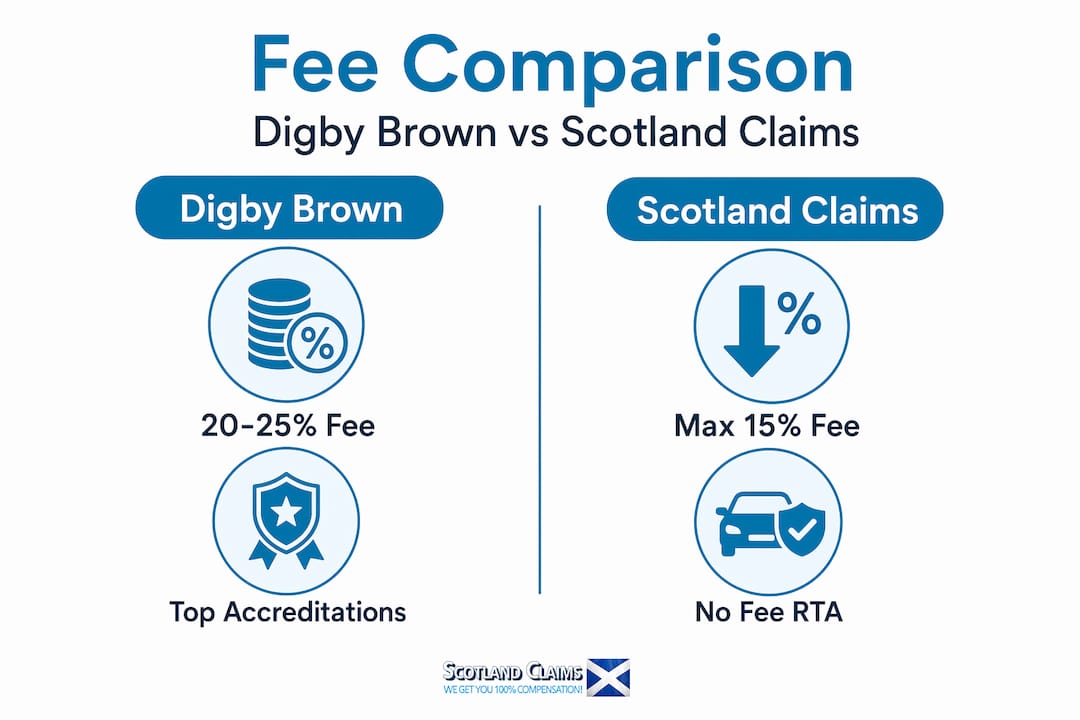
For road traffic accident and whiplash claims where you are not at fault, Scotland Claims takes nothing from your compensation at all. You receive 100% of what is awarded. That is a genuinely unusual arrangement and one worth understanding clearly before you sign anything with any firm.
Pro Tip: Always ask for a written breakdown of the success fee before instructing a solicitor. Verbal assurances are not enough. You need to know exactly what percentage will be deducted from your compensation if the claim succeeds.
You can find a detailed fees comparison between leading Scottish personal injury firms, including Digby Brown, on the Scotland Claims website.
Legal expertise alone does not define the quality of a personal injury service. How you are treated as a person, particularly in the aftermath of a serious accident or bereavement, shapes your entire experience of the claims process.

Digby Brown has invested heavily in this area. The firm has been a partner with Brake for over 15 years, the road safety and victim support charity. This partnership reflects a genuine commitment to trauma-informed care, which means recognising that injured clients and bereaved families are not simply case files. They are people in crisis who need both legal and human support.
This approach is especially significant in fatal accident claims. Partner Brian Castle has noted that families often seek answers more than compensation when a loved one has been killed. The legal investigation that accompanies a fatal accident claim can uncover information that families would never otherwise access, including witness accounts, expert reconstructions, and internal records from employers or road authorities.
Key aspects of client support to consider when comparing firms include:
- Whether the firm offers dedicated case managers or single points of contact
- Access to peer support networks or mental wellbeing resources
- Investigative capacity for gathering evidence in complex or fatal claims
- Clear communication about timelines and next steps throughout the process
- Sensitivity in communications with families and dependants
Scotland Claims prioritises clear, accessible communication and a straightforward claims process. The online platform makes it easy to start a claim, check progress, and understand what is happening at each stage, which matters enormously when you are already dealing with the physical and emotional aftermath of an injury.
Claim timelines and prescription risks
Scotland’s approach to prescription deadlines is unforgiving. The three-year period is a hard limit in most cases, and Scottish courts apply it strictly. If you miss it, you almost certainly lose your right to claim entirely, regardless of how strong your case might be.
The Inner House of the Court of Session has reinforced this position clearly. Pursuers who argue they were misled about the nature or cause of their injury face a high burden of proof to extend the deadline. The onus is on you, not the defender, to demonstrate why the clock should not have started running from the date of the accident.
Here is what good solicitors do to protect your position from day one:
- Record the date of the accident and the date you first became aware of your injury in writing.
- Gather and preserve all medical records, photographs, and witness details as early as possible.
- Keep a contemporaneous diary of symptoms, medical appointments, and any communications with employers or insurers.
- Instruct a solicitor well before the three-year deadline, ideally within weeks of the accident.
- Confirm in writing with your solicitor that they have noted the prescription date and are actively managing it.
Both Digby Brown and Scotland Claims understand the critical importance of managing these deadlines. The risk lies in waiting too long before seeking advice, or in instructing a solicitor who is not actively tracking the prescription clock on your behalf.
Success rates, reviews, and coverage across Scotland
Digby Brown is one of the most widely recognised names in Scottish personal injury law. The firm has offices across Scotland, including Glasgow, Edinburgh, Aberdeen, Dundee, and Inverness, and its APIL accreditations speak to a proven track record in high-value and complex claims. Digby Brown reviews from clients frequently highlight the firm’s thoroughness and the depth of expertise available for serious injury cases.
Scotland Claims operates nationally across Scotland through an accessible online platform, connecting clients with specialist solicitors wherever they are based. This model suits people who want straightforward access to legal help without needing to travel to a city centre office.
When weighing up your options, consider:
- The complexity and value of your claim
- Whether you need specialist accreditation for a brain, spinal, or fatal accident case
- How much of your compensation you want to retain after fees
- Whether you prefer face-to-face meetings or are comfortable with online and phone-based service
- The accessibility of the firm’s intake process and how quickly they respond
For a side-by-side look at success fees compared between these two firms, Scotland Claims has published a detailed breakdown worth reading before you make a decision.
My honest take on this comparison
I have spent years reading Digby Brown reviews, analysing claims litigation in Scotland, and watching how different firms handle the full spectrum of personal injury cases. Here is what I genuinely think.
Digby Brown is an outstanding firm for catastrophic injury cases. If you or a family member has suffered a brain injury, spinal cord damage, or a fatal accident, the APIL accreditations and the trauma-informed support model are genuinely valuable. The investigative depth they bring to fatal accident claims is something few firms in Scotland can match. For those cases, the higher success fee may well be worth paying.
But for the majority of personal injury claims in Scotland, including road traffic accidents, whiplash, slips, trips, and workplace injuries, the fee difference matters enormously. Keeping 100% of your compensation on an RTA claim, or paying a maximum of 15% rather than 25% on a serious injury, is a meaningful financial advantage. I have seen too many claimants sign up with a well-known name and receive thousands of pounds less than they should have, simply because they did not compare fee structures before instructing.
My view is this: match the firm to the claim. For the most complex, high-value cases, specialist accreditation justifies the cost. For everything else, transparent fees and a straightforward process should be your priority.
— Roger
Start your claim with Scotland Claims today
If you have been injured in a road traffic accident, a slip or trip, or a workplace accident, Scotland Claims offers some of the most competitive fee arrangements available in Scotland. For whiplash and RTA claims where you are not at fault, you keep 100% of your compensation. For more serious injuries, the maximum fee is 15%, well below the 20 to 25% charged by larger firms.
The no win no fee guarantee means you pay nothing if your claim is unsuccessful. There are no upfront costs and no hidden charges. Whether you are dealing with a back injury claim or a knee injury following an accident, Scotland Claims connects you with specialist injury lawyers who know Scottish law and are focused on securing the maximum compensation you are entitled to. Contact Scotland Claims today for a free, no-obligation assessment of your claim.
FAQ
What is the main difference between Digby Brown and Scotland Claims?
Digby Brown is a traditional law firm with APIL specialist accreditations for brain, spinal, and fatal accident claims, while Scotland Claims is an accessible online platform offering lower fees, including 0% on RTA and whiplash claims where you are not at fault.
How much does Scotland Claims charge compared to Digby Brown?
Scotland Claims charges a maximum of 15% on serious injury claims and takes nothing from compensation on road traffic accident or whiplash claims where you are not at fault. Larger firms typically charge 20 to 25%.
How long do personal injury claims in Scotland take?
Most personal injury claims in Scotland settle within 12 to 18 months, though complex cases can take longer depending on the severity of the injury and the defence approach.
What happens if I miss the three-year deadline in Scotland?
Scottish courts apply the prescription deadline strictly. If you miss the three-year limit, you will almost certainly lose your right to claim. Instructing a solicitor as early as possible protects your position.
Do I need a specialist solicitor for a personal injury claim in Scotland?
For most standard claims, a specialist injury lawyer is sufficient. For brain injuries, spinal cord damage, or fatal accident claims, APIL-accredited specialists provide a level of expertise that can make a significant difference to the outcome.
Recommended