
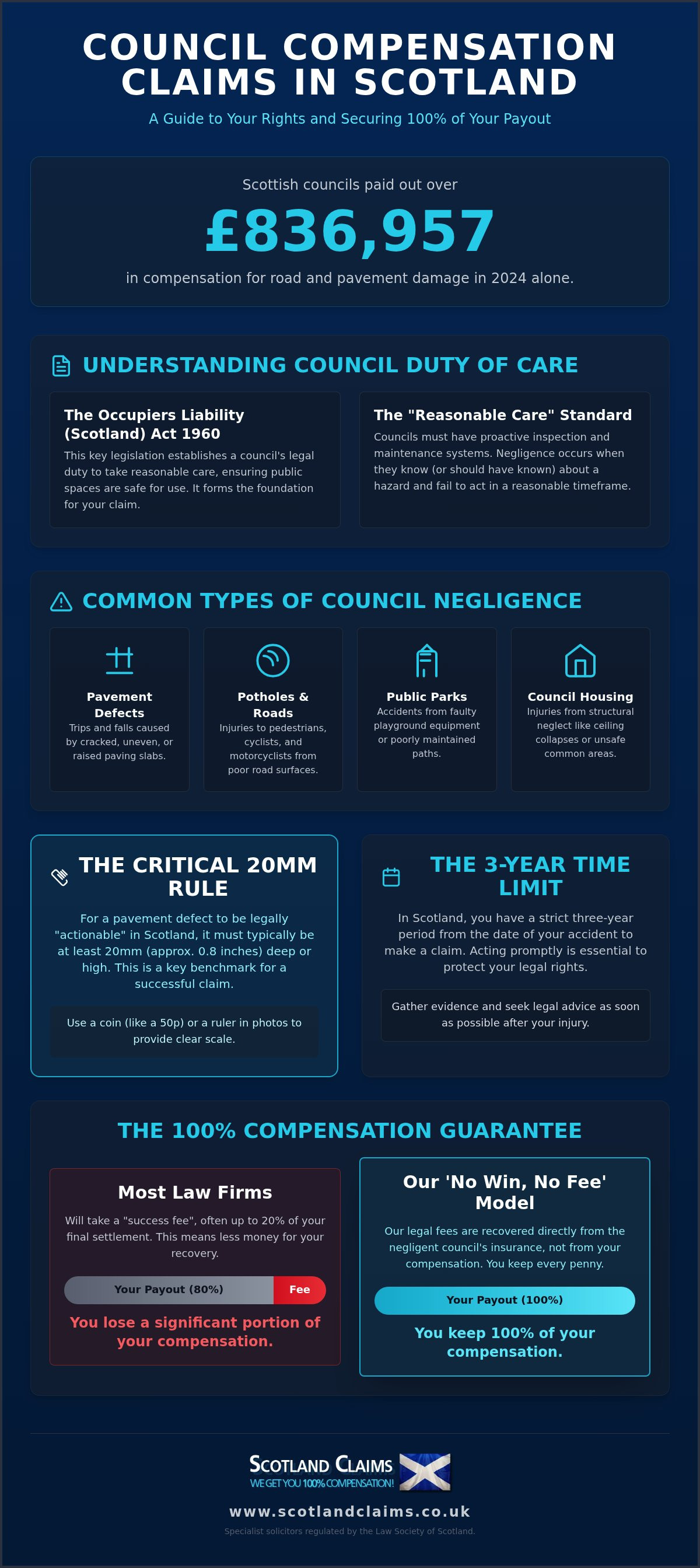
Did you know that Scottish councils paid out over £836,957 in compensation for road and pavement damage in 2024 alone? If you have been injured due to a trip on a cracked pavement or a fall caused by a pothole, you aren't just another statistic. You are a victim of negligence. It is frustrating to feel ignored by local authorities, especially when your physical recovery is stalled by their inaction.
We agree that the person responsible for your injury should be the one to pay for it, not you. Navigating council compensation claims scotland can feel intimidating, but you deserve a process that prioritises your recovery over profit. Most law firms will try to take a 20% cut of your final settlement, leaving you with less than you need to move forward. We do things differently.
This article explains exactly how to hold your local council accountable while ensuring you keep 100% of your compensation. You will learn about the critical 20mm defect rule, the strict three-year Scottish limitation period, and how our specialised legal team secures your full payout with zero financial risk to you.
Key Takeaways
- Understand how the Occupiers Liability (Scotland) Act 1960 establishes a clear duty of care for local authorities to keep public spaces safe.
- Identify the specific criteria for successful council compensation claims scotland, including the critical 20mm rule for pavement defects.
- Discover how the 100% compensation model ensures you keep the full value of your settlement without any success fee deductions.
- Learn why the strict three-year limitation period in Scotland makes immediate action and official reporting essential for your case.
- Find out how to access expert legal representation from solicitors regulated by the Law Society of Scotland at no financial risk to you.
Understanding Council Duty of Care under Scottish Law
A council compensation claim is a legal process used to seek financial redress when a local authority's failure to maintain public property results in an injury. In Scotland, these claims are rooted in the Scots law of delict. This legal framework ensures that if a council is negligent, they are held responsible for the consequences. It's not just about the injury itself; it is about holding public bodies to the standards of safety they are legally required to uphold.
Scottish courts use the "Reasonable Care" standard as their benchmark. This means the council isn't expected to ensure every inch of pavement is perfectly smooth at all times. Instead, they must show they have a proactive inspection and maintenance system in place. Actionable negligence occurs when a council knows about a hazard, or should have known through regular inspections, but fails to fix it within a reasonable timeframe. A simple trip over a minor irregularity might be an accident; a fall caused by a deep, long-standing pothole that was reported months ago is negligence.
Who is Responsible? Identifying the Occupier
Local councils act as the primary occupiers of most public infrastructure. They are legally responsible for the safety of public roads, pavements, and walkways. Their duty also extends to public parks, recreational centres, libraries, and the common areas of council-owned housing. Identifying the correct "occupier" is vital for successful council compensation claims scotland. If you are injured on a path, it's essential to determine if it is a "core path" maintained by the local authority or a private track. Our solicitors can help you identify the responsible party by checking the Land Register of Scotland or local road adoption records.
The Occupiers Liability (Scotland) Act 1960
The Occupiers Liability (Scotland) Act 1960 is the primary legislation that governs the safety duties of those in control of land and premises in Scotland. This Act protects pedestrians and visitors by requiring occupiers to take such care as is reasonable to ensure persons entering the land do not suffer injury. It creates a clear expectation that public spaces should be safe for their intended use. However, the burden of proof lies with you. To win your case, you must demonstrate that a hazard existed, the council failed in its duty of care, and this specific failure caused your injury. If you have been injured in a public place, you can learn more about the process on our slip or trip claims page. Using a specialist ensures your council compensation claims scotland are built on solid legal foundations from the very start.
Common Types of Council Negligence Claims
Local authorities oversee a vast range of public spaces, from the streets outside your home to the parks where your children play. When maintenance fails, the results are often painful and life-altering. Most council compensation claims scotland involve everyday environments where you should be able to expect safety. Between 2020 and 2025, over 18,600 claims were lodged for road defects alone. This staggering figure proves that negligence isn't a rare occurrence; it's a systemic issue that requires professional intervention.
Hazards aren't limited to the street. Faulty swings, rusted slides, or uneven pathways in public parks pose a direct threat to families. Similarly, in council-owned housing, structural neglect can lead to ceiling collapses or injuries in poorly maintained common closes. These aren't just minor inconveniences. They represent a failure to meet the legal standards outlined in the Scottish Parliament’s briefing on Understanding Council Duty of Care. Whether it's a deep pothole or a broken floorboard, the council must be held accountable for the harm caused.
Road defects are particularly dangerous for cyclists and motorcyclists. While a car might suffer a burst tyre from a pothole, a person on two wheels can be thrown into traffic. The physical trauma in these cases is often severe. If you've been injured due to road neglect, you have every right to seek redress for your pain and suffering.
The 20mm Pavement Rule in Scotland
For a pavement defect to be considered "actionable" in a Scottish court, it generally needs to be at least 20mm deep or high. This is the technical benchmark councils use to distinguish between a minor irregularity and a dangerous hazard. If you've been injured, don't leave the measurement to chance. Take a clear photograph of the defect immediately. Place a 50p coin or a standard ruler inside the hole to provide a sense of scale. This simple piece of evidence is often the difference between a rejected claim and a successful settlement. You can find more specific advice on our Slip or Trip Claims page.
Injuries in Council-Owned Buildings
Public liability isn't confined to the outdoors. Leisure centres, libraries, and local authority offices must be kept safe for the public. Common issues include slips on wet floors without warning signs, poor lighting in public stairwells, or loose handrails that fail when needed. These environments are high-traffic areas, and councils must have rigorous cleaning and inspection logs to prevent accidents. If you were working as a local authority employee at the time of your accident, your case might fall under an Accident at Work Scotland claim. Regardless of the setting, if the council’s neglect caused your pain, you shouldn't have to pay for it. If you're ready to see if you have a case, you can speak with our Scottish legal team today.
The 100% Compensation Guarantee Explained
Many people hesitate to start council compensation claims scotland because they fear the legal costs will eat into their settlement. It’s a valid concern. In the standard "No Win, No Fee" model used by most UK firms, a "success fee" of up to 20% or 25% is deducted from your final award. If you win £10,000, you only see £8,000. We believe this is inherently unfair. You are the one who suffered the injury. You are the one who endured the pain. You should be the one who receives the full compensation.
Our "Zero Success Fee" model changes the game. We don't take a single penny from your payout. Instead, we recover our legal costs directly from the council’s insurance providers. This approach removes the financial barrier to justice. It ensures that your focus remains on recovery, not on how much your solicitor will take at the end of the day. In 2026, this is the most transparent way to handle personal injury claims. We stand as a protective advocate, ensuring that local authorities pay for their negligence without you footing the bill for your own representation.
Comparative Payout Analysis: What You Keep
To understand the difference, look at the numbers. Most firms will take a significant chunk of your money as a reward for winning. With Scotland Claims, the amount awarded by the court or agreed in a settlement is the exact amount that lands in your bank account. The difference can amount to thousands of pounds that you could use for physiotherapy, lost wages, or simply moving on with your life.
- On a £5,000 settlement: You receive £5,000 with us. With a 20% fee firm, you lose £1,000 and keep only £4,000.
- On a £12,000 settlement: You receive £12,000 with us. Others would take £2,400, leaving you with £9,600.
- On a £30,000 settlement: You receive the full £30,000. A standard firm would deduct £6,000, leaving you with £24,000.
True No Win, No Fee Protection
Financial risk shouldn't stop you from holding a negligent council accountable. Our framework provides absolute protection. If your claim is unsuccessful, you owe us nothing. There are no hidden charges, no surprise "admin fees," and no catch. We operate with total transparency because we are confident in our ability to win. This is about empowerment and fairness. For a deeper look at how this works, read our No Win No Fee Scotland guide. We protect your interests from the first phone call to the final payment, ensuring you never feel intimidated by the legal process.
Evidence and the 3-Year Limitation Period
Success in council compensation claims scotland depends on the strength of your evidence and the speed of your actions. You have a strict three-year window to initiate legal proceedings under the Prescription and Limitation (Scotland) Act 1973. If you miss this deadline, your right to compensation is usually lost forever. Many local authorities, such as Glasgow City Council, will encourage you to use their internal complaints procedure first. This is a common trap. While reporting the incident is necessary, an internal complaint is not a legal claim. It does not stop the three-year clock from ticking whilst you wait for a response.
Medical evidence is the backbone of your case. You must visit a GP or a hospital as soon as possible after your accident. These records provide an unbiased account of your injuries and link them directly to the incident. Without a medical trail, the council's insurers will likely argue that your injuries weren't serious or were caused by something else entirely. For claims valued up to £25,000, we follow the Compulsory Pre-Action Protocol. This forces the council to acknowledge your claim within 21 days and complete their investigation within three months, preventing them from dragging their heels.
How to Prove Council Negligence
Winning a claim requires clear proof that the council failed in its duty. Follow these three steps immediately:
- Step 1: Photograph the defect from multiple angles. Include a shot showing the hazard's location relative to landmarks and a close-up with a ruler or coin for scale. Councils often repair hazards quickly once reported, so capture this evidence now.
- Step 2: Collect contact details from anyone who saw you fall. Independent witness statements are far more persuasive than your account alone when facing local authority lawyers.
- Step 3: Save every receipt. You can claim for "special damages," which include lost wages, taxi fares to medical appointments, and prescription costs.
Exceptions to the 3-Year Rule
The law provides some flexibility for specific groups. For children under 16, the three-year limitation period only begins on their 16th birthday. This gives them until they turn 19 to settle or raise a court action. Similarly, if a claimant lacks the mental capacity to manage their affairs, the clock may be paused indefinitely. However, you shouldn't wait. Instructing a solicitor early is vital for recovering CCTV footage. Most public and private security systems overwrite their data every 7 to 30 days. If we don't act fast, that crucial video evidence could be gone forever.
Start your claim with our Scottish legal team today
Starting Your Council Claim with Scotland Claims
Starting council compensation claims scotland doesn't have to be a source of stress. We've designed a streamlined process that moves your case from an initial inquiry to a qualified solicitor in record time. It begins with a single phone call. From that moment, you stop being a claimant and start being a client with a dedicated legal advocate. We understand that you are likely dealing with physical pain and financial uncertainty. Our job is to remove the weight of the legal process from your shoulders.
Our team consists of qualified solicitors authorised by the Law Society of Scotland. This distinction is vital. Many online services act as "claims farms" that simply sell your details to the highest bidder. We don't do that. As a trading style of Kerr Brown Solicitors, we provide direct, professional representation from start to finish. We handle the council’s legal team, their insurance investigators, and all technical correspondence. You won't need to argue with a local authority official or decipher complex insurance jargon. We manage the confrontation so you can focus on your recovery.
Your Injury. Your Claim. 100% Your Compensation.
Our mission is to demystify the legal system for every person in Scotland. We believe in transparency and financial integrity, which is why we never take a success fee from your award. We organise your case with maximum efficiency to ensure the quickest possible settlement without compromising on the value. You can trust our Scotland Claims Injury Lawyers team to prioritise your interests above all else. We are here to ensure that negligence has consequences for the council, not for your bank balance. We stand as a protective barrier between you and the profit-heavy tactics of traditional law firms.
Take the First Step Today
You've already taken the first step by educating yourself on your rights. Now, it's time to act. Evidence can disappear and the three-year statutory limit is always approaching. Call our 24-hour freephone helpline on 0800 611 8132 for an immediate, honest assessment of your situation. Our experts are ready to listen and provide the clarity you need. If you aren't ready to speak to someone yet, use our Personal Injury Compensation Calculator to get an estimate of what your claim could be worth based on your specific injuries.
Start your claim online now and keep 100% of your payout.
Secure Your Full Payout Today
You shouldn't have to settle for less than you deserve because of a local authority's failure. Holding a council accountable requires swift action and specialised evidence. By choosing a legal team that prioritises your recovery over their own profit, you ensure that the 100% Compensation Guarantee remains the foundation of your case. Our solicitors are regulated by the Law Society of Scotland, providing you with the professional protection you need against council-appointed legal teams.
Don't let the stress of the three-year limitation period or the fear of hidden fees stop you from seeking justice. Whether you use our 24-hour freephone support or our online calculator, the path to a fair settlement starts with a single decision. Securing council compensation claims scotland is about restoring your quality of life and ensuring you keep every penny of your award.
Keep 100% of your compensation with Scotland Claims.
We are ready to stand as your protective advocate and fight for the result you deserve. Your recovery is our priority.
Frequently Asked Questions
Can I claim for a trip on a public pavement in Scotland?
Yes, you can claim if you can prove the local authority failed in their duty of care. Under the Occupiers Liability (Scotland) Act 1960, councils must ensure pavements are safe for public use. If a defect has been left unrepaired for an unreasonable time, it constitutes negligence. We help individuals navigate these claims to ensure they aren't left to suffer because of a council's maintenance failure.
How long do I have to make a council compensation claim?
You have a three-year window from the date of your accident to initiate a legal claim. This limit is set by the Prescription and Limitation (Scotland) Act 1973. If you don't start the process within this timeframe, your right to seek compensation is lost. Acting quickly is essential because it allows us to secure time-sensitive evidence like council maintenance records and CCTV footage before they are overwritten or deleted.
Will I really receive 100% of my compensation award?
Absolutely. We ensure you retain every penny of the settlement awarded to you. Traditional firms often take a success fee of up to 20% or 25%, but we recover our fees entirely from the at-fault party's insurers. If your award is £30,000, you receive £30,000. Our model removes lawyer fee anxiety and ensures that the compensation meant for your recovery stays in your pocket where it belongs.
Who is responsible if I fall in a council-owned park?
The local council is the occupier of public parks and is responsible for their upkeep. This duty covers everything from ensuring play equipment is structurally sound to keeping footpaths free of dangerous hazards. If you fall due to a broken bench, a deep pothole on a park path, or faulty equipment, the council is liable. We will help you hold the correct local authority department accountable for your injury.
Can I claim if the council says the pavement defect is too small?
The 20mm rule is the standard benchmark, but it isn't an absolute law. While councils often reject claims for defects smaller than 20mm, you may still have a case if other factors contributed to your fall. For instance, poor lighting or the defect’s location in a high-traffic area can increase the council’s liability. We offer a fast assessment to see if your council compensation claims scotland can proceed despite the defect size.
What happens if my claim against the council is unsuccessful?
If your claim is unsuccessful, you won't pay us a penny. Our "No Win, No Fee" framework is designed to provide risk-free access to justice for everyone. You don't have to worry about hidden admin costs or surprise legal bills at the end of the process. This transparency ensures that you can hold a powerful local authority accountable without any personal financial risk, regardless of the final outcome of your case.
How much compensation can I expect for a public place injury?
Payouts vary based on the injury's severity and your financial losses. A minor injury might result in a £5,000 settlement, while more serious injuries can attract awards of £30,000 or higher. You are entitled to claim back lost earnings and medical expenses. To get a specific estimate for your situation, we recommend using our online calculator or speaking with one of our solicitors for a detailed review of your potential award.
Do I need to go to court for a council liability claim?
Most council compensation claims scotland are settled without ever stepping foot in a courtroom. We use the Compulsory Pre-Action Protocol to negotiate directly with the council's insurers. This streamlined process is designed to reach a fair settlement quickly and efficiently. While we are always prepared to take a case to court if the council refuses to settle fairly, the vast majority of our clients receive their compensation through a negotiated agreement long before a trial.