
What if being partly responsible for an accident doesn’t automatically end your claim? In Scotland, a contributory negligence allegation may reduce your compensation, but it isn’t an automatic claim-stopper. If you’re looking for contributory negligence scotland explained, the key point is that the evidence and each party’s contribution matter.
It’s understandable to worry that an accusation of fault could wipe out your right to claim or unfairly cut your compensation. Under the Law Reform (Contributory Negligence) Act 1945, damages can be reduced by a percentage the court considers just and equitable. The defender must support the allegation that you failed to take reasonable care for your own safety and that this contributed to your injury.
This guide explains how shared responsibility is assessed, what evidence may support or challenge an allegation, and what practical steps to take if one is made. It also shows how a proposed fault split affects damages, so you can respond with a clearer understanding of your position.
Key Takeaways
- With contributory negligence scotland explained, you can see why an allegation may affect the amount of damages rather than automatically end your claim.
- Look for evidence connecting your actions to the accident or injury, rather than relying on speculation.
- There’s no fixed percentage for shared responsibility. Any reduction depends on the circumstances and evidence.
- Keep photographs, messages, witness details and accident records. Ask for the insurer’s reasons and evidence behind its allegation.
- Scotland Claims Injury Lawyers charges no success fee and recovers legal costs from the at-fault party’s insurer. Keeping 100% of compensation means no success fee is deducted; it doesn’t prevent a reduction for contributory negligence.
What does contributory negligence mean in a Scottish injury claim?
Contributory negligence means that the injured person’s own conduct may have played a part in causing the injury or making its effects worse. It does not, by itself, mean someone else had no responsibility. The question is whether the defender’s actions caused harm and whether the pursuer’s conduct also contributed. If contributory negligence is established, damages may be reduced to reflect the pursuer’s share of responsibility. It doesn’t automatically prevent a claim.
A key distinction is that an allegation is not a finding. The facts must be examined, including what each person did and how that conduct relates to the injury. For example, a defender might be alleged to have left a hazard unrepaired while also arguing that the injured person wasn’t paying attention. Whether that argument affects damages depends on the evidence and the circumstances.
How does contributory negligence fit into Scottish delict law?
Delict is the Scottish legal framework for many civil claims involving harm caused by another person’s wrongful conduct. In a personal injury action, the injured person is usually called the pursuer, meaning the person bringing the case. The person or organisation being sued is the defender.
The Law Reform (Contributory Negligence) Act 1945 provides for damages to be reduced where a claimant’s own fault contributed to the damage, rather than automatically barring recovery. How the Act applies alongside Scottish delict principles depends on the facts. The legal labels matter less than the evidence showing what happened and how each party’s conduct contributed.
Does sharing responsibility mean you cannot make a claim?
No. A defender’s allegation that you share blame does not, on its own, mean you have lost the right to claim. If a contribution is established, it can reduce the damages awarded. The size of any reduction depends on the circumstances; there is no automatic outcome simply because you may have made a mistake.
For instance, a person injured in a public place might have been distracted, but that fact alone does not establish that their distraction contributed to the accident. The condition of the place, what could reasonably have been seen and the sequence of events may all be relevant. The evidence needs to be considered before drawing conclusions about responsibility or compensation.
If an insurer raises contributory negligence, focus on what supports or challenges the allegation rather than accepting a proposed share of blame without scrutiny. Scottish personal injury lawyers at Scotland Claims can assess the evidence and arguments about responsibility. The outcome depends on the individual circumstances of your claim.
What must be proved before contributory negligence can reduce damages?
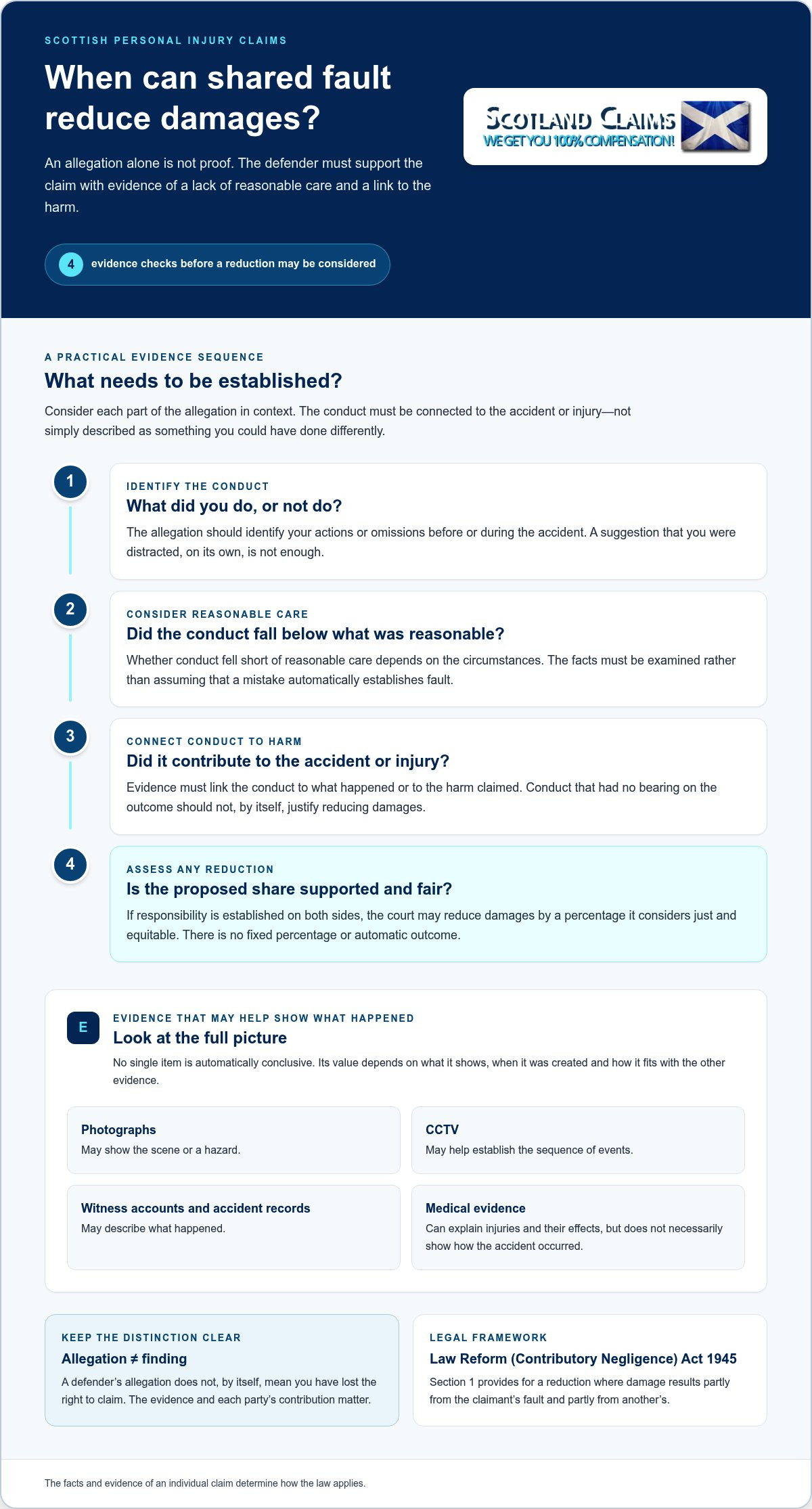
An allegation needs more than a suggestion that you could have acted differently. The defender must support it with evidence that your conduct fell short of reasonable care and contributed to the injury or damage. That link matters: conduct that had no bearing on what happened should not, by itself, justify reducing damages.
Section 1 of the Law Reform (Contributory Negligence) Act 1945 provides for a reduction the court considers just and equitable when damage results partly from the claimant’s fault and partly from another’s. A Scottish solicitor should consider how the Act and Scottish delict principles apply to the facts of an individual case.
As a practical checklist, consider whether there is evidence to show:
- What you did, or failed to do, before or during the accident.
- Why that conduct may have fallen below reasonable care in the circumstances.
- How that conduct contributed to the accident or the injury claimed.
- Why the proposed share of responsibility is supported by the evidence.
An allegation that you were distracted, for example, is not enough on its own. The evidence must connect that distraction to the incident or the harm. The relevant questions depend on the accident and the points the parties dispute.
What evidence might be relevant to an allegation?
Photographs may show the scene or a hazard; CCTV may help establish the sequence of events; and witness accounts or accident records may describe what happened. Medical evidence can explain the injuries and their effects, but evidence about injury severity does not necessarily show how the accident occurred. No single photograph, record or account is automatically conclusive. Its value depends on what it shows, when it was created and how it fits with the other evidence.
Who has to establish contributory negligence?
Generally, the defender raising contributory negligence must provide evidence to support that allegation. The pursuer, meaning the person bringing the claim, still needs evidence for the underlying case, including evidence of the injury and the defender’s responsibility. The precise burden and terminology should be considered in the context of the claim. Don’t assume you must disprove an unsupported assertion before it has been properly evidenced.
In short, the defender needs evidence of a lack of reasonable care and a link between that conduct and the harm; an assertion alone is not proof.
If an allegation has been made, a case-specific review can help distinguish evidence about the accident from evidence about the resulting injuries. You can request a no-obligation assessment of your Scottish injury claim to discuss the evidence and the allegation.
How is a claimant’s share of responsibility assessed in Scotland?
There’s no standard percentage for contributory negligence. The court considers what is fair and equitable in the circumstances, weighing the parties’ actions and how those actions contributed to the harm. The result depends on the particular evidence, not a figure that automatically applies to a type of accident.
If an insurer proposes a responsibility split, treat it as a position to examine, not a fixed rule. A Scottish solicitor can assess whether the evidence supports the proposed share and whether it fairly reflects each party’s role.
What factors can influence the responsibility split?
The court may compare the parties’ conduct, the surrounding circumstances and the evidence of how the incident unfolded. It also matters whether the claimant’s actions actually contributed to the accident or injury. Conduct that seems careless in isolation may carry less weight if it had little connection to the harm, while another party’s actions may have played a more direct role.
For example, in a hypothetical collision, the evidence might concern both a driver’s actions and a cyclist’s conduct. The court would need to consider the full circumstances and the causal connection between each person’s behaviour and the resulting injury. There’s no universal percentage for every road, workplace or public-place accident.
How does a percentage reduction affect damages?
A percentage reduction is applied to the damages figure. The example below uses invented round figures to show the arithmetic only. It is not an estimate of a real claim or a prediction of what a court would decide.
| Hypothetical calculation |
Amount |
| Total damages before any contributory negligence reduction |
£10,000 |
| Illustrative 20% reduction for contributory negligence |
£2,000 deducted |
| Damages after that illustrative reduction |
£8,000 |
In this example, £2,000 is deducted from the hypothetical damages figure, leaving £8,000. The percentage is purely illustrative. A reduction in damages is separate from solicitor’s fees or the funding arrangement. Scotland Claims charges no success fee and recovers legal costs from the at-fault party’s insurer, rather than deducting a success fee from the client’s settlement. Its 100% compensation model concerns fee deductions; it does not reverse a reduction in damages if contributory negligence is established.
Keep the two calculations separate: first, any reduction to damages based on responsibility; second, any fee deduction under the legal funding arrangement. A case-specific review can assess the evidence and any proposed split.
What should you do if an insurer alleges contributory negligence?
An insurer’s allegation is a position to assess, not a decision you have to accept. Ask what conduct it says contributed to the accident or injury, what evidence supports that claim and how it arrived at any proposed responsibility split. Keep your response factual. Avoid admitting fault or agreeing to a percentage before you understand the evidence and have had the allegation reviewed.
A clear record can help a Scottish solicitor compare the insurer’s account with what happened. Take these steps:
- Preserve what you have. Keep photographs, messages, letters, medical documents, witness details and accident reports. Retain original files where possible, and note when and how they were created.
- Write a timeline. Record what you remember about the events before, during and after the accident. Separate what you saw or heard from what someone else later told you.
- Request the allegation in detail. Ask the insurer to explain the conduct it relies on, the evidence it has and why it believes that conduct contributed to your injury.
- Get advice before responding on liability. A solicitor can assess disputed facts, the evidence and whether the proposed percentage is justified.
How can you organise evidence after an accident?
Make notes while your memory is fresh, including dates, locations, weather or lighting conditions where relevant, and the order events occurred. Keep original documents and correspondence together. Note potential witnesses’ names and contact details, and where relevant footage or incident records may be held. In a road collision, photographs of vehicle positions, damage and the scene may help clarify events; a Scottish road traffic accident claims guide can offer further context. For a workplace incident, retain relevant accident documentation and records, alongside witness details. Scotland Claims also explains workplace accident claims.
Evidence needs context. A photograph may show a hazard but not establish how long it was there or what each person could see. A witness may recall only part of an incident. Preserve material without editing it, and consider the evidence as a whole. Don’t assume one item settles responsibility either way.
How should you respond to a proposed responsibility split?
Ask for the reasoning behind the split and the material the insurer relies on. A Scottish solicitor can compare that account with your records, identify disputed facts and assess whether the proposed percentage reflects the evidence. You can challenge an unsupported allegation or an unfair apportionment. A careful review helps protect your position without making claims about liability that the evidence may not support.
If an allegation has left you unsure what to do next, a free, no-obligation assessment can help you understand the issues. Scotland Claims charges no success fee, recovers legal costs from the at-fault party’s insurer and clients owe nothing if their claim is unsuccessful.
How can Scottish legal support help you understand a contributory negligence allegation?
An allegation can affect how much compensation is offered, so the facts and proposed responsibility split need to be properly assessed. A Scottish personal injury solicitor can review the accident evidence, the arguments about liability and the reasoning behind any suggested reduction. That gives you a clearer view of what is disputed and what may support your position. It won’t guarantee a particular outcome, but it can help you make decisions based on evidence rather than pressure.
A case-specific review is more useful than relying on a general percentage or assumption. Personal injury solicitors in Scotland at Scotland Claims can assess how the allegation relates to the available evidence and explain what the proposed split could mean for your claim.
What does no win, no fee mean if responsibility is disputed?
Scotland Claims operates a no-win, no-fee model. Clients owe nothing if a claim is unsuccessful, there is no success fee, and legal costs are recovered from the at-fault party’s insurer rather than deducted from the client’s settlement.
Keep the fee arrangement separate from the liability question. If contributory negligence is established, damages may still be reduced to reflect shared responsibility. Scotland Claims’ 100% compensation model means there’s no success-fee deduction from compensation; it does not remove or reverse a reduction to damages arising from the responsibility split. This distinction makes it easier to understand how the liability assessment and legal costs affect a claim.
What is a practical next step for an injured person in Scotland?
Share the basic accident details, the injury and any contributory negligence allegation for a free, no-obligation assessment. If you have them, keep the insurer’s correspondence and relevant photographs, witness details or accident records available. A solicitor can consider what the allegation is based on and explain the next steps without promising a successful claim or a particular level of compensation.
Scotland Claims also provides a 24-hour freephone helpline for initial enquiries. An initial discussion can help you explain what happened and understand how the allegation may be assessed. You remain in control of what you do next.
Get a case-specific view before accepting a proposed responsibility split. Clear advice can help you understand the evidence, the arguments and the effect on your claim.
Discuss your claim with Scotland Claims
Take the next step with a clearer view of your claim
An allegation of shared responsibility can feel decisive, but it doesn’t have to dictate your next move. Focus on the evidence and get advice tailored to your circumstances. A clear assessment can help you understand the issues before deciding how to respond.
Scotland Claims is regulated by the Law Society of Scotland. There’s no success fee, and legal costs are recovered from the at-fault party’s insurer rather than deducted from your settlement. This fee arrangement is separate from any reduction in damages if contributory negligence is established.
Share the allegation and the information you have, then consider your options with Scottish legal support.
A fair assessment starts with your facts. Take that step with confidence.
Frequently Asked Questions
Can I claim compensation in Scotland if I was partly at fault?
Yes, you may still be able to claim, even if your actions are questioned. An allegation might arise, for example, if a pedestrian is said to have been looking at a phone when they tripped over a damaged pavement. The important issue is how the evidence connects that behaviour to the accident and injury. Shared responsibility can affect damages without automatically ending a claim.
Is contributory negligence the same in Scotland and England and Wales?
The general idea of reducing damages for a claimant’s contribution exists in each jurisdiction, but the legal systems and procedures are not identical. Scottish claims use delict law and terms such as pursuer and defender, while England and Wales use different legal terminology. If an online article refers to a process or rule from another part of the UK, check whether it applies in Scotland before relying on it.
How does a court decide the percentage of contributory negligence?
A court considers the evidence about what each party did and how their conduct related to the injury. The assessment depends on the full circumstances, including the sequence of events and the significance of each person’s actions. There’s no set percentage for a particular accident type. Online calculations can show how a reduction works arithmetically, but they can’t tell you what percentage would be applied to your case.
Can a child be found contributorily negligent in Scotland?
It may be considered, but a child’s age, understanding and circumstances can be relevant to the assessment. The standard applied should not simply be assumed to match that of an adult. For instance, the circumstances surrounding a child’s actions near a road may need careful examination. This is a sensitive, fact-specific question, so get advice from a Scottish solicitor before relying on a general explanation or drawing conclusions about a child’s claim.
Could a passenger be partly responsible for injuries in a Scottish road accident?
Yes, a passenger’s own conduct may be examined if it is said to have contributed to their injury. The driver’s responsibility and the passenger’s actions are separate questions. For example, an allegation about a passenger’s choice not to wear a seat belt would need to be assessed against the evidence and its connection to the injury claimed. A solicitor can review the circumstances rather than treating the allegation as proof.
Does contributory negligence apply to an accident at work in Scotland?
It can be raised in a workplace injury claim if the defender argues that the worker’s conduct contributed to the harm. The specific task, instructions, equipment and events surrounding the accident may all be relevant. A worker’s action should be considered in context, not in isolation. Preserve any records you have and get advice before agreeing that your conduct caused the accident or accepting a proposed reduction.
Can I challenge an insurer’s proposed contributory negligence percentage?
Yes. An insurer’s suggested split can be questioned, particularly if its explanation does not account for important evidence or disputed events. You can ask how the percentage was reached and what material supports it. A solicitor can compare that reasoning with the available records and explain possible responses, such as disputing specific facts or the proposed share. The right approach depends on the evidence and stage of discussions.
Does a contributory negligence allegation mean I will receive nothing?
No, an allegation alone doesn’t mean you’ll receive nothing. The effect depends on the outcome of the liability assessment and any reduction applied to damages. A claim could still result in compensation where responsibility is shared, although the amount may be affected. Keep three questions distinct: whether another party is responsible, whether your conduct contributed, and how any established contribution affects damages. A solicitor can assess these issues against your circumstances.