
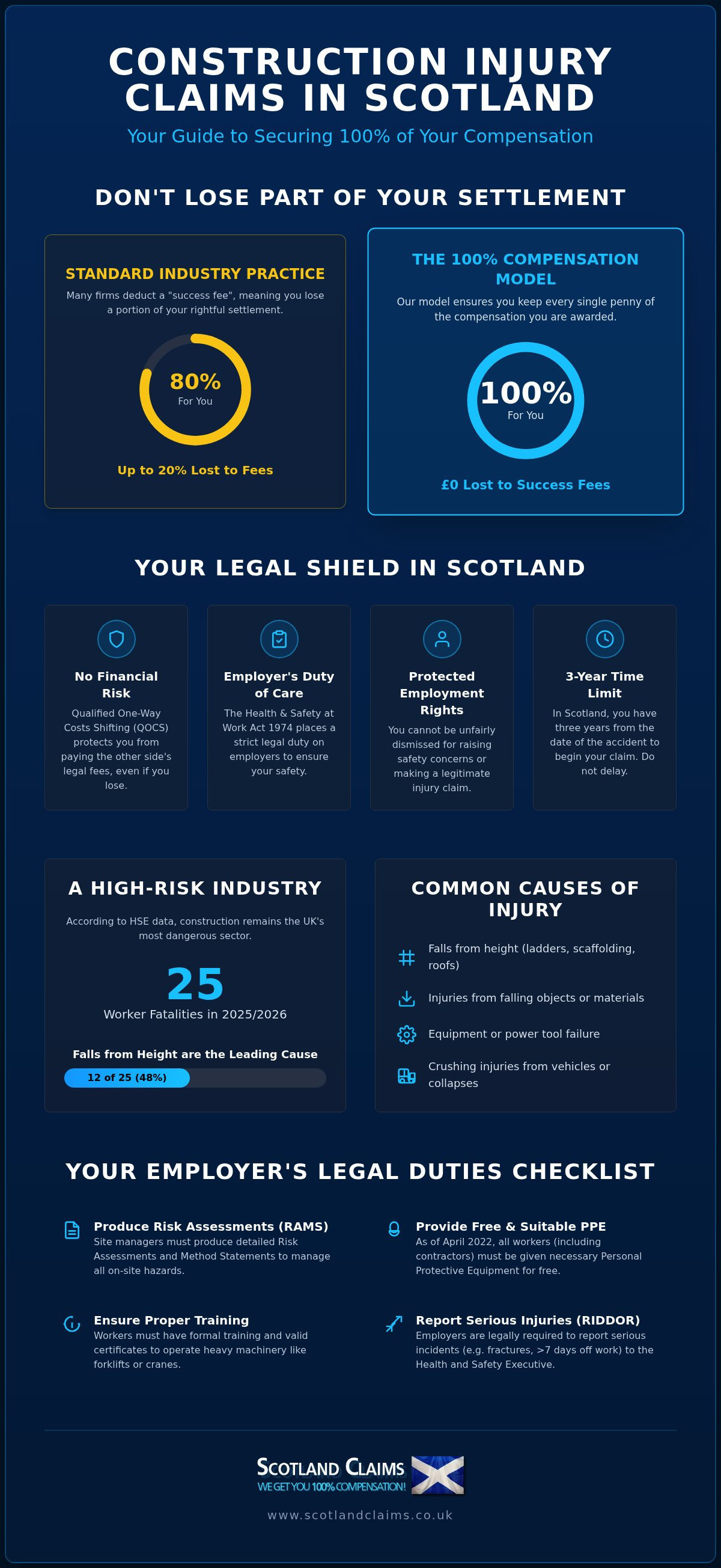
Did you know that most workers in Scotland lose up to 20% of their settlement to legal "success fees" even when they win? It's a standard industry practice, but it's completely unnecessary. When you've been hurt on a building site, you shouldn't have to pay for the privilege of getting justice. You're likely already worrying about how to pay the bills whilst you're off work and feeling anxious about whether your employer will retaliate. These fears are common, but they shouldn't stand in the way of your financial recovery.
We believe in a fairer path to justice. This guide explains how a specialist construction injury lawyer can help you navigate Scottish law to secure 100% of your settlement. You'll learn how the Qualified One-Way Costs Shifting (QOCS) rules protect you from financial risk and why your employment rights are stronger than you realise. We'll show you exactly how to claim the maximum amount for your medical bills and lost income without losing a single penny to hidden legal costs.
Key Takeaways
- Understand the strict legal duty of care site managers owe you under the Health and Safety at Work etc. Act 1974.
- Discover how the 100% compensation model allows you to retain your full settlement without losing a penny to success fees.
- Learn why a specialist construction injury lawyer is essential for navigating Scottish-specific regulations and securing maximum financial recovery.
- Identify the immediate steps you must take on-site to document your accident and protect your right to claim for lost earnings.
- Gain clarity on how Qualified One-Way Costs Shifting (QOCS) removes the financial risk of pursuing justice in Scotland.
Understanding Construction Injury Claims in Scotland
Scottish law is distinct from the rest of the UK. When you pursue a work injury claim north of the border, it is founded on the Scots law of delict. This system handles civil wrongs and liability. A construction injury claim arises when a site manager or contractor fails in their duty of care, leading to your physical or psychological harm. This duty isn't a suggestion; it's a strict legal obligation to ensure the site is as safe as reasonably practicable.
This protection extends further than you might think. It doesn't matter if you are a full-time employee, a self-employed subcontractor, or even a visitor to the site. If someone else's negligence caused your accident, you have a right to seek compensation. You must act within a specific timeframe. In Scotland, the statutory time limit to start your claim is three years from the date of the accident. Waiting too long can result in your right to claim being lost forever.
Common Types of Building Site Accidents
Construction remains the UK's most dangerous industry. According to HSE data for 2025/2026, there were 25 worker fatalities in the sector. Falls from height, including accidents involving scaffolding, ladders, and roofs, remain the leading cause of serious injury. They accounted for 12 of those 25 fatalities. Other frequent incidents include:
- Injuries from falling objects or poorly secured materials.
- Equipment failure involving cranes, forklifts, or power tools.
- Crushing injuries from moving vehicles or collapsing structures.
Your Legal Rights as a Worker in Scotland
You have the right to work without fearing for your safety. Your employer must provide proper training, maintained equipment, and necessary PPE. If you raise a health and safety concern or start a claim, the law protects you. You cannot be unfairly dismissed for exercising these rights. It's a common fear, but the legal safeguards are robust.
To ensure your case is handled correctly, you should instruct a specialist construction injury lawyer regulated by the Law Society of Scotland. This ensures your representation meets the highest professional standards. A dedicated construction injury lawyer understands the nuances of Scottish site regulations and will fight to secure the settlement you deserve. They will handle the complex paperwork whilst you focus on your recovery.
Employer Responsibilities and Safety Regulations
Employers on Scottish building sites have a clear legal mandate. The Health and Safety at Work etc. Act 1974 isn't just a list of suggestions. It's a set of rules designed to keep you alive and well. Your site manager must create a safe environment. This involves producing Risk Assessments and Method Statements (RAMS) that align with Scottish building standards. These documents should outline every hazard and explain exactly how it will be managed. If your employer skipped this step or ignored their own safety plan, they've failed in their duty.
Safety equipment is another non-negotiable. As of April 2022, regulations were updated to ensure all workers, including casual contractors, receive free and suitable Personal Protective Equipment (PPE). If you were forced to work without a helmet, boots, or respiratory protection, your employer is in breach of their duties. The same applies to specialised tasks. Operating heavy plant machinery requires formal training. You shouldn't be handed the keys to a forklift or crane without a valid certificate and proper induction. If you aren't sure where you stand, a specialist construction injury lawyer can review your site's safety records to find the proof you need.
The Construction (Design and Management) Regulations 2015
The CDM 2015 regulations ensure safety is planned before the first brick is laid. Every member of the project team has a specific duty. The Principal Contractor holds the most weight. They must manage the site daily to ensure everyone follows the health and safety file. When a Principal Contractor fails to coordinate these efforts, accidents happen. A breach of these specific regulations often forms the core of a successful compensation claim. It proves that the system meant to protect you was broken.
Reporting Injuries: The Role of RIDDOR
RIDDOR (Reporting of Injuries, Diseases and Dangerous Occurrences Regulations) requires employers to report serious accidents to the Health and Safety Executive (HSE). This includes fractures, amputations, or any injury that keeps you off work for more than seven days. These reports are vital evidence. They provide an unbiased account of what happened. An official RIDDOR record validates the timeline and severity of your injury, making it much harder for insurers to dispute your story. If your accident wasn't reported, a construction injury lawyer can help you rectify the record and ensure the correct authorities are notified.
Choosing a Construction Injury Lawyer: The 100% Compensation Difference
Most people assume that hiring a solicitor means giving up a slice of their settlement. This is the traditional "success fee" model used by the majority of UK firms. They take a percentage, often up to 20% plus VAT, as payment for winning your case. We do things differently. Our 100% compensation model ensures that every penny awarded by the court or insurer goes directly into your bank account. You shouldn't be penalised for seeking justice after an accident that wasn't your fault.
We recover our legal fees directly from the at-fault party's insurer. This removes the financial burden from you entirely. Many "big-brand" UK firms have massive marketing budgets and high overheads. To cover these costs, they often make significant deductions from their clients' awards. By choosing a specialist construction injury lawyer who operates with a Zero Success Fee agreement, you avoid these hidden costs. You get the full value of your claim without compromise. This transparency is at the heart of our protective advocacy. It isn't just a marketing slogan; it's a commitment to financial integrity.
Comparing Your Settlement: Scotland Claims vs. Competitors
The numbers speak for themselves. Imagine you receive a £12,000 settlement for a moderate injury. With a traditional firm, you might only take home £9,600 after their 20% success fee and VAT. With us, you keep the full £12,000. For serious injury awards of £30,000 or more, these deductions can reach thousands of pounds. True "No Win No Fee" should mean zero financial risk, not just a promise to pay later from your own pocket. We believe fairness should be the industry standard, not the exception.
Specialist Scottish Expertise vs. National Generalists
Scotland has its own legal system and dedicated courts, such as the Personal Injuries Court in Edinburgh. National generalists often lack the specific local knowledge required to navigate these institutions effectively. Using a firm that exclusively handles Scottish personal injury law gives you a distinct advantage. Our solicitors understand how to apply HSE construction safety guidelines within the context of the Scottish court system. This focused approach is why specialized expertise matters for injury lawyers in Scotland. Hiring a local construction injury lawyer ensures your representative is a specialist in the laws that actually govern your workplace. They know the local procedures and the insurers' tactics inside out. This isn't just about knowing the law; it's about knowing how the law is applied on the ground in Scotland.
How to Make a Construction Accident Claim in Scotland
Taking the right steps immediately after a site accident can mean the difference between a full settlement and a rejected claim. Your priority is health. Seek medical attention from a GP or hospital straight away. This ensures your injuries are documented in official medical records. Next, report the incident to your supervisor. Every Scottish building site must have an accident book. Ensure your version of events is recorded accurately. If you don't report it, the insurer may later argue the accident never happened.
Gathering evidence is your next move. Take photos of the site, the specific hazard, and any faulty equipment involved. Collect the contact details of any colleagues who saw what happened. Once you have these basics, consult a specialist construction injury lawyer to assess your case. They will determine if you have a valid claim. If you do, your solicitor will initiate the claim against the negligent party's insurance company. You can then focus on your recovery whilst they handle the legal heavy lifting.
Evidence Required for a Successful Claim
Strong evidence removes doubt. CCTV footage is often overwritten quickly, so your construction injury lawyer must act fast to secure it. Dashcam footage from site vehicles or nearby traffic can also provide a clear view of the incident. Colleague statements are equally vital. They provide a first-hand account of the working conditions at the time. To understand what your claim might be worth, you can use the Scotland Claims Compensation Calculator. This tool provides a realistic estimate based on current Scottish judicial guidelines.
The Scottish Claims Process Timeline
Scotland operates under a Compulsory Pre-Action Protocol. This sets a strict timeline for insurers. Once your solicitor intimates the claim, the insurer has 21 days to acknowledge it. They then have a maximum of three months to investigate and either admit or deny liability. If they admit fault, the negotiation phase begins. Your solicitor will fight for a settlement that covers your lost earnings and medical costs. If the insurer refuses to be fair, your representative will raise proceedings in the Scottish courts to secure your 100% compensation.
Start your work injury claim today
Secure Your Future with Scotland Claims
Securing your financial future after a workplace accident shouldn't be a gamble. Scotland Claims Injury Lawyers is committed to a 100% compensation model for every worker in Scotland. This means the full value of your settlement stays with you. We don't believe in taking a cut of your recovery to cover our costs. Instead, we recover our fees directly from the at-fault party's insurance company. This approach places your needs at the centre of the process. It ensures you have the funds required for medical bills, rehabilitation, and the income you've lost whilst being unable to work.
Insurance companies are powerful entities with vast resources. They often use complex tactics to minimise payouts or deny liability altogether. You need a construction injury lawyer who acts as a protective advocate. We stand between you and the insurer to ensure you aren't pressured into accepting a low-ball offer. Our team is assertive and results-oriented. We handle the negotiations and the legal hurdles so you can focus entirely on your physical recovery. You get professional, high-level representation without the intimidation factor usually associated with legal services.
True No Win No Fee Explained
Our "Risk-Free Justice" framework removes the financial barriers that often prevent people from seeking help. There are no hidden legal fees and no surprise charges at the end of your case. If your claim is unsuccessful, you won't owe us a penny. This 0% deduction policy is what sets us apart from traditional firms that might take a significant portion of your award. We want the legal process to feel accessible and fair for everyone. To understand exactly how this works in practice, you can learn more about our No Win No Fee Scotland model.
Start Your Claim Today
Taking the first step is often the hardest part of the recovery journey. We've made our online claim assessment process as simple and low-friction as possible. You don't need to worry about complex legalese or overwhelming paperwork. Our specialist construction injury lawyer team will guide you through every stage with clarity and speed. If you have questions or need immediate reassurance, our 24-hour freephone helpline is always available. We provide expert advice whenever you need it, day or night. Don't let your employer's negligence dictate your financial future. You have rights, and we are here to protect them.
Start your claim online now or call our 24-hour helpline
Take Control of Your Recovery and Claim Your Full Settlement
You've worked hard on-site; an accident shouldn't rob you of your financial stability. You now understand that Scottish law provides specific protections for workers, from strict CDM regulations to the safety net of QOCS. Most importantly, you know that the traditional model of losing a huge slice of your award to legal fees is a choice, not a necessity. By choosing a specialist construction injury lawyer who prioritises your interests, you ensure that every penny of your settlement goes where it belongs. It stays in your pocket.
Our team is regulated by the Law Society of Scotland and stands ready to act as your protective advocate. We back our service with a 100% Compensation Guarantee, ensuring no success fees or hidden deductions. Whether you need immediate advice via our 24-hour freephone helpline at 0800 611 8132 or you're ready to start the legal process, we provide the expert guidance you need to move forward without stress. Your path to justice is clear and risk-free.
Secure your 100% compensation today - Start your claim with Scotland Claims
Let us handle the complexity and challenge the insurers whilst you focus on getting back to your best. You deserve a legal partner who values fairness as much as results.
Frequently Asked Questions
Can I make a construction accident claim if I was partly at fault?
You can still pursue a claim even if you share some responsibility for the incident. This is known as contributory negligence. The court or insurance company will assign a percentage of fault to each party involved. Your total compensation is then reduced by your percentage of blame. If you are found 25% responsible, you will receive 75% of the total settlement value. This ensures you still get the support you need.
How much compensation will I get for a construction injury in Scotland?
Your settlement depends on the severity of your injury and the total financial impact on your life. Compensation is split into two parts: solatium for your pain and suffering, and special damages for financial losses. This includes lost wages, future loss of earnings, and medical expenses. Every case is unique, but we use the Judicial College Guidelines to ensure your award reflects the true cost of your recovery.
Will I lose my job if I sue my employer for a building site accident?
It is illegal for an employer to sack you or treat you unfairly for making a personal injury claim. You are protected by robust employment laws against unfair dismissal and victimisation. Most employers recognise that claims are handled by their insurance company rather than their own pocket. If you face any repercussions for exercising your legal rights, you may have grounds for an additional employment tribunal claim.
How long do I have to make a construction injury claim in Scotland?
The statutory time limit for starting a personal injury claim in Scotland is generally three years from the date of the accident. This is a strict deadline set by the Prescription and Limitation (Scotland) Act 1973. It's vital to contact a construction injury lawyer as soon as possible. Early action allows us to secure fresh evidence and witness statements before site conditions change or people move on to new projects.
What if I am a self-employed contractor on a construction site?
Self-employed workers and subcontractors have the same rights to a safe workplace as full-time employees. Under the CDM 2015 regulations, the principal contractor and site managers owe you a duty of care. If your injury was caused by faulty equipment they provided or a failure in site safety management, you can claim. Your status as a contractor doesn't waive your right to a safe environment or full financial recovery.
How does the 100% compensation model work for construction claims?
We recover our legal fees directly from the at-fault party's insurance company rather than taking a cut from you. Most firms deduct a success fee of up to 20% from your final settlement. Our model ensures that 100% of the agreed compensation is passed directly to you. This transparent approach means you don't have to worry about hidden costs or surprise deductions when your case is successfully settled.
What happens if my construction injury claim is unsuccessful?
If your claim doesn't succeed, you won't owe us a penny in legal fees. This is the foundation of our No Win No Fee guarantee. Furthermore, the Qualified One-Way Costs Shifting (QOCS) rules in Scotland generally protect you from paying the defender's legal costs. This framework removes the financial barriers to justice. You can pursue your claim with a construction injury lawyer without any personal financial risk or upfront costs.
Do I need to go to court for a construction accident claim?
The vast majority of construction claims are settled through negotiation without ever stepping foot in a courtroom. We focus on securing a fair settlement quickly by presenting the insurer with undeniable evidence. If the insurer refuses to admit liability or offers an unfair sum, we may raise court proceedings to protect your interests. Even then, most cases settle before a final hearing takes place. Your solicitor handles all the complex litigation on your behalf.