
Can your injury claim recognise the hours your family has spent helping you recover, even when no one was paid? If you’re researching “compensation for care provided by family scotland”, you may be unsure whether that help has a value in law or whether making a claim could put pressure on your family. Care can be considered as part of an eligible personal injury claim, but it isn’t automatic.
Family care may be relevant when an injury means you need help with everyday tasks you could previously manage yourself. The injured person makes the claim, not the relative who provided the support. The care still needs to be explained: what help was needed, what tasks were done, how often and for how long. Clear records can help show what happened.
This guide explains the Scottish legal basis and limits of care-related claims, how the value may be assessed and what to record. It also distinguishes a care claim from carer benefits, so you can understand the options without confusing separate forms of support.
Key Takeaways
- Unpaid family support may be relevant to an injury claim if the injury made that help necessary.
- Find out how compensation for care provided by family scotland may be assessed, and why the value isn’t automatic or based on one fixed rate.
- Keep a clear record of who provided help, the tasks involved, and how often and for how long they were needed.
- Medical records can help explain the effects of an injury, alongside accounts from the family members who provided care.
- Care is raised as part of the injured person’s personal injury claim, not as a separate claim by the relative.
What does compensation for care provided by family in Scotland mean?
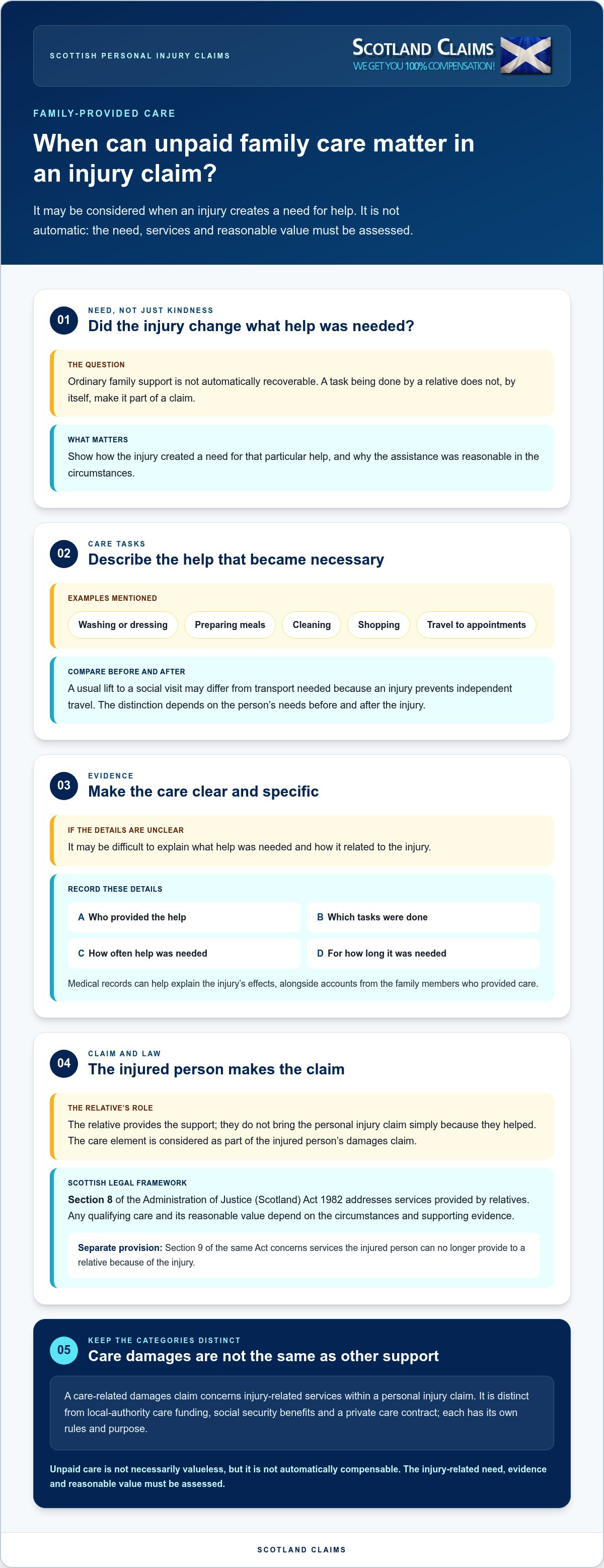
A personal injury claim may include the reasonable value of care or services made necessary by an injury. A relative might help without asking for payment at the time, but that doesn’t automatically make the support irrelevant to a claim. The key question is whether the injury created a need for help, rather than whether the family would ordinarily support one another.
In Scottish personal injury law, damages for gratuitous care may reflect services a relative provided because of the injured person’s needs after an injury. This is often called gratuitous care. Section 8 of the Administration of Justice (Scotland) Act 1982 addresses services provided by relatives. The injured person generally includes this element in their damages claim; it isn’t a separate claim for wages made by the relative.
This is distinct from local-authority care funding, social security benefits and a private care contract. Those arrangements have their own rules and purposes. A care-related damages claim concerns injury-related services and is considered within a personal injury claim. It doesn’t, by itself, establish entitlement to a benefit or council funding, and it shouldn’t be confused with either.
If you’re looking into compensation for care provided by family scotland, the practical point is that unpaid support can still matter, but its relevance depends on the circumstances and evidence. A Scottish personal injury solicitor can assess how the care fits into the wider claim and explain the applicable Scottish procedure.
What kinds of family help could be relevant after an injury?
Support might include help with washing or dressing, preparing meals, cleaning, shopping or travelling to appointments. This isn’t a fixed list, and none of these tasks creates an automatic entitlement. The important question is whether the injury caused a need for that particular help and whether the assistance was reasonable in the circumstances.
Ordinary family contact and routine household contributions are not automatically recoverable. For example, a relative’s usual lift to a social visit may be different from transport needed because an injury prevents the person travelling independently. The distinction depends on the person’s needs before and after the injury, not simply on the task being done by a family member.
Who is usually making the personal injury claim?
Usually, the injured person is the claimant. The relative provides the support but does not bring the personal injury claim simply because they helped. The care element is considered as part of the injured person’s damages, subject to the facts and Scottish legal advice.
Under the approach described by section 8, damages are claimed by the injured person and paid to them, with an obligation to account to the relative who provided the services. The family’s practical payment arrangements and the relative’s position can depend on the circumstances, so they should be explained and reviewed as part of the claim. This helps set clear expectations without treating unpaid help as valueless.
How Scottish law treats care provided by relatives after an injury
Scottish law can recognise services a relative provides because an injured person needs help. The relevant provision is section 8 of the Administration of Justice (Scotland) Act 1982, not section 8 of the Law Reform (Miscellaneous Provisions) (Scotland) Act 1980. Getting the statute right matters because guidance from another UK jurisdiction may describe a different legal framework.
Section 8 concerns services provided to the injured person by a relative. It allows the value of qualifying services to be considered in the injured person’s damages claim. The issue is not simply whether a relative has lost wages or sent an invoice. The focus is the services required because of the injury and their reasonable value. The phrase compensation for care provided by family scotland describes this Scottish personal injury claim element, not a benefit or wage payment.
What does the Scottish statutory framework say?
In plain English, section 8 can apply where a relative provides services the injured person needs as a result of the injury. The injured person generally pursues this as part of their damages claim; the relative does not simply invoice the at-fault party for their time. The circumstances and any payment arrangements should be reviewed under Scottish law, including how an award is accounted for between claimant and relative.
Section 9 of the same Act addresses a different situation: services the injured person can no longer provide to a relative because of the injury. This distinction can matter where, for example, the injured person previously cared for someone else. Neither provision guarantees an award. Liability for the injury, the connection between the injury and the services, supporting evidence and reasonable valuation all affect whether damages can be recovered.
Does unpaid care count if no money changed hands?
No invoice does not, by itself, answer whether care has a value in a claim. A relative may have helped without expecting payment, yet the services may still be relevant if the injury created the need. Conversely, ordinary family help is not automatically compensable. The claim must show what changed because of the injury and why the assistance was reasonably required.
Unpaid care is not necessarily valueless, but its relevance and reasonable value must be assessed under Scottish law. That value is not automatically the relative’s usual hourly wage or the earnings they gave up. It relates to the services provided and the evidence supporting them. A solicitor can consider records, medical evidence and the relative’s account alongside the circumstances of the claim.
Keep care damages separate from carer benefits. For example, the Carer Support Payment in Scotland is a social security payment with its own eligibility rules; it is not compensation for an injury. If you need advice on how care may fit into your wider case, Scottish personal injury claim support can help you understand the relevant issues.
Family care or paid care: how the claim value is assessed
There’s no single calculation that fits every care claim. The assessment looks at the services made necessary by the injury and considers their type, frequency, duration and reasonable value. Family help and paid care can support the same underlying need, but they aren’t automatically valued in the same way.
Family-provided support: A relative may help without charging. A diary, care records and the relative’s account can help show what support was provided and how often.
Paid replacement care: Invoices or receipts may show the service, dates and amount paid. These documents help evidence expenditure, but the care and its connection to the injury still need to be considered.
Care need without a paid service: If support was needed but not arranged, the claim may need evidence of the need and the reasonable services involved. An unmet care need isn’t automatically valued like an invoice.
These are different ways of evidencing a claim, not three guaranteed ways to calculate an award. A relative’s time isn’t automatically valued as though a professional carer had invoiced for every hour. Equally, the absence of a bill doesn’t by itself show that family support had no value. The circumstances and appropriate method of assessment need to be considered in the individual claim.
Which factors can affect the assessment?
The assessment may consider how the injury affected everyday independence, what tasks became difficult or impossible, how often help was required and for how long. It also matters whether the support was genuinely linked to the injury rather than part of the person’s usual routine. Records and accounts can help establish those details.
Past care can be assessed using evidence of what was actually provided. Future care is a separate question. It may be considered where ongoing needs are reasonably anticipated, but the claim needs evidence to support the expected type and duration of help. A solicitor assesses the facts and relevant evidence; there is no universal formula or guaranteed figure.
How is family care different from paid replacement care?
Invoices for paid care can identify services and expenditure. Family support often needs a different record, such as notes of tasks, dates, time spent and the reasons help was required. Neither type of evidence settles the claim alone. A relative’s lost earnings may be relevant background, but that is not automatically the measure of the care services’ value.
Care-related damages should also be kept distinct from other parts of an injury claim. Medical expenses, lost earnings and future care needs are separate issues, even where they arise from the same injury. Setting them out clearly helps avoid counting the same loss twice and shows how each item relates to the evidence.
The phrase “compensation for care provided by family scotland” raises a broader valuation question, but a general calculator cannot determine the value of family care. The Scottish injury compensation calculator offers broader claim context; the care element still needs an assessment based on its specific circumstances and evidence.
What evidence helps support a claim for family-provided care?
Clear records help show what support was needed, who provided it and how the need related to the injury. You don’t need complicated forms. A regular diary or simple table can capture useful detail, especially if the injured person and relative keep notes as events happen.
What should the injured person and relative record?
Use this sequence to build a practical record. Include both the help provided and what the injured person could no longer manage independently because of the injury.
- Name the person who helped. Record who provided each service, including where more than one relative shared the tasks.
- Describe the task. Be specific, such as help getting dressed, preparing a meal, cleaning or travelling to an appointment. Note what the injured person needed help with and why.
- Add the date and duration. Record when the help took place and roughly how long it took. Mark estimates clearly rather than presenting them as exact contemporaneous records.
- Show the frequency and timeline. Note whether help was daily, weekly or occasional, when it began, and any changes as the person recovered or their needs changed. Record when support reduced or stopped.
- Keep relevant supporting material. Retain existing messages, diaries and receipts where they help explain arrangements or related expenditure. Don’t create backdated notes and describe them as though they were written at the time.
Core care records should identify who helped, the task, date, duration, frequency and how the injury affected the need for help; the evidence required varies from case to case.
If you’re recording events after the fact, say so plainly and explain how the information was reconstructed, for example from a calendar or messages. Consistency matters more than polished wording. If the level of help changed, note what changed and when rather than treating the whole period as uniform.
How does the care evidence fit into a wider injury claim?
Care records help explain the practical impact of an injury, but they form only one part of the evidence. Medical records may help show the injury, symptoms and restrictions. They don’t necessarily list every task a relative took on, so care notes and the relative’s account can add detail. Evidence about how the injury happened and who was responsible is also relevant to the wider claim.
Keep the information factual. A medical note may not prove every hour of support, and a diary alone does not establish liability. A solicitor can organise the material, compare accounts and identify gaps that may need explanation. This can make the evidence for compensation for care provided by family scotland clearer and easier to assess alongside the rest of the injury claim.
For advice on how care records fit into a Scottish injury claim, personal injury solicitors in Scotland can explain the relevant process and evidence.
Making a Scottish injury claim that includes care from family
Care provided by a relative is considered as part of the injured person’s wider personal injury claim, not as a separate care-provider service. The claim still needs to establish the injury and the relevant facts. A solicitor can assess whether family support may be included, identify helpful evidence and explain the Scottish procedure that applies.
Scotland Claims Injury Lawyers handles personal injury claims arising from road traffic accidents, workplace injuries and slips or trips in public places across Scotland. If family care followed one of these injuries, explain what happened, how your needs changed and what support your relative provided. This helps the solicitor consider the care alongside the rest of your claim, without assuming that an award will be made.
What happens during an initial claim assessment?
You can outline the accident, your injury, the help your family provided and any records you have kept. Useful material might include medical information, a care diary or notes from the relative who assisted you. Scotland Claims Injury Lawyers offers no-obligation claim assessments and a 24-hour freephone helpline on 0800 611 8132. The assessment considers the available facts and helps explain the next steps.
Be open about what is known and what is still uncertain. You don’t need a complete file before describing your situation. A solicitor can explain which details matter, identify potential gaps and discuss how care evidence may fit with questions of liability and the impact of the injury. The aim is to understand the circumstances before deciding how to proceed.
How are legal fees handled if you proceed?
Scotland Claims Injury Lawyers operates on a no-win, no-fee basis, so you owe nothing if your claim is unsuccessful. If your claim succeeds, the firm recovers its legal costs from the at-fault party’s insurer rather than deducting them from your settlement. No success fee is taken from your compensation, so you keep 100% of your award. The fee arrangement is explained before you proceed.
For anyone researching compensation for care provided by family scotland, the key step is to raise the support as part of the injury claim and explain it accurately. The solicitor can assess the circumstances, review relevant records and set out the next steps without promising a particular result.
Take the next step with clarity
Before deciding what to do, consider having an open conversation with the relative who supported you. Agree on what help was provided and what information you both remember. This can make it easier to discuss the care element clearly, without assuming that raising it means family members must disagree about money.
If you’re considering compensation for care provided by family scotland, an individual assessment can help establish whether the circumstances and available information support including care in your injury claim. Scotland Claims is authorised and regulated by the Law Society of Scotland. An assessment cannot promise a particular outcome, but understanding your position can help you make an informed next decision.
You don’t need to have every answer before taking that step. A clear account of what happened and how your needs changed is a practical place to begin.
Frequently Asked Questions
Can I claim compensation in Scotland for care provided by my family?
Yes, care may be included in a Scottish personal injury claim if the injury created a need for the support and the claim meets the relevant legal tests. For example, after a road accident, you might need temporary help with tasks you managed independently before. The care element depends on the evidence and the wider claim, including whether someone was legally responsible for the injury. No particular outcome is guaranteed.
Can family members be paid for care if they did not charge at the time?
Potentially, yes. The fact that your relative didn’t ask for payment as they helped doesn’t automatically rule out a care-related claim. The injured person generally claims this element as part of their damages, and Scottish law may require them to account to the relative for the relevant award. If your family later agrees how money will be handled, keep that arrangement clear and raise it for legal review.
What kind of care provided by relatives can be included in a claim?
It depends on the injury-related need. Support might include assistance with transfers, supervision where symptoms affect safety, or help managing appointments and daily routines during recovery. A task is not included simply because a relative performed it. The key distinction is whether the injury created or increased the need for that service. Explain any change from the person’s usual routine, including support that was only needed temporarily.
How do you calculate compensation for family care in Scotland?
There is no single fixed rate. In practice, assessment may use a commercial care rate adjusted to reflect that a relative didn’t pay tax or National Insurance, or may use a wage-based benchmark. These are valuation approaches, not guaranteed rates. The reasonable value depends on the services and evidence in the individual case. A general injury calculator can’t determine the care element on its own.
What evidence should I keep for care provided by a relative?
Keep any records that help corroborate the support, such as existing text messages arranging lifts, appointment calendars, receipts for related purchases and notes from the relative. If you start recording after care has already begun, mark clearly which details are remembered or estimated. Don’t make a record now and present it as though it was written at the time. Consistent, honest information is more useful than false precision.
Does the family member have to make a separate compensation claim?
Usually, no. The injured person brings the personal injury claim and raises qualifying family care within it. A relative doesn’t become the claimant simply because they provided help. This is different from a relative pursuing a claim for an injury of their own. If several people provided support, identify each person and their contribution so the solicitor can assess how the details fit the injured person’s claim.
Will claiming for family care affect care benefits or local-authority support?
Don’t assume that an injury award and care support payments are interchangeable, or that a claim has no effect on every benefit or funding arrangement. They operate under different rules, and the impact can depend on the specific payment, assessment and circumstances. Before making decisions about existing support, check the relevant benefit or local-authority rules and explain any proposed claim to your solicitor.