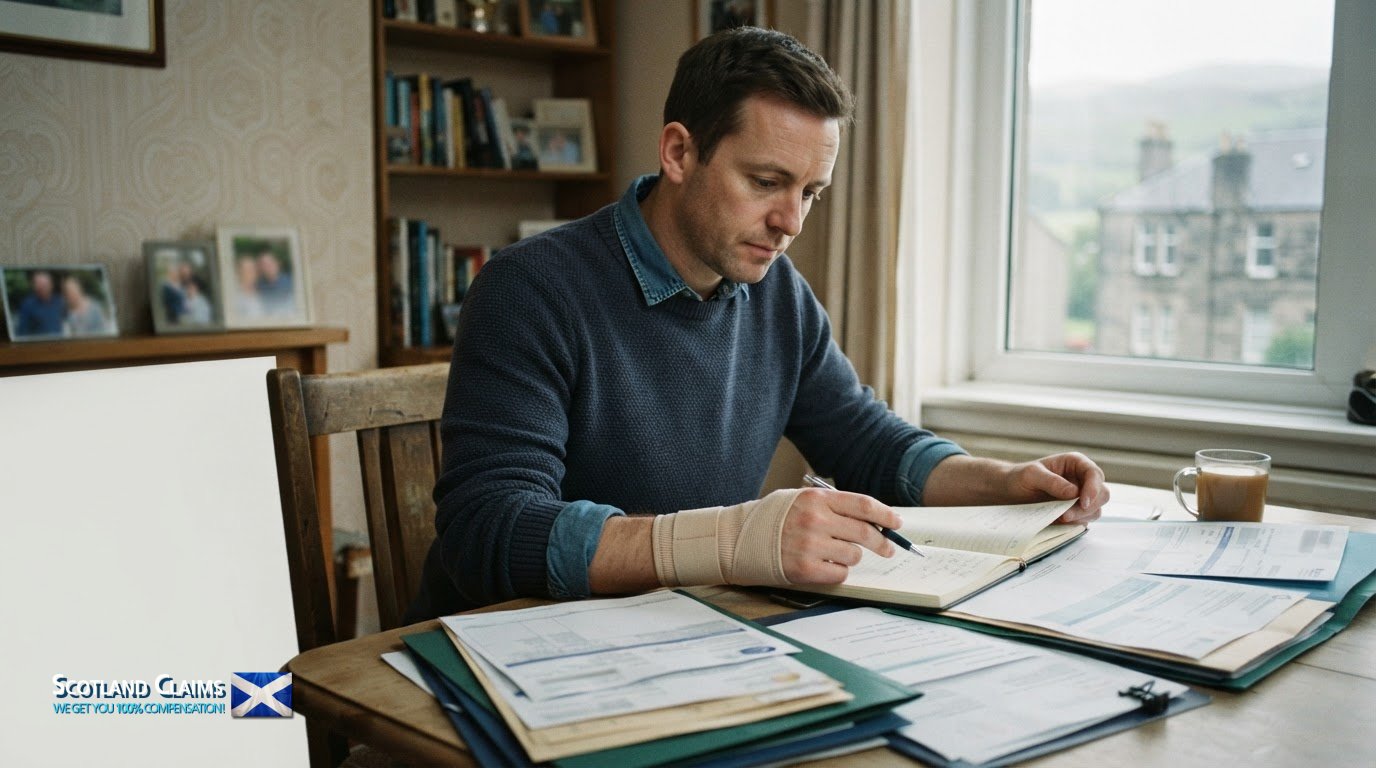
If an injury has stopped you working, the wages you’ve lost may be relevant to a personal injury claim. When you are claiming for loss of earnings in Scotland, the key question is whether your income loss resulted from the injury and can be supported with evidence. This is different from expenses for attending court as a juror or witness.
It’s understandable to be unsure what counts, particularly if you’ve used sick leave, received sick pay or had to reduce your hours. This article explains which past and possible future income losses to discuss with a solicitor, and how payslips, employer records, accounts and medical documents may help show what happened. It also separates injury-related losses from expenses connected with attending court.
You’ll find practical steps to organise your evidence and understand what happens next. Concerned that legal fees could reduce compensation intended to replace lost earnings? Scotland Claims Injury Lawyers works on a No Win, No Fee basis, charges no success fee and ensures clients keep 100% of their compensation. Organising a clear record of your losses is a useful first step towards discussing your circumstances with a solicitor.
Key Takeaways
- When claiming for loss of earnings scotland, focus on income lost because your injury affected your ability to work, not costs linked to attending court.
- Consider both income already lost and possible future effects on your work or earning capacity.
- Keep a clear record of time off and gather relevant payslips, employer records or self-employed income documents to discuss with a solicitor.
- Juror and witness expenses follow separate processes, so the reason for the loss and the evidence needed can differ.
- Scotland Claims handles road traffic, workplace and public-place slip or trip injury claims on a No Win, No Fee basis, with no success fee deducted from your compensation.
Claiming for loss of earnings in Scotland: injury claims or court expenses?
If an accident caused an injury that kept you from working, the income you missed may be relevant to a personal injury claim. That is different from claiming expenses for attending court as a juror or witness. The two subjects can appear together in search results, but they concern separate situations and processes.
This article focuses on injury-related losses in Scottish personal injury claims. It is not a guide to claiming expenses for jury service or giving evidence. If you’re claiming for loss of earnings scotland, first identify why your income was affected: was it because of an injury, or because you had to attend court?
The distinction matters because the circumstances and evidence differ. An injury claim may involve information about your work, income and how the injury affected your ability to earn. Court-attendance expenses follow the relevant court process. Scotland’s economy includes a range of industries and forms of employment, as outlined in the Economy of Scotland. For an individual claim, your own job and circumstances matter most.
What does loss of earnings mean in an injury claim?
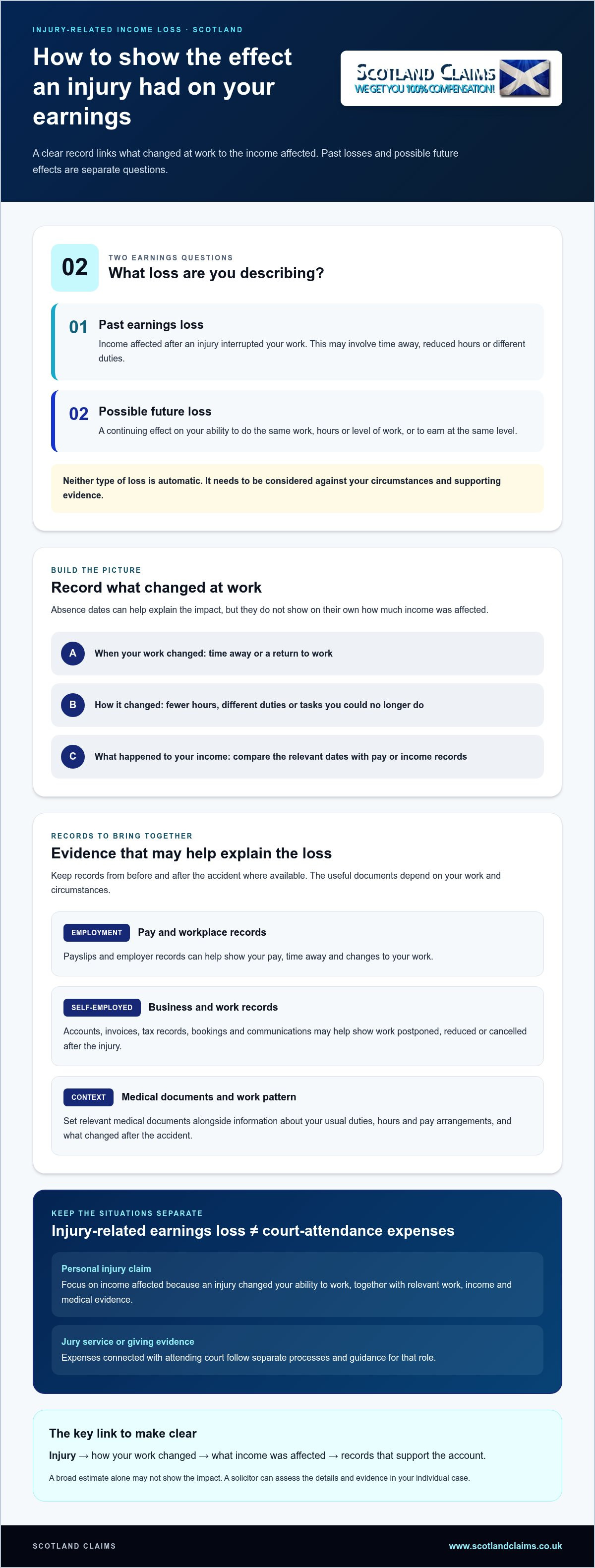
Past loss concerns earnings you missed after an injury affected your work. For example, you may have been unable to work for a period or needed to reduce your hours. Possible future loss is different: it may be relevant if the injury continues to affect your ability to do your job or earn at the same level. Neither type of loss is automatic. The impact needs to be considered in light of your circumstances and supporting evidence.
Your usual duties, time away from work and actual income impact can help explain what changed. A broad estimate alone may not show how the injury affected your earnings. The sections below cover the losses to discuss and the records that may help clarify them.
Why do search results mention jurors and witnesses?
Scottish court guidance describes separate processes for jurors and witnesses seeking expenses connected with attending court. Those processes concern jury service or giving evidence, not wages missed because an accident caused an injury. If your question is about injury-related income loss, focus on a personal injury claim. If you’re seeking reimbursement for court attendance, follow the guidance for that role.
Keeping the distinction clear can help you find information relevant to your situation. For an injury claim, the cause of the loss, its effect on your work and the available evidence need to be considered together. A solicitor can assess those details as part of your claim. You can explore personal injury legal support across Scotland to discuss how an accident has affected your earnings.
Which past and future earnings losses could an injury claim address?
Past earnings loss concerns income affected after an injury interrupted your work. Future earnings loss concerns a possible continuing effect on your ability to work or earn. These are separate questions, and neither means compensation is automatic.
Start by identifying what changed in your working life because of the injury. The days you were absent may help explain the impact, but they don’t, by themselves, show how much income was affected. Your usual duties, hours, pay arrangements and any changes after returning to work all matter. A solicitor can assess the facts and evidence in your individual case.
How can an injury affect earnings already lost?
If your injury prevented you from doing your job, you may have missed work and income during your recovery. You might also have returned on reduced hours or been given different duties, affecting your earnings even if you weren’t absent for long. The period away from work and the income impact are related, but they are not the same calculation.
For example, two people may each miss a week but experience different effects on their income because their roles and pay arrangements differ. Someone who returns quickly may still have a loss if they work fewer hours or can’t carry out paid duties they previously performed. Record when your work changed and how, then compare those dates with relevant pay or income records. This gives a clearer picture than relying on absence dates alone.
What if an injury affects future work or self-employment?
A continuing effect may need closer assessment. You may be back at work but unable to do the same tasks, hours or level of work as before. Any possible future loss depends on the evidence and circumstances, including how the injury affects your actual work and income. A general estimate cannot establish what your individual claim may include.
If you’re self-employed, useful starting records may include accounts, invoices, tax records, bookings and communications showing work postponed, reduced or cancelled after the injury. Set these alongside information about your usual work pattern and any changes since the accident. These records can help explain the disruption, but they do not determine the legal treatment or calculation of a future loss. A solicitor needs to assess those questions individually.
For anyone claiming for loss of earnings scotland, the practical focus is a clear link between the injury, its effect on work and the income affected. Keep evidence from before and after the accident where available, and note changes as they happen. This can help a solicitor understand past losses and possible future effects without relying on a one-size-fits-all figure.
If an accident has changed your ability to work, you can discuss your injury-related earnings loss with Scotland Claims as part of a personal injury claim.
How does an injury earnings claim differ from juror or witness expenses?
The key difference is what caused the income loss. In an injury claim, you’re considering earnings affected because an accident caused an injury and changed your ability to work. Juror and witness expenses relate to attending court. Each follows a different process, so the relevant records and decision-makers differ.
This distinction matters if you’re claiming for loss of earnings scotland. Scottish Courts and Tribunals Service guidance covers expenses for jury service, while mygov.scot explains expenses for people cited to give evidence. Neither is a guide to valuing injury-related losses. Use the comparison below to identify which situation matches yours.
Situation
Reason for loss and process
Example evidence
Injury-related earnings loss
An accident injury affected your work or income. The loss is considered as part of a personal injury claim.
Work and income records, alongside information showing how the injury affected your work.
Juror expenses
You lost income or incurred eligible expenses through jury service. Follow the Scottish Courts and Tribunals Service process.
Jury service details and documents supporting the expense claimed.
Witness expenses
You were cited to give evidence and had expenses connected with attending court. Follow the relevant witness guidance.
Citation details and records supporting relevant expenses, such as travel or income loss.
When are earnings losses connected to jury service?
Scottish Courts and Tribunals Service guidance concerns attending jury service. It describes eligible expense categories and applicable maximum amounts. Those limits belong to the jury-expense process, not an injury claim. If your income was affected because you served as a juror, use the court’s guidance and application process. If an injury stopped you working, focus on evidence for your personal injury claim instead.
When are expenses connected to being a court witness?
mygov.scot addresses expenses for people formally cited to give evidence. Its examples include travel, meals, income and caring responsibilities. This guidance covers costs linked to attending court as a witness. It does not determine whether earnings lost because an accident caused an injury can form part of a personal injury claim. Keep the reason for each loss clear when organising your records.
A useful first step is to note the cause beside each missed payment or expense. Was it time away from work because of your injury, jury service or a witness appearance? That distinction helps direct you to the right process and prevents court expense guidance being mistaken for information about injury-related earnings. For an injury claim, the individual facts and supporting evidence still need to be assessed together.
What evidence can help show loss of earnings after an accident?
A clear record can help explain how an injury affected your work and income. Start gathering information early, even if you’re unsure which documents will ultimately matter. The examples below are practical starting points, not a fixed checklist for every claim. The evidence a solicitor considers relevant depends on your work, the loss you’re discussing and your circumstances.
Which employment and income records should you organise?
Useful examples may include payslips, employer absence records and correspondence about time off, reduced hours or changed duties. If you’re self-employed, consider invoices, accounts and records showing work postponed, reduced or cancelled. The right documents depend on your employment status and the type of loss being considered. A solicitor can help identify which records are relevant to your claim.
What practical steps can you take after an accident?
Follow this sequence to build an organised record of what changed:
- Record each work change. Note dates you were absent, worked reduced hours or took on different duties. Briefly explain how the injury affected your work.
- Keep income records together. Save payslips, accounts, invoices and other documents showing your usual income and any changes after the accident.
- Preserve workplace communications. Keep relevant messages or letters about absence, adjusted duties, hours or pay. These can help clarify when and why arrangements changed.
- Organise documents by date and type. Use folders or a simple list to make records easier to follow. Keep original documents unchanged and store copies separately; don’t edit or annotate the originals.
- Make a note of gaps or questions. If a record is missing or a change is hard to explain, note it for discussion rather than guessing at the answer.
This process can make it easier to explain the connection between the accident, your work and the income affected. It does not, by itself, establish that a particular amount is recoverable. A solicitor needs to assess the evidence in context, including any records that may need clarification. If your injury happened at work, the work injury claims guide can help you understand the process for that type of accident.
If you’re unsure which documents matter, raise that during a free, no-obligation assessment. Bring the records you have, even if they’re incomplete. A solicitor can discuss your circumstances and identify what further information may help. Keeping a dated record now can also help you explain changes accurately later, rather than relying on memory alone.
Lost income can add financial pressure while you’re recovering. Scotland Claims handles personal injury claims involving road traffic accidents, workplace injuries and slip or trip accidents in public places across Scotland. If an injury from one of these accidents has affected your work or earnings, a solicitor can assess your circumstances and the information you have gathered.
That assessment considers more than a headline figure. The accident, injury, effect on your work and supporting evidence all matter. For personal injury legal support in Scotland, find out more about injury lawyers in Scotland.
How does the No Win, No Fee arrangement work here?
Scotland Claims works on a No Win, No Fee basis and charges no success fee. No success fee is deducted from your compensation, so you keep 100% of it. You owe nothing if your claim is unsuccessful.
Scotland Claims recovers legal costs from the at-fault party’s insurer. This means legal fees do not reduce the compensation intended to replace lost earnings. Your solicitor can explain how the arrangement applies to your claim before you decide how to proceed.
What happens when you ask about a claim?
The first step is a free, no-obligation assessment. A qualified solicitor can consider the accident, your injury and the earnings-loss information you’re able to provide. You don’t need every document in order before raising questions. Explain what work you missed or how your duties or income changed, then discuss which records may help clarify the situation.
For people claiming for loss of earnings scotland, an early conversation can make the process clearer. You can explain what happened, understand what information may be relevant and learn how the fee arrangement applies. The assessment is an opportunity to discuss your circumstances, not a promise that a particular loss will be recovered or that a claim will succeed.
To discuss an injury-related earnings loss, start a free, no-obligation assessment or call Scotland Claims’ freephone helpline on 0800 611 8132. The helpline is available 24 hours a day.
Take a clear next step with your earnings-loss claim
If an injury has affected your ability to earn, you don’t need every answer before seeking guidance. Start by explaining what changed at work and what income was affected. A solicitor can help you understand how those details may fit into a personal injury claim. If you’re considering claiming for loss of earnings scotland, an initial conversation can help you work out a clearer next step.
Scotland Claims ensures clients keep 100% of their compensation, with no success fee deducted. The firm is authorised and regulated by the Law Society of Scotland, and its freephone helpline is available 24 hours a day. You can discuss your circumstances and understand the next steps without obligation.
Your work and income matter. Get clear guidance on your options and take the next step with confidence.
Frequently Asked Questions
Can I claim loss of earnings after an accident in Scotland?
Income loss may be considered in a personal injury claim if an accident-related injury affected your ability to work. Whether it can form part of your claim, and what evidence is needed, depends on your circumstances. This differs from expenses for jury service or attending court as a witness. If you’re claiming for loss of earnings scotland, seek an individual assessment rather than assuming a particular loss will be recovered.
What evidence do I need to claim lost wages after an injury?
Useful records may include payslips, employer absence records, relevant correspondence and a dated note of work missed or reduced. Self-employed people may also find invoices, accounts and records of disrupted work helpful. These are examples, not a fixed checklist. Keep documents in their original form and organise them by date if you can. A solicitor can assess which records are relevant to your work and the loss being considered.
Can I claim future loss of earnings if my injury affects my work?
Possibly. If an ongoing injury affects your future work or earning capacity, a future loss may be relevant, but it isn’t automatic. Its relevance and assessment depend on your circumstances and supporting medical and employment evidence. A lasting change to your duties or hours, for example, may help explain the impact. Tell a solicitor about changes to your role and work prospects so they can consider the potential effect rather than relying on a generic estimate.
Are juror loss-of-earnings expenses the same as an injury claim?
No. Juror expenses relate to eligible costs of attending jury service and are handled through the Scottish Courts and Tribunals Service process. Injury-related earnings loss concerns income affected because an accident caused an injury. The processes, evidence and rules differ. If your loss arose from jury service, follow the court’s guidance. If an injury affected your earnings, seek an assessment as part of a personal injury claim.
Can self-employed people claim loss of earnings after an accident?
Self-employed people can ask for an assessment of income losses linked to an injury. Accounts, invoices, contracts and details of work missed or rearranged may help show what changed. No single document proves a claim, and useful evidence varies with the work and circumstances. Keep records showing your usual trading pattern as well as disruption after the accident, then discuss them with a solicitor.
Will Scotland Claims deduct a success fee from my compensation?
No. Scotland Claims charges no success fee, and clients keep 100% of their compensation. The firm recovers its legal costs from the at-fault party’s insurer rather than deducting a success fee from your settlement. You owe nothing if your claim is unsuccessful.
How long do I have to make an injury claim in Scotland?
Personal injury claims in Scotland commonly have a three-year time limit, but when it starts and whether an exception applies depend on the circumstances. The period is generally counted from the accident or the date you became aware of the injury. Different rules apply if the injured person was a child. Seek legal advice promptly, especially if time has passed or the injured person was under 16.