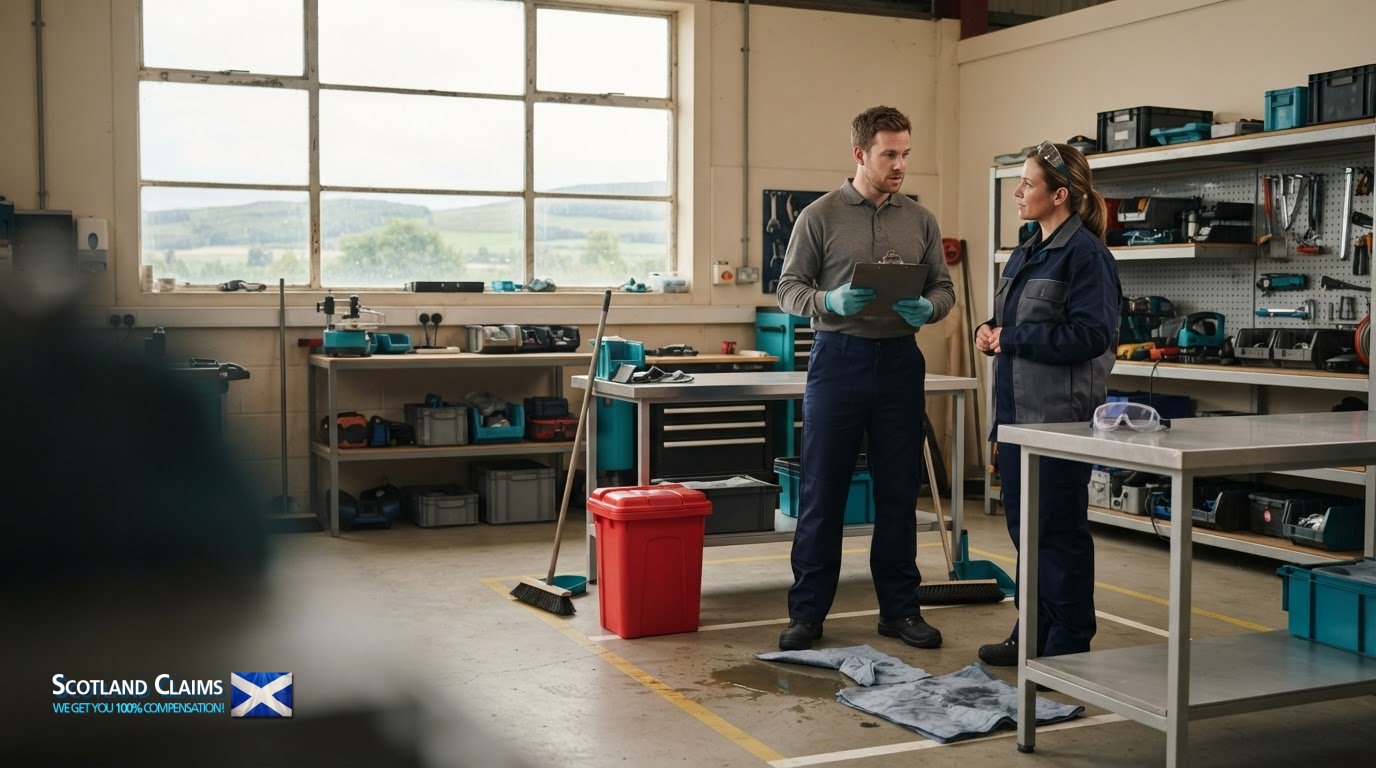
Could symptoms that appear after a workplace spill be linked to what you were exposed to? If you’re asking, “chemical spill injury at work scotland: can I claim?”, the answer depends on the evidence, the effect on your health and whether someone was responsible. Symptoms may not appear straight away, and uncertainty about the cause does not automatically rule out a claim.
Put your health first, report the incident and make a clear record of what happened. This guide explains what to do after chemical exposure in Scotland, what evidence may help link your symptoms to the spill, and how responsibility may be assessed. It also covers what to consider if you’re unwell and worried about returning to work.
You can ask about a workplace injury claim without paying legal fees upfront. With Scotland Claims Injury Lawyers’ no-win-no-fee arrangement, there is no success fee deducted from a successful settlement, and you owe nothing if the claim is unsuccessful. If your claim succeeds, you keep 100% of the settlement, with legal fees recovered separately from the at-fault party’s insurer.
Key Takeaways
- A chemical spill injury at work scotland claim may depend on evidence of both harm and another party’s responsibility. A spill alone does not establish that a claim can succeed.
- Record when symptoms began, how they changed and what treatment you received. This timeline may help show how your health was affected.
- Keep relevant records and note what happened, who you told and how the workplace responded. Evidence can help a solicitor assess the incident, but it does not prove fault by itself.
- Follow workplace emergency procedures and medical advice. Do not handle chemicals if you do not know what they are.
- An initial assessment gives you an opportunity to discuss the incident, your injury, available records and any concerns.
Chemical spill injury at work in Scotland: when might a claim be possible?
A workplace chemical-spill injury is harm linked to contact with a substance during work. It could follow a splash, leak, overturned container or accidental release. A spill alone, however, does not establish that anyone was injured or that a claim can succeed.
In brief: an exposure incident involves contact with a chemical; a personal injury claim also needs evidence that you suffered harm and a basis for alleging another party was responsible. For a chemical spill injury at work Scotland claim, relevant questions include what substance was involved, how exposure happened, how it affected you and what the evidence shows about the circumstances. Each incident needs to be assessed on its own facts.
Exposure can happen during routine work as well as during an unexpected release. The general chemical accident overview describes a range of incidents, but it cannot establish what happened in your workplace or whether you have a claim. That depends on the evidence relating to your situation.
What kinds of workplace chemical exposure can cause concern?
Contact may involve skin or eyes, breathing in a substance, or accidental ingestion. Examples include cleaning products, solvents and industrial substances. These examples do not identify what was present in a particular spill, and exposure does not automatically mean an injury occurred. The substance, route, duration and circumstances may all be relevant. If you are concerned after contact, seek appropriate medical advice and explain what you know about the substance and exposure.
What needs to be considered before making a claim?
Separate what happened from what can be evidenced. A spill may show that an incident took place, but whether you were injured is a separate question. Medical records, your account and other available information may help clarify whether you were harmed and whether that harm could be linked to the exposure. A solicitor can assess how the details fit together.
Responsibility also needs to be considered. The circumstances may raise questions about how the substance was stored or handled, what happened before the spill and how people responded afterwards. None of these details alone proves fault. The evidence must be considered as a whole, and the connection between the incident and your injury must be assessed rather than assumed.
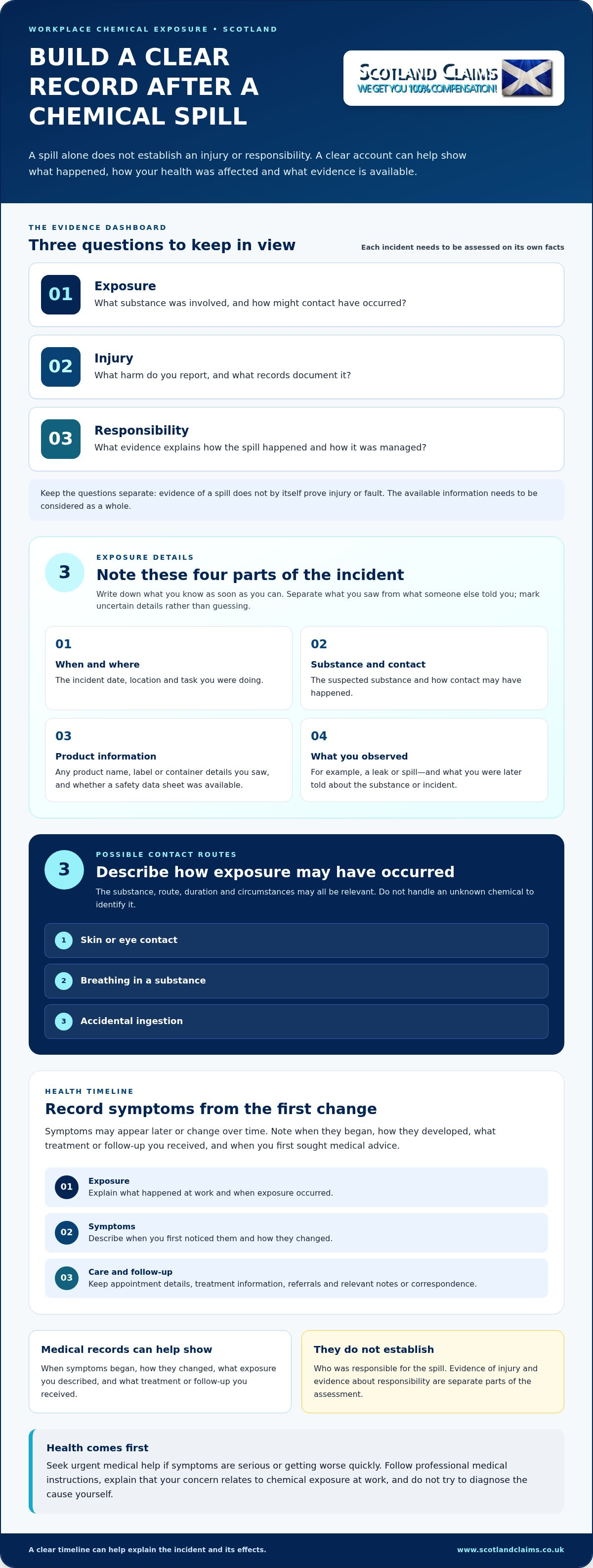
- Exposure: What substance was involved, and how might contact have occurred?
- Injury: What harm do you report, and what records document it?
- Responsibility: What evidence explains how the spill happened and how it was managed?
These are starting points, not questions you need to resolve by yourself. Scotland Claims’ personal injury solicitors in Scotland assess workplace injury circumstances and the evidence available. The accident-at-work guide provides wider context on related workplace claims.
Chemical exposure symptoms and medical evidence: what to record
After exposure, pay attention to how you feel and when symptoms begin. If symptoms are serious or getting worse quickly, seek urgent medical help. Follow professional medical instructions and explain that your concern relates to chemical exposure at work. Do not try to diagnose the cause yourself.
For a chemical spill injury at work scotland claim, a clear timeline may help connect the incident with the health effects you report. Prompt, accurate medical records can document when symptoms began, how they changed, what exposure you described and what treatment or follow-up you received. They may support evidence of an injury, but they do not establish who was responsible for the spill.
Which details about exposure should a worker note?
Write down what you know as soon as you can. Be precise, and separate what you saw yourself from what someone else told you. If a detail is uncertain, say so rather than guessing. Include:
- The incident date, location and task you were doing.
- The suspected substance and how contact may have happened, such as through skin or eye contact, breathing it in or accidental ingestion.
- Any product name, label or container details you saw, and whether a safety data sheet was available.
- What you directly observed, such as a leak or spill, and what you were later told about the substance or incident.
If workplace information identifies the substance, keep a copy or note where it can be found. The Scottish Government’s Control of Substances Hazardous to Health (COSHH) Policy provides context on managing hazardous substances in a Scottish workplace. Do not handle an unknown chemical to identify it.
How can medical records support the account?
Tell the clinician what happened at work, when exposure occurred and when you first noticed symptoms. Describe how they developed, even if they appeared later or changed over time. Clear details can help ensure that your account and symptoms are recorded accurately. The appropriate assessment depends on your circumstances; no single test or diagnosis is required for every exposure.
Keep appointment details, treatment information, referrals and relevant notes or correspondence. If you take time away from work, retain records showing the dates and any related workplace communication. These documents can help explain the effect on your routine and provide a timeline alongside clinical records. Medical notes may record what you reported and the care provided, but they do not, by themselves, prove how the spill happened or that another party was at fault.
Keep your notes factual and update them if your symptoms or treatment change. If you are unsure how your records fit into a workplace injury claim, you can discuss your circumstances with Scotland Claims.
Proving responsibility after a workplace chemical spill in Scotland
It can be difficult to piece together what happened, especially if no single report captures the whole incident. Evidence may come from different sources: a witness might describe the spill, a product label could help identify the substance, and medical records may document the injury. Considered together, these details can help a solicitor assess the sequence of events and whether there is a basis for alleging responsibility.
The Control of Substances Hazardous to Health Regulations 2002, known as COSHH, are a key part of the UK framework for managing risks from hazardous substances. The Health and Safety Executive (HSE) provides workplace health and safety guidance and enforces relevant regulations. Whether the evidence points to a breach or supports a claim depends on the specific circumstances. A spill, or a report about it, does not automatically prove fault.
Which workplace records and witness details may matter?
Use this evidence map to organise potentially relevant information. You do not need to obtain restricted workplace records yourself. Keep what you already have, note where other material may exist, and let a solicitor assess how it can be accessed appropriately.
| Evidence area | Examples to note or retain |
|---|
| Spill | Incident report, photographs you lawfully took, and details of the location and time. |
| Exposure | Product label, container name, safety data sheet or notes about the task and how contact may have happened. |
| Injury | Clinical records, appointments, treatment and records of how your health changed. |
| Workplace response | Who was notified, what steps followed, and any relevant workplace procedures or communications you hold. |
Write down the names and contact details of people who witnessed the spill or its immediate aftermath, if you can do so appropriately. Note what each person directly saw rather than asking them to speculate. Under RIDDOR, the responsible person must report certain specified workplace incidents, but not every spill meets the criteria. An incident report can be useful evidence, although its existence alone does not establish liability.
How do medical evidence and workplace evidence work together?
Clinical records can help document the injury and symptoms you described. Workplace material may explain the substance, task, exposure circumstances and response. Dates that align, alongside consistent accounts, can help a solicitor assess the connection between exposure and injury and consider responsibility. Gaps or differences do not decide a claim by themselves; they need to be considered in context.
For a chemical spill injury at work scotland claim, a solicitor can review the available records without treating any one document as conclusive. Scotland Claims’ work injury claims service can help assess how workplace and medical evidence relate to your circumstances.
What to do after a chemical spill injury at work in Scotland
Take things in order: put your health first, then make a careful record of what happened. You do not need to decide straight away whether you have a claim. These steps can help protect your wellbeing and preserve useful information for an assessment later.
- Prioritise safety and medical care. Follow workplace emergency procedures and leave the affected area if required. Do not touch or try to clean up an unknown chemical. Seek urgent medical help for serious or rapidly worsening symptoms, and follow medical professionals’ instructions.
- Notify the appropriate workplace contact. Tell your manager, supervisor or designated safety contact as soon as it is safe. Give a factual account, including when and where the incident happened and how you may have been exposed.
- Document what you know. Note the date, location, task, substance if known and what you directly observed. Keep the account factual. If a detail is uncertain, say so rather than guessing.
- Retain relevant records. Keep copies of messages, any incident reference, medical notes and records of time away from work. Do not alter, remove or dispose of workplace materials without permission.
- Seek advice about your options. A solicitor can consider the incident, available evidence, potential responsibility and any deadlines that may apply.
How should the incident be reported and documented?
Use your workplace’s reporting process when it is safe and appropriate, and note when and to whom you reported the spill. Save related correspondence or reference numbers. You can record where relevant workplace documents may be held, but do not access restricted files or take workplace materials without permission. A clear record helps preserve your recollection while events are fresh.
When should someone get advice about a Scottish claim?
Seek advice promptly. Records can become harder to locate, and early guidance may help identify relevant evidence. In Scotland, the general time limit for a personal injury claim is three years, but the point from which it runs can depend on when the injury happened or when you became aware of the injury and its possible cause. Exceptions may also apply. Do not calculate a deadline from general information alone; a qualified solicitor must assess your circumstances and the applicable rules.
If you are considering a chemical spill injury at work scotland claim, Scotland Claims’ injury solicitors can review the facts, records and potential time limits with you. Prompt advice can help clarify what to preserve and what steps may be appropriate next.
Discuss your workplace injury circumstances
Starting a chemical spill injury claim with Scotland Claims
You do not need to have every document or know exactly what caused your symptoms before asking about a claim. An initial assessment gives you the chance to explain what happened and raise concerns, including uncertainty about the substance, when symptoms began or whether you can return to work. It is a practical first step, not a promise that a claim will succeed.
What happens during an initial claim assessment?
You can describe when and where the spill happened, what task you were doing, how you may have been exposed and what symptoms or treatment followed. Share any records you have, such as medical notes, incident references, product details or messages from work. If you do not know an answer, say so. A clear account of what you know and what remains uncertain helps the solicitor understand the situation.
Scotland Claims offers a free, no-obligation initial assessment. A qualified solicitor can consider the circumstances and available information, then discuss whether there may be grounds to pursue a workplace injury claim. The assessment is an opportunity to ask questions and understand possible next steps; it does not guarantee a particular decision or compensation amount. Scotland Claims also provides a 24-hour freephone helpline on 0800 611 8132.
For a chemical spill injury at work scotland claim, raise practical concerns as well as questions about responsibility. For example, tell the solicitor if symptoms developed over time, records are incomplete or you are worried about the effect of making an enquiry at work. An accurate account helps the solicitor assess what further information may be needed.
How does the 100% compensation model work?
With Scotland Claims, if your claim succeeds, you keep 100% of the settlement. No legal fee or success fee is deducted from it. The firm recovers its legal fees separately from the at-fault party’s insurer, rather than taking them from your compensation.
The arrangement is no-win-no-fee, but it does not guarantee success or a particular award. If your claim is unsuccessful, you owe nothing under this arrangement. Your solicitor will explain the funding terms and how they apply to your case before you decide how to proceed. Scotland Claims’ solicitors are authorised and regulated by the Law Society of Scotland, and can explain the process in plain language.
You can start by sharing the incident details and requesting a free, no-obligation assessment. You do not need to make a final decision about pursuing a claim before discussing your situation.
Choose your next step with confidence
Considering a claim can feel like one more thing to manage while you are dealing with the effects of an incident. You do not have to reach a firm conclusion on your own. A conversation can help clarify what questions remain, what information may be relevant and whether you want to take things further.
If you are considering a chemical spill injury at work scotland claim, focus on advice that reflects your circumstances, not assumptions about what happened or what the outcome might be. You can raise concerns about work, recovery and the process before deciding how to proceed. An initial discussion gives you a clearer basis for making that decision.
You deserve clear answers and the confidence to choose what happens next.
Frequently Asked Questions
Can I claim for a chemical spill injury at work in Scotland?
You may be able to claim if you suffered an injury and there is a basis for alleging someone else was responsible. A spill or exposure alone does not establish that a claim will succeed. The assessment depends on the circumstances, including what happened and how your injury relates to it. A solicitor can review the available information and explain whether it may support a claim.
What should I do immediately after chemical exposure at work?
Move away from danger if you can do so safely, follow your workplace emergency procedure and seek urgent medical help for serious or rapidly worsening symptoms. Do not re-enter an affected area or handle an unknown substance to gather evidence. Tell the clinician that exposure happened at work and follow their advice. Once you are safe, notify the appropriate workplace contact; do not delay medical care to collect documents or photographs.
What evidence do I need for a chemical spill injury claim?
You do not need a complete evidence file before asking for an assessment. Useful material may include your own dated account, relevant messages, an incident reference, medical records and contact details for people who witnessed events. If you have them, retain photographs or product information obtained safely and with permission. Different records can clarify different parts of the incident, so an incomplete set does not automatically prevent a solicitor from reviewing your circumstances.
How long do I have to make a workplace chemical injury claim in Scotland?
The general time limit for a personal injury claim in Scotland is three years, under the Prescription and Limitation (Scotland) Act 1973. The period may run from the accident date or, in some cases, the date you knew or should reasonably have known that you had a significant injury linked to someone’s fault. Exceptions can apply. A solicitor should assess the relevant start date and deadline for your situation.
Can I make a claim if I do not know which chemical caused my symptoms?
Not knowing the chemical’s identity does not automatically rule out asking about a claim. Explain what you observed, such as the task, container, location or any product name you remember, and be clear about what you do not know. Other records or witness accounts may help clarify the exposure. If you are researching “chemical spill injury at work scotland”, remember that a solicitor must assess whether the available evidence can connect the incident, your symptoms and responsibility.
Will I have to pay legal fees if my chemical spill claim is unsuccessful?
Under Scotland Claims’ no-win-no-fee arrangement, you owe nothing if your claim is unsuccessful. If a claim succeeds, the firm recovers legal fees from the at-fault party’s insurer, not by deducting them from your settlement. This funding model does not guarantee that a claim will succeed or determine its value. Your solicitor will explain how the terms apply to your case.