A claim may be possible on behalf of a deceased relative after a fatal road accident in Scotland. Finding car crash lawyers near me can help you understand who may pursue a claim and which losses could be considered. The circumstances and available evidence matter.
After a collision, you may be dealing with injuries, vehicle damage and uncertainty about responsibility. If the other driver was uninsured, cannot be traced or disputes liability, car crash lawyers near me can explain the claims process and what information may be relevant.
This article explains how road accident claims work, including claims after fatal accidents, rehabilitation and vehicle costs. It also covers what can affect a claim and when legal support may help you move forward.
Key Takeaways
- Find out what steps may apply when the driver responsible is uninsured or cannot be traced, and organise the evidence you have.
- Learn how no-win, no-fee representation works and what to understand before proceeding with an injury claim.
- Keep a clear record of your injuries, treatment and rehabilitation needs to support your account of the accident’s effects.
- See how disputed responsibility can affect a claim and what evidence may help clarify how the collision happened.
- Separate injury losses from vehicle costs, and learn what details matter when considering repairs, replacement or a hire vehicle.
Claims involving uninsured or untraced drivers
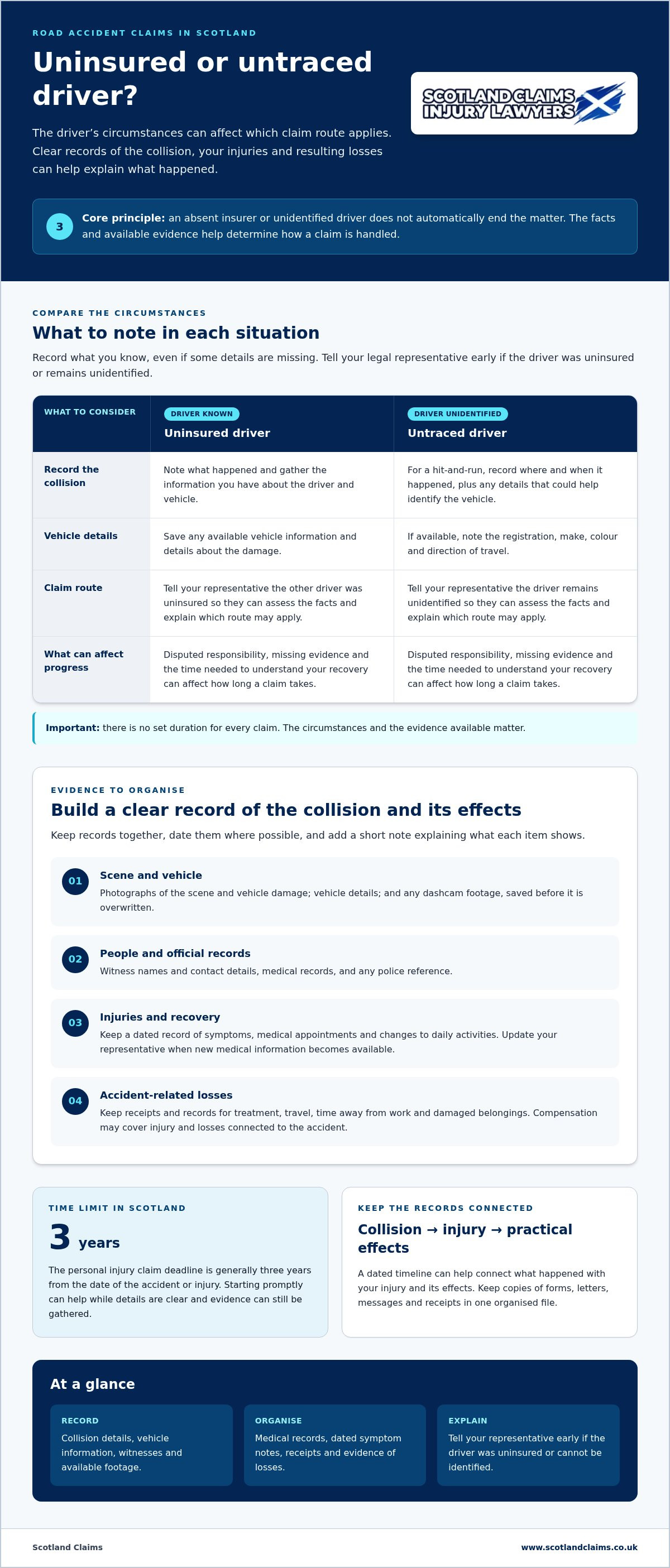
If the other driver was uninsured or cannot be identified, record what happened and get advice about the appropriate claim route. For an injury claim, gather medical records, witness details, photographs, information about vehicle damage and any police reference. The National Library of Medicine describes investigations that examine these types of evidence.
Uninsured or untraced drivers
If available, note the vehicle registration, make, colour and direction of travel. For a hit-and-run, record where and when the collision happened and any details that could help identify the vehicle. Ask witnesses for their names and contact details, and save dashcam footage before it is overwritten.
Tell your legal representative early if the driver was uninsured or remains unidentified. They can assess the facts and explain which route may apply. Do not assume that the absence of an insurer ends the matter. Evidence about the collision, your injuries and the driver’s identity can all affect how a claim is handled.
Compensation and claim duration
Compensation may cover the injury and its effects, along with losses connected to the accident. Keep receipts and records for treatment, travel, time away from work and damaged belongings. These documents help show what changed after the collision.
There is no set duration for every claim. Disputed responsibility, missing evidence and the time needed to understand your recovery can all affect progress. In Scotland, the personal injury claim deadline is generally three years from the date of the accident or injury. Start promptly, while details are still clear and evidence can be gathered.
Evidence for an injury claim
Useful evidence includes photographs of the scene and vehicle damage, witness accounts, medical records and a dated record of symptoms. The National Library of Medicine describes crash investigations that review scene evidence, vehicle damage, recorded vehicle data and driver information, including phone records and medical information.
Keep everything in one organised file. For example, date each repair photograph and add a short note explaining what it shows. Record medical appointments and changes in your daily activities. A clear timeline can help connect the collision, your injury and its practical effects.
Starting and managing a claim
Start by recording the collision details, saving photographs and footage, and seeking medical attention for injuries. Note the date, location, vehicles involved, witnesses and any communication from an insurer. Share accurate information, and keep copies of forms, letters and receipts.
Update your representative when new medical information or evidence becomes available. If the other driver was uninsured or cannot be traced, say so at the outset. Personal injury claims can involve several connected records, so dated notes and prompt replies help ensure important details are not missed.
Bicycle and pedestrian claims
You do not need to have been driving a car to be injured in a road collision. A cyclist or pedestrian can record the same essential details: location, time, vehicle description, witnesses and injuries. Photograph the scene and damaged belongings when it is safe, and keep medical documents together.
For example, a cyclist may have damage to a bicycle and helmet as well as an injury. A pedestrian may have no vehicle evidence of their own, making witness details and scene photographs particularly useful. Tell your representative which losses relate to the collision, and provide supporting records as they become available.
HOW DO I CLAIM FOR A ROAD ACCIDENT?
Start by gathering your accident records and finding legal representation experienced in road injury claims. When comparing car crash lawyers near me, consider relevant experience, clear funding terms and how each solicitor explains possible outcomes before deciding who should represent you.
No Win No Fee representation
A No Win No Fee agreement explains how legal costs are handled if your claim succeeds or fails. Before signing, read the written terms, including any provisions on costs, deductions or expenses in either outcome. Make sure the agreement explains how its terms affect the settlement you receive.
Ask the solicitor to explain each clause in plain English. If an offer is made, for example, you should understand how the agreement affects the amount you receive. Do not rely on the label alone. Read the written terms and ask about anything you do not understand.
To get a claim moving, prepare a concise account of the collision and its effects. Include the date and location, vehicles involved, what you remember happening and how your injuries have affected daily activities. Keep medical correspondence and receipts together, ready to provide when requested.
Tell your representative if responsibility is disputed or another driver’s details are incomplete. This context can affect which records need attention. A witness account, for example, may help clarify conflicting versions of events, while repair documents can support details about vehicle damage. Keep copies of messages and note when you sent documents.
Comparing lawyers’ experience and reviews
How can you compare car accident lawyers’ experience, reviews and success rates? Look for experience with road traffic injury claims like yours. Compare how clearly each solicitor explains the process and agreement. Treat headline success claims cautiously unless the firm explains how it defines and measures them.
Reviews can show how clients describe communication, explanations and case updates. Look for detailed accounts that reflect your priorities instead of relying on a single rating. Ask who will handle your case, how you will receive updates and how evidence is assessed when fault is contested.
- Relevant experience: Check whether the solicitor handles claims involving circumstances like yours.
- Clear terms: Read the agreement and ask for unclear wording to be explained.
- Meaningful outcomes: Ask what a stated success rate includes and how it relates to similar cases.
- Communication: Establish who your main contact will be and how updates are provided.
Choosing car crash lawyers near me should leave you clear about who will manage your claim and what happens next. Once you have organised your records and compared these points, you can make a more informed choice. For guidance on road accident claims in Scotland, explore road accident claim support.
After a road collision in Scotland, keep a record of treatment, symptoms and changes to everyday life. Rehabilitation needs and injury-related losses are assessed using evidence that connects the collision with its effects. A dated symptom diary can show how pain affects tasks such as driving, sleeping, shopping or caring for family members.
Recording rehabilitation and losses
Follow the treatment plan provided by your healthcare professional and keep appointment letters, prescriptions and rehabilitation records. Note when treatment starts, what it involves and how your condition changes. If an exercise or activity causes difficulty, record what happened and when instead of relying on memory later.
Keep receipts and documents for costs connected with the injury. These may include travel to appointments, paid help with household tasks and earnings lost during time away from work. Record the date, reason and amount for each expense. A spreadsheet or organised folder can make the information easier to review and explain.
The effects of an injury may go beyond treatment costs. An assessment can consider the injury and its practical consequences, such as reduced ability to work or take part in usual activities. Specific records help distinguish accident-related losses from regular household spending or health issues unrelated to the collision.
Types of personal injury cases
Personal injury claims can arise from road collisions, workplace accidents, and slips or trips. The relevant evidence depends on the incident. A road accident account may focus on the collision and vehicle damage; a workplace incident may involve an accident report and details of the task being performed.
For any injury, organise medical records, work absence details and supporting receipts. If the injury affects several parts of your life, describe each effect separately. For example, note whether a shoulder injury limits lifting at work and makes dressing difficult at home. Clear examples explain its practical impact.
Solicitors, location and fees
Choose a solicitor whose work includes the type of personal injury claim you are considering. If your accident happened in Scotland, seek legal support for Scottish claims. The accident’s location is important when discussing where a claim should be pursued and which process applies.
Before agreeing to representation, read the funding terms and ask how costs are handled if the claim succeeds or fails. Check whether any deductions could affect your settlement and ask for the terms in writing. Understand the agreement itself instead of relying only on its headline description.
A Personal Injury Compensation Calculator can provide an initial estimate, but organised records help explain your individual losses. Keep updating your treatment and expense file as your recovery progresses, so every part of the claim is supported by information.
Court proceedings and disputed liability
A disputed account does not, on its own, explain how a collision happened. A driver who shares responsibility can still pursue a claim, with the evidence and degree of responsibility affecting the outcome. A passenger can also claim for injuries suffered in a collision, even if the driver they travelled with was involved.
Court proceedings may become relevant if those involved cannot agree on responsibility or compensation. Before then, each person’s account and supporting evidence can help identify the disagreement. For example, one driver may say they had stopped while another describes the vehicles moving. A witness account, scene photograph or vehicle damage record may help clarify the difference.
Make your account specific. Note the road layout, direction of travel, traffic signals, weather and what you saw immediately before impact. Separate what you remember from what another person told you. If your memory changes as you recover, add a dated note rather than replacing your earlier account.
Useful material can include:
- Photographs showing vehicle positions, road markings or damage.
- Witness names and contact details, with a brief note of what each person observed.
- Messages, letters or claim forms containing accounts of the collision.
- Relevant vehicle or dashcam footage, preserved before it is lost.
When accounts conflict, do not guess or adopt another person’s version to simplify the paperwork. Correct errors promptly and keep copies of both the original and amended records. If an initial report gives the wrong junction, for instance, provide the accurate location and explain the correction. Clear, consistent records help show which facts are agreed and which remain disputed.
A passenger should record their position in the vehicle, journey details and injuries. Their account may differ from the drivers’ because they saw the collision from another angle. Keep any communication from insurers and note whether it asks about the passenger’s injuries, the drivers’ actions or both.
If the disagreement continues, ask your legal representative which evidence supports each disputed point and what the next procedural step involves. Court is not simply a repeat of the initial claim: statements, documents and witness evidence may need to be organised for formal consideration. Read each document carefully, flag factual mistakes and meet the stated response dates.
Prepare for any discussion by arranging records in chronological order, starting with the collision. A short timeline can link the road conditions, each account, medical appointments and later correspondence without mixing separate events. If a court hearing is required, your representative can explain which documents and evidence relate to the issues being decided.
Vehicle repair or replacement and hire vehicles
Keep vehicle costs separate from injury-related losses. Record what happened to your car, what repairs are proposed and how you managed transport afterwards. A dated file helps connect each expense to the collision and makes the amount claimed easier to explain.
Documenting repair or replacement costs
When it is safe, photograph the damage from several angles before repairs begin. Save any repair assessment, estimate, invoice and payment record. Ask the repairer to describe the damaged parts and required work. If further damage is found during repairs, keep the updated assessment and explain why the original estimate changed.
If the vehicle may need replacing rather than repairing, keep documents explaining its condition and the basis for that assessment. Record the vehicle’s make, model, age, mileage and condition before the collision. These details help distinguish collision damage from existing wear or faults. Keep receipts for necessary recovery or storage charges with the repair documents.
A photograph alone does not explain a cost. Pair it with a dated document, such as an estimate showing the proposed work. If you disagree with an assessment, note the specific issue, such as a damaged door missing from the list. Clear questions and written responses create a useful record of how the repair decision developed.
Keeping track of hire and travel expenses
If your car cannot be used, record when it became unavailable and when it returned to use. Keep the hire agreement, invoices, proof of payment and communications about collection or return. Note why you needed transport, such as travelling to work or attending appointments, and describe the vehicle you hired.
Keep the hire period and vehicle choice proportionate to your actual needs. For example, explain if you needed space for mobility equipment or regular care duties. If your circumstances changed, such as your own car becoming usable, record the date and arrange the hire vehicle’s return. This helps explain why you chose that vehicle and hire period.
If you used taxis, public transport or lifts instead, keep relevant receipts and note the purpose of each journey. A simple dated list can connect travel expenses to work, treatment or essential commitments. Separate ordinary journeys from those made because your vehicle was unavailable. Clear records are easier to review.
Organising your vehicle-cost file
Create a timeline from the collision through assessment, repair or replacement, and the end of any hire. Keep originals where possible, and store copies of emails, photographs and receipts together. Note any unexplained gaps, such as the period between a repair estimate and completed work, so you can provide context.
Vehicle expenses depend on the documents and circumstances presented with the claim. A clear record helps your representative assess how each cost relates to the accident and explain what evidence is needed next.
Discuss a road accident claim
Scotland Claims Injury Lawyers: Road Traffic Accident Claims
Scotland Claims Injury Lawyers handles Road Traffic Accident Claims for people injured in road accidents in Scotland. If you are dealing with disputed responsibility, injury losses or questions about what to do next, its solicitors can explain the claims process.
The firm works on a no-win-no-fee basis and promises 100% compensation. This means it recovers its fees from the at-fault party and passes your entire settlement to you. Its support is for accidents in Scotland within the past three years. A Personal Injury Compensation Calculator can also help you explore a potential claim value.
If your accident happened in Scotland and you want to discuss an injury claim, contact Scotland Claims Injury Lawyers.
Take the next step with clarity
Use your next conversation with a solicitor to set clear priorities. Explain what matters most to you, whether you want to understand your options, organise the claim or find out how vehicle losses fit alongside an injury claim. A car crash lawyer near you should explain the process in plain language and show how your evidence informs the next steps.
Scotland Claims Injury Lawyers handles Road Traffic Accident Claims, as well as Slip or Trip Claims and Work Injury Claims. If your road accident happened in Scotland, contact the firm to discuss your claim and the support you need.
Taking action can make the process feel more manageable. Keep your records together and ask for clear explanations as your claim progresses.
Move forward at your own pace, with the information you need to make informed decisions.
Frequently Asked Questions
Can I make a claim on behalf of a deceased relative?
A claim may be possible after a fatal road accident, but who can bring it depends on the circumstances and applicable Scottish rules. Gather documents about the accident, your relative’s losses and your relationship, if relevant. A solicitor can explain who may be entitled to act and which losses may be considered. Keep correspondence and records together so the claim can be assessed using the available evidence.
How much compensation can you claim?
There is no single amount that applies to every road accident claim. An assessment can consider the injury, its effect on daily life, treatment needs and documented financial losses. Time away from work and travel for appointments may be relevant, for example, if supported by records. An estimate is not the same as an agreed settlement. A Personal Injury Compensation Calculator can provide an initial indication, while evidence supports the individual claim.
What if the other driver denies responsibility in London?
You can still present a claim if the other driver disputes responsibility. Keep your account factual and preserve evidence that may help explain the collision, such as photographs, witness details, dashcam footage and relevant correspondence. This article focuses on claims in Scotland, so a collision in London involves a different jurisdiction. Make the accident location clear when seeking legal guidance, and organise evidence by date to show how events unfolded.
Will I have to go to court?
Starting a claim does not automatically mean you will attend court. The parties may reach an agreement without a hearing, but unresolved disputes can lead to court proceedings. If that happens, your representative can explain the documents, evidence and decisions involved. Keep copies of formal letters and note response dates. Ask what each procedural step means for you, including whether you may need to provide a statement or attend a hearing.
Will making a claim affect my insurance premiums?
A claim may affect how an insurer assesses a renewal, depending on your policy and circumstances, including how responsibility is recorded. Read your policy wording and keep a note of any conversations with your insurer. If you are unsure how to report the accident, review the policy’s claims instructions. An injury claim and a vehicle damage claim may involve different records, so label each communication clearly.
How do I find a car accident solicitor near me in the UK?
Start by identifying where the accident happened and looking for a solicitor whose work covers that location and road injury claims. If your accident happened in Scotland, choose a firm that handles Scottish claims and explains its funding terms clearly. Compare how it communicates, who will manage your case and what evidence it needs. A car crash lawyer near you should make the next steps clear, not leave you uncertain about the process.
Which local personal injury solicitors specialise in car crash claims?
In Scotland, Scotland Claims Injury Lawyers handles Road Traffic Accident Claims, as well as Work Injury Claims and Slip or Trip Claims. Its work focuses on personal injury matters in Scotland, and the firm is regulated by the Law Society of Scotland. To discuss whether its road accident service fits your situation, explain where the collision occurred and which injuries or losses you are claiming.
Do UK car accident lawyers offer a no win no fee agreement?
Some UK personal injury solicitors offer no-win-no-fee representation, but the agreement’s terms differ between firms. Read the written terms carefully and ask how costs are handled if a claim succeeds or fails. Scotland Claims Injury Lawyers operates on a no-win-no-fee basis and states that clients owe nothing if their claim is unsuccessful. Make sure you understand the agreement before instructing a solicitor.