Bicycle accident in Scotland: your rights explained

TL;DR:
- If you’ve been involved in a bicycle accident in Scotland, your immediate actions can significantly influence your health and legal rights.
- Gathering strong evidence, seeking prompt medical attention, and understanding your legal entitlements are crucial steps to maximize compensation and safety.
If you’ve been involved in a bicycle accident in Scotland, the decisions you make in the hours and days that follow can significantly affect your health and your legal position. Many cyclists assume that because a bike crash happened at low speed or without obvious injuries, there’s nothing serious to address. That assumption is wrong, and it costs people. This guide covers everything you need to know: the common causes of cycling injuries in Scotland, exactly what to do at the scene, how to gather evidence, and how to protect your rights when pursuing compensation.
Table of Contents
Key takeaways
| Point |
Details |
| Seek medical help immediately |
Even mild symptoms after a bike crash can indicate concussion or internal injury that worsens without treatment. |
| Document everything at the scene |
Photos, witness details, and police reports directly strengthen any future bike accident claims. |
| Know your legal rights |
As an injured cyclist in Scotland, you may be entitled to compensation covering medical costs, lost earnings, and equipment damage. |
| Act quickly on legal advice |
Early legal instruction preserves evidence and meets strict claim deadlines that apply in Scotland. |
| No win no fee is available |
Scotland Claims Injury Lawyers never deducts a success fee on any claim type, so you keep 100% of your compensation on serious cycling injuries. |
Common causes of bicycle accidents in Scotland
Scotland’s roads present a particular mix of hazards for cyclists. Understanding what typically causes a bike crash puts you in a better position to avoid one, and to recognise who may be liable if one occurs.
Collisions involving motor vehicles are among the most serious and most common scenarios. Drivers failing to give way at junctions, opening car doors without checking mirrors (“dooring”), tailgating on rural roads, and overtaking too closely all feature regularly in cycling injury claims across Scotland. Poor road infrastructure adds another layer of risk. Potholes, crumbling road edges, inadequate cycling lanes, and poor signage mean that falls caused entirely by road conditions are not uncommon. In these situations, it may be the local authority, not a driver, that bears responsibility.
The most common injuries from a bicycle accident include:
- Head injuries and concussion, even when helmets are worn
- Fractures, particularly to the wrist, collarbone, and forearm from instinctive bracing during a fall
- Soft tissue injuries, including ligament damage and deep bruising that may not be immediately visible
- Spinal injuries, especially in high-speed collisions with vehicles
- Facial injuries, including dental damage and lacerations
Reduced visibility is a significant contributing factor in many Scottish accidents, particularly during autumn and winter. Drivers are less likely to see cyclists in low light, and wet road surfaces extend stopping distances. Driver negligence, including distraction and speeding, remains the most frequently cited cause in reported road traffic incidents involving cyclists.
Speed and calm matter in the minutes after a cycling injury. Here is a clear sequence to follow.
- Move to safety if you can do so without worsening any injury. Get off the road or away from traffic, but do not move an unconscious casualty unless there is immediate danger. Incorrect movement of an unconscious person risks worsening spinal injuries.
- Call 999 without delay if there is any loss of consciousness, seizure, persistent confusion, vomiting, or unequal pupils. These are signs of serious head injury. Post-concussion symptoms persist beyond three months in 20 to 50% of mild head injury cases.
- Stay at the scene until emergency services arrive, or until you have exchanged details with all other parties involved.
- Contact the police if the accident involved a vehicle, if you believe a crime has been committed, or if the other party refuses to provide their details.
- Seek a medical assessment even if you feel relatively fine. Adrenaline masks severity, and symptoms such as concussion or internal trauma often have a delayed onset of hours or days.
- Photograph your injuries as soon as possible, even before treatment, as they change quickly.
- Rest and follow medical advice carefully. Experts advise gradual activity resumption after concussion, pacing yourself rather than pushing through symptoms.
Pro Tip: Do not accept any informal settlement or sign anything at the scene. Any offer made at the roadside is almost always far below what you are legally entitled to claim.
Gathering evidence after a bicycle accident
The quality of evidence you collect immediately after the accident can make or break a compensation claim. This is one area where most cyclists fall short, often because they’re shaken, in pain, or focused entirely on their physical state. Making it a habit to document everything is the single biggest practical step you can take.
Photographic and witness evidence directly aids liability assessment and strengthens the validity of a claim. Here is what to collect if you are physically able to do so:
- Photographs of the full scene: road markings, signage, weather conditions, the position of vehicles, and any obstacles such as potholes
- Close-up images of your bicycle: damage to the frame, wheels, and components, as well as any torn or bloodied clothing
- Vehicle details: registration number, make, model, and colour of any vehicle involved
- Driver details: name, address, telephone number, and insurance information
- Witness contact information: even a name and phone number is enough to follow up later
- Police incident reference number: always ask for one if police attend
| Type of evidence |
Why it matters |
| Scene photographs |
Establishes road conditions, visibility, and vehicle positions at the time of the accident |
| Damaged bicycle and clothing |
Demonstrates the physical force of impact and supports injury severity claims |
| Helmet condition |
A cracked or damaged helmet is definitive proof of head impact and should be retained for medical and legal use |
| Helmet camera footage |
Camera footage clarifies fault and can resolve disputes about sequence of events |
| Witness statements |
Independent accounts corroborate your version of events |
Pro Tip: Never discard your helmet after an accident, even if it looks undamaged on the surface. Internal foam compression that isn’t visible to the eye can still serve as clinical and legal evidence of the force you experienced.
Your legal rights as an injured cyclist in Scotland
Scotland operates under Scots law, which differs from English law in meaningful ways. Understanding your position under the correct legal framework is not optional. It directly affects how your claim is handled and what you can recover.
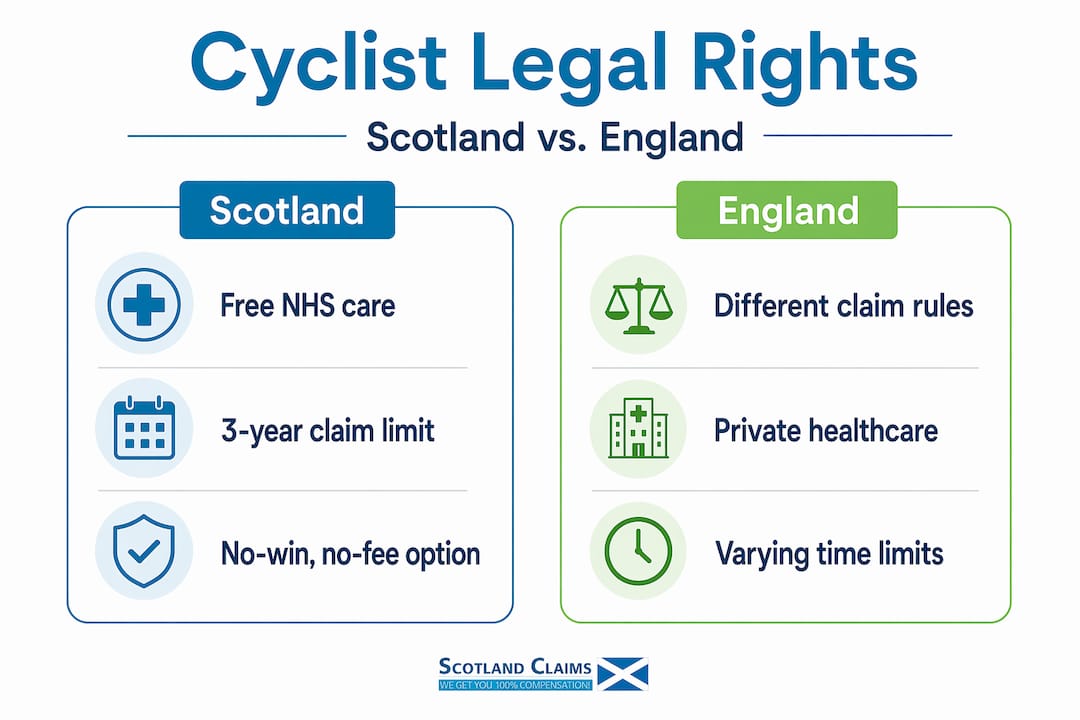
Liability in a bicycle accident most often rests with a negligent driver, but it can also fall on a local authority responsible for road maintenance, a vehicle manufacturer, or even an employer if you were cycling for work at the time. Claims can cover a range of losses.
Compensation claims in Scotland can include:
- Medical treatment costs, including physiotherapy and specialist consultations
- Repair or replacement of your bicycle and cycling equipment
- Lost earnings during recovery, including self-employed income
- Long-term care costs where injuries are serious
- Pain, suffering, and loss of enjoyment of life
| Compensation type |
Scotland-specific consideration |
| Medical costs |
NHS treatment is free but private treatment costs and prescription charges are recoverable |
| Equipment damage |
Replacement value of your bicycle and accessories can be included in the claim |
| Lost earnings |
Both employed and self-employed income loss is claimable with appropriate documentation |
| Uninsured driver claims |
The Motor Insurers’ Bureau handles claims against uninsured or untraced drivers, though these are more complex |
For road traffic accident claims where another party is at fault, including bicycle accidents involving a negligent driver, you keep 100% of your compensation when you use Scotlandclaims. Nothing is deducted from your award. Scotland Claims Injury Lawyers never deducts a success fee on any claim type, so you keep 100% of your compensation - compared with up to 20% including VAT charged by most large solicitor firms.

Early legal instruction also matters practically. Solicitors can arrange independent medical assessments, formally request police records, and calculate financial losses with precision, all of which improve claim outcomes. You can read more about why early legal advice matters when making an injury claim in Scotland.
Bicycle safety tips that actually reduce your risk
Prevention is always worth more than a claim. Scotland’s roads are challenging, and some hazards cannot be avoided, but you can substantially reduce your risk with the right habits.
- Wear a properly fitted helmet on every ride. A helmet reduces serious head injury risk by approximately 60% and fatal injury by around 71%. No other single piece of equipment comes close to that level of protection.
- Use lights and high-visibility clothing in all low-light conditions. In Scotland, this is practically year-round from October to April. Front and rear lights are a legal requirement at night.
- Fit a helmet camera. It costs relatively little and provides footage that regularly resolves liability disputes in your favour.
- Understand driver blind spots. Never sit alongside a large vehicle at a junction. Position yourself so you are visible, not merely present.
- Check your bicycle before every ride. Brakes, tyres, and lights take less than two minutes to inspect. Tyre pressure and brake response are the two most common mechanical causes of cyclist falls.
- Choose appropriate cycling eyewear for the conditions. Glare, rain, and road spray all reduce your ability to spot hazards in time to react.
- On wet or damaged roads, reduce your speed earlier than you think necessary. Scotland’s road surfaces deteriorate faster than in warmer climates, and a pothole that was manageable last month may have expanded significantly.
My perspective on bicycle accidents and legal claims in Scotland
What I’ve observed time and again is that the cyclists who lose out after an accident are not the ones with weaker cases. They’re the ones who waited too long or assumed their situation wasn’t serious enough to pursue.
I’ve seen people sit on a cycling injury for weeks because they didn’t want to “make a fuss,” only to find that their pain was the result of a fracture that had been left untreated. By the time they sought medical help, the evidence at the scene was gone, witnesses had forgotten details, and the at-fault driver’s insurer had already begun building a defence. The gap between what those people recovered and what they were entitled to was significant.
The evidence side is where I genuinely believe most cyclists could do better. Not because they’re careless, but because nobody teaches you what to do at the roadside. The habit of photographing everything, retaining damaged equipment, and noting down registration numbers before dealing with anything else is a skill that has to be deliberately built. Helmet cameras, in my view, are no longer optional for anyone riding regularly on public roads in Scotland.
On the legal side, what stands out to me is how many cyclists don’t realise that Scotland has some of the most favourable conditions in the UK for pursuing an injury claim, particularly with no win no fee arrangements that genuinely protect your compensation rather than eroding it with high fees. The difference between keeping 100% of your award and having up to 20% deducted by a large firm is real money. You have the right to ask what a solicitor will take before you instruct them.
— Roger
How Scotland Claims Injury Lawyers can help after a bicycle accident
If you’ve been injured in a bicycle accident that wasn’t your fault, Scotland Claims Injury Lawyers can connect you with specialist injury lawyers in Scotland who handle cycling claims on a no win no fee basis. For road traffic accident injuries involving a negligent driver, you keep 100% of your compensation. On every claim type, you keep 100% of your compensation - Scotland Claims never deducts a success fee. Solicitors can handle medical assessments, evidence requests, and negotiations with insurers on your behalf, at no upfront cost to you. Use the compensation calculator to estimate what your claim may be worth, or contact the team directly for a free case evaluation. Find out how no win no fee claims work and what you could be entitled to.
FAQ
What should I do first after a bicycle accident?
Move to safety if possible, call 999 if there are signs of serious injury, and seek a medical assessment even if you feel unharmed. Adrenaline can mask serious symptoms including concussion, which may worsen if left untreated.
How long do I have to make a bike accident claim in Scotland?
In Scotland, personal injury claims generally must be made within three years of the date of the accident. Acting sooner rather than later gives your solicitor time to gather evidence before it is lost.
Can I claim if the driver who hit me was uninsured?
Yes. The Motor Insurers’ Bureau exists to compensate victims of uninsured or untraced drivers in the UK, though these claims are more complex and time-consuming than standard claims.
What compensation can injured cyclists claim in Scotland?
You may be entitled to claim for medical costs, equipment repair or replacement, lost earnings, long-term care, and damages for pain and suffering, all calculated against medical evidence.
Does wearing a helmet affect my legal claim?
Not wearing a helmet may reduce your compensation through a legal concept known as contributory negligence, though it does not prevent you from making a claim entirely. Wearing one protects both your health and your legal position.
Recommended