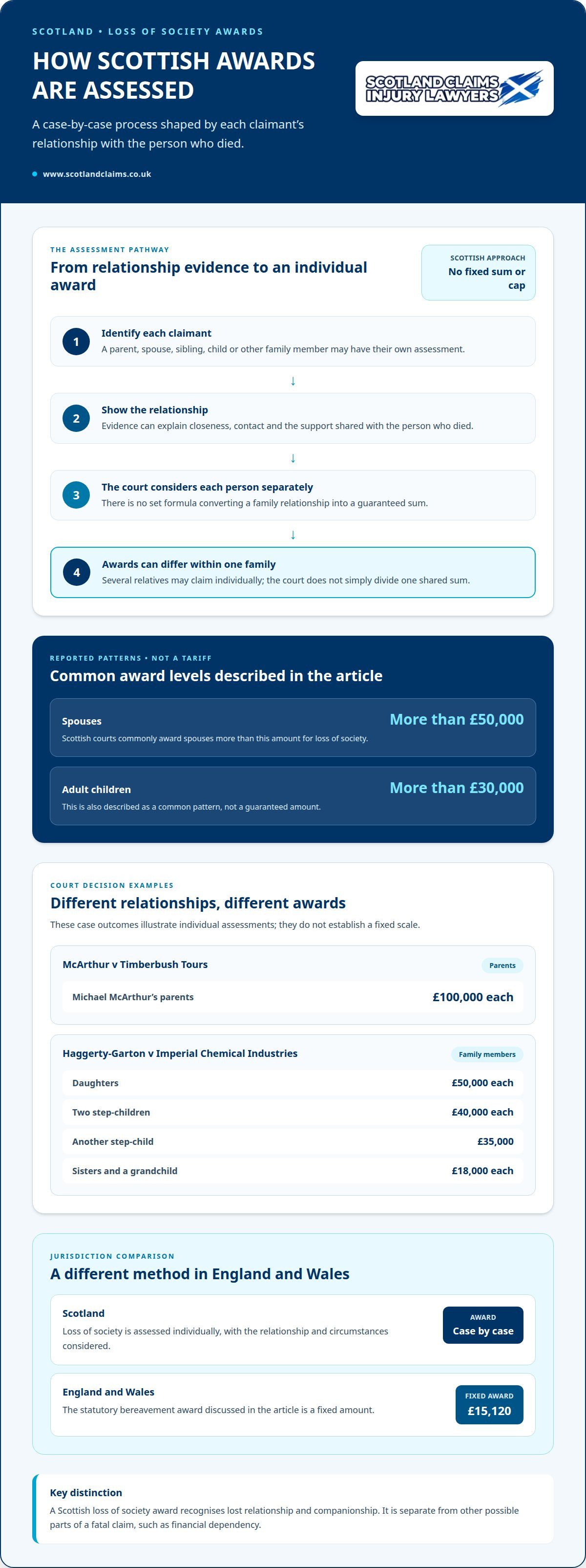
Bereavement damages in Scotland have no fixed sum or cap: loss of society awards are assessed case by case, with the claimant’s relationship with the deceased helping determine the amount. In England and Wales, the statutory bereavement award is £15,120, according to the UK legislation portal. The two jurisdictions therefore use different approaches to valuing bereavement and deciding who may claim.
It’s understandable to expect one UK-wide rule, but the place of death can affect both eligibility and compensation. This article explains how Scottish loss of society awards are assessed, what court decisions illustrate, and how the rules differ from those in England and Wales. You’ll also see why the relationship with the person who died matters, and why more than one relative may be eligible to bring a fatal injury claim.
Key Takeaways
- Scottish loss of society awards are assessed individually, with the claimant’s relationship to the deceased shaping the valuation.
- Eligibility rules differ across Scotland and England and Wales, so where the death occurred can affect who may claim.
- Campaigns to reform bereavement damages have focused on the limits of England and Wales’ statutory scheme.
- A fatal claim may involve separate compensation for bereavement, financial dependency and the deceased’s estate.
- Understanding the jurisdiction and the type of loss involved can help you see which parts of a fatal injury claim may apply.
How much is a loss of society award worth?
There is no fixed Scottish sum or cap: the award is assessed case by case, with the relationship to the deceased central to valuation. In Scotland, loss of society awards are made under the Damages (Scotland) Act 2011, according to the UK legislation portal.
Unlike Scotland’s individual assessments, England and Wales has a fixed bereavement award. Scottish court decisions show that awards can differ between family members in the same case.
Awards for spouses and adult children
Scottish courts commonly award spouses more than £50,000 for loss of society, while adult children often receive more than £30,000. These are reported patterns, not a tariff. For example, in Robert McArthur & Ors v Timberbush Tours Limited & Anr, Michael McArthur’s parents each received £100,000. That example helps show why a claimant’s relationship and circumstances matter.
Calculating Scottish award amounts
There is no set formula that turns a relationship into a guaranteed sum. The court assesses each claimant separately, considering their closeness to the deceased and evidence of their relationship. Several family members may claim individually, and awards in the same case can differ. Clear evidence of each relationship therefore matters to the assessment.
Case decisions illustrate that difference. In Haggerty-Garton and Others v Imperial Chemical Industries Limited, the deceased’s daughters received £50,000 each, while two step-children received £40,000 each. Sisters and a grandchild received £18,000 each, and another step-child received £35,000. These awards show that family position alone does not determine value.
For comparison, the fixed bereavement award in England and Wales is £15,120, according to the UK legislation portal. That figure provides a set amount, unlike Scotland’s case-by-case approach. Northern Ireland also has a fixed award, reported as £17,200 at the time of the page’s publication. The systems therefore differ in how they value bereavement, not just in the amounts shown.
In Scotland, an award for loss of society recognises the relationship and companionship lost. It is distinct from other possible parts of a fatal claim, such as financial dependency. The court considers each family member’s circumstances rather than dividing one sum among all claimants. A parent, spouse, sibling or child may therefore have a separate assessment.
Evidence can help explain the closeness of the relationship, including the contact and support shared with the deceased. It gives context to the loss claimed and helps distinguish one member’s circumstances from another’s. For a broader overview of personal injury claims in Scotland, the legal route depends on the circumstances of the injury and resulting loss.
What are the differences in bereavement damages between Scotland and England & Wales?
The key difference is the legal framework: the Fatal Accidents Act 1976 governs the statutory bereavement award discussed for England and Wales. Scotland instead assesses loss of society individually. That distinction affects both who can claim and how compensation is valued. A family’s circumstances therefore matter differently on either side of the border.
Under section 1A of the Fatal Accidents Act 1976, eligibility in England and Wales is restricted to specified relationships. A deceased person’s wife, husband or civil partner may qualify. Parents may claim for an unmarried child who died under 18. If those parents were unmarried, only the mother was entitled under the rules described here.
That narrow eligibility has prompted calls for reform. Excluding cohabiting couples from bereavement damages has been challenged on human-rights grounds. The Fatal Accidents Act 1976 (Remedial) Order 2020 then added an unmarried partner to the eligible claimants. The change recognised that someone’s family relationship may not be formalised through marriage.
However, the partner rule still uses a qualifying period. Cohabiting partners in England and Wales can qualify if they lived with the deceased for at least two years. Amelia and Jordan had lived together for 18 months when Jordan died, so they fell short of that threshold. The example shows how a time-based test can exclude a close partner.
Campaigners have also questioned limits affecting parents and children. Parents of an adult child over 18 are excluded from the statutory award described here. Children who lose a parent are also excluded, regardless of age. In June 2019, 85 per cent of British adults thought a father should receive compensation, even when existing rules made him ineligible.
Reform campaigns have challenged both the fixed amount and the restricted claimant categories. APIL published Bereavement Damages: A Dis-United Kingdom in April 2021, highlighting differences across UK jurisdictions. The report’s title captures a central concern: a family’s eligibility and award can depend on where the fatal injury occurred. Scottish awards have tended to be higher, but they are assessed individually.
Scotland’s approach can recognise a wider range of close relatives, including siblings and other family members. In England and Wales, the statutory scheme lists eligible claimants; Scottish courts consider each claimant’s relationship with the deceased. This distinction matters when several relatives seek compensation. Fatal claims require each person’s loss to be considered separately from other losses, rather than treating every family member’s claim alike.
How Scottish bereavement claims differ from other UK jurisdictions
Scotland’s framework for fatal injury claims differs from that of England and Wales. The rules affect who may claim, which losses can be included and whether an inquiry is involved.
Scotland’s fatal injury claims framework
Scottish fatal personal injury claims can include loss of society, financial dependency and losses connected with the deceased’s suffering before death. The Damages (Scotland) Act 2011 re-enacted bereavement provisions and expanded eligible relatives. Under section 4(3), close relatives may claim loss of society when negligence causes a person’s death. This includes deaths caused by medical negligence, where negligence is established.
That differs from damages in England and Wales, where statutory bereavement damages follow the Fatal Accidents Act 1976. Cohabiting partners there may qualify after living with the deceased for at least two years, according to the UK legislation portal.
Fatal Accident Inquiries and civil claims
A Fatal Accident Inquiry examines certain deaths in Scotland, but it does not award compensation. Most deaths in custody and most workplace deaths require an inquiry under the Inquiries into Fatal Accidents and Sudden Deaths etc. (Scotland) Act 2016. A civil claim can proceed alongside the inquiry, so families do not have to wait for it to finish before pursuing compensation.
An inquiry and a civil claim serve different purposes. An inquiry investigates the circumstances and may make recommendations; a civil claim seeks damages for recognised losses. A fatal injury at work may involve both processes.
Relatives entitled to claim and other compensation
Eligible relatives in Scotland can include a spouse or civil partner, a cohabiting partner who lived with the deceased immediately before death, a parent, child, sibling, grandparent or grandchild. Someone accepted by the deceased as a child of their family may also qualify. The court assesses each family member’s relationship separately, rather than treating it as one shared claim.
Bereavement damages are not the only possible compensation. A relative may also claim for financial dependency, while the executor of the deceased’s estate can bring a separate claim in a fatal personal injury case. The injury, losses and each claimant’s connection to the deceased help determine which claims are relevant.
Claim time limits and evidence
A Scottish bereavement damages claim generally has a three-year time limit from the date of death under the Prescription and Limitation (Scotland) Act 1973. Evidence should establish the death, the circumstances of the fatal injury and the claimant’s relationship with the deceased. Family records, correspondence and accounts of shared life can help show that relationship.
An eligible relative brings a civil action based on the fatal injury and identifies the losses claimed. Medical negligence can support a bereavement claim when negligence caused the death. The claim should distinguish loss of society from dependency or estate losses, as each addresses a different impact on the family.
Bereavement damages under the Fatal Accidents Act 1976
The Fatal Accidents Act 1976 governs statutory bereavement damages in England and Wales, not Scotland. Its section 1A sets out which relatives can claim and provides a fixed award, rather than the Scottish approach of assessing loss of society individually.
The award has changed over time, but its eligibility rules have remained a central reform issue. It was set at £3,500 in 1982, rose to £7,500 in 1990, then to £10,000 in 2002. Before the increase effective 1 May 2020, it stood at £12,980. The current award is £15,120, according to the UK legislation portal.
This is a statutory category of damages, separate from other losses that may arise after a fatal accident, such as financial dependency. The scheme does not give every bereaved relative an entitlement. A person’s relationship to the deceased must fall within the categories set out in the Act.
Eligible claimants include a deceased person’s wife, husband or civil partner. Parents may qualify where their deceased child was unmarried and under 18. If the child’s parents were unmarried, only the mother was entitled under the rules described here. By contrast, children who lose a parent and parents whose adult child dies are excluded from this statutory award.
Rules for partners have changed. In 2017, the Court of Appeal ruled that excluding cohabiting couples breached the European Convention on Human Rights. The Fatal Accidents Act 1976 (Remedial) Order 2020 added an unmarried partner to the eligible categories. A cohabiting partner must have lived with the deceased for at least two years, according to the UK legislation portal.
That threshold can produce difficult outcomes for bereaved families. Amelia and Jordan had lived together for 18 months when Jordan died, leaving them short of the qualifying period. Their example shows how the statutory test can turn on the length of a relationship, rather than only its closeness.
Reform campaigns have questioned both the fixed sum and the narrow list of relatives. In June 2019, 85 per cent of British adults thought a father should receive bereavement compensation even when existing rules excluded him. The Association of Personal Injury Lawyers published Bereavement Damages: A Dis-United Kingdom in April 2021, drawing attention to differences between jurisdictions. For a sibling or a child bereaved by a parent’s death, the statutory categories may leave no award under this scheme. That differs from Scotland, where eligible relatives can pursue individual loss of society claims.
How much are bereavement damages in Scotland?
There is no set Scottish tariff or maximum for loss of society. The award is assessed for each eligible relative, with their relationship to the deceased guiding the valuation. The court does not simply apply one standard figure to every family member. Two relatives in the same fatal claim can receive different sums because their relationships with the deceased differ.
The awards for Mr McGee’s grandchildren provide a clear example. These outcomes show how a court can assess claimants individually, rather than divide a fixed bereavement payment between them.
Those figures are examples from a court decision, not a guaranteed scale for future claims. They show what two particular relatives were awarded in Mr McGee’s case. A claimant’s position in the family is relevant, but does not automatically determine the sum. The assessment focuses on that person’s relationship with the deceased and the loss of society caused by the death.
For families, the practical step is to identify each eligible claimant and explain their relationship separately. A grandchild’s relationship is not interchangeable with a spouse’s or child’s. When several relatives claim, evidence of their individual bonds helps show how their circumstances differ. The court assesses each person’s loss, rather than treating the family as one claimant with a single award.
A fatal claim’s overall value can also involve different categories of compensation. Loss of society addresses the relationship lost; financial dependency and estate claims concern separate losses. These categories should not be confused or treated as one bereavement figure. Families assessing potential compensation should separate each claimant’s loss of society from any dependency or estate claim.
Scottish court awards have tended to be substantially higher than fixed bereavement awards elsewhere in the UK. But comparing headline figures alone does not establish what a Scottish relative will receive. Scotland’s approach considers each relationship, while a fixed statutory scheme applies its set amount to eligible claimants. A useful comparison must therefore consider both the valuation method and eligibility.
In June 2020, 69 per cent of British adults thought £15,120 was too little compensation for bereavement. That view highlights why fixed awards remain part of reform discussions. Scotland instead leaves valuation to the circumstances of each claimant and the court’s assessment. Mr McGee’s grandson and granddaughter show how that approach can produce distinct awards within one family.
Scotland Claims Injury Lawyers: Road Traffic Accident Claims
Scotland Claims Injury Lawyers handles Road Traffic Accident Claims for people injured in collisions in Scotland. If your questions about a fatal accident also involve an injury claim, the firm’s personal injury services may be relevant. It also handles Work Injury Claims and Slip or Trip Claims, and offers a Personal Injury Compensation Calculator to help you explore injury compensation.
The firm’s 100% compensation promise means it recovers its fees from the at-fault party and passes the entire settlement to you. This relates to the injury compensation claim, not a guarantee of a bereavement award. The right claim depends on the loss being pursued and the circumstances of the accident.
Contact Scotland Claims Injury Lawyers to discuss a road traffic accident claim and the losses involved.
Take the next step with clarity
For bereavement damages in Scotland, keep your circumstances distinct from any separate personal injury claim. Note what you need to understand, such as your position as a relative, the loss you want assessed, or whether the accident also caused an injury. Clear questions help focus a conversation on the issue that matters to you.
Scotland Claims Injury Lawyers handles personal injury claims involving road traffic accidents, workplace injuries and slips or trips. If your situation also includes an injury claim, contact the firm to discuss that aspect. Bereavement damages and injury compensation are different, so be clear about which matter you want to raise.
Take the next step at your own pace, with a clearer understanding of the help you need.
Frequently Asked Questions
What else can a fatal claim include?
A fatal claim can include several distinct losses, not only bereavement. Depending on the circumstances, relatives may seek compensation for financial dependency, while the deceased’s executor can bring a separate estate claim. The estate claim may cover the deceased’s suffering between the injury and death. For example, a fatal road collision could involve a relative’s loss of society, financial support provided by the deceased, and losses belonging to the estate.
Who can claim this type of award?
In Scotland, potential claimants include a spouse or civil partner, a cohabiting partner who lived with the deceased immediately before death, and close relatives such as parents, children, siblings, grandparents and grandchildren. Someone accepted by the deceased as a child of their family may also qualify. Each person’s relationship is assessed separately. Being part of the same family does not mean every relative will receive the same assessment or award.
Can a child claim for the death of a parent, or a parent for an adult child?
In Scotland, a child may be eligible to claim loss of society after a parent’s death, and a parent may claim after an adult child dies. This differs from the England and Wales statutory bereavement award described in this article, which excludes children who lose a parent and parents whose deceased child was an adult. The place of death can therefore affect whether those family relationships qualify under the relevant scheme.
Can an unmarried partner claim in Scotland?
Yes. An unmarried cohabiting partner may be eligible in Scotland if they lived with the deceased immediately before death. This differs from the test in England and Wales, where cohabiting partners can qualify after living with the deceased for at least two years, according to the UK legislation portal. For a Scottish claim, the key issue is the couple’s living arrangements immediately before the death.
Can more than one family member claim?
Yes. Several eligible relatives can bring individual loss of society claims following one death. For example, a surviving partner, parent and adult child may each have their own claim assessed. Their awards are not automatically combined into one family payment or divided equally. Each claimant’s relationship and circumstances are considered individually, so relatives should identify their own connection and loss rather than rely on another family member’s claim.
Is a bereavement claim the same as a fatal accident claim?
No. A bereavement claim seeks damages for loss of society, while a fatal accident claim can cover a wider range of losses arising from the death. It may also involve financial dependency or a separate claim brought by the deceased’s executor. Bereavement is one possible part of the wider fatal injury claim. Keeping these categories distinct helps families explain what each claimant is seeking.
Is the compensation taxable?
Tax treatment depends on the type of payment and what it represents. A fatal claim may include bereavement damages, dependency compensation, estate losses or interest; these should not be treated as interchangeable. Keep a settlement breakdown showing each component and its recipient. This record helps you understand the payment and address any tax questions about the amount received.
Loss of society: who has a right to claim in Scotland?
Eligible relatives in Scotland who may bring loss of society claims include a spouse or civil partner, qualifying cohabitant, parent, child, sibling, grandparent or grandchild. A close personal bond is relevant to assessing the loss, but the claimant must also fall within an eligible relationship category. Each relative’s circumstances are considered individually.