Ankle injury claims in Scotland: your guide to compensation

TL;DR:
- Ankle injuries, often underestimated, can cause long-term disability and substantial financial loss. Scottish law allows claims for injuries caused by negligence, with compensation based on injury severity and damages type. The process involves evidence gathering, medical assessments, and possibly a no win no fee arrangement to pursue rightful compensation.
Ankle injuries are routinely dismissed as minor inconveniences, yet the reality is far more serious. A fractured ankle or torn ligament can keep you off work for months, restrict your mobility for years, and permanently alter your quality of life. If your injury was caused by someone else’s negligence, whether through a slip on a wet floor, a road traffic collision, or an unsafe workplace, Scottish law entitles you to claim compensation. This guide explains exactly how these claims work, what you could receive, and how to get started without paying a penny upfront.
Table of Contents
Key Takeaways
| Point |
Details |
| Compensation depends on severity |
Scottish claims use clear bracket ranges based on injury severity for ankle injuries. |
| No win no fee accessible |
Most claimants can pursue ankle injury claims without upfront legal costs thanks to no win no fee arrangements. |
| Evidence is critical |
Thorough medical documentation and supporting details are essential to maximise claim success. |
| Apply within Scottish law |
Understanding the Scottish legal process helps you avoid delays and secure fair compensation. |
Understanding ankle injury claims in Scotland
Ankle injury claims in Scotland fall under the broader category of personal injury law. To pursue a claim successfully, you must demonstrate three things: that another party owed you a duty of care, that they breached that duty through negligence or recklessness, and that their breach directly caused your ankle injury. These principles apply whether you are pursuing a claim against an employer, a local council, a business, or another driver.
The most common causes of ankle injuries that lead to compensation claims include:
- Slips and trips on wet floors, uneven pavements, or poorly maintained premises
- Road traffic accidents, where a collision causes fractures or ligament damage
- Workplace accidents, including falls from height, heavy objects dropping on the foot, or unsafe flooring
- Sporting or public venue incidents, where inadequate safety measures are in place
- Accidents in shops or supermarkets, where spills are not promptly cleared
One widespread misconception is that ankle injuries are always minor and rarely justify a formal claim. This is simply not true. A severe ankle fracture requiring surgery and physiotherapy can result in chronic pain, reduced mobility, and an inability to return to your previous occupation. The ankle claim process in Scotland is designed to account for the full impact of your injury, not just the immediate medical costs.
“For valuing ankle injury compensation, the Judicial College Guidelines (JCG) are commonly used in practice as a benchmark for general damages (pain, suffering and loss of amenity), with bracketed ranges varying by injury severity (e.g., moderate and severe ankle injuries).”
Understanding the legal framework from the outset helps you approach your claim with realistic expectations. Following the correct injury claim steps from the very beginning also strengthens your position considerably.
How compensation is calculated for ankle injuries
With the fundamentals covered, let’s explore how your potential compensation is determined. Ankle injury compensation in Scotland is divided into two main categories: general damages and special damages.
General damages cover the pain, suffering, and loss of amenity (meaning the loss of enjoyment of life and everyday activities) caused by your injury. These are calculated using the Judicial College Guidelines, which provide bracket ranges based on the severity of the injury and its long-term prognosis.
Special damages cover your actual financial losses, such as lost earnings, medical expenses, travel costs to appointments, and the cost of care or assistance you required during recovery. These are calculated separately and added on top of your general damages award.
Here is an overview of the general damages brackets for ankle injuries, based on commonly cited figures:
| Injury severity |
Approximate compensation range |
| Moderate ankle injuries |
£16,770 to £32,450 |
| Severe ankle injuries |
£38,210 to £61,090 |
| Very severe ankle injuries |
£61,090 to £85,070 |
These bracket ranges vary by injury severity, and the figures above represent general damages only. When you add special damages for lost income and expenses, the total award can be significantly higher.
Several factors influence where within a bracket your award falls:
- Medical evidence: Detailed reports from orthopaedic specialists, physiotherapists, and your GP carry significant weight.
- Impact on daily life: Evidence that your injury affected your ability to work, care for your family, or participate in hobbies strengthens your claim.
- Recovery trajectory: Whether you have made a full recovery, are still recovering, or face permanent limitations all affect the valuation.
- Age and occupation: A younger claimant with a physically demanding job may receive a higher award due to the longer-term impact on their earning capacity.
Understanding special damages explained in detail is well worth your time, as many claimants significantly underestimate this portion of their award.
Pro Tip: Keep every receipt, invoice, and record of any expense related to your injury from day one. Prescription costs, taxi fares to hospital appointments, and even the cost of hiring help around the home can all be claimed as special damages.

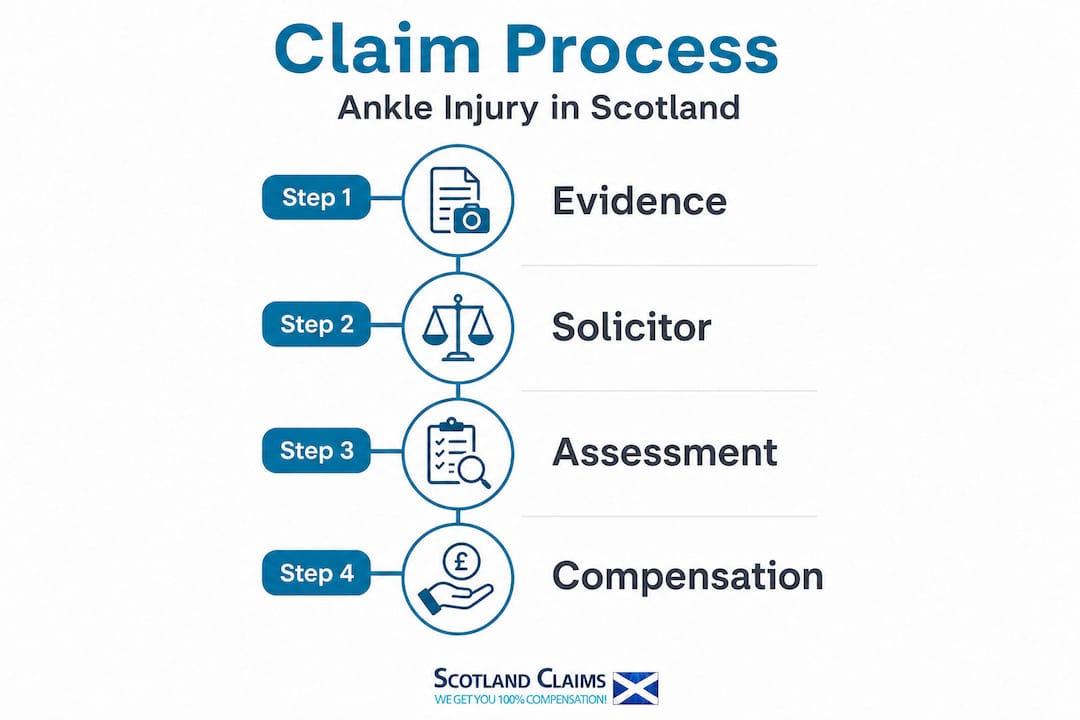
The step-by-step process for making an ankle injury claim
After understanding the compensation you could receive, here’s what you need to know about actually starting a claim. The process can feel daunting, but broken down into clear stages it becomes far more manageable.
-
Seek medical attention immediately. Your priority after any ankle injury is to get proper medical treatment. This also creates an official medical record, which forms a critical part of your evidence.
-
Document the incident as thoroughly as possible. Take photographs of the location where the accident happened, including any hazards such as wet floors, broken paving, or obstructions. If there were witnesses, collect their names and contact details.
-
Report the accident formally. If the injury happened at work, report it to your employer and ensure it is recorded in the accident book. If it happened on someone else’s premises, report it to the manager or owner.
-
Contact a specialist solicitor. Reaching out to a solicitor who specialises in personal injury claims in Scotland is your next step. Most offer a free initial consultation, so you can discuss your case without any financial commitment.
-
Gather your supporting evidence. Your solicitor will guide you on exactly what is needed, but typically this includes medical records, photographs, witness statements, payslips showing lost earnings, and any correspondence with the responsible party.
-
Undergo an independent medical examination. Your solicitor will usually arrange for an independent medical expert to assess your injury. Their report is used to support the valuation of your claim.
-
Negotiate or proceed to court. The majority of ankle injury claims are settled through negotiation before reaching court. Your solicitor will handle all communications with the other party’s insurers on your behalf.
Gathering strong evidence for claims early in the process is one of the most important things you can do to protect the value of your claim. Evidence deteriorates over time. CCTV footage is overwritten, witnesses forget details, and the scene of an accident changes. Acting quickly matters.
In terms of timescales, straightforward claims can resolve within a few months. More complex cases involving serious injuries, disputed liability, or ongoing medical treatment may take considerably longer. Your solicitor should keep you informed at every stage so you are never left wondering what is happening.
Pro Tip: Never accept a settlement offer from an insurer without first consulting your solicitor. Initial offers are frequently lower than what you are genuinely entitled to, and accepting one prematurely can prevent you from claiming further compensation if your condition worsens.
The injury severity brackets used to value your claim mean that even what appears to be a moderate injury can attract a meaningful award, particularly when special damages are factored in.
No win no fee arrangements and your rights
Now that the process is clear, let’s look at the arrangements that make claims more accessible for everyone. The phrase “no win no fee” refers to a Conditional Fee Agreement (CFA), which means your solicitor agrees to handle your case without charging you legal fees unless your claim is successful.
Here is how it works in practice:
- You pay nothing upfront to start your claim
- If your claim is unsuccessful, you pay no legal fees to your solicitor
- If your claim succeeds, your solicitor’s fees are typically recovered from the other party’s insurer, or a pre-agreed success fee may be deducted from your compensation
- You retain 100% of your compensation in many arrangements, though this depends on the specific terms agreed with your solicitor
“For valuing ankle injury compensation, the Judicial College Guidelines (JCG) are commonly used in practice as a benchmark for general damages, with bracketed ranges varying by injury severity.”
A common concern is the fear of hidden costs or unexpected charges. A reputable solicitor will be transparent about all terms before you sign anything. You should always ask for a clear written explanation of what happens in both a successful and unsuccessful outcome before agreeing to proceed.
The benefits of no win no fee arrangements are significant. They level the playing field, ensuring that access to justice is not restricted to those who can afford to pay legal fees upfront. If you suffered a genuine ankle injury through no fault of your own, financial worry should not prevent you from pursuing what you are rightfully owed.
You can read more about how these arrangements work in our no win no fee explained section, or revisit the full claim guide for a broader overview of the process.
Your rights as a claimant in Scotland are protected by law. Solicitors are regulated and must act in your best interests. If you are ever uncertain about the advice you are receiving, you have the right to seek a second opinion.
Our perspective: the reality of claiming for ankle injuries in Scotland
Having guided many people through the claims process, there is one truth that stands out above all others: most claimants underestimate the value of their own suffering.
The compensation brackets exist for good reason. They represent years of legal precedent and medical understanding about how ankle injuries genuinely affect people’s lives. Yet time and again, individuals settle for less than they deserve because they feel uncomfortable placing a financial value on their pain, their sleepless nights, or their inability to walk their children to school.
This discomfort is understandable, but it works against you. Non-economic losses, things like reduced independence, the loss of a hobby you loved, or the psychological toll of long-term mobility problems, are legitimate and significant components of your claim. They are not extras to be embarrassed about. They are central to what the law is designed to compensate.
There is also a widespread belief that documentation is something you sort out after the fact. It is not. The claimants who achieve the best outcomes are those who treat evidence gathering as an immediate priority. A photograph taken on the day of the accident is worth far more than a written description provided six months later.
Our view, informed by experience with claim success stories across Scotland, is that the most important shift you can make is to stop thinking of your claim as an inconvenience and start thinking of it as a legitimate legal right. You did not choose to be injured. Someone else’s negligence caused your suffering. The law exists precisely to address that.
Claims are not just about settlement figures. They are about restoring, as far as money can, the quality of life that was taken from you. That is a purpose worth pursuing seriously.
Connect with expert injury solicitors in Scotland
If this guide has helped clarify your options, the next step is to speak with a specialist who can assess your specific circumstances. At Scotland Claims, we connect individuals across Scotland with experienced personal injury solicitors who handle ankle injury claims every day. Whether your injury was caused by a workplace accident, a road traffic collision, or a slip on someone else’s premises, our no win no fee lawyers are ready to help you pursue the compensation you deserve without any upfront cost. You can also explore our network of injury lawyers Scotland wide, or use our online tool to calculate compensation and get an early estimate of what your claim could be worth.
Frequently asked questions
What evidence do I need for an ankle injury claim in Scotland?
You need medical records, documentation of how the injury occurred, and any witness statements to support your claim. Photographic evidence of the accident scene and records of financial losses such as lost wages also strengthen your case considerably, particularly given that injury severity brackets vary based on the evidence presented.
How long does an ankle injury claim take in Scotland?
Most claims are resolved within several months, but complicated cases can take longer depending on the evidence available and the complexity of negotiations with the other party’s insurers.
Can I claim if my injury happened at work?
Yes, work-related ankle injuries caused by negligence or unsafe conditions may qualify for compensation under Scottish law. Employers have a legal duty of care to provide a safe working environment, and the Judicial College Guidelines apply equally to workplace injury claims as to any other type.
What costs are involved in a no win no fee claim?
You usually pay nothing upfront and legal fees are only deducted if your claim succeeds, making this arrangement low-risk for claimants and ensuring that financial circumstances do not prevent anyone from accessing justice.
Recommended