
If you’re injured while working through an agency, who may be responsible: the agency that placed you or the company where you were working? Understanding agency worker accident rights scotland starts with a key distinction: your agency status doesn’t remove your right to a safe workplace, but an injury claim depends on the circumstances and evidence showing that someone was at fault.
It’s understandable to worry that reporting an accident or asking about a claim could affect your future shifts. You may also be unsure whether the 12-week qualifying period for some employment conditions affects your right to claim. It doesn’t determine whether you can pursue an injury claim. That depends on what happened, the injury and the available evidence.
This guide explains the respective safety responsibilities of agencies and hirers, how employment rights differ from injury-claim eligibility, and what to report and record after an accident. It also covers why acting promptly matters in Scotland, where court proceedings for a personal injury claim generally need to begin within three years. A specialist assessment can help clarify who may be responsible and whether you may have a claim. Scotland Claims Injury Lawyers offers a free, no-obligation assessment. With its no-win, no-fee service, you keep 100% of your compensation and owe nothing if your claim is unsuccessful.
Key Takeaways
- Understanding agency worker accident rights scotland means separating employment protections from the evidence needed to establish an injury claim.
- After an accident, prioritise your safety and medical care, report what happened through workplace procedures, and keep a copy of the report where possible.
- Record key details while they’re fresh, including where and when the accident happened, what caused it and who witnessed it.
- An assessment can consider how the agency and hirer were involved, your injury and the available evidence. An accident alone doesn’t establish that someone was at fault.
- Scotland Claims recovers legal costs from the at-fault party’s insurer. Under its no-win, no-fee framework, you owe nothing if your claim is unsuccessful.
Agency worker accident rights in Scotland: what protections apply?
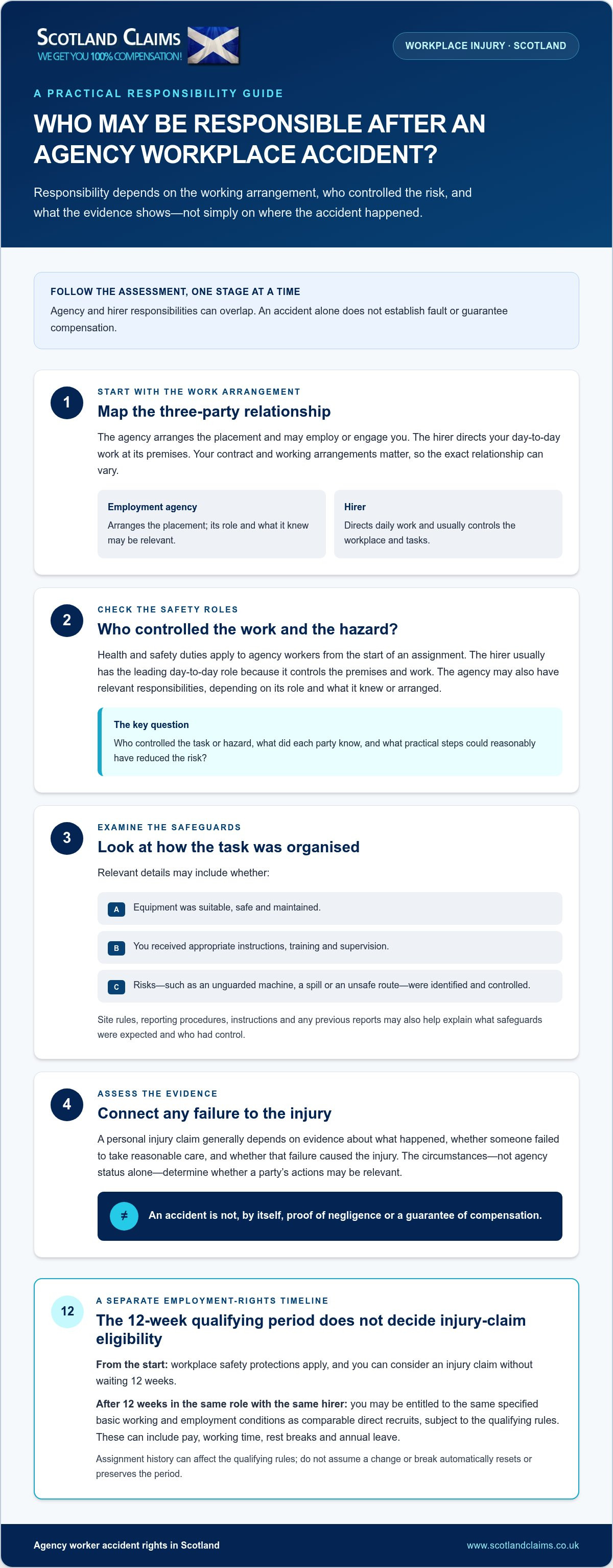
Agency work usually involves three parties. The employment agency arranges your placement and may employ or engage you, while the hirer directs your day-to-day work at its premises. Your contract and working arrangements matter, so the exact relationship can vary. Understanding agency worker accident rights scotland means keeping two questions separate: what protections apply at work, and whether the facts support a personal injury claim.
An accident does not, by itself, prove negligence or guarantee compensation. A claim generally turns on evidence about what happened, whether someone failed to take reasonable care, and whether that failure caused your injury. Your employment rights are a separate issue. They can apply even when no injury claim is available, and an injury claim does not depend on completing the equal-treatment qualifying period.
Who is responsible for your work and workplace?
Imagine an agency arranges a warehouse assignment. The agency may provide information about the role and known risks, while the warehouse hirer controls the site, equipment and daily tasks. Their responsibilities can overlap. In Scotland, health and safety duties apply to agency workers from the start of an assignment, with the hirer generally responsible for day-to-day safety because it controls the workplace and work.
That doesn’t make the hirer automatically liable for every accident, and it doesn’t automatically remove the agency from consideration. The relevant facts include who controlled the task, what training or supervision was provided, whether equipment was safe, and what each party knew or should have done. A specialist review can help identify which party’s actions may be relevant. Scotland Claims’ personal injury solicitors in Scotland can assess the circumstances without assuming who was at fault.
Which agency worker rights apply from day one or later?
The Agency Workers Regulations 2010 set out equal-treatment rights. From your first day on assignment, you’re generally entitled to access the hirer’s collective facilities, such as a canteen or car park, and to be told about job vacancies there. These are specific access and information rights, not a promise that every working condition will match those of a permanent employee. The overview of British agency worker law gives further background on the framework.
After a 12-week qualifying period in the same role with the same hirer, you may be entitled to the same basic working and employment conditions as comparable direct recruits. These can include pay, working time, rest breaks and annual leave. The qualifying rules can depend on your assignment history, so don’t assume a change or break automatically resets or preserves the period.
- Day one: access to collective facilities and information about vacancies.
- After the qualifying period: equal treatment in specified basic conditions, subject to the rules.
- From the start: workplace safety protections and the ability to consider an injury claim do not wait for 12 weeks.
For broader context on workplace hazards and accident claims, see this Scottish accident-at-work guide. Employment protections and compensation address different issues: the first concerns your treatment at work, while the second depends on the evidence surrounding the accident and injury.
How agency and hirer responsibilities affect workplace accidents in Scotland
Agency work can place safety responsibilities across more than one organisation. Under the Health and Safety at Work etc. Act 1974, health and safety duties apply to workers, including agency staff, from the start of an assignment. The hirer usually has the leading day-to-day role because it controls the premises and the work being done. The agency may also have relevant responsibilities, depending on its role and what it knew or arranged.
Responsibility can depend on who controlled the hazard, what each party knew, and what practical steps they could reasonably take to reduce the risk. An injury alone doesn’t establish fault. The circumstances need to be examined, including how the task was organised and whether a safety measure could have prevented the accident.
When might the hirer’s workplace arrangements matter?
Consider the conditions and instructions around the task. Was the equipment suitable and maintained? Were you shown how to use it? Was supervision appropriate for the work? Had the hirer identified and controlled risks, such as an unguarded machine, a spill or an unsafe route? Site rules and reporting procedures may also help show what safeguards were expected and whether they were followed.
Hypothetical example: An agency worker is asked to use a cutting machine at a factory. If the guard is missing and no one has explained the safe procedure, those facts may raise questions about equipment, training and supervision. They don’t settle the legal outcome. Evidence about the machine, instructions, previous reports and who had control will matter.
Useful evidence can include training records, risk assessments, maintenance logs, task instructions, photographs and witness accounts. These details can help establish what happened and whether a safety failure contributed to the injury. A workplace accident report may also record the event, but it won’t by itself decide who was responsible.
What part can the employment agency play?
The agency’s involvement may include arranging the placement, describing the role, passing on information about known risks or communicating changes to the assignment. If the work differs from what was agreed, or important safety information wasn’t shared, that may be relevant. The agency’s responsibilities must be assessed against its actual role, the information available to it and the duties that applied. Agency status alone doesn’t identify the responsible party.
Keep a record of who gave you task instructions, who supplied the equipment and who you told about any hazard. These practical details can help a solicitor assess how the agency and hirer were involved. For a broader explanation of workplace injury claims, Scotland Claims also provides information about accidents and injuries at work.
It can help to consider workplace safety responsibilities separately from employment conditions. Acas guidance on agency worker rights explains the employment-rights framework, while the facts of an accident determine which parties’ safety arrangements may be relevant. You can read more about Scotland Claims and its injury claim services.
Can an agency worker claim after an accident at work in Scotland?
Yes, an agency worker can pursue a personal injury claim if the circumstances support one. Employment protections and injury compensation answer different questions. An employment issue might concern pay, rest breaks or access to workplace facilities. An injury claim asks whether someone failed to take reasonable care, whether that failure caused the accident and whether you were injured as a result.
The 12-week qualifying period for certain equal-treatment rights is not a test for an injury claim. You don’t have to complete 12 weeks before you can consider a claim. Equally, being injured at work doesn’t automatically mean the agency or hirer is legally responsible. The evidence and specific circumstances matter.
What needs to be established for an injury claim?
A claim usually involves showing that a party owed you a duty to take reasonable care, failed to meet that duty and caused an injury through that failure. For example, evidence might indicate that a hazard wasn’t addressed or that suitable instructions weren’t provided. The precise question is whether the relevant party’s actions or omissions caused, or contributed to, your injury.
An accident book entry or incident report can help confirm when and where an event happened. It doesn’t, by itself, prove that someone was at fault. Medical records can document the injury, while photographs, witness details, training records, equipment information and communications may help explain how the incident occurred. Keep copies of relevant documents where you can.
For information about the firm’s work injury claim service, see its workplace injury page. An assessment can consider the accident, your injury, available evidence and the potential roles of the agency and hirer. It won’t assume that every accident establishes liability.
Does the Scottish claim deadline depend on agency status?
No. The general time limit for a personal injury claim in Scotland applies whether you work directly for an organisation or through an agency. Under the Prescription and Limitation (Scotland) Act 1973, court proceedings generally need to be started within three years of the accident, or within three years of the date you became aware that your injury was caused by someone else’s negligence.
That is a general rule, not a deadline that should be applied to every case without advice. Different considerations can apply, including where the injured person is a child or has impaired capacity. The date from which time runs can also depend on the circumstances. Don’t wait until the deadline is close to seek guidance: evidence may become harder to obtain over time, and court proceedings must be raised in time.
Employment concerns, such as worrying about future shifts, don’t determine whether an injury claim can be considered. If you’re unsure how the qualifying period, evidence or time limit affects your situation, a specialist assessment can help clarify the relevant questions and next steps.
What should you do after an agency worker accident at work?
The steps you take after an accident can protect your health and create a clearer record of what happened. You don’t need to decide immediately whether the agency or hirer was at fault. Focus first on safety, medical care and preserving information while it’s fresh.
- 1. Get to safety. Stop work if continuing could put you or someone else at risk. Alert a supervisor or site contact about any ongoing hazard.
- 2. Seek appropriate medical attention. Get urgent help for serious injuries. For other symptoms, contact a suitable healthcare professional and explain how and when the incident happened. Keep appointment details and any records you receive.
- 3. Report the accident promptly. Follow the hirer’s accident-reporting procedure and tell your agency as well. Ask for the report to reflect what happened accurately, and request a copy or confirmation where possible.
- 4. Make your own notes. Write down the date, time, location, task, equipment involved, hazard and names of people present. Record what you saw and did in your own words.
- 5. Preserve relevant evidence. Keep messages, emails, assignment details, rotas, shift records and training information. Take photographs only if it’s safe and permitted. Keep original files unchanged and store copies securely.
- 6. Note witnesses. Record names and, if they’re willing to share them, contact details. Don’t pressure anyone to provide a particular account.
Which details and evidence should you preserve?
Include practical details that may help someone understand the sequence of events: what you were asked to do, who gave the instruction, what equipment or protective measures were provided, and whether you had raised the hazard before. Keep relevant agency communications and shift information alongside workplace documents. Preserve photographs and messages in their original form. Don’t edit, annotate or delete the originals; make a separate note if you need to explain when or why a record was created.
Handle information lawfully and respect other people’s privacy. Don’t enter restricted areas or access someone else’s account to obtain evidence. If you’re unsure whether a record can be copied or shared, note where it exists and who holds it instead.
Who should receive an accident report?
Notify the appropriate workplace contact, such as your supervisor or the person named in the site procedure, and inform your employment agency. If you can’t report it yourself, ask someone you trust to help, then follow up in writing when you’re able. Keep a note of when you reported it and to whom.
An internal accident report records an incident for workplace purposes; it doesn’t establish negligence, determine legal liability or prove that a claim will succeed. Separately, some specified work-related incidents may need to be reported under RIDDOR by the responsible person, such as an employer or person controlling the premises, depending on the circumstances. You aren’t expected to assume that you must personally make every statutory report. Ask who is handling any required reporting and keep a record of the response.
Clear records can help an assessment of your agency worker accident rights in Scotland by showing what happened and what information was available afterwards.
How Scotland Claims can help an agency worker assess an injury claim
If you’re unsure whether an agency, a hirer or another party may be responsible for your workplace injury, an initial assessment can help organise the key questions. It considers the accident circumstances, your injury, the records available and how each organisation was involved. An assessment doesn’t promise that every accident will lead to a claim or compensation.
This can be useful if you’re concerned that reporting an accident or asking about a claim could affect future shifts. Employment arrangements and injury-claim questions are different matters. A specialist can focus on the personal injury issues, including what evidence may help show how the accident happened and whether someone’s failure to take reasonable care contributed to your injury.
What happens during an initial claim assessment?
You can discuss what task you were doing, how the accident occurred, your injury and any treatment, and whether the agency or hirer gave instructions or supplied equipment. Relevant records might include an accident report, photographs, messages, rota details or witness information. Scotland Claims’ Scottish personal injury solicitors can consider the available information and explain possible next steps. Missing documents don’t necessarily prevent an initial discussion, but the details you do have can help.
For agency workers, it can be important to examine who arranged the work, who controlled the task and workplace, and what each party knew about any hazard. The assessment can help identify questions to investigate and whether the available facts may support an injury claim. It doesn’t decide employment-law disputes or guarantee a particular outcome.
Scotland Claims offers a free, no-obligation assessment. You can explain what happened and discuss how the agency and hirer’s possible roles may be assessed, without committing to a particular outcome.
How does the firm’s no-win, no-fee model work?
Scotland Claims ensures clients keep 100% of their compensation, with no success fee deducted from it. Under the firm’s no-win, no-fee framework, clients owe nothing if a claim is unsuccessful. If a claim succeeds, the firm recovers its legal costs from the at-fault party’s insurer, rather than taking a percentage of your compensation. The firm’s solicitors are authorised and regulated by the Law Society of Scotland.
This cost-recovery model means legal costs are recovered from the at-fault party’s insurer, not taken from your settlement. There are no hidden legal fees or surprise success charges. The assessment considers whether there may be a basis to investigate further; it doesn’t mean liability or compensation is assured.
Your agency status doesn’t, by itself, determine whether an injury claim is possible. The accident evidence, your injury and the responsibilities of the parties all matter. You can find out more about the firm’s assessment service.
Take a clear next step with confidence
Uncertainty about future shifts or which organisation may be responsible shouldn’t leave you guessing about your options. If you’re weighing up agency worker accident rights scotland, an individual assessment can help put your circumstances into focus without assuming that an accident automatically entitles you to compensation.
Scotland Claims’ solicitors are authorised and regulated by the Law Society of Scotland. The firm ensures clients keep 100% of compensation, with no success fee deducted, and recovers legal costs from the at-fault party’s insurer. Under its no-win, no-fee arrangement, you owe nothing if your claim is unsuccessful. The assessment considers the facts of your case, helping you understand whether there may be a basis to take things further.
You can take that first step without committing to a particular outcome. Get an informed view of your potential claim and decide what feels right for you.
You deserve clear information before making your next decision. A straightforward assessment can help you move forward with greater confidence.
Frequently Asked Questions
Can an agency worker claim compensation for an accident at work in Scotland?
Yes, you can pursue a claim if the evidence supports that someone’s failure to take reasonable care caused your injury. Being supplied by an agency doesn’t rule out a claim, but an accident alone isn’t enough to establish liability. For example, messages raising a recurring hazard could help explain what a party knew, alongside medical evidence and records of the incident. The circumstances need individual assessment.
Is the employment agency or the hirer responsible if I am injured?
It depends on what happened and each organisation’s role. The hirer may have controlled the site, equipment or task, while the agency may have arranged the placement or passed on information about the work. Responsibility could involve one party or more than one. Keep details of who gave instructions, provided equipment and received reports about hazards. Those facts help distinguish practical control from assumptions based only on your contract.
Does the 12-week rule affect an agency worker’s accident claim?
No. The 12-week qualifying period relates to certain equal-treatment rights, not whether you can bring a personal injury claim. If you were injured during your first shift, the relevant questions still concern the circumstances, evidence, injury and potential fault. Conversely, completing 12 weeks doesn’t automatically establish a claim. Keep employment-condition concerns separate from records about how the accident occurred.
Can I make a claim if my agency assignment has ended?
An assignment ending doesn’t automatically prevent you from pursuing an injury claim. Keep documents that may become harder to access later, such as rota records, placement details, training information and messages with the agency or hirer. Write down the names of supervisors and witnesses, and note how to reach them if known. The claim still depends on the evidence and applicable time limit, so don’t assume the end of a placement resolves the issue.
Could I lose future shifts for reporting a workplace accident?
It’s understandable to worry about future work, but no one can guarantee how an agency will allocate shifts in an individual situation. Make your report factual and keep a dated copy, along with messages about later scheduling changes. If shifts change, record when you were told and any reason given. This creates a clear timeline, but doesn’t by itself prove that a decision was made because you reported an accident.
Does every workplace accident have to be reported under RIDDOR?
No. RIDDOR applies to specified work-related incidents, not every accident or injury. Whether an incident must be reported depends on its type and circumstances, including the nature of the injury and work involved. The reporting duty generally rests with the responsible person, such as an employer or person in control of the premises, rather than automatically with the injured worker. Report the event through workplace procedures and ask who is handling any required statutory report.
How long do I have to make an accident-at-work claim in Scotland?
Generally, court proceedings for a personal injury claim in Scotland must begin within three years of the accident, or within three years of when you became aware that the injury was caused by someone else’s negligence. Exceptions can apply, including in cases involving children or impaired capacity. The date can be more complex than it first appears, so get advice promptly rather than relying on a calculation made without reviewing your circumstances.