
What if you do not need an insurance policy to manage every legal cost risk in a Scottish personal injury claim? After the event insurance scotland explained starts with an important distinction: under Qualified One-Way Costs Shifting, pursuers will generally not have to pay the other side’s legal expenses if their claim fails, although exceptions apply.
It is understandable to worry about who pays if a case is unsuccessful, and whether a policy premium or legal fee could reduce your compensation. ATE insurance may cover certain expenses of your own case, such as expert report costs, but protection depends on the policy. Premiums are generally not recoverable from the other side in Scotland, so check the terms carefully.
This article explains what ATE cover may include, how it differs from no-win, no-fee representation, and what to ask your solicitor before agreeing to either arrangement. It also explains how Scotland Claims’ stated cost-recovery approach differs from insurance. Eligibility and terms apply. The aim is to help you compare your options, not to suggest every claim needs ATE cover.
Key Takeaways
- Separate solicitor fees, the other side’s expenses, your own case costs and any insurance premium before deciding what protection you may need.
- Use this guide to understand after the event insurance scotland explained, then check the policy wording for covered costs, exclusions and when payment may be due.
- Ask your solicitor how Qualified One-Way Costs Shifting applies to your case, and what circumstances could affect that protection.
- Compare ATE insurance with no-win, no-fee funding. One is an insurance policy; the other is a solicitor-client funding arrangement with its own terms.
- Ask for a clear explanation of how legal costs and any deductions are handled, including whether your settlement could be affected.
What is after the event insurance in Scotland, and why might a claimant consider it?
Legal-cost terms can make an injury claim feel financially uncertain. After the event (ATE) insurance is a policy arranged after an incident that may help protect against specified legal expenses connected with a claim. It is separate from legal representation: the policy does not provide a solicitor or determine whether your claim succeeds. For a general overview of the wider insurance category, see Legal expenses insurance.
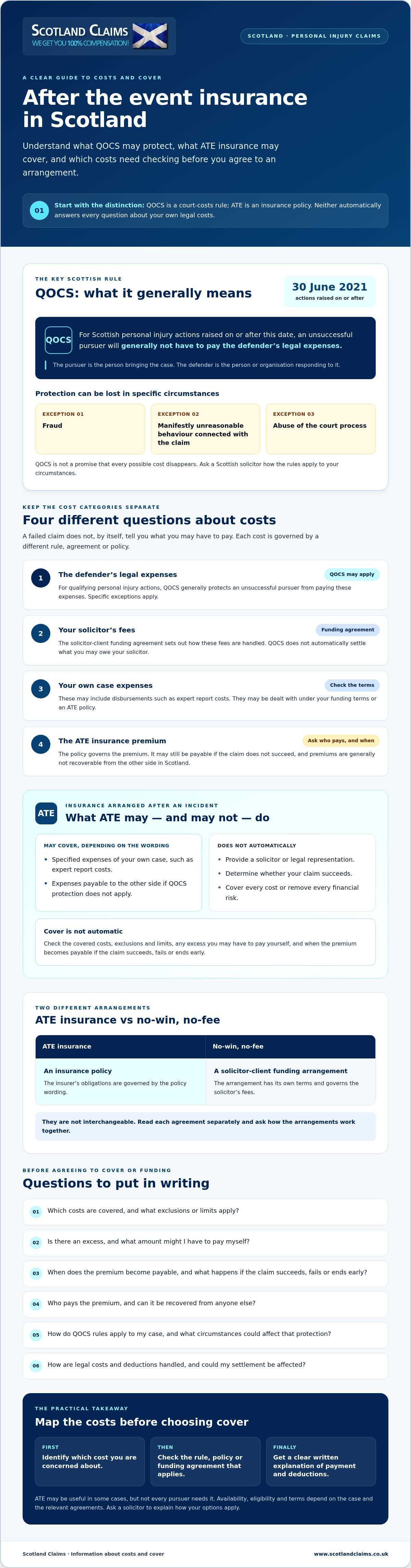
Scotland has its own rules. For personal injury actions raised on or after 30 June 2021, Qualified One-Way Costs Shifting (QOCS) generally means an unsuccessful pursuer does not have to pay the defender’s legal expenses. The pursuer is the person bringing the case; the defender is the person or organisation responding to it. Protection can be lost in specific circumstances, including fraud, manifestly unreasonable behaviour connected with the claim, or abuse of the court process. Ask a solicitor how the rules apply to your circumstances. For background on personal injury solicitors in Scotland, review the firm’s information separately.
What might an ATE policy cover in a Scottish claim?
Depending on its wording, a policy may cover specified expenses of your own case, such as expert report costs, or expenses payable to the other side if QOCS protection does not apply. Neither type of cover is automatic. Check which costs are covered, the exclusions and limits, and whether there is an excess, meaning an amount you may have to pay yourself. Ask when the premium becomes payable and what happens if the claim succeeds, fails or ends early.
Keep the different obligations separate. Your solicitor’s fees are governed by your funding agreement; the insurer’s obligations are governed by the policy. The outcome of the claim does not, on its own, tell you what you might owe. Ask for the arrangements in writing before agreeing to them.
When does ATE insurance enter the picture?
ATE cover is generally considered after a potential claim has arisen, rather than being arranged before an incident. Whether a policy is available or useful depends on the case and the insurer’s terms. You do not need to assume every pursuer needs one. First establish which costs could arise and what protection already applies.
In Scotland, ATE insurance is a policy arranged after an incident that may cover specified legal expenses, subject to its terms and the rules applying to the claim. That is the practical starting point for after the event insurance scotland explained: identify the possible costs and check the policy wording before deciding whether cover is appropriate.
How ATE insurance and Scottish claim costs work if a case is unsuccessful
A failed claim does not, by itself, tell you what you will have to pay. Separate the possible costs, then check which agreement or rule applies to each. Your solicitor’s fees are governed by your funding agreement. The defender’s expenses may be affected by Scottish court rules. Disbursements, such as expert report costs, may be dealt with under your funding terms or an ATE policy. Any insurance premium is governed by the policy and may still be payable even if the claim does not succeed.
For personal injury actions raised in Scotland on or after 30 June 2021, Qualified One-Way Costs Shifting (QOCS) generally protects an unsuccessful pursuer from paying the defender’s legal expenses. Exceptions include fraudulent representation, manifestly unreasonable behaviour connected with the claim, or abuse of the court process. Check the current rules and how they apply to your case with a Scottish solicitor.
What does an unsuccessful claim mean for costs?
QOCS concerns the other side’s expenses. It does not automatically settle questions about your own solicitor’s fees, case expenses or insurance premium. An insurer may pay only the costs included in the policy, subject to its conditions. Your solicitor’s agreement separately sets out what you may owe them. The premium for ATE cover is generally not recoverable from the losing party in Scotland, even if the claim succeeds, so ask who pays it and when.
Which policy terms can change the financial risk?
Before agreeing to cover, ask whether the premium is deferred until the claim ends, whether it depends on success, and whether it can be recovered from anyone else. Check the exclusions, maximum cover, any excess, cancellation terms and what happens if you reject settlement advice. Do not rely on a verbal summary. Request a written explanation of every amount you could personally owe, including what happens if the claim fails or your circumstances change.
For example, your claim might need an expert report and later prove unsuccessful. Ask whether the report cost is covered, whether the insurer will pay it under the policy, and whether any other costs remain your responsibility. Then ask separately whether QOCS applies and whether an exception could affect it. The answers depend on your case, funding agreement, policy wording and applicable rules, not on a general promise of cover.
Citizens Advice outlines options for affordable legal help, but check that guidance against Scottish rules and your specific arrangements. For another perspective on funding, you can review Scotland Claims’ approach. Its no-win, no-fee service is not ATE insurance, and eligibility and terms apply.
ATE insurance vs no-win, no-fee: what's the difference?
ATE insurance and no-win, no-fee address different parts of the financial picture. ATE insurance is a policy that may cover specified legal expenses, subject to its wording. No-win, no-fee is a funding arrangement between you and your solicitor. It sets out how legal fees are handled if your claim succeeds or fails. One does not automatically include or replace the other.
| Point to compare | ATE insurance | No-win, no-fee |
|---|
| Who provides it? | An insurer issues the policy. | Your solicitor agrees funding terms with you. |
| What may it address? | Only the expenses specified in the policy, potentially including certain case costs. | How the solicitor’s fees are handled if the claim succeeds or fails. |
| Which terms apply? | Policy wording, including exclusions, limits and premium conditions. | The solicitor-client agreement and applicable Scottish rules. |
The Scottish legal framework includes the Civil Litigation (Expenses and Group Proceedings) (Scotland) Act 2018. However, neither a general description of that legislation nor a funding label tells you exactly what your agreement covers. Read the documents and ask how they work together in your case. This distinction is central to after the event insurance scotland explained: insurance is a policy, while no-win, no-fee describes an arrangement for funding legal representation.
Does no-win, no-fee automatically include ATE insurance?
No. Do not assume ATE cover is included, or that you need to buy a separate policy. Check whether there is a separate insurance document and ask who is responsible for each expense if the claim fails or is discontinued. Your solicitor’s fee terms and an insurer’s policy create separate obligations, even if they form part of one funding plan.
What should you compare before choosing a funding arrangement?
Compare the payments you could owe, which expenses are covered, what exclusions apply and whether a settlement decision could affect cover. Ask directly whether any fee or premium may be deducted from compensation, and request the answer in writing. Scotland Claims states that its eligible no-win, no-fee arrangement has no success fee or settlement deduction, and that legal costs are recovered from the at-fault party’s insurer. Its service is not ATE insurance; check the agreement and eligibility terms for your circumstances.
For a fuller funding explanation, read a Scottish no-win, no-fee guide. If you are comparing legal representation, consult a guide to personal injury solicitors in Scotland and use it to prepare questions about fees, expenses and settlement terms.
How to assess an ATE policy before starting a Scottish injury claim
Do not judge a policy by its name alone. Read it alongside your solicitor’s funding agreement, then use this checklist to establish what protection you would actually receive. If a term is unclear, ask for a written explanation before you agree or sign.
- Identify the cover. Ask which specific expenses are insured, including whether the policy covers any of your own case costs or expenses payable to the other side. Confirm the cover limit and whether you must pay an excess.
- Check the premium. Find out when it becomes due, who pays it and whether payment depends on the claim succeeding. Ask what happens to the premium if the case settles early, is discontinued or proceeds on different terms.
- Read the exclusions and conditions. Check what the insurer will not cover, any cancellation provisions and whether rejecting settlement advice could affect cover. Ask the solicitor to explain relevant Scottish court-cost rules and exceptions in your circumstances.
- Get clear answers in writing. Ask for a plain-English breakdown of every payment you could personally owe, and what happens to expenses and compensation if the claim succeeds or fails.
Questions to ask about cover, premiums and exclusions
Be specific. “Am I covered?” is not enough. Ask whether a particular expense, such as an expert report, is included, whether the policy limit could be reached and whether an excess applies. Confirm how the premium is treated if your claim settles, stops or changes course. The answers should match the policy wording, not just a general explanation.
What to check in the solicitor’s funding agreement
The policy and funding agreement do different jobs. Check the agreement for solicitor’s fees, any other charges, and how these are handled if the claim succeeds, fails or is discontinued. Ask whether anything may be deducted from compensation and request a written answer. Keep the policy, funding agreement and claim correspondence together so you can refer to the same terms if circumstances change.
In Scotland, QOCS generally protects pursuers in personal injury actions raised on or after 30 June 2021 from paying the defender’s expenses if the claim fails. Specific exceptions can apply, including fraudulent representation, manifestly unreasonable behaviour connected with the claim, or abuse of the court process. Ask your solicitor to explain the current rules and how they relate to your policy and case.
For guidance about representation in Scotland, review the firm’s information and ask for an assessment of your circumstances.
Explore Scottish injury lawyers
How Scotland Claims explains its funding approach and your next steps
Scotland Claims Injury Lawyers describes its personal injury service as no-win, no-fee. It does not sell ATE insurance. The distinction matters: its funding approach explains how legal costs are handled, while ATE is a separate insurance policy with its own cover, exclusions and premium terms.
How the firm’s 100% Compensation approach differs from ATE insurance
Scotland Claims Injury Lawyers says it recovers legal costs from the at-fault party’s insurer. That is a legal-fee model, not insurance. Under its 100% Compensation approach, the firm says eligible clients pay no success fee and keep their full settlement without a deduction for its legal fees. It also says clients owe nothing if a claim is unsuccessful under its no-win, no-fee framework. These statements are subject to eligibility, the claim circumstances and the written agreement. Ask which costs are included and whether any separate expenses or cover need to be considered.
That is a practical point to take from after the event insurance scotland explained: a no-win, no-fee arrangement and an ATE policy are not interchangeable. A case-specific review can help establish whether insurance is relevant, rather than assuming you need a policy or that a funding agreement covers every possible expense.
Where to get Scotland-specific advice about your situation
Before deciding, ask a solicitor to assess your circumstances and explain the written funding terms. In particular, ask:
- How are legal costs handled if the claim succeeds, fails or is discontinued?
- Could you be responsible for any expenses, premium or other payment?
- Would ATE cover address a risk not dealt with by the funding agreement?
Scotland Claims Injury Lawyers is a trading style of Kerr Brown Solicitors, which is authorised and regulated by the Law Society of Scotland. This provides a Scotland-specific route to discuss a personal injury claim and clarify the firm’s stated funding model. It does not mean every claim or expense is automatically covered, so check the agreement that applies to you and request clear answers before proceeding.
A measured next step is to request an assessment and ask directly whether ATE cover may be relevant to your circumstances. You can then compare the policy terms, if applicable, with the solicitor’s funding agreement before making a decision.
Deciding whether to arrange ATE cover starts with the risks and terms in your own case. Scottish QOCS generally protects pursuers from paying the other side’s expenses if a personal injury claim fails, but exceptions can apply. ATE insurance is separate from no-win, no-fee representation, and its cover, exclusions and premium conditions depend on the policy.
That is the key point in after the event insurance scotland explained: do not assume every claim needs a policy, or that a funding agreement includes one. Ask your solicitor to explain what you could owe if your claim succeeds, fails or ends early, and get the answer in writing.
Scotland Claims says its eligible no-win, no-fee clients pay no success fee and keep their full settlement without a deduction. It also states that clients owe nothing if a claim is unsuccessful under its framework. The firm is regulated by the Law Society of Scotland; your eligibility and written agreement still matter.
With clear answers about costs and cover, you can compare your options and choose your next step with greater confidence.
Frequently Asked Questions
What is after the event insurance in Scotland?
After the event (ATE) insurance is a policy arranged after an incident that may cover specified legal expenses connected with a claim. It is separate from your solicitor’s representation and does not guarantee that your claim will succeed. Cover depends on the policy wording, including its limits, exclusions and premium conditions. For after the event insurance scotland explained, the key is to check exactly which expenses are insured and when the insurer may pay.
Do I need ATE insurance for a personal injury claim in Scotland?
Not necessarily. For personal injury actions raised in Scotland on or after 30 June 2021, Qualified One-Way Costs Shifting (QOCS) generally protects an unsuccessful pursuer from paying the defender’s legal expenses. Exceptions can apply, including fraudulent representation, manifestly unreasonable behaviour connected with the claim, or abuse of the court process. ATE may address other specified expenses. Ask a solicitor to assess your circumstances before deciding whether cover is relevant.
Does no-win, no-fee include after the event insurance?
No-win, no-fee does not automatically include ATE insurance. No-win, no-fee is a solicitor-client funding arrangement; ATE is a separate insurance policy. Check your written agreement and ask whether a separate policy exists, what it covers and who pays any premium. Also ask what you could owe if the claim fails or is discontinued. Do not assume either that cover is included or that you must arrange it separately.
What happens if my Scottish injury claim is unsuccessful?
The costs depend on your funding agreement, any ATE policy, your claim circumstances and the Scottish rules that apply. QOCS generally protects pursuers in qualifying personal injury actions from paying the defender’s expenses, subject to exceptions. It does not by itself settle responsibility for your own solicitor’s fees, disbursements or insurance premium. Ask your solicitor to explain each cost separately and confirm in writing what you may have to pay if the claim fails.
Can ATE insurance cover the other side’s legal costs?
It may, if the policy specifically provides that cover and its conditions are met. Check the wording rather than relying on the policy name. In Scotland, QOCS generally limits an unsuccessful pursuer’s liability for the defender’s expenses in qualifying personal injury actions, but exceptions can apply. Ask whether the policy covers any remaining risk in your case, what exclusions or limits apply, and whether the premium is due if the claim is unsuccessful.
How much does after the event insurance cost in Scotland?
There is no single premium for every Scottish claim. The price depends on the case and the cover offered, so request a written quote that explains the premium, any excess, limits and when payment is due. Ask whether payment depends on the claim succeeding and whether Insurance Premium Tax is included. The premium is generally not recoverable from the losing party in Scotland, so check who would ultimately pay it.
Can I keep all my compensation if I do not take out ATE insurance?
Not taking out ATE insurance does not by itself determine whether money will be deducted from your compensation. That depends on your solicitor’s funding agreement and any other costs or policy terms. Scotland Claims says its eligible clients pay no success fee and keep their full settlement without a legal-fee deduction under its 100% Compensation approach. Check your own written terms and ask which expenses, if any, could still affect the amount you receive.