
Table of Contents
Last Updated: October 16, 2026
What Counts as an Accident at Work
An accident at work is any unexpected event causing injury or harm while carrying out your job duties, on your employer's premises, during work travel, or while performing work-related tasks off-site. (Source: Health and Safety Executive (HSE) guidance on reporting accidents)
Common scenarios include slips on wet floors, falls from height, being struck by falling objects, manual handling injuries, and vehicle accidents during work. The injury must arise from your employment, not a pre-existing condition or something unrelated to work.
Even minor incidents count, a small cut or twisted ankle can form the basis of a valid claim if your employer's negligence caused it.
Key Takeaway
An accident at work is any injury caused by your job duties or your employer's failure to keep you safe. Document every incident, even minor ones.
What to Do After an Accident at Work
Your actions in the hours and days after an accident at work protect your health, preserve evidence, and strengthen any future claim. Here is a Scotland-specific sequence from the first hour through the first week.
Stop work immediately if you're injured. Tell your line manager or supervisor right away. Pushing through pain worsens the injury and weakens your case.
Seek medical attention. Call emergency services for serious injuries; for minor ones, visit your GP or a minor injuries unit in Glasgow. Get a medical record created on the day of the accident to link the incident to your injury.
Report verbally to your employer immediately. Use clear language: "I've had an accident at work. I was [describe what happened] and I've injured my [body part]." Ask them to confirm they've recorded it.
Take photographs if possible. Photograph the scene, the hazard, and any visible injuries. Your phone's camera timestamps these automatically.
Collect witness details. Ask anyone who saw the accident for their name, job title, and contact number. Write these down immediately while they're fresh in people's minds.
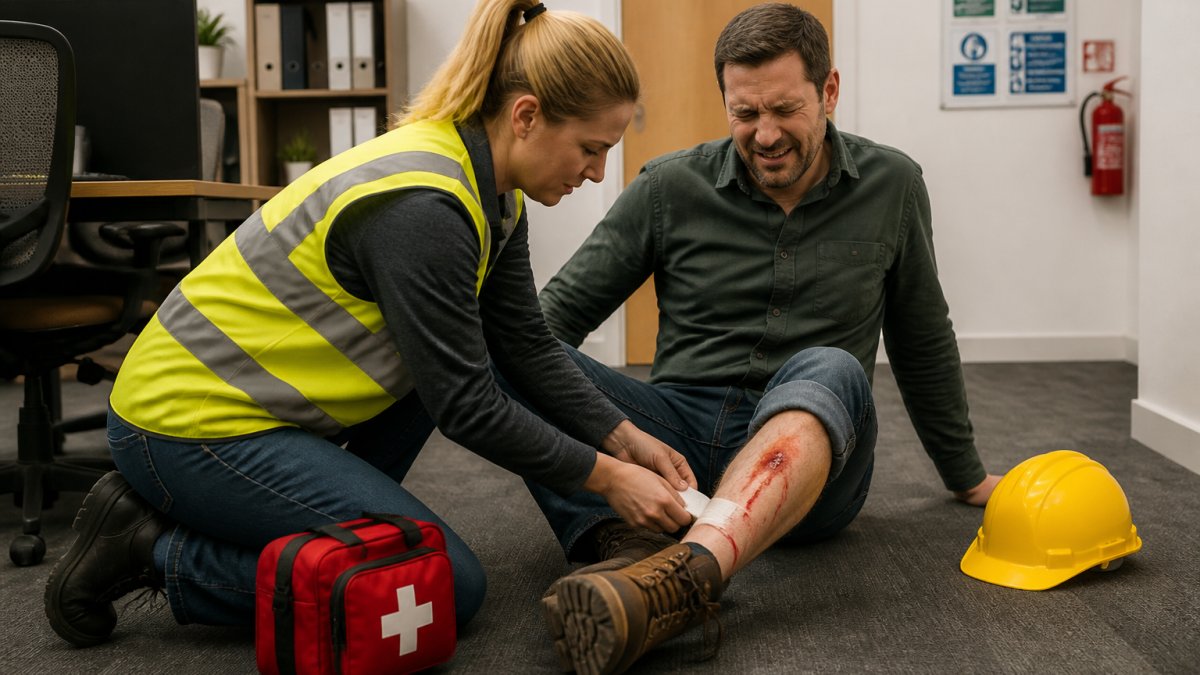 Workplace first aid scenario showing a colleague providing assistance to an injured worker in an office environment with safety posters visible on walls
Actions in the first 24-72 hours
Request a copy of the accident book entry. Your employer must record the accident at work in their accident book (Report accidents and illness). Ask for a copy and check it for accuracy.
Write your own account. While it's fresh, record the time, location, what you were doing, how the accident occurred, and how you were injured.
Keep all medical records. Save appointment letters, prescriptions, test results, and medical reports.
Notify your employer in writing. Send an email or letter confirming the accident at work, the date, and your injuries. Keep a copy as a written record.
Do not sign anything without reading it carefully. If asked to sign an incident form or statement, read it thoroughly, check it's accurate, and add corrections or notes before signing.
Watch Out
Never accept a settlement offer in the first few days. You don't yet know the full extent of your injury or its impact on your work and life.
Actions in the first week
Follow up on the accident book entry. If your employer hasn't recorded the incident, request it in writing and keep copies.
Contact witnesses again. Ask for a written statement within days, while memories are fresh.
Keep a pain and symptoms diary. Write down daily how you're feeling, what activities you can't do, and how the injury affects your work and home life. This narrative evidence shows the real impact of the accident at work.
Seek advice if needed. If your employer isn't cooperating, contact the Health and Safety Executive (HSE) to report a breach. For legal advice specific to Scotland, including time limits, speak to a solicitor who practises in Scotland.
Pro Tip
In Glasgow, you can also get free, independent advice from Citizens Advice Scotland or a local law centre. They can explain your rights and help you understand next steps.
Scotland-specific reporting and support
If your accident happened in Glasgow or elsewhere in Scotland, health and safety reporting routes are the same as the rest of the UK, but the legal process for claiming compensation differs. The time limit for raising a personal injury claim in Scotland is normally three years from the accident, so get case-specific legal advice early.
For support in Glasgow, you can contact:
- Citizens Advice Scotland for free, independent advice
- Glasgow City Council's environmental health team for workplace safety concerns
- A solicitor who specialises in personal injury claims in Scotland
The rules for claiming compensation are the same across Scotland, but court procedures and the legal framework are distinct from England and Wales. Always get advice from a solicitor qualified in Scots law.
Reporting an Accident at Work
Reporting an accident at work quickly and thoroughly protects your rights and creates the evidence you'll need if you claim compensation.
Recording the incident in the accident book
Your employer has a legal duty to maintain an accident book and record serious incidents, including your name and job title, the date, time and location of the accident at work, what you were doing, how it occurred, the injury sustained, and any treatment given.
Ask to see what your employer has written. If it's incomplete or inaccurate, request corrections, and write your own note in the book if you disagree. (Source: The Management of Health and Safety at Work Regulations 1999)
Keep a personal copy of the accident book entry. Take a photograph of the page if your employer won't provide a copy.
What to do if your employer does not record the accident
Some employers fail to record accidents at work, by mistake or deliberately, a breach of their legal duty.
If your employer refuses to record the accident:
- Request it in writing by email or letter
- Explain the date, time, and nature of the accident at work
- Ask them to confirm receipt and when they'll record it
- Keep copies of all correspondence
If they still refuse after a reasonable period (3-5 working days), you can contact the Health and Safety Executive (HSE) to report the breach, proceed with your claim anyway using your own evidence (medical records, witness statements, photographs), or seek legal advice from a specialist in personal injury claims. A missing accident book record weakens your case but doesn't destroy it.
Pro Tip
If your employer pressures you to say the accident at work was your fault or wasn't serious, don't agree. Anything you say can be used against you later. Stick to the facts.
Common Workplace Injuries
Knowing which injuries are most common helps you judge whether your own incident is typical and more likely to have legal merit.
Slips, trips, and falls account for the largest share of workplace injuries, happening when floors are wet, cluttered, or poorly lit. Loose carpets, worn stairs, and inadequate handrails increase the risk.
Manual handling injuries occur when lifting, carrying, or moving heavy objects. Back, shoulder, and knee injuries are common when equipment is awkward, loads are too heavy, or training is absent.
Struck-by injuries happen when a falling object, moving machinery, or vehicle hits you. These are common in construction, warehousing, and manufacturing.
Repetitive strain injuries develop over weeks or months from repetitive tasks, keyboard work, or constant gripping, causing pain, numbness, and loss of function.
Violence and aggression injuries occur when a customer, colleague, or member of the public assaults you. These are increasingly common in healthcare, retail, and public-facing roles.
Machinery and equipment injuries result from contact with moving parts, sharp edges, or hot surfaces. Lack of guards, inadequate training, or faulty equipment increases the risk.
Each injury type has different implications for your claim. The key question is always: did your employer's negligence or breach of duty cause it?
Gathering Workplace Accident Evidence
Strong evidence is the foundation of a successful claim. The more documentation you collect, the clearer your case becomes.
Types of evidence to collect
Medical records are your most important evidence, proving the injury exists and when it occurred. Collect GP appointment notes and diagnoses, hospital records, prescriptions, physiotherapy or specialist reports, sick notes from your employer, and any scans or test results.
Photographs and video show the hazard that caused the accident at work. Take pictures of the exact location, the hazard itself (wet floor, broken equipment, poor lighting), any warning signs that should have been there but weren't, and your injuries if visible.
Witness statements from colleagues who saw the accident carry significant weight. Ask each witness to write down what they saw, when it happened, where they were standing, and any safety breaches they noticed, then get their signature, date, and contact details.
Get Started Today →
Witness statements and documentation
Witness evidence is often more persuasive than your own account because it's independent. Contact witnesses within days of the accident at work, while memories are fresh, and ask if they'll provide a statement.
A good witness statement includes the witness's name, job title and length of service, exactly what they saw (not opinions), the date and time, the location and conditions, any safety failures they noticed, and their signature and date. If a witness won't write a statement, ask if they'll speak to your solicitor later.
Keep all documentation together in one folder, physical or digital, labelled with the date and what it is, so it's easy to hand to your legal representative later.
Employer Responsibilities and Your Rights
Your employer has a legal duty to keep you safe at work. Understanding what they must do helps you recognise when they've failed, and when you have a claim.
Risk assessment. Your employer must identify hazards in your workplace, assess the risk of accidents at work, and implement safety measures.
Safe systems of work. They must provide safe equipment, proper training, and clear procedures, giving you the tools and knowledge to do dangerous tasks safely.
Maintenance and inspection. Equipment must be maintained and inspected regularly, floors kept clean and dry, and lighting adequate.
Reporting and investigation. Your employer must record accidents at work in their accident book, investigate what went wrong, and take steps to prevent it happening again.
Your rights as an employee include:
- The right to a safe workplace
- The right to refuse unsafe work without penalty
- The right to report safety concerns to your employer or the HSE
- The right to claim compensation if your employer's negligence causes injury
If your employer breaches these duties and you're injured, you can claim compensation. The claim covers medical costs, lost wages, and pain and suffering. (Source: The Limitation (Scotland) Act 1973)
Key Takeaway
Your employer's job is to keep you safe. If they fail and you're injured, you have the right to claim. Document everything to prove the breach.
Seeking Medical Attention and Building Your Case
Medical evidence is essential. It proves the injury exists, shows how serious it is, and demonstrates the impact on your life.
See your GP immediately after the accident at work. Describe exactly what happened and your symptoms, and ask them to record everything. This creates an official timestamp.
Be honest about your symptoms. Tell your doctor about pain, loss of function, difficulty sleeping, or emotional distress. These details matter for your claim.
Follow medical advice. Attend appointments, take prescribed medication, and complete physiotherapy, or insurers will argue you're not taking your injury seriously.
Request copies of all records. Ask your GP for appointment notes, diagnoses, and referrals, and hospitals for discharge summaries and reports. Keep these safe.
Photograph visible injuries. If you have bruising, swelling, or visible wounds, take clearly dated photographs, powerful evidence.
Keep a pain and symptoms diary. Write down daily how you're feeling, what activities you can't do, and how the injury affects your work and home life. This narrative evidence shows the real impact of the accident at work.
Get a specialist report if needed. For serious injuries, ask your GP to refer you to a consultant. The stronger your medical evidence, the easier it is to prove your claim.
Understanding Your Compensation Claim
A compensation claim for an accident at work covers the losses and suffering caused by your injury. In Scotland, the legal framework is distinct from the rest of the UK, and understanding how compensation is assessed helps you know what to expect.
What compensation covers:
- Medical costs (GP visits, prescriptions, physiotherapy)
- Lost earnings while you're unable to work
- Reduced earnings if you return to work but earn less
- Pain and suffering (the physical discomfort and emotional distress)
- Loss of amenity (inability to do hobbies or activities you enjoyed)
- Care costs if you need help with daily tasks
The amount you receive depends on the severity of your injury, how long recovery takes, whether you have lasting effects, your age and occupation, your lost earnings, and the strength of evidence that your employer was negligent.
How compensation is assessed in Scotland
In Scotland, compensation is assessed under Scots law. The court considers both injury-related losses (such as pain and suffering) and financial losses (such as lost earnings and medical costs). There is no fixed tariff; each case is decided on its own facts. Claims often settle out of court, but if your case goes to court, the sheriff court or Court of Session will apply Scottish legal principles. The amount awarded depends on the evidence you produce and whether liability is established.
Time limits in Scotland
The time limit for raising a personal injury claim in Scotland is normally three years from the date of the accident, the limitation period. There are exceptions, for example if the injury was not immediately apparent, but do not rely on them. Seek legal advice as soon as possible.
What affects your claim
Several factors can affect the outcome and value of your claim:
- Liability: You must show your employer was at fault or breached a duty of care. If liability is disputed, your claim may take longer.
- Evidence: Medical records, witness statements, photographs, and accident book entries strengthen your case; missing evidence weakens it.
- Your actions: If you delayed reporting the accident or seeking medical attention, the other side may argue your injury is not as serious as claimed.
- Pre-existing conditions: If a pre-existing condition was made worse by the accident, compensation may be adjusted.
Uncertainty and realistic expectations
No one can guarantee a specific amount of compensation. Claims are usually settled by negotiation, and the final figure depends on the evidence and the other side's willingness to settle. A minor sprain might be worth hundreds of pounds; a serious back injury with long-term effects might be worth thousands. Your legal representative can advise on a realistic range, but the final amount is never certain until settlement or court award.
Watch Out
Do not accept a settlement offer without getting legal advice. Once you accept, you cannot usually reopen the claim, even if your injury turns out to be worse than first thought.
Getting legal advice in Scotland
If you're in Glasgow or elsewhere in Scotland, speak to a solicitor who specialises in personal injury claims under Scots law. They can explain the time limits, assess your evidence, and advise on the likely range of compensation. Many solicitors work on a No Win No Fee basis, so you pay nothing upfront and no fees if your claim fails.
At Scotland Claims Injury Lawyers, we specialise in accident at work claims across Glasgow and beyond. We understand workplace injuries, employer negligence, and how to build a strong case under Scots law. We work on a No Win No Fee basis, so you have nothing to lose by getting in touch.
Contact us for a free consultation. We'll review your accident at work, explain your rights, and advise whether you have a claim worth pursuing.
When to Seek Legal Advice
You don't need to handle a claim alone. Specialist solicitors can guide you through the process and maximise your compensation.
Seek legal advice if:
- You've been injured in an accident at work
- Your injury has caused you to miss work or lose earnings
- You have ongoing symptoms or lasting effects
- Your employer was negligent or breached safety duties
- Your employer hasn't recorded the accident at work
- You're unsure whether you have a valid claim
Why get legal help:
- Solicitors understand the law and what you need to prove
- They handle all communication with your employer and insurers
- They gather and organise evidence professionally
- They negotiate on your behalf to maximise your settlement
- They protect your rights if your employer retaliates
Many solicitors work on a No Win No Fee basis, so you pay nothing upfront and no fees if your claim fails.
At Scotland Claims Injury Lawyers, we specialise in accident at work claims across Glasgow and beyond. We understand workplace injuries, employer negligence, and how to build a strong case. We work on a No Win No Fee basis, so you have nothing to lose by getting in touch.
Contact us for a free consultation. We'll review your accident at work, explain your rights, and advise whether you have a claim worth pursuing.
If you've had an accident at work, you deserve to know your rights. The first step is getting proper legal advice from specialists who understand workplace injuries and compensation claims. At Scotland Claims Injury Lawyers, we help injured workers across Glasgow and Scotland claim the compensation they're entitled to. Get in touch today for a free, impartial consultation, you'll keep 100% of any compensation you receive, with no upfront costs.
accident at workwhat to do after an accident at workreporting an accident at workcommon workplace injuriesworkplace accident evidence