
A full and final settlement should leave no balance to pay once you’ve met the agreed terms. If you’re accepting a final settlement offer to clear a debt, get the creditor’s written acceptance before paying. Make sure it confirms the payment settles your liability, rather than counting only as part payment.
A workplace compensation offer can have a different effect. A settlement agreement may exchange compensation for your agreement not to pursue certain legal claims, so signing can affect what you can claim later. You don’t have to accept an offer, and independent legal advice is required for a UK settlement agreement to be legally valid.
Before deciding, understand what you’ll receive, what the agreement requires in return and when payment is due. This article explains full and final debt settlements, negotiating compensation and other terms, and when legal advice can help you make an informed decision.
Key Takeaways
- Get a creditor’s written acceptance before paying a lump sum, with clear wording that it settles your liability rather than counting as part payment.
- A workplace settlement agreement can affect your right to bring legal claims later, so understand its terms and get independent legal advice before signing.
- You can negotiate more than the compensation amount. Payment timing, an agreed reference and your leaving date may also matter.
- Check what the offer covers, what you agree to give up and when payment will be made before you accept.
- For a personal injury claim in Scotland, understand how the settlement and any legal fees affect the compensation you receive.
Independent legal advice for settlement agreements
A workplace settlement agreement can end employment or resolve a dispute in return for compensation and agreed terms. Before signing, understand what you’ll receive and which legal claims you agree not to pursue.
Written terms and agreement contents
A written settlement agreement records the employer’s and employee’s agreed obligations, including payment and the claims being settled. It gives you a clear record of what acceptance means, rather than leaving important terms in a conversation or letter.
Before accepting, check that the document identifies the parties, sets out the payments and explains when and how they’ll be made. It should also specify which potential employment claims are covered. These may include unfair dismissal, discrimination, whistleblowing, breach of contract, or unpaid wages and holiday pay.
What should a UK settlement agreement include before I accept? It should state the agreed payments, when and how they’ll be made, and which claims you agree not to pursue. Check that any agreed reference and leaving date are recorded too.
The independent adviser’s role should be clear. A qualified adviser, usually a solicitor, must explain the agreement’s effect and how it affects your ability to bring legal claims in future. Ask them to explain these consequences in plain language before you sign.
Voluntary acceptance and changing your decision
Acceptance is voluntary: you can negotiate the proposed terms or make a counteroffer instead of agreeing immediately. An employer’s first offer may be an opening proposal, so a reasoned request for different compensation or terms can be part of the negotiation.
Signing has consequences. A settlement agreement becomes legally binding once all parties have signed, and it usually requires you to give up specified employment claims in exchange for the agreed compensation and other terms. Independent legal advice from a qualified adviser, usually a solicitor, is required for the agreement to be legally valid. The adviser must explain its effect and how it affects your ability to bring claims in future.
Can I withdraw acceptance of a final settlement offer? If all parties have signed the settlement agreement, it’s legally binding, so don’t assume you can withdraw unilaterally. If you’ve accepted verbally or in writing but the agreement remains unsigned, tell the employer promptly that you want to change your decision and get independent legal advice about your position.
Before signing, ask the adviser to explain which specific claims you’re waiving and the payment terms. For example, if the document includes an agreed reference, make sure its wording appears in the agreement rather than relying on a separate conversation.
Negotiating financial compensation and other terms
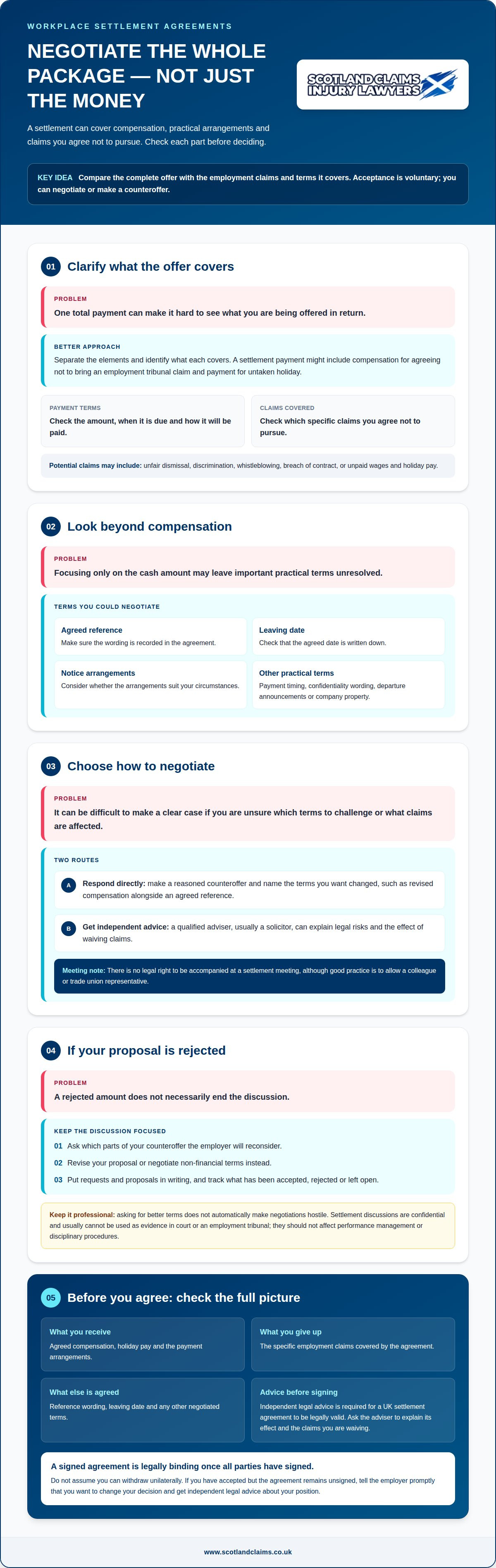
An employer’s first proposal isn’t necessarily its best or final offer. You can negotiate compensation and practical terms, then weigh the complete package against the claims you may be giving up.
Start by identifying what the offer covers. A settlement payment might include compensation for agreeing not to bring an employment tribunal claim and payment for untaken holiday. Separate these elements so you can explain which part you want changed and why. Stronger legal risks for an employer may give you more scope to negotiate better compensation or other benefits.
Money isn’t the only point to negotiate. You could seek an agreed reference, a clear leaving date, suitable notice arrangements or changes to confidentiality wording. You might also discuss payment timing, an announcement about your departure, or keeping company property. Put each request in writing and ask the employer to respond to each point.
Choosing how to negotiate
Choosing how to negotiate means deciding whether to make your case yourself or get help preparing it. That choice matters because you need to explain your requests clearly and understand which claims the proposed agreement affects.
You can respond directly with a reasoned counteroffer, especially when you know which terms you want changed. For example, you might request an agreed reference alongside revised compensation. An independent adviser can help explain legal risks and assess the effect of waiving claims. There’s no legal right to be accompanied at a settlement meeting, although good practice is to allow a colleague or trade union representative.
Managing negotiations and rejected offers
Keep negotiations focused on specific terms and record proposals in writing. This helps you track what the employer has accepted, rejected or left open.
If the employer rejects your proposed amount, ask which parts of your counteroffer it will reconsider. You can revise your proposal or negotiate non-financial terms instead. Settlement discussions are confidential and usually cannot be used as evidence in court or an employment tribunal. They should not affect performance management or disciplinary procedures.
Keep the exchange professional. Asking for better terms doesn’t automatically make negotiations hostile, and a counteroffer gives both sides a clear basis for further discussion. Unlike a full and final offer to creditors, an employment settlement concerns workplace claims and agreed employment terms. Don’t treat the two processes as interchangeable.
Before agreeing, compare the whole package: compensation, holiday pay, reference wording, payment timing and leaving date. If an injury claim rather than an employment dispute is involved, the Personal Injury Compensation Calculator can help you explore how personal injury compensation is assessed.
Accepting a settlement offer
Acceptance has different consequences for workplace agreements and debt settlements. Identify which type of offer you have, then check what acceptance requires and what it resolves.
What accepting a final offer means
Accepting a final offer means agreeing to its stated terms, which may make the settlement binding once the relevant conditions are met. In an employment agreement, all parties signing makes the agreement legally binding. For a debt, the creditor’s clear acceptance and your payment of the agreed lump sum can settle the liability.
The Financial Conduct Authority says in Consumer Credit sourcebook reference CONC 7.14.14 that a firm accepting a customer’s debt settlement offer must formally and unequivocally communicate acceptance as settlement of the customer’s liability. Keep that acceptance with the offer and payment record. A creditor can reject an offer or make a counteroffer, so don’t assume silence means agreement.
A partial debt settlement is different: the creditor accepts less than the full balance and writes off the remainder. The account may be recorded as partially settled on your credit file, which could make obtaining further credit harder. Your circumstances matter, but the written terms should clearly say whether the debt is fully or only partially settled.
Tax implications of settlement payments
Tax treatment depends on what each payment is for, so separate compensation from salary-related payments in the agreement. In the UK, the first combined £30,000 of compensation for giving up the right to make an employment tribunal claim and redundancy pay is usually not subject to tax or National Insurance.
Tax and National Insurance are usually deducted from wages or salary, bonuses, commission, holiday pay and payment in lieu of notice. For example, an agreement that includes both compensation and unpaid holiday pay may contain payments treated differently. Check that the document clearly describes each amount and its purpose.
Receiving payment after acceptance
There’s no single payment date for every settlement. The agreement should state when and how each payment will be made. Good practice is to pay as soon as possible after it’s signed.
Before signing, find the payment clause and note any steps required from you, such as returning signed documents. If a payment is late, compare the agreed date and method with the payment record, then raise the specific discrepancy with the other party.
For a debt offer, send the lump sum only after receiving written acceptance. If you offer a cheque as full and final settlement, a creditor may be treated as accepting by banking it, unless it says it accepts the cheque only as part payment. A creditor rejecting the cheque should write to you and avoid banking it.
Keep the offer, acceptance, agreement and proof of payment together. For debt settlements, retain the letters for at least six years after paying. These records help show what the parties agreed, whether payment was made and whether the settlement was intended to clear the balance.
What does accepting a final settlement offer mean in the UK?
For a debt, accepting a full and final settlement means the creditor agrees to take a lump sum and treat the debt as settled, rather than pursue the unpaid remainder. The offer doesn’t settle anything until the creditor accepts it. A creditor can reject it or make a counteroffer. Get clear written acceptance before paying and make sure it says the payment settles your liability in full.
This differs from repaying the whole balance. Full repayment clears everything owed, while a partial settlement means paying less and the creditor writing off the rest. The account can then be marked as partially settled on your credit file, which may make it harder to obtain more credit. A debt repaid in full is marked as satisfied or settled, depending on whether the account defaulted.
Settlement amounts depend on what you can offer and the creditor’s decision. Full and final offers are often described as falling between 25% and 50% of the total debt, but this is not a guaranteed range or an automatic entitlement. Creditors are more likely to consider a partial settlement when you cannot repay within a reasonable time, or may never be able to repay the full amount.
With several creditors, divide an available lump sum in proportion to the amounts owed. For example, if you owe £10,000 in total and can raise £4,000, the proportional share for a creditor owed £2,300 is £920. A creditor owed £1,200 would receive £480, whilst one owed £4,500 would receive £1,800. This approach treats creditors consistently, rather than directing the whole offer to one account.
Consider your credit record as well as the amount cleared. A partially settled debt is removed from a UK credit file six years after it’s partially settled, or from the default date if that was earlier. Ask the creditor to update the credit reference file to show the account as closed and the balance as zero. Keep the offer, acceptance and payment records together for at least six years after paying.
Acceptance must be clear. The Financial Conduct Authority’s Consumer Credit sourcebook reference CONC 7.14.14 requires a firm accepting a customer’s debt settlement offer to formally and unequivocally communicate that acceptance as settlement of the customer’s liability. Don’t assume a bank transfer or silence proves agreement. Confirm the terms first, then pay the agreed lump sum through the stated method.
How should I accept a final settlement offer in writing?
For a debt settlement, get the creditor’s written acceptance before sending the lump sum. Your letter should identify the debt, state the payment you’re proposing and make clear that it’s intended to settle the liability in full. Keep the creditor’s reply with your payment records.
Write to the creditor or debt collection firm handling the account. Include your name, address, account reference and the date. State the exact amount offered and how you intend to pay. Don’t rely on a phone conversation or an ambiguous phrase such as “payment in settlement”. Ask for written confirmation that acceptance is full and final and that the remaining balance won’t be pursued after payment.
A clear offer can use wording such as: “I offer the agreed figure as full and final settlement of my account number. Please confirm in writing that, if accepted and paid, this settles my liability and no further balance will be pursued.” Make sure you swap the placeholder text with your actual agreed payment amount and specific account reference number. This is a drafting example, not a substitute for the creditor’s written acceptance.
Before paying, make sure the creditor’s reply matches your offer. It should identify the account, confirm the accepted amount and state whether payment settles the whole liability or only part of it. If the creditor changes the amount or terms, treat that as a counteroffer and decide whether to accept. Don’t send the money until the terms are clear in writing.
- Keep copies of your offer and the creditor’s response.
- Use the payment method and account details agreed in writing.
- Save the payment confirmation alongside the settlement correspondence.
- Retain letters about the offer for at least six years after payment.
Take particular care with a cheque. A creditor may state in writing that it accepts a cheque only as part payment and that the remaining balance is still due. If the creditor rejects a cheque offered as full and final settlement, it should write to you and avoid banking it. Don’t assume that sending a cheque or making a bank transfer without prior agreement settles the debt.
If a creditor rejects an unsolicited bank transfer made on that basis, it should tell you the offer is rejected and return the money. Once payment is complete, ask the creditor to update the credit reference file so the account is closed and the balance is zero. Keep the written acceptance and payment evidence together to record what was agreed and paid.
Get advice from Scotland Claims Injury Lawyers
Scotland Claims Injury Lawyers
Scotland Claims Injury Lawyers helps with personal injury compensation claims, not debt settlements or workplace settlement agreements. If your offer relates to an injury caused by a road traffic accident, workplace injury, or slip or trip in Scotland, the firm can help you understand the claim and proposed compensation. These claims must relate to an incident in Scotland within the past three years.
The firm’s 100% compensation promise means it recovers its fees from the at-fault party and passes your entire settlement to you. Its Personal Injury Compensation Calculator can also help you explore potential compensation. This support is relevant when you’re reviewing an injury settlement, rather than negotiating a debt balance or employment terms.
Contact Scotland Claims Injury Lawyers to discuss a personal injury claim.
Make your next decision with confidence
Before accepting a final settlement offer for an injury, consider what the agreement means for your recovery and financial position going forward. A decision made under pressure can leave important questions unanswered. Take time to understand the proposed terms and how they relate to your claim.
If your offer concerns an injury claim in Scotland, Scotland Claims Injury Lawyers can help you understand your options and the proposed settlement. The next step is a clear discussion about your circumstances, the evidence and what the offer covers.
You’re entitled to make an informed decision. Get the advice you need, then choose your next step with confidence.
Frequently Asked Questions
What is a full balance settlement?
A full balance settlement generally means paying the full amount owed, rather than settling for less. For example, if your account balance is £2,000, paying that full amount is different from proposing a partial settlement. Ask the creditor for an updated balance before arranging payment, as this helps you identify the amount that would repay the debt in full.
What should you do if you’re not happy with a compensation offer?
Ask for a written explanation of how the offer was calculated, then identify which parts you believe don’t reflect your circumstances. For an injury claim, you could ask how the evidence about your injury and its effects was considered. Make a reasoned counteroffer rather than accepting under pressure. If you need help assessing a Scottish personal injury claim, consider independent legal advice before deciding.
Is a final settlement offer legally binding once accepted in the UK?
It depends on the type of settlement and how acceptance is recorded. An employment settlement agreement becomes legally binding once all parties have signed it. For a debt offer, the Financial Conduct Authority says under CONC 7.14.14 that a firm’s acceptance must formally and unequivocally confirm settlement of your liability. Keep that confirmation, because a payment receipt alone may not show what the creditor agreed.
Can I negotiate or reject a final settlement offer in the UK?
Yes. You can reject an offer or propose different terms, and an employer’s opening offer may leave room for negotiation. Decide what needs changing, such as the payment amount, timing or an agreed reference, then explain your position in writing. If a creditor rejects a debt offer, don’t treat a later payment as acceptance unless the creditor has clearly agreed to the terms.
Do I need independent legal advice to accept a settlement agreement in the UK?
Yes, independent legal advice from a qualified adviser, usually a solicitor, is required for a UK employment settlement agreement to be legally valid. The adviser should explain the agreement’s effect and how it affects your ability to bring claims later. This matters particularly if the agreement covers several potential claims or includes terms you don’t understand. Ask the adviser to explain those clauses before signing.
What risks should I check before signing a settlement agreement in the UK?
Check which claims you’re giving up and whether the payment and other terms match what you agreed. For example, an agreed reference should have settled wording, not a promise to discuss it later. Review the leaving date, payment timing, confidentiality terms and notice arrangements. Signing can close off specified employment claims, so make sure you understand the practical effect of each obligation before committing.