
A 100% compensation promise is about the settlement you receive, not a disability rating. In this context, what 100 percent compensation means is that the firm recovers its fees from the at-fault party and passes your entire settlement to you.
It’s easy to confuse that promise with other uses of “100% compensation”. Disability-benefit discussions may refer to a 100% rating alongside benefits involving automobile allowances, adaptive equipment, or limb loss and loss of use. This article explains how those benefits relate to the term, and how that differs from receiving the full value of a personal injury settlement. You’ll get a clearer picture of what the promise means and which issues belong to a separate benefits context.
Key Takeaways
- Understand what “100% compensation” means in a personal injury claim, and how it differs from a disability rating.
- See which losses and impacts may affect a compensation assessment, including limb loss or loss of use.
- Learn how automobile allowances and adaptive equipment fit into separate benefit considerations.
- Recognise why full reimbursement is not automatic and what may limit the amount recovered.
- Find out what information can help support a claim and when specialist legal help may be useful.
How is 100% compensation calculated?
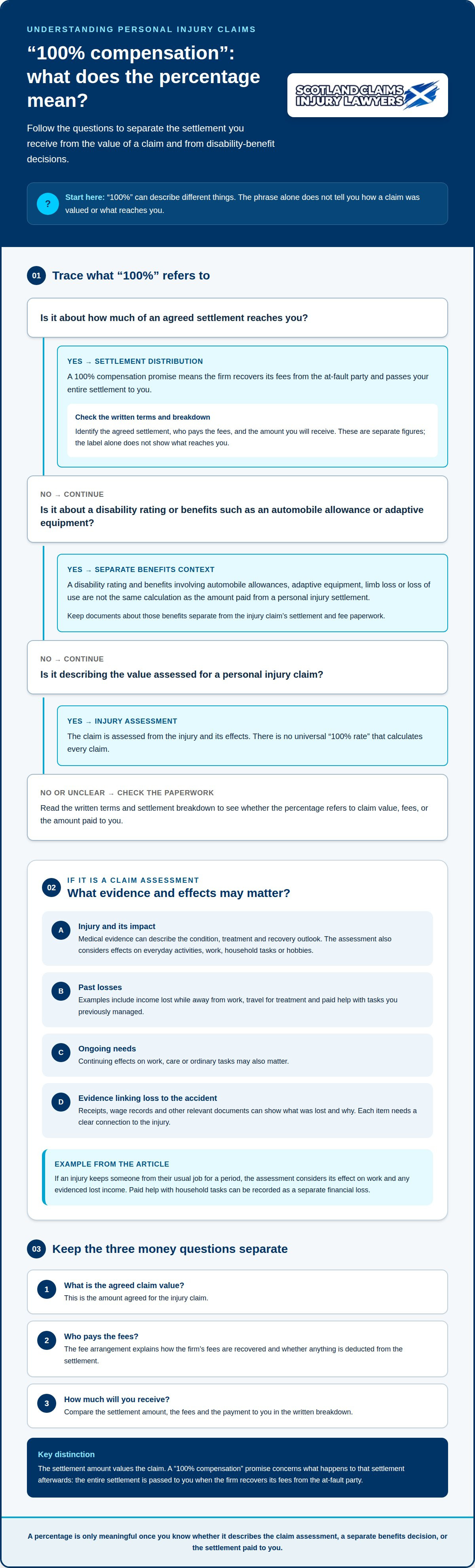
In a personal injury claim, the settlement is assessed from the injury and its effects, rather than by applying a universal 100% rate. The phrase “100% compensation” can also describe a separate promise: the entire settlement is passed to you, with the firm recovering its fees from the at-fault party. These meanings concern different calculations. One values the claim; the other explains what happens to the settlement afterwards.
For the claim itself, the first step is to identify the injury and its impact. Medical evidence helps describe the condition, treatment and recovery outlook. The practical consequences matter too. For example, a hand injury may affect someone’s ability to carry out work, household tasks or hobbies. The assessment must reflect the actual injury and its effects, not simply label it “100%”.
The next step is to record financial losses linked to the accident. These may include income lost while you were away from work, travel for treatment, or paid help with tasks you could previously manage. Each item needs a clear connection to the injury. Receipts, wage records and other relevant documents can show what you lost and why. Future effects may also matter if the injury continues to affect your work or daily needs.
- Injury impact: medical evidence and the effects on everyday activities.
- Past losses: income, treatment-related travel and other expenses caused by the injury.
- Ongoing needs: continuing effects on work, care or ordinary tasks.
- Supporting evidence: records that connect each loss to the accident.
Consider a worker whose injury keeps them from their usual job for a period. The assessment would consider the injury and its effect on work, along with any evidenced loss of income. If they also pay for help with household tasks, that cost is a separate part of the financial picture. This shows why one percentage cannot calculate every claim.
A personal injury compensation calculator can help you explore an estimate, but it does not replace evidence about your specific injury and losses. The final settlement figure and the amount passed to you are separate questions. Under a 100% compensation promise, the second question concerns whether the full settlement reaches you after the firm recovers its fees from the at-fault party.
What UK rules govern compensation and full reimbursement?
“100% compensation” can describe two different things: the value of an injury claim, or how much of an agreed settlement reaches you. Those are separate calculations. A settlement is the amount agreed for the claim; full reimbursement describes the arrangement for dealing with fees. The phrase alone doesn’t show which meaning applies, so the written terms and settlement breakdown matter.
For a personal injury claim in Scotland, consider the claim assessment separately from the fee arrangement. The assessment concerns the injury and its effects. The fee arrangement explains how the firm’s fees are recovered and whether anything is deducted from your settlement. Read both explanations together. Scotland Claims Injury Lawyers recovers its fees from the at-fault party’s insurer, so the client receives the entire settlement.
Follow the money through the written explanation. Identify the agreed settlement, who pays the fees, and how much you will receive. This example explains the wording only; it is not an estimate of a claim’s value.
- Claim value: the amount agreed for the injury claim.
- Fee source: whether fees are recovered from the at-fault party.
- Amount received: whether the full settlement reaches you.
- Written terms: how the arrangement is described and applied.
Check any settlement breakdown against those three figures: the settlement amount, the fees, and the payment to you. If the figures don’t align, ask for the calculation to be explained before treating “100%” as a statement about your take-home amount. For example, an offer may describe a claim as fully compensated while a separate fee arrangement explains deductions. The label cannot replace the figures showing what you receive.
Automobile allowances, adaptive equipment and benefits linked to limb loss or loss of use raise separate questions. Their eligibility and value cannot be calculated from a personal injury settlement promise. Keep documents about those benefits separate from the injury claim’s settlement and fee paperwork. This helps prevent a benefit decision from being mistaken for a percentage of compensation.
In short, look for a clear distinction between the compensation agreed for your injury and the fees paid for handling the claim. The relevant terms should explain who pays those fees and whether the full settlement reaches you. That distinction gives “full reimbursement” a concrete meaning without confusing it with a 100% disability rating or a separate allowance.
These are separate from UK fee questions. A retroactive U.S. VA rating decision can allow reimbursement of co-payments dating back to the effective date of the rating. A VA 100% Permanent and Total rating is governed by 38 C.F.R. § 3.340 and § 3.341; the VA clothing allowance is governed by 38 C.F.R. § 3.810.
How does 100% compensation compare with partial compensation?
In a personal injury claim, “100%” and “partial” can describe different comparisons. They might refer to the share of an agreed settlement you receive, or how much of the claimed loss is recognised. These are not interchangeable. A settlement can reflect an assessed claim while the amount paid to you depends on its separate fee arrangement. Start by identifying what the percentage describes.
For the amount you receive, 100% means the entire agreed settlement reaches you. Partial means you receive less than the whole settlement. The difference is about distribution, not necessarily the injury’s seriousness. A person with a substantial injury could still need to distinguish the settlement figure from the payment they receive. The written terms should explain how the two amounts relate.
In a claim assessment, full and partial can describe whether all claimed losses are included. For example, someone injured at work might claim for the injury and related financial effects. If an item remains unresolved or is not included in an agreement, the settlement may not cover every claimed loss. That is not necessarily a deduction from the settlement. It concerns which parts of the claim the agreement addresses.
- Full settlement received: the complete agreed amount is paid to you.
- Partial settlement received: you receive less than the agreed amount.
- Full claim addressed: the agreement includes all accepted claim elements.
- Partial claim addressed: some claimed elements remain outside the agreement.
Consider a road traffic accident claim involving an injury and time away from work. The settlement may address the injury while the parties also consider whether related income loss is included. Separately, the fee arrangement determines whether the whole settlement reaches the injured person. These questions need separate answers. The percentage describing one cannot, by itself, answer the other.
A 100% compensation promise relates to the second question. The firm recovers its fees from the at-fault party and passes the entire settlement to the client. That promise concerns the settlement received, not a guarantee that every amount claimed will be accepted. It also does not mean a disability rating, automobile allowance or adaptive equipment benefit forms part of the personal injury settlement.
To compare an offer with a full-settlement promise, identify the agreed settlement, the items it covers and the payment due to you. Then read the fee terms alongside those figures. If the settlement covers only part of a claim, that is different from receiving only part of an agreed settlement. Keeping those comparisons separate makes “100%” meaningful and helps you see exactly what the percentage refers to.
VA disability compensation is a separate rating-based benefit, not the personal injury settlement discussed above. In 2026, the monthly amount is 3,938.58 for a veteran with a 100 percent rating, compared with 180.42 at 10 percent, 356.66 at 20 percent, 552.47 at 30 percent, and 795.84 at 40 percent.
A veteran with active service-connected cancer receives a 100 percent VA disability rating while the cancer is active and for six months after successfully completing treatment.
What are the limits and exclusions of 100% compensation
A promise that you receive the entire settlement concerns deductions from that settlement. It doesn’t mean every loss you mention becomes part of the claim, or that a separate benefit is automatically included. Keep these questions distinct. For example, a road accident settlement and an automobile allowance involve different processes, even if both matter to the same person.
The first limit is the scope of the claim. An agreement covers the losses it addresses, not automatically every financial or personal difficulty after an accident. If an injured person claims for an injury and lost earnings, but the agreement addresses only the injury, the earnings issue remains separate. The settlement description should make clear what has been agreed.
Evidence also affects what can be included. A cost needs a connection to the injury or accident to form part of the claim being assessed. For instance, a receipt for travel to treatment can help explain that expense. A household purchase unrelated to the injury would not become an injury-related loss just because it appears in the same paperwork.
- Claim scope: the settlement relates to the matters it expressly addresses.
- Connection: claimed losses need a clear link to the accident or injury.
- Separate benefits: allowances and equipment are not automatically part of a settlement.
- Fee arrangement: the promise concerns who pays fees and what reaches you.
Automobile allowances and adaptive equipment require particular care in this context. They aren’t extra items that can simply be added to a personal injury settlement because someone has an injury. Likewise, compensation for limb loss or loss of use may refer to a distinct benefit or assessment. The relevant decision depends on the benefit’s own criteria, rather than the phrase “100% compensation” used for a settlement.
For example, imagine someone loses the use of a hand after an accident and also needs vehicle adaptations. The injury claim and any benefit relating to equipment or loss of use must not be treated as one combined percentage. A promise to pass on the full agreed settlement does not establish eligibility for an allowance, equipment or another benefit.
There is also a practical limit to the wording itself. “Full settlement” means the entire agreed settlement is passed on under the stated arrangement; it doesn’t expand what the settlement covers. Scotland Claims Injury Lawyers recovers its fees from the at-fault party’s insurer, leaving the entire settlement for the client. This does not mean every claimed loss will be accepted or every separate benefit awarded.
Before relying on a “100%” description, identify what it refers to: the settlement received, the losses included, or a separate benefit. A written breakdown can distinguish those matters. That simple distinction helps prevent an allowance, adaptive equipment or limb-loss benefit from being mistaken for an automatic addition to an injury settlement.
How can someone claim 100% compensation in the UK
Start by separating the injury claim from the promise about the settlement you receive. In Scotland, a personal injury claim needs to identify the accident, the injury and its effects. The full-settlement promise concerns the amount passed to you after fees are handled. These are connected, but require different information and separate explanations.
Build a clear record of the incident. Note where it happened, what occurred and who was involved. For a road collision, this could include the vehicles, location and sequence of events. For a workplace injury, record the task you were doing and the circumstances. Keep relevant photographs, messages and incident records together. These details help establish what the claim concerns.
Next, gather documents that show the injury and its consequences. Medical records can describe diagnosis and treatment. Payslips or employer records may help explain time away from work. Receipts can support expenses connected with treatment or travel. A simple timeline can link each document to the accident. For example, record when symptoms began and how they affected your work or daily activities.
- Describe the incident: record the place, circumstances and people involved.
- Document the injury: keep relevant medical records and treatment information.
- Record its impact: organise employment details, expenses and changes to daily activities.
- Clarify the agreement: identify what the settlement covers and how fees are handled.
Once your claim is being assessed, organise the evidence by topic. Separate injury information from income records and other expenses. This makes it easier to see whether a proposed settlement addresses each part of the claim. If a workplace injury affects your duties, for example, work records can explain that practical effect alongside medical information.
Before agreeing to a settlement, understand its scope and the payment arrangement. The written terms should show what the settlement covers and how the fee arrangement affects the amount you receive. A promise of 100% compensation means the entire settlement is passed to you, with fees recovered from the at-fault party. It does not mean every claimed loss or separate benefit is automatically included.
Automobile allowances, adaptive equipment and benefits relating to limb loss or loss of use may involve separate eligibility assessments. Keep correspondence about these matters distinct from the personal injury claim. For example, a need for vehicle adaptations should not be treated as an automatic addition to an accident settlement. Identifying which process addresses each issue helps prevent important information from being confused.
If you’re preparing a claim in Scotland, organise the incident details, injury records and evidence of its effects before discussing settlement terms. A clear record helps define what the claim includes and what “100%” refers to in the payment arrangement.
Scotland Claims Injury Lawyers
Scotland Claims Injury Lawyers can help you understand how a personal injury claim and its settlement terms apply to your circumstances. If you’ve been injured in a road traffic accident, at work, or in a slip or trip, the firm can assist with the relevant claim. Its 100% compensation promise means fees are recovered from the at-fault party, with the entire settlement passed to you. A personal injury compensation calculator can also help you explore an estimate.
Contact Scotland Claims Injury Lawyers to discuss your personal injury claim.
Make your next decision with clarity
Understanding what 100 percent compensation means can help you ask focused questions before deciding how to proceed. Keep the settlement terms and any separate benefit decision distinct. Then consider what matters most to you, such as understanding the claim’s scope or how the settlement will be handled. Clear priorities make it easier to have a useful discussion about your circumstances.
Scotland Claims Injury Lawyers handles claims involving road traffic accidents, slips or trips, and work injuries. If one of these situations applies to you, you can discuss the accident, its impact and the questions you still have. You don’t need to settle every detail before starting that conversation.
A clear next step can help you move forward with greater confidence.
Frequently Asked Questions
What does 100% compensation mean in general?
It means a full amount or proportion within a defined scheme, agreement or assessment, but the reference point matters. In one arrangement, 100% may mean the whole agreed payment reaches the recipient. In another, it may describe a rating or the recognised share of eligible costs. For example, a benefit rating doesn’t automatically mean every financial loss is reimbursed. Identify what the percentage measures before relying on it.
Does 100% compensation mean full reimbursement of costs or losses?
No, not by itself. The phrase doesn’t establish which costs qualify, whether they’re covered, or whether they’ve been accepted. For example, an invoice may show what you paid, but the relevant agreement must also cover that type of expense. Separate the total amount claimed from the amount agreed for payment, then identify any exclusions or limits in the terms.
What does 100% compensation mean in insurance claims?
In an insurance claim, it can mean payment of the full covered amount, rather than every loss you experienced. The policy wording defines what is insured and may set limits, exclusions or an excess. For example, damage may fall within a covered category but still be affected by the policy excess. Compare the claim decision with the relevant wording to see how the insurer reached its figure.
Does 100% compensation include bonuses, benefits, tax, or expenses?
Not automatically. A work bonus, state benefit, tax issue or out-of-pocket expense is a separate item, and its treatment depends on the claim or agreement. For example, a missed bonus may need to be identified as a distinct loss rather than assumed to fall within a general compensation figure. Keep records showing each item and its connection to the claim, and distinguish payment terms from tax treatment.