
A “100% compensation” claim is about what you keep, not a fixed payout. Understanding how 100% compensation claims work means looking at both parts: how your injury and financial losses are valued, and whether legal costs are deducted from your settlement. Under a 100% arrangement, the aim is for you to receive the full settlement, with legal fees recovered from the at-fault party rather than taken from your compensation.
If you’ve had an accident at work, it’s natural to focus on what your injury might be worth. The amount depends on factors such as the injury’s severity, its effect on your daily life, your recovery and financial losses, including lost income and treatment or travel costs. Evidence helps show how each factor affects your claim.
This article explains how compensation is assessed, how deductions can affect your payout and what evidence can support a claim in Scotland. A calculator can provide a useful starting estimate, but it cannot account for every detail of an individual claim.
Key Takeaways
- Separate the value of your injury from any legal costs or deductions to understand what you may actually receive.
- For a work injury, the assessment considers the injury’s impact, recovery and how the incident happened.
- Eligibility and the strength of a claim depend on evidence linking the accident, responsibility and your injury.
- Keep records of income lost, treatment and travel expenses so financial losses can be considered alongside the injury.
- Accident records, photographs and medical evidence can help support both liability and the effect of the injury.
Deductions from personal injury compensation
You may still receive compensation if your own actions contributed to an accident. However, the amount can be reduced to reflect your share of responsibility, based on evidence about how the incident happened and what each party did.
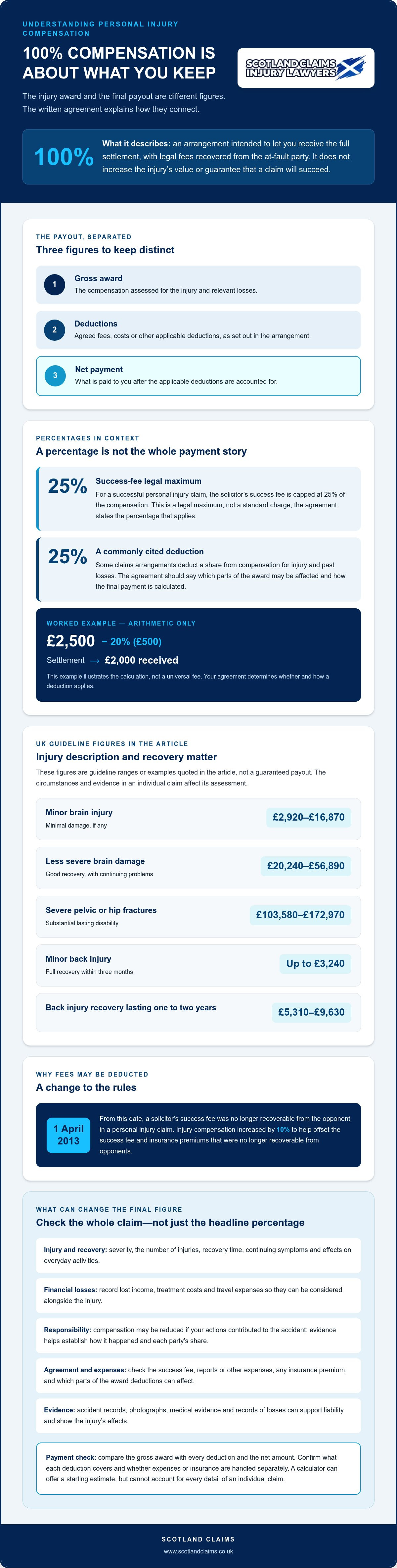
First, separate the compensation awarded from the amount eventually paid to you. An injury award reflects the harm and losses assessed in the claim. Deductions relate to costs or agreed fees taken from that award before payment. A 100% compensation arrangement concerns what you keep, not an automatic increase in the injury’s value.
Some claims arrangements deduct a share from compensation for injury and past losses. A commonly cited deduction is 25%. The agreement matters: it should explain which parts of the award can be affected and how the final payment is calculated. Read the terms alongside any settlement breakdown, so you can see the gross award, deductions and net amount separately.
A separate example shows how a percentage can change a payout. If a claims organisation takes 20% from a £2,500 settlement, the deduction is £500 and the claimant receives £2,000. This illustrates the arithmetic, not a universal fee. The agreement determines whether a deduction applies to your injury award, past losses or another part of the settlement.
Injury severity can also shift the award substantially. UK guideline ranges include £2,920 to £16,870 for a minor brain injury with minimal damage, if any. Less severe brain damage with good recovery and continuing problems is £20,240 to £56,890. Severe pelvic or hip fractures with substantial lasting disability range from £103,580 to £172,970. These figures show why the description and lasting effect of an injury matter.
Two people with the same type of injury may receive different assessments. Relevant factors include the number and severity of injuries, recovery time and any continuing symptoms. The effect on everyday activities matters, too. A serious injury that causes lasting restrictions may be valued differently from one followed by a full recovery, even if the initial diagnosis is similar.
Assessment starts with the injury’s impact, then considers the evidence and financial consequences. Guideline figures help frame the injury award, while documented losses can add a separate part to the claim. For example, a minor back injury with full recovery within three months has a UK guideline figure of up to £3,240. Recovery lasting one to two years is listed at £5,310 to £9,630.
To understand how much you may receive, compare the assessed compensation with any agreed deductions. Check that the calculation includes all your injuries and losses, and accounts for any contribution to the accident. A compensation calculator can provide an estimate, but injury severity, recovery and negotiations all affect the final valuation.
How Much Compensation Do You Get for a Work Injury?
A work injury payout has two parts: the compensation awarded and the amount you receive after any agreed deductions. A No Win, No Fee agreement sets out the success fee and explains what happens if the claim succeeds or fails. Read the terms so you understand how the fee affects your payout.
For a successful personal injury claim, the solicitor’s success fee is capped at 25 per cent of the compensation, according to UK Parliament. That is a legal maximum, not a standard charge. The agreement should set out the percentage that applies and how it will be calculated. A lower fee, a waived fee or a 100% compensation arrangement can change what you keep.
The rules changed on 1 April 2013. From that date, a solicitor’s success fee was no longer recoverable from the opponent in a personal injury claim. Injury compensation increased by 10% to help offset the success fee and insurance premiums that were no longer recoverable from opponents. These changes explain why success fees may be deducted from compensation rather than paid by the at-fault party.
Check the agreement for more than the headline percentage. It should explain what happens to the success fee, expenses and any insurance premium if the claim succeeds. Some No Win, No Fee arrangements may require clients to pay for reports or other expenses. Terms also differ on settlement payments, so establish how the final figure is reached and which deductions apply.
The example shows why the percentage alone doesn’t tell you the whole story. Compare the settlement figure with each item in the payment breakdown. Check what each deduction covers and whether it comes from your compensation or is paid separately.
Some 100% compensation arrangements work differently: the legal fees are recovered from the at-fault party, and the claimant receives the entire settlement. Confirm what “100%” means in the agreement, including how expenses and insurance are handled. The key is the written payment structure, not simply the label used to describe the arrangement.
If a workplace injury has left you weighing a claim, understanding the agreement helps you assess the likely deductions alongside the injury award. You can explore the work injury claim process as a relevant next step.
Are Compensation Amounts Calculated Differently For Different Types Of Claim?
Yes. Eligibility and compensation depend on how the accident happened, who was responsible, the injury and its effect. A 100% compensation claim means the claimant receives the full settlement, with legal fees recovered from the at-fault party. This describes the payment arrangement, not a promise that every claim will succeed.
100% compensation may be available for accident-at-work and public-liability claims, and for certain road traffic accident claims. The type of accident alone doesn’t establish eligibility. A road claim needs evidence connecting another party’s responsibility with the injury; a workplace claim may depend on whether the employer failed in its duty of care.
For workplace injury compensation, relevant questions include whether the employer was negligent or breached a statutory duty, and whether that failure caused your injury. Medical evidence helps establish the injury and its effects. Accident records, witness accounts and proof of lost earnings can help connect the incident to the losses claimed.
Across England, Wales, Scotland and Northern Ireland, compensation assessments consider the injury, responsibility and resulting losses. However, legal procedures and applicable rules can differ between jurisdictions, so the location matters. A claim arising in Scotland should be considered under the rules that apply there, rather than assuming procedures are identical across the UK.
The usual limitation period for a personal injury claim in England, Wales and Northern Ireland is 3 years under the Limitation Act 1980, whereas Scottish personal injury claims are governed by separate limitation rules under Scots law. The relevant start date and rules can depend on the claim and jurisdiction, so establish the applicable deadline early. Waiting can make accident records, witness evidence and medical details harder to obtain.
To start a claim, record the accident, seek medical attention, preserve evidence and consider who may be responsible. For a workplace accident, report it to your employer and keep a copy of the accident-book entry. Gather medical records, witness details and proof of lost earnings to support the claim assessment.
Legal advice from specialists such as Scotland Claims Injury Lawyers can help assess a claim by considering responsibility, causation, injury evidence and financial losses together. A calculator can provide an initial estimate, but it cannot establish whether you qualify to make a personal injury claim. The strength of a case depends on how clearly the available evidence supports each part of it.
There is no single settlement timetable for UK compensation claims. A claim may take longer if responsibility is disputed, injuries need further assessment or financial losses remain uncertain. Clear accident records and organised medical and earnings evidence can help resolve questions, while negotiations affect when a settlement is reached.
Can My Compensation Payout Include Financial Losses?
Yes. A personal injury settlement can include compensation for financial losses as well as the injury itself. Record expenses separately and note how each relates to the accident.
Financial losses and expenses
Special damages compensate for financial losses and expenses caused by an injury. They matter because compensation for the injury alone may not reflect money you have lost or spent. Keep a clear list of lost income, paid treatment and travel expenses. Retain receipts, invoices and wage records to support each item.
Keep these costs separate from compensation for pain, suffering and the effect of the injury on your usual activities. This makes the settlement easier to understand. A payslip can show income before an absence, while employer records can help establish earnings lost. Treatment invoices and travel receipts document spending connected to appointments.
Organise expenses by type and date. For example, group travel records together and match each journey to an appointment or treatment record. Keep proof of payment where available. If someone else paid an expense for you, record who paid and why. This creates a clearer account than a collection of unlabelled receipts.
Future costs
Future costs are expected expenses or financial losses that continue after the claim is assessed. They matter because a settlement should account for an injury’s ongoing financial effects, not just bills already paid. Ongoing treatment or continuing limits on work may affect future needs. Keep records explaining the expected expense and its connection to the injury.
Describe each future cost clearly. Distinguish treatment already received from treatment expected to continue, and explain how the injury affects your ability to earn. Medical information and employment records can help show why a cost is relevant. Supporting details allow the financial impact to be considered alongside the injury.
Create a simple schedule with separate entries for past and future losses. For each item, note its purpose, date or expected timing, amount and supporting document. List lost income, paid treatment and travel as distinct categories. This makes missing evidence easier to spot and helps prevent counting a cost twice.
Before agreeing to a settlement, compare the proposed financial-loss items with your records. Check that paid expenses and continuing needs have been considered, then ask how each figure was assessed. The settlement should show compensation for the injury separately from financial losses, so you can understand each part and how it contributes to the total payout.
Evidence supporting liability and losses
A strong personal injury claim connects three things: the accident, the injury and the losses that followed. Evidence should show what happened, how you were hurt and what you spent or lost in earnings. Keep documents organised by topic so the incident, medical effects and financial impact are clear.
For a workplace accident, record the incident in your employer’s accident book and seek medical attention promptly. Note the date, location, task you were doing and how the injury happened. A clear entry can help establish the circumstances later. If a hazard or faulty equipment was involved, describe what you saw before it changes or is removed.
Photographs can show the incident scene, the hazard and visible injuries. Take images that provide context as well as close-up detail, such as a wide view of a spill and a closer image showing its position. Keep the original files and note when and where each photograph was taken. Witness names and accounts can also help explain what happened.
Medical evidence helps link the accident to the injury and record its effects. Tell the treating professional how the incident happened and describe your symptoms accurately. Keep appointment records, treatment documents and notes on changes to your daily activities. Consistent accounts in medical and accident records make the events and the injury’s impact easier to understand.
To support financial losses, keep payslips, employer records and proof of earnings missed during absence. Retain receipts for paid treatment and travel, and note which appointment or injury-related need each cost relates to. A simple schedule can list the date, reason and amount of each loss. These records help show what you may claim and why.
Store digital evidence safely and keep copies of letters, emails and incident reports. Avoid editing photographs or deleting messages about the accident. If a witness sends you an account, keep the original message and record their contact details. These steps preserve the source and context of evidence, rather than leaving you with an unsupported summary months later.
Evidence of liability and losses is separate from your solicitor’s fee agreement. The agreement should explain how fees are handled and be discussed and agreed at the start. Keep it with your settlement documents. This helps you distinguish evidence supporting the claim from the terms affecting payment, while keeping records of the injury, expenses and lost earnings organised.
For a workplace injury, organised accident and loss records can support a work injury claim.
Scotland Claims Injury Lawyers: Road Traffic Accident Claims
Scotland Claims Injury Lawyers handles road traffic accident claims for people injured in accidents in Scotland. If you’ve been hurt on the road and need help understanding the claim, the firm can assess the injury, supporting evidence and related losses. Its personal injury claims are handled on a no-win-no-fee basis.
Its 100% compensation promise means legal fees are recovered from the at-fault party, and the full settlement is passed to you. The firm also handles work injury and slip or trip claims, and provides a Personal Injury Compensation Calculator for an initial estimate. The calculator is a starting point, not an exact valuation of your case.
Contact Scotland Claims Injury Lawyers to discuss a road traffic accident claim and the evidence supporting it.
Take the next step with a clear view of your claim
Knowing how 100% compensation claims work gives you a better basis for discussing your situation. Before moving forward, bring together the records that show what happened, how your injury affected you and what losses followed. A clear account makes it easier to explain your priorities and understand the decisions ahead.
Scotland Claims Injury Lawyers handles road traffic accident, slip or trip, and work injury claims in Scotland. If one of these reflects your circumstances, discuss the evidence and claims process with the firm. Its solicitors can assess your accident and the records you have gathered.
A well-organised claim starts with clear information. Take that step when you’re ready, and move forward with greater confidence.
Frequently Asked Questions
How do 100% No Win No Fee claims work?
The question “how do 100% compensation claims work” comes down to the fee agreement and how costs are paid if the claim succeeds or fails. If successful, the agreement determines whether legal costs are recovered from the at-fault party or deducted from compensation. If the claim fails, what you owe depends on the written terms. Read the funding and fee clauses carefully, including how expenses and any insurance are treated.
How much is the right amount?
There isn’t one correct figure for every injury claim. Compensation should reflect the injury’s severity, its effect on daily life, recovery and evidenced financial losses. For instance, two people with the same diagnosis may have different outcomes if one has continuing symptoms or missed more work. Compare any proposed settlement with the injuries and losses included in the calculation, not just its headline total.
What percentage of compensation do No Win No Fee solicitors take?
The solicitor’s success fee in a personal injury claim is capped at 25 per cent of compensation, according to UK Parliament. That is a maximum, not an automatic deduction of that amount. Your agreement should identify the actual percentage and explain how it applies to the settlement. Check whether the calculation distinguishes compensation for injury from financial losses, and ask for a clear breakdown before accepting the payout.
Can Evidence Affect the Payout for a Workplace Injury?
Yes. Evidence can affect whether responsibility is established and how the injury’s impact and losses are assessed. A clear accident-book entry may help explain the incident, while medical notes can document symptoms over time. If your earnings changed after the accident, payslips or employer records can help show the impact. Keep dates consistent across your records, as conflicting timelines can make the account harder to assess.
Can You Keep 100% of Your Compensation?
It depends on what “100%” means in the particular arrangement. Scotland Claims describes its 100% compensation promise as recovering fees from the at-fault party and passing the entire settlement to the claimant. Always distinguish this from the amount awarded for injury and losses: the phrase concerns what reaches you under the fee arrangement, not a guaranteed award or outcome.
How is compensation calculated in a UK personal injury claim?
The question “how do 100% compensation claims work” also involves how the injury and its consequences are assessed. Compensation reflects the injury’s seriousness, recovery and effect on your usual activities, alongside financial losses supported by evidence. Guideline figures can help assess the injury element, but they don’t calculate every part of a claim. A calculator is only a starting point and cannot fully account for individual circumstances or negotiations.
How do no win no fee agreements and solicitor fees affect compensation?
The agreement explains what happens to legal fees when a claim succeeds and what you owe if it doesn’t. A success fee may reduce the amount paid directly to you, while some arrangements recover legal costs from the at-fault party instead. Before signing, identify the success-fee percentage, how it is calculated, and how expenses or insurance are treated. Use the written terms to understand your expected net payout.
What evidence and documents are needed to make a compensation claim?
Useful records can include an accident-book entry, photographs of the scene or injury, witness details and medical documents. For financial losses, gather payslips, employer records, treatment invoices and travel receipts. A dated note about symptoms and changes to daily activities can add context to formal records. Keep original files and organise documents by incident, injury and loss, so each item supports the relevant part of your claim.